
Key Social Tools Airbnb Added and Why They Matter
Key Social Tools Airbnb Added and Why They Matter
 Sachin Sharma
Last Updated on November 13, 2025
Key Takeaways
What You’ll Learn:
- Airbnb added social tools like “Who’s Going” and guest messaging to boost engagement.
- Airbnb social features help travelers connect, chat, and build communities before and after trips.
- Founders can use Airbnb’s social features to increase user retention and trust in their rental platforms.
- Social connections create loyalty and repeat bookings, reducing marketing costs.
- Oyelabs helps startups build Airbnb-like apps with integrated social engagement systems.
Stats That Matter:
- Airbnb guest bookings in the EU grew 28.3% year-over-year (Eurostat, 2025).
- 64% of Airbnb guests say they feel closer to local culture than hotels (Airbnb, 2024).
- The travel and tourism app market will reach $3.5 trillion by 2034 (Market.us, 2025).
- User-generated travel content will grow 15% annually until 2035 (FMI Report, 2024).
Real Insights:
- Community features increase trust faster than discounts or coupons.
- Conversations between guests create brand loyalty and authentic marketing.
- Simpler, privacy-safe tools attract more daily active users.
- Start small with messaging and connection tabs, then scale gradually.
Platforms that connect users emotionally outperform pure transaction-based marketplaces.
Key Social Tools Airbnb Added and Why They Matter
Ever noticed how your Airbnb feed suddenly feels a little more like Instagram than Expedia? That’s not by accident. Airbnb has officially entered its social era, rolling out features designed to make travel more connected, personal, and community-driven. In a world where travelers crave belonging as much as a bed, the company’s latest updates – ranging from guest messaging to shared experience visibility – mark a technical and strategic shift.
For founders, this isn’t just a product update; it’s a blueprint for marketplace engagement. Airbnb’s social tools blend behavioral data, UI psychology, and network-effect mechanics to keep users coming back long after checkout. Whether you’re leading a growing startup or planning to launch your own vacation rental platform, these changes signal where the industry is heading next. And with partners like Oyelabs, who help entrepreneurs build Airbnb-style apps ready for scale, there’s never been a better moment to rethink how people connect through travel.
What’s Driving Airbnb’s Shift Toward Social Tools in 2025?
Airbnb’s success has always rested on more than just accommodation – it’s about human connection. In 2025, the company doubled down on this principle by introducing a new suite of social-first tools aimed at transforming how guests interact before, during, and after their trips. The move comes as the global short-term rental industry enters a new phase where trust, retention, and engagement are the key differentiators, not just price or property inventory.
Unlike traditional booking platforms, Airbnb understands that network effects – how one user’s actions influence another’s – drive long-term growth. By embedding social discovery, messaging, and community layers, Airbnb is reshaping travel from a transactional act into a participatory ecosystem.
For founders and CEOs, this shift provides valuable insight: the future of marketplaces lies in fostering relationships, not just facilitating exchanges. Building such relational ecosystems early can dramatically increase your brand’s lifetime value and organic reach.
How Is Airbnb Redefining the Travel Experience Through Social Features?
Airbnb is no longer positioning itself as a booking engine; it’s becoming a social infrastructure for travel. Each update is designed around a clear objective – to deepen interaction. Guests now connect with one another through trip-specific chats, see who else is joining an experience, and maintain social connections through integrated profiles. In one Airbnb survey, 22 % of guests said they chose Airbnb for a more local experience, and 64 % said it gave them a closer cultural connection than a hotel.
This shift mirrors three core travel trends:
- Experience-led tourism: Travelers want stories, not stays.
- Digital belonging: Communities define brand loyalty more than discounts.
- Post-stay engagement: Keeping users in the loop increases repeat bookings and advocacy.
In practical terms, Airbnb’s model now borrows from social networks – retention loops, friend graphs, and personalized feeds – but applies them to hospitality. For startups in the travel or marketplace space, it’s a clear message: functionality alone no longer sustains engagement. The winning platforms of this decade will blend utility with social identity, creating emotional anchors that bring users back organically.
What Are the Key Social Tools Airbnb Recently Introduced?
Airbnb’s latest product release marks one of its most strategic pivots since “Experiences.” Each tool is built to turn isolated bookings into interactive micro-communities, reinforcing both trust and engagement. Below are the core features and why they matter.
| Feature | What It Does | Why It Matters |
| “Who’s Going” | Displays profiles of guests who have booked the same experience. | Encourages transparency, builds trust, and improves booking conversion rates. |
| Direct Messaging Between Guests | Enables trip-based group chats and 1:1 conversations before, during, and after experiences. | Fosters connection and shared anticipation; increases app engagement time. |
| Connections Tab / Travel Graph | Curates a network of past travel companions within a profile interface. | Introduces long-term retention by converting users into recurring social contacts. |
| Privacy Controls | Lets users choose what details to share and with whom. | Balances openness with safety, a crucial factor in trust-based ecosystems. |
| Enhanced Search & Map Functions | Upgrades backend responsiveness and UI for real-time location and discovery. | Supports scalability and ensures a smooth social experience. |
Together, these tools represent a structural redesign of the platform’s engagement model. Instead of treating users as individual accounts, Airbnb treats them as nodes in a social graph – each capable of triggering further participation.
For early-stage founders, this approach highlights a fundamental principle: every social layer must serve a measurable business outcome – whether that’s higher booking frequency, better referral traffic, or community-driven brand advocacy.
Why Do These Social Tools Matter for CEOs and Startup Founders?
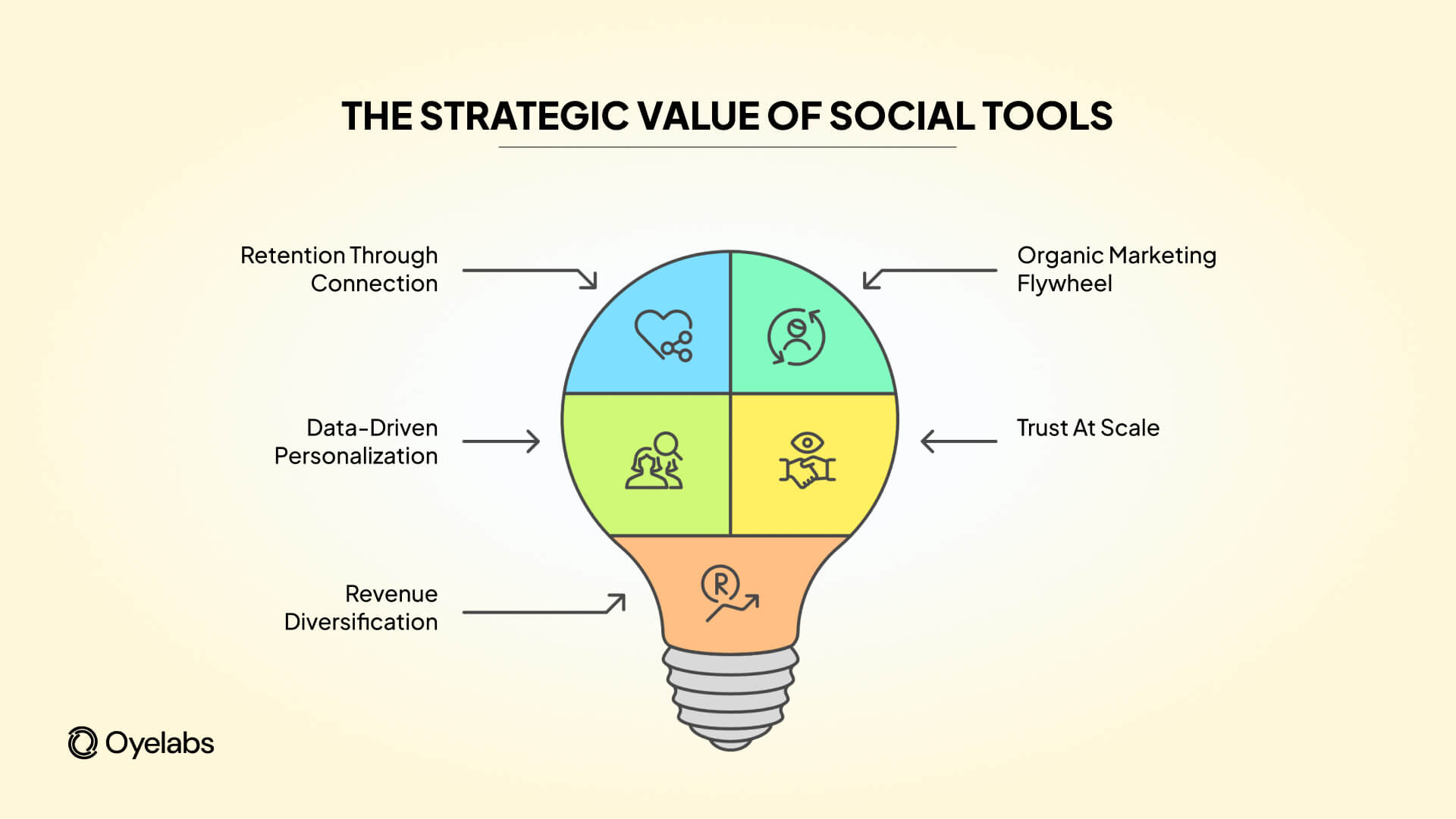
For founders and decision-makers, Airbnb’s recent product evolution is more than a design update – it’s a strategic playbook for sustainable growth. The platform’s shift toward social engagement provides a clear lesson: building technology that connects people, not just processes, amplifies long-term value.
Here’s why these features matter for any marketplace startup:
- Retention through connection: Users who engage socially are twice as likely to return. Airbnb’s model shows that community-based retention costs less than paid re-acquisition.
- Organic marketing flywheel: Guests who share experiences and conversations generate free brand visibility through word-of-mouth and social media.
- Data-driven personalization: Social graphs reveal user preferences beyond search terms, enabling precision-driven recommendations.
- Trust at scale: Peer interaction minimizes friction in decision-making, which translates into higher booking conversions.
- Revenue diversification: Social features create upselling opportunities – from premium community access to event collaborations.
In essence, social mechanics turn a platform from a marketplace into an ecosystem. For CEOs, it’s a reminder that the next phase of digital disruption won’t come from cheaper pricing – it will come from stronger community architecture built into the core product.
How Can Founders Apply Airbnb’s Social Playbook to Their Own Platforms?
Building social engagement into your product doesn’t have to start at Airbnb’s scale. The principle is to start simple, scale smart, and measure every interaction’s business outcome. McKinsey data shows that nearly half of experience bookings in 2024 still took place offline, while only 22 % were processed via online platforms – highlighting a major digital opportunity.
Below is a step-by-step framework founders can adopt:
- Identify your core connection point
Decide whether your social dynamic will center around users (guest-to-guest), service providers (host-to-host), or events (shared bookings). - Integrate minimal viable social features
Launch with lightweight tools – like messaging, visible profiles, or event group chats – that encourage natural interaction. - Embed trust mechanics early
Features such as ID verification, review systems, and content moderation preserve authenticity and safety. - Design retention triggers
Use data to prompt re-engagement: post-transaction updates, trip recaps, or community badges for repeat users. - Measure and optimize continuously
Track engagement KPIs – average time per session, repeat transactions, referral conversions – and adjust the UX accordingly.
For example:
A new rental platform could introduce “Trip Circles,” allowing guests attending the same event to connect beforehand. Beyond enhancing the user experience, this creates valuable behavioral data for future marketing.
That’s where Oyelabs comes in. With deep expertise in white-label Airbnb-like marketplace solutions, Oyelabs provides founders with the right framework to integrate these social models efficiently – without rebuilding the wheel. Its modular system supports messaging, identity verification, dynamic feed algorithms, and scalable architecture, letting startups focus on brand growth instead of backend complexity.
How Did Oyelabs Help a Founder Build a Brand Like Airbnb?
When one travel-tech founder approached Oyelabs with a vision to create a niche vacation rental marketplace for eco-lodges, the challenge was clear: build not just a booking app, but a community-led travel experience.
The Oyelabs team delivered a full-scale deployment inspired by the Airbnb framework – complete with user profiles, trip-based messaging, and a social discovery feed connecting guests with similar interests. The result was a platform that didn’t just facilitate bookings; it fostered relationships between travelers and hosts.
Within six months of launch, the startup reported:
- 2.8× increase in average user engagement time
- 3× growth in organic impressions through social sharing
- 40% rise in repeat bookings within the first quarter
What began as a product became a brand movement. Travelers weren’t just booking stays – they were returning for the sense of belonging. For the founder, it translated into stronger investor confidence and measurable valuation growth.
This story reflects what Oyelabs consistently enables – helping founders evolve from an idea to an influential brand by building platforms that combine technical excellence with emotional connection.
Curious how Airbnb turned these social dynamics into billions in revenue?
Explore Airbnb’s business model and the secrets behind its profitability to learn how founders can replicate similar monetization strategies in their own marketplaces.
What Challenges Should You Expect When Adding Social Features?
Introducing social functionality into a marketplace is not simply a technical upgrade – it’s a behavioral design challenge. When done right, it strengthens brand loyalty; when done poorly, it can erode user trust and dilute product focus. Founders must anticipate these challenges early to ensure sustainable growth.
Key challenges include:
- Privacy and moderation: Social features demand transparent data policies and clear moderation workflows. Missteps in content control or identity verification can damage brand credibility.
- Feature overload: Adding too many interactive options early can distract from your core booking or transaction flow. Airbnb built its social layer gradually – founders should follow the same incremental model.
- Cold-start problem: Social tools rely on user density. At launch, when activity is low, engagement loops may fail to trigger naturally. Start with use cases where interactions have inherent value – like event-based groups or verified communities.
- Measurement misalignment: Success isn’t just “likes” or “messages sent.” It’s retention, repeat use, and lifetime value. Define metrics before coding.
In short, founders must balance ambition with discipline. The smartest platforms don’t just add social tools – they design social intent into the experience, aligning every new interaction with measurable business outcomes.
What’s Next for Social Tools in Travel and Marketplace Apps?
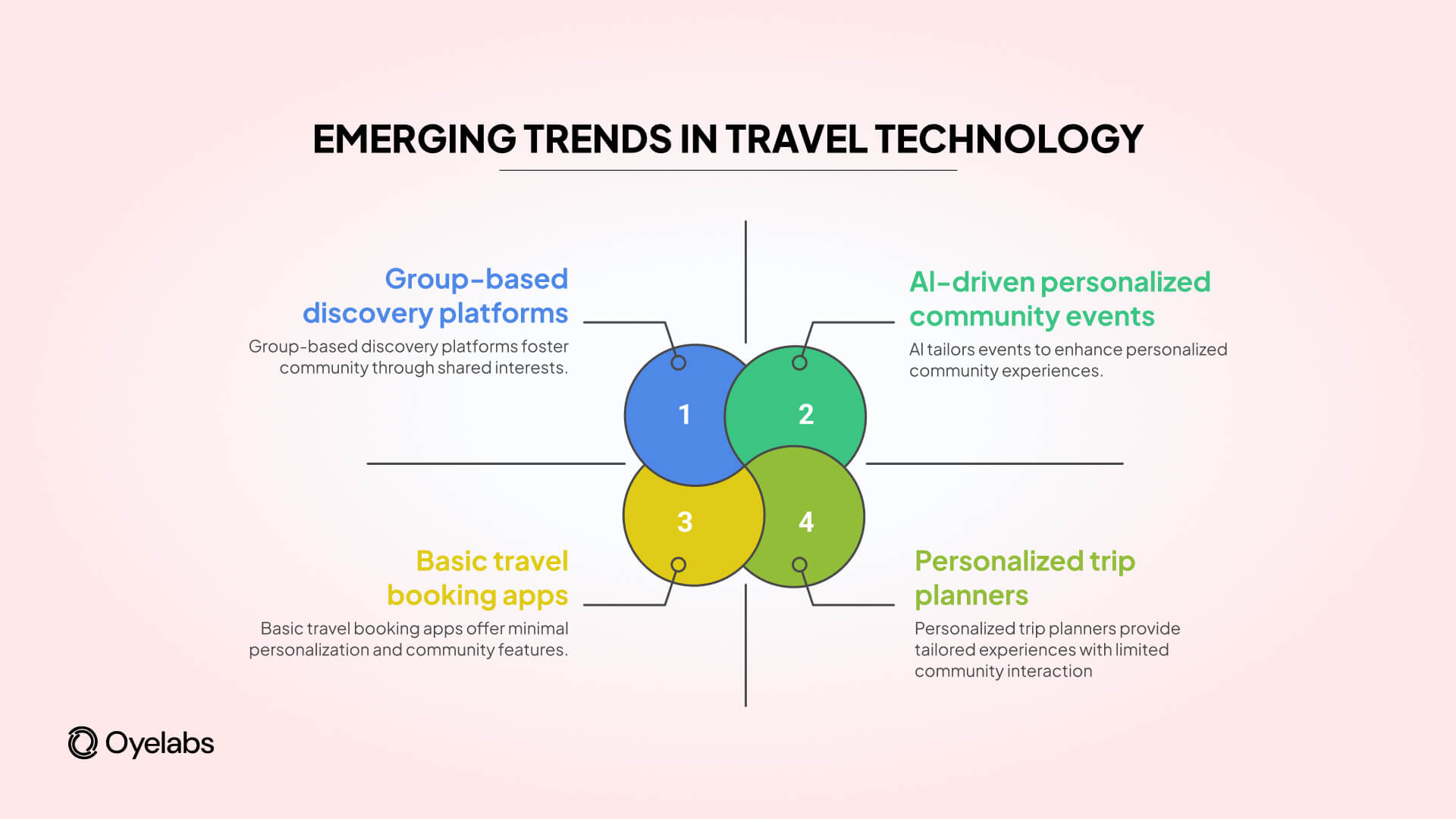
The next decade of travel technology will merge community, personalization, and immersive experiences. Airbnb’s pivot marks the early wave of a trend that will soon redefine the broader marketplace ecosystem.
Emerging directions shaping this evolution include:
- Group-based discovery: Algorithms will prioritize shared interests – traveling with similar guests, attending community-led events, or joining themed trips.
- Hybrid online–offline engagement: Expect integrations that connect digital planning with physical meetups, workshops, or host gatherings.
- AI-driven personalization: Platforms will analyze behavior, preferences, and social graphs to deliver highly relevant trip suggestions.
- Micro-communities and private networks: Startups will move toward niche, interest-based communities that feel exclusive yet accessible.
For entrepreneurs, this signals a clear opportunity. Building now with social readiness ensures long-term adaptability as user expectations shift toward experiential connectivity. Oyelabs already equips founders with modular architectures – so integrating new community or AI layers later requires minimal redevelopment.
Conclusion
Airbnb’s evolution in 2025 signals a clear industry inflection point – one where connection, not convenience, defines the next era of digital marketplaces. The company’s introduction of social tools like “Who’s Going,” guest messaging, and connection graphs marks a deliberate shift from being a booking platform to becoming a relationship ecosystem.
For startup founders and CEOs, the lesson is unmistakable: technology alone no longer differentiates a brand. What separates the next generation of successful platforms is how deeply they engage their users. Social mechanics – when thoughtfully integrated – turn passive audiences into active communities, increase retention, and unlock organic growth through advocacy.
Partnering with Oyelabs gives founders this very advantage. With its proven expertise in building scalable Airbnb-like marketplaces, Oyelabs helps transform concepts into market-ready products that combine engineering precision with human connection.
The takeaway is simple: in the evolving digital economy, the most valuable platforms will be those that don’t just host users – they bring them together.
FAQs
What new social tools has Airbnb introduced in 2025?
Airbnb added guest messaging, “Who’s Going,” connection tabs, and improved privacy controls for community engagement.- How do Airbnb’s social features help rental hosts and startups?
They boost trust, drive repeat bookings, and help startups build long-term user retention ecosystems. - Why are social tools important for Airbnb’s business growth?
Social features convert one-time guests into active community members, increasing engagement and brand loyalty. - Can startups replicate Airbnb’s social engagement strategy?
Yes, with platforms like Oyelabs, startups can integrate scalable social layers into rental marketplaces.