
Easy Taxi Business Model – How the Platform Works

 Sachin Sharma
Last Updated on December 13, 2025
Key Takeaways What You’ll Learn: Stats That Matter:
Easy Taxi is one of the earliest and most influential companies to digitalize traditional taxi services. Founded in Brazil in 2011, it entered a market where taxi booking was manual, unreliable, and dependent on street hailing. The platform offered a simple mobile-based system that connected passengers with licensed drivers instantly. At its peak, Easy Taxi expanded into 30 countries and over 420 cities, becoming one of the first global mobile taxi-booking platforms. Its focus on regulatory compliance, professional drivers, and user-friendly experiences fueled rapid growth across Latin America, Asia, and the Middle East. Later, the platform became part of the Cabify family (Maxi Mobility). In this blog, you’ll learn how Easy Taxi works, the ecosystem behind its growth, and why many entrepreneurs aim to build a taxi booking app like Easy Taxi today. Easy Taxi operates as a two-sided marketplace, connecting passengers who need reliable transportation with drivers seeking more ride opportunities. The platform’s foundation lies in simplicity, compliance, and transparency. Its model demonstrates how structured digital solutions can enhance traditional taxi services while creating a scalable business. Digital hailing apps have experienced explosive growth worldwide. In 2023, they reached around 1.7 billion active users, and by 2029, the number of ride-hailing users is projected to rise to 2.3 billion. This rapid expansion highlights the enormous demand for convenient, app-based transportation solutions, a demand that Easy Taxi tapped into early in emerging markets. Here’s a closer look at each side of the ecosystem: 1. Passengers Passengers are individuals looking for a safer, faster, and more predictable way to book taxis. Instead of waiting on the street, they can request a ride within seconds through the app. Key benefits include: Quick access to available taxis Verified and licensed drivers Clear pricing and reduced negotiation Real-time ride tracking This ensures a convenient and trustworthy experience for everyday commuters, tourists, business travelers, and occasional riders alike. With growing adoption of digital hailing apps, platforms like Easy Taxi continue to meet the evolving expectations of a massive user base. 2. Taxi Drivers Taxi drivers are licensed professionals who use the Easy Taxi driver app to receive ride requests and boost their earnings. Instead of driving around looking for passengers, the platform directs ride demand toward them. Drivers benefit from: More consistent ride requests Reduced idle time Integrated navigation support Efficient trip allocation This model aligns perfectly with the needs of drivers operating in competitive urban markets and ensures they can maximize income while minimizing wasted time. 3. Platform Operators The company itself oversees the technology and operations behind the service. Easy Taxi manages: App development and updates Driver onboarding and background verification Customer support GPS tracking and trip management Payment processing Local partnerships with taxi associations and authorities By handling the entire operational cycle, Easy Taxi ensures a smooth, compliant, and scalable mobility ecosystem. The combination of passengers, drivers, and platform operators creates a highly efficient marketplace that thrives even in regions with strict transportation regulations. Easy Taxi operates through a structured and efficient workflow designed to ensure speed, transparency, and reliability for both passengers and drivers. Each stage of the process is optimized to reduce friction, enhance safety, and deliver a smooth transportation experience. 1. Customer Requests a Ride The journey begins when a passenger opens the Easy Taxi app and enters the pickup and drop off locations. GPS technology automatically detects the user’s current position, making the process simple and accurate. Once the request is submitted, the system immediately searches for the nearest available taxi, removing the uncertainty of manual street hailing. 2. Nearby Drivers Receive the Request After the passenger submits the ride request, Easy Taxi’s matching system identifies drivers who are closest to the pickup point. These drivers receive an instant notification with details about the passenger’s location and the suggested route. Since the platform works only with licensed taxi drivers, passengers benefit from a reliable and compliant service. Drivers can review the request and choose to accept it based on their availability. 3. Driver Accepts the Ride When a driver accepts the request, the passenger receives detailed information about the trip. This includes the driver’s name, the taxi identification number, the estimated time of arrival, and live GPS tracking of the approaching vehicle. The app also provides communication tools so both parties can coordinate smoothly if needed. This transparent flow of information builds trust and ensures a comfortable waiting experience. 4. Trip Completion and Payment Once the passenger reaches the destination, the ride concludes and the payment step begins. Easy Taxi supports multiple payment methods depending on the region, including cash, in‑app payments, and digital wallets, preferred by over 70 % of urban app users for convenience. Industry Research Fares are calculated according to local regulations or the app’s pricing model, and drivers receive their earnings after the platform deducts its commission. 5. Rating and Feedback At the end of every ride, both the passenger and the driver have the opportunity to rate each other and share feedback. This two way rating system helps maintain service quality, promotes accountability, and highlights areas where improvements may be needed. Drivers with consistently high ratings receive better visibility, while issues raised through feedback are reviewed promptly. This ongoing feedback loop plays a crucial role in delivering a dependable and safe ride experience for all users. Below is the complete Business Model Canvas summarizing Easy Taxi’s operations: Easy Taxi’s revenue model is built to maintain steady income while ensuring that both passengers and drivers benefit from the platform. The company combines multiple monetization methods to diversify earnings and support long-term sustainability. Below is an expanded explanation of how Easy Taxi generates revenue across different channels. 1. Ride Commissions The core of Easy Taxi’s revenue strategy is the commission collected on every completed trip. Whenever a passenger books a taxi and the ride is successfully finished, a percentage of the fare is retained by Easy Taxi. This model ensures consistent daily earnings because revenue directly scales with the number of completed rides. Since taxi demand remains steady in busy urban areas, commission based income creates a reliable financial foundation for the platform. 2. Surge Pricing Revenue During periods of high demand, such as rush hours, late nights, bad weather, or citywide events, the platform applies surge pricing. This means fares increase temporarily due to limited driver availability and high passenger volume. Although this primarily boosts a driver’s earnings, it also increases Easy Taxi’s revenue because the platform’s commission is applied to a higher fare value. Surge pricing helps balance supply and demand while maximizing income during peak times. 3. Corporate Mobility Contracts Easy Taxi partners with companies that require dependable transportation solutions for their employees. Through corporate accounts, businesses can manage rides centrally and receive monthly billing instead of individual payments. These corporate agreements often include priority ride allocation, dedicated support, and negotiated pricing plans. This segment generates stable, recurring revenue and strengthens Easy Taxi’s presence in the business mobility sector. 4. Subscription Plans for Drivers In certain regions, drivers can choose a subscription based payment model. Instead of paying a commission on every ride, drivers pay a fixed weekly or monthly subscription fee to access the platform. This model benefits drivers who complete a high number of rides because it reduces their overall costs. For Easy Taxi, it ensures predictable recurring income regardless of seasonal fluctuations in ride volume. 5. In App Promotions and Advertisements Easy Taxi also monetizes its digital real estate by offering advertising placements within the app. Brands can display in app banners, promotional messages, and local partnership offers to passengers. These ads generate additional revenue with very low operational expenses, making it a highly efficient income stream. This approach also allows Easy Taxi to collaborate with local businesses, events, and service providers. Ready to launch your own taxi-hailing platform? At Oyelabs, we help brands transform mobility ideas into powerful, fully customized taxi booking apps built on proven models like Easy Taxi. Our team designs solutions that are scalable, secure, and equipped with the essential features passengers and drivers expect today, including real-time tracking, automated dispatch, seamless payments, driver performance monitoring, and intuitive dashboards. Whether you’re targeting a single city or planning a multi-country launch, we ensure your platform is optimized for reliability, growth, and long-term market success. If you’re looking to build a taxi booking app that stands out and performs exceptionally well, our team is here to support your journey from concept to launch. Easy Taxi’s business model demonstrates how digital solutions can enhance rather than disrupt traditional transportation systems. By working exclusively with licensed taxi drivers and maintaining compliance with local regulations, the platform successfully bridged the gap between traditional taxi services and modern on-demand mobility. Its simple workflow, robust ecosystem, and scalable business model helped it thrive in regions where private-car ride-sharing faced barriers. For entrepreneurs exploring mobility platforms today, Easy Taxi provides a powerful blueprint that proves innovation and regulatory cooperation can coexist to create sustainable growth. 1. How does Easy Taxi connect passengers and drivers? 2. What makes Easy Taxi different from regular street-hailing? 3. How does Easy Taxi help taxi drivers earn more? 4. How does the platform make money? 5. What is the role of surge pricing on Easy Taxi? 6. Why did Easy Taxi succeed in emerging markets?
Understanding the Easy Taxi Ecosystem
How Easy Taxi Works (Step-by-Step)
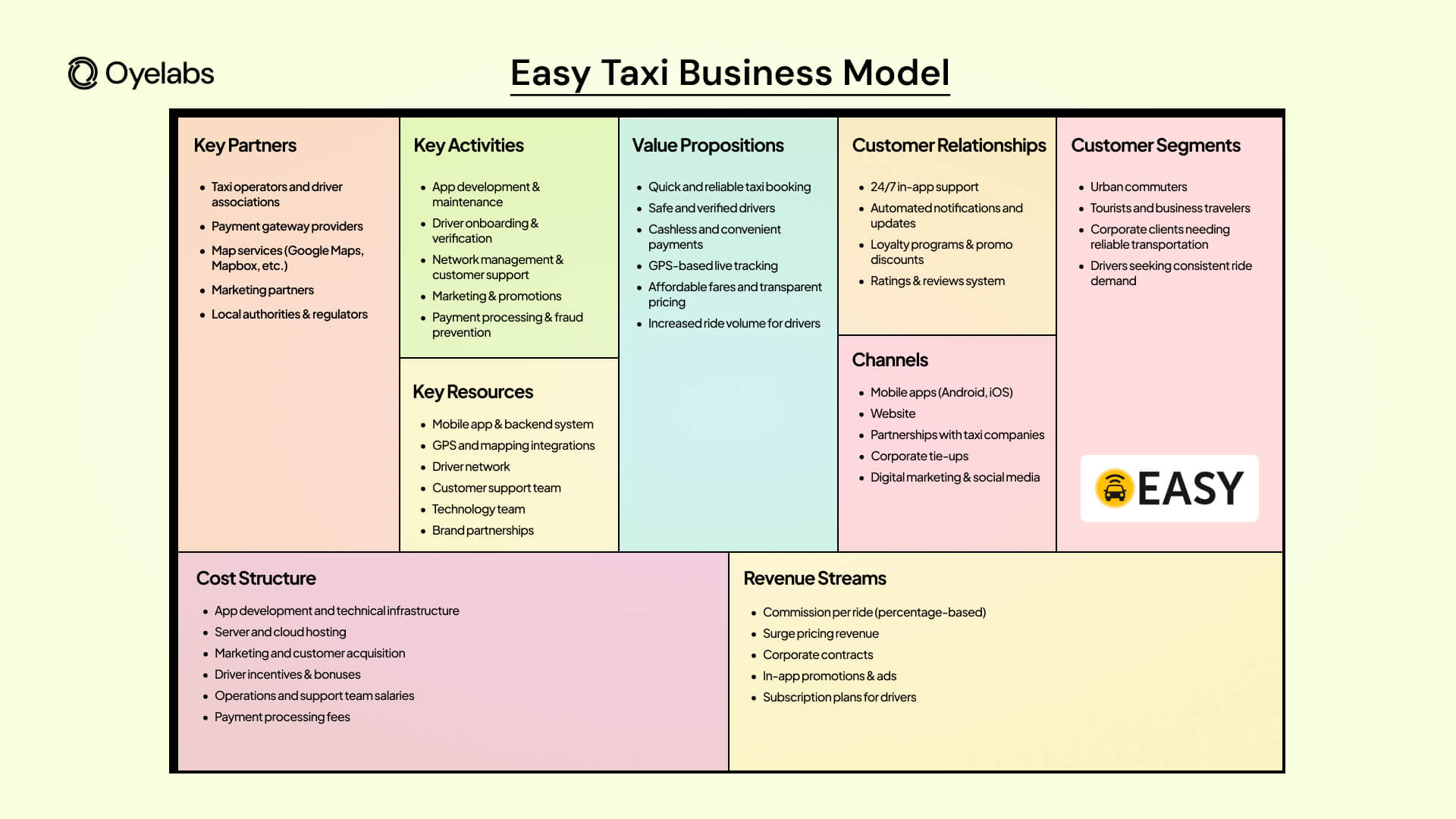
Easy Taxi Business Model Canvas
Easy Taxi’s Revenue Model Explained
Build a Taxi App Like Easy Taxi
Conclusion
FAQs
Easy Taxi matches passengers with the nearest licensed taxi driver through real-time GPS.
It offers faster bookings, verified drivers, real-time tracking, and predictable fares.
Drivers receive steady ride requests, reduced idle time, and built-in navigation support.
Easy Taxi earns through ride commissions, subscriptions, corporate accounts, and ads.
Surge pricing increases fares during high demand to balance supply and demand.
Its simple workflow, licensed drivers, and regulation-friendly model fit local needs.