
How to Build a Hotel Booking App – Step-by-Step Guide

 Sachin Sharma
Last Updated on March 16, 2026
Key Takeaways – What You’ll Learn: Hotel booking apps let travelers search, compare, and reserve hotels easily. Smart filters help users quickly find hotels by price, location, and amenities. Secure payment gateways protect transactions and increase booking confidence. Cross-platform apps reduce development time and support both Android and iOS. Launching with a focused niche helps new booking platforms compete. Stats That Matter: The global online travel market generated over $566 billion in 2024. The travel industry may exceed $1 trillion in market value by 2030.
Let’s be honest. If you’ve ever fumbled through a clunky travel website trying to book a hotel room on your phone, you already understand the problem you’re solving.
Travelers today don’t have patience for slow load times, confusing filters, or checkout flows that make them question whether their card details are safe. They want fast, clean, and trustworthy. And right now, there’s a wide-open window for founders who can actually deliver that experience.
If you’re thinking about building a hotel booking app, this guide is for you. We’ll walk through what the market looks like, what features actually matter, how the tech works, and what it realistically costs to build.
Market Opportunity for Hotel Booking Apps
Here’s the thing about travel: people never really stop wanting to do it. Even after everything the industry went through, demand bounced back faster than most analysts predicted.
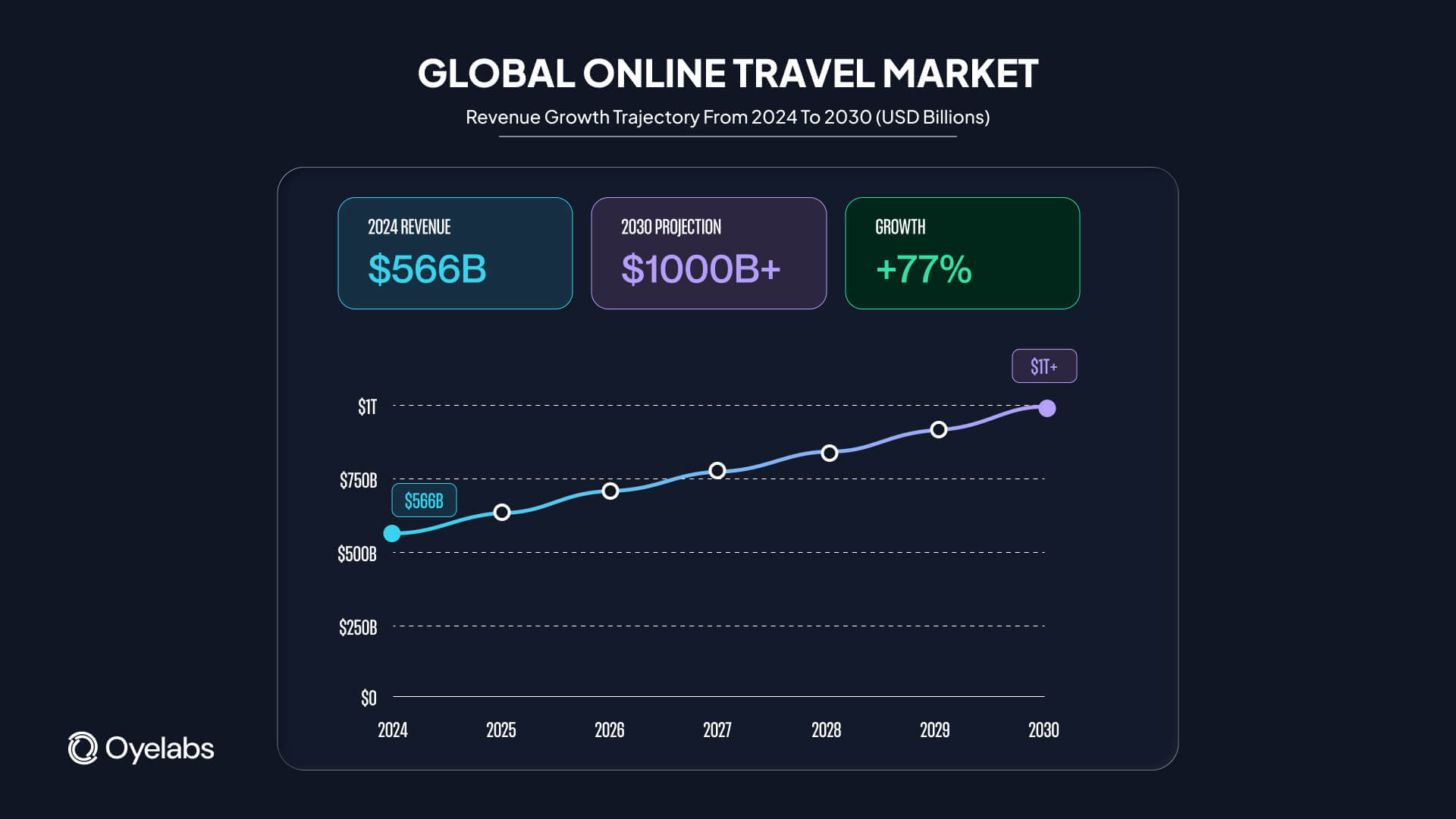
The global online travel market generated over $566 billion in revenue in 2024, and it’s on track to cross the $1 trillion mark by 2030. That’s not a niche. That’s a category.
And mobile is where the action is. The mobile travel booking market was valued at $228 billion in 2024 and is projected to hit $526 billion by 2032. Travel companies that actually built dedicated apps saw their mobile booking share jump from 41% to 60% almost immediately after launch.
So what’s driving all of it?
- A growing middle class in Asia, Latin America, and Africa who are traveling more than ever
- Independent travelers who want to plan on their own terms, not through a travel agent
- Business travel coming back in a big way
- Niche stays like eco-lodges, boutique hotels, and wellness retreats that bigger platforms barely touch
There’s room for new players here, especially ones willing to go deep on a specific audience or region instead of trying to serve everyone at once.
Also Read: How to Choose the Best Readymade Taxi Booking Script
Features of a Successful Hotel Booking App
This is where a lot of founders get tripped up. They want to build every feature they’ve ever seen before launch. Don’t do that. Focus on what your users actually need to search, trust, and complete a booking.
Here’s how to think about features across the three people who’ll use your platform:
Feature Breakdown by User Role
| User Role | Core Features |
|---|---|
| Guest (Traveler) | Search & filters, property listings, reviews, booking & payment, trip management, cancellations |
| Hotel / Property Manager | Listing management, availability calendar, booking dashboard, revenue reports, guest messaging |
| Admin (Platform Operator) | User management, commission settings, dispute resolution, analytics, promotional tools |
A few features worth getting right from day one
Smart Search & Filtering This sounds basic, but it’s where most apps quietly fail. Guests want to filter by location, dates, price, star rating, amenities, and property type without it feeling like a chore. A map-based view is a nice touch for people who are still figuring out which neighborhood they want to stay in.
Real-Time Availability & Pricing Nothing destroys trust faster than a traveler completing a booking only to find out the room isn’t actually available. Your platform needs live inventory sync, ideally through a channel manager or direct API connections with properties.
Secure Payment Gateway Offer credit cards, digital wallets like Apple Pay and Google Pay, and consider BNPL options. And please, make your security visible. A PCI-DSS badge and a clean checkout flow do more for conversions than most marketing tactics.
Reviews & Ratings People trust other travelers. Verified reviews close bookings. Set up an automatic post-stay prompt and make it easy to leave feedback in two minutes or less.
Messaging & Notifications Let guests talk to properties directly inside the app. Send booking confirmations, check-in reminders, and the occasional deal. Done well, this keeps users inside your ecosystem instead of defaulting to email.
Technology Stack Used in Booking Platforms
You don’t need to know how to code to make smart decisions about your tech stack. You just need to understand the broad strokes well enough to have an informed conversation with your development team.
| Layer | Technology Options |
|---|---|
| Frontend (Mobile) | React Native, Flutter |
| Frontend (Web) | React.js, Next.js |
| Backend / API | Node.js, Python (Django/FastAPI), Ruby on Rails |
| Database | PostgreSQL, MongoDB |
| Real-Time Features | WebSockets, Firebase |
| Payment Processing | Stripe, Braintree, PayPal |
| Maps & Geolocation | Google Maps API, Mapbox |
| Cloud Hosting | AWS, Google Cloud, Azure |
| Search & Filtering | Elasticsearch, Algolia |
For most early-stage founders, the smartest move is a cross-platform mobile app (React Native or Flutter) with a solid Node.js or Python backend. You get one codebase that works on both iOS and Android, which cuts your build time and keeps your team from maintaining two separate codebases. Save the complexity for later, when you actually need it.
Steps to Build a Hotel Booking App
Building a product like this isn’t a one-and-done sprint. It’s a series of focused phases, each one building on the last. Here’s a realistic view of what that looks like:
Development Stages
| Stage | What Happens | Estimated Duration |
|---|---|---|
| 1. Discovery & Strategy | Define your niche, audience, revenue model, and MVP scope | 2-3 weeks |
| 2. UX/UI Design | Wireframes, user flows, visual design, prototype | 3-5 weeks |
| 3. Backend Development | APIs, database architecture, admin panel | 6-10 weeks |
| 4. Frontend Development | Mobile app and web portal | 6-10 weeks |
| 5. Third-Party Integrations | Payment gateways, maps, hotel data APIs | 2-4 weeks |
| 6. QA & Testing | Bug fixes, performance testing, security audits | 3-4 weeks |
| 7. Launch & Deployment | App store submission, cloud deployment | 1-2 weeks |
| 8. Post-Launch Iteration | User feedback, feature updates, scaling | Ongoing |
One thing we’d push every founder on: please, launch something small first. Pick one city. Pick one type of property. Get real bookings happening with real users before you start bolting on more features. You’ll learn more in two weeks of real usage than six months of planning.
Monetization Models
There’s no single right way to make money with a travel booking platform. Most successful ones actually use a combination. Here’s what’s worked across the industry:
| Monetization Model | How It Works | Best For |
|---|---|---|
| Commission per Booking | Charge hotels 10-25% per completed reservation | Marketplaces with high booking volume |
| Subscription (Hotels) | Monthly/annual fee for hotels to list on platform | B2B-focused platforms |
| Featured Listings | Hotels pay for premium placement in search results | Mature platforms with traffic |
| Affiliate Partnerships | Earn referral fees from car rentals, tours, insurance | Add-on revenue for any platform |
| White-Label Licensing | License your platform to other travel brands | Tech-first companies |
| Dynamic Pricing Markup | Add a margin on top of wholesale hotel rates | Curated or membership models |
If you’re just starting out, commission-based revenue is the most natural fit. You don’t charge hotels to join. You only take a cut when a booking actually happens. That makes it an easy yes for property owners, which helps you build supply faster.
Check Out: Instant Book vs Request to Book – Best Rental App Model
Challenges and How to Solve Them
Every founder who’s built a hotel reservation app has hit some version of the same walls. Here’s how to go in with your eyes open.
Challenge: Building inventory from day one:The classic chicken-and-egg problem. No hotels means no guests. No guests means no reason for hotels to join.
What actually works: Go small and local. Target boutique hotels in one city, or eco-resorts in one specific region. Get 20-30 properties signed up before you open the doors to travelers. You can also plug into a hotel content API like Amadeus or Hotelbeds to fill out your catalog while you build direct relationships.
Challenge: Getting first-time users to trust you enough to pay:Travelers are handing over real money to a platform they’ve never used before. That’s a big ask.
What actually works: Make your trust signals impossible to miss. SSL badges, clear cancellation policies, verified reviews, and a visible support option all do the heavy lifting here. The more a user feels like they’re in safe hands, the more likely they are to complete the booking.
Challenge: Keeping availability accurate in real time:An overbooking doesn’t just lose you a customer. It can tank your reviews and burn the hotel relationship at the same time.
What actually works: Integrate with a channel manager and use webhooks to sync inventory the moment anything changes. Build in low-availability alerts so your team (and the hotel) can catch issues before they become problems.
Challenge: Going up against platforms with decade-long head starts:You’re not going to out-spend or out-feature the category leaders. That’s just reality.
What actually works: Don’t compete on their terms. Find the corner of the market they’re ignoring and own it completely. A boutique travel app for a specific region, a platform built for extended-stay business travelers, a curated wellness retreat directory. Specificity wins when scale isn’t on your side yet.
Development Cost Factors
One of the first questions every founder asks is: what’s this actually going to cost? The honest answer is it depends, but here’s a realistic range:
| Cost Factor | Budget Range (USD) |
|---|---|
| MVP (Basic App, 1 Platform) | $25,000 – $50,000 |
| Mid-Range (iOS + Android + Web) | $50,000 – $120,000 |
| Full-Featured Platform | $120,000 – $250,000+ |
| UI/UX Design | $5,000 – $20,000 |
| Third-Party API Integrations | $5,000 – $15,000 |
| QA & Testing | $5,000 – $15,000 |
| Ongoing Maintenance (Annual) | 15-20% of initial build cost |
The biggest variable isn’t the feature list, it’s who you build with. A team that’s done this kind of platform before moves faster, makes fewer expensive mistakes, and flags problems before they become rebuilds. That experience is worth paying for.
Future Trends in Travel Booking Apps
If you’re building something today, you should be designing for where travelers are heading, not just where they are right now.
AI-Powered Personalization: This is already shifting from a nice-to-have to an expectation. Nearly 48% of travelers say they trust AI to help plan their trips. Apps that surface the right property at the right price based on past behavior are going to outperform generic search results.
Voice Search Integration: More and more travelers are searching by voice, especially on mobile. Building voice-friendly search into your UX now puts you ahead of platforms that have to retrofit it later.
Blockchain for Transparent Pricing & Trust: Still early, but the direction is clear. Blockchain-based systems for verifying guest identities and securing transactions are starting to show up in serious platforms, especially in markets where fraud is a bigger concern.
Sustainability Filters: This one’s already hitting mainstream. A growing segment of travelers actively want to know the environmental footprint of where they’re staying. Platforms that make that information easy to find are winning over a younger, more values-driven travel demographic.
Flexible Booking & BNPL: Buy-now-pay-later for travel is exploding. Affirm and Klarna have already made their way into major booking flows. If your average booking value is over $300, BNPL can meaningfully lift conversion.
Hyper-Local & Experience-First Stays: The “I’m going to Paris” traveler is becoming “I want to stay somewhere that gets me close to the Marais food scene.” People are booking around experiences, not just destinations. Platforms that connect accommodations to curated local experiences have a real edge here.
Ready to Build Your Hotel Booking Platform?
You’ve read this far, which tells us something. You’re serious about this. The market is there. The timing is right. What you need now is a team that’s actually built products like this before and knows how to get you from a concept on a whiteboard to a live platform that handles real bookings.
At Oyelabs, we specialize in creating scalable hotel booking scripts and on-demand marketplace platforms. From your first product conversation to launch and beyond, we help you design systems that actually work when real users start booking.
If you’re ready to turn your hotel booking app idea into a fully functional platform, visit Oyelabs.com and get in touch with our team. We’ll guide you on building the smartest, most reliable hotel booking script for your business.
Conclusion
Building a hotel booking app today is less about copying existing platforms and more about delivering a faster, cleaner, and more trustworthy travel experience. Travelers expect seamless search, real-time availability, secure payments, and transparent reviews, all within a few taps on their phones.
Founders who focus on a clear niche, launch with a focused MVP, and scale based on real user feedback have the best chance of building a platform that actually gains traction. With the travel industry continuing to grow and mobile bookings leading the way, the opportunity is real. The key is partnering with the right team that can turn your idea into a reliable, scalable booking platform.
FAQs
1. Can a hotel booking app support multiple currencies and languages?
Yes, multi-currency payments and multilingual interfaces help travel platforms attract international users and provide a smoother booking experience for travelers from different countries.
2. How do hotel booking apps handle last-minute reservations?
Hotel booking apps use real-time availability systems and instant confirmations to allow travelers to secure rooms quickly, even for same-day or last-minute bookings.
3. Can hotel booking apps integrate loyalty or reward programs?
Yes, many platforms include reward points, loyalty tiers, or cashback offers to encourage repeat bookings and increase long-term user retention.
4. How do hotel booking apps reduce booking cancellations?
Apps reduce cancellations through clear cancellation policies, instant booking confirmations, reminder notifications, and sometimes partial prepayments to ensure traveler commitment.