
Uber For Home Services: How to Develop an On-Demand Home Services App?

Uber For Home Services: How to Develop an On-Demand Home Services App?
 Sushmeet Setia
Last Updated on October 22, 2026
Key Takeaways
What You Will Learn
* How on-demand home services app development connects customers, professionals, and an admin team through one booking flow.
* Why the market is projected to grow from $6.79 billion in 2026 to $11.78 billion by 2030, and what that means for a new entrant.
* Which services to launch with, and why standardized jobs beat custom ones at the start.
* The four business models founders choose from, and the revenue streams that sit on top of them.
* An eight step process for on-demand home services app development, from market research to a secured, marketed launch.
* A feature matrix that separates the MVP from version two and from 2026 differentiators.
* A cost table for on-demand home services app development that compares ready-made, customized, and fully custom routes.
Real Insights
* Research on TaskRabbit found that growth followed local density and standardized tasks, so start with one city and a few repeatable services.
* Urban Company’s FY26 revenue was about 36% of its net transaction value, but that includes product sales, so it is not a pure commission rate.
* Urban Company’s adjusted EBITDA was positive excluding its InstaHelp service and negative with it, which shows why new service lines need their own budget.
* Ratings act like a substitute brand: a Harvard study found a one star Yelp increase lifted independent restaurant revenue by 5 to 9 percent.
* Provider verification and split payments are launch requirements, not later upgrades.
How to Develop an On-Demand Home Services App?
By Sushmeet Setia, AI Architect at OyeLabs | Last updated: October 22, 2026
Booking a plumber used to mean three phone calls, a vague arrival window, and a quote nobody could compare. Apps changed that. You pick a service, see the price, watch the professional travel to your door on a map, and pay without cash. For founders weighing on-demand home services app development today, the question is no longer whether people will book this way. It is whether you can build a platform they trust with their front door.
This is a step by step guide for founders and service businesses who want to build one. It walks through eight steps, from market research to launch, and then covers what the build costs and how a development team works with you. If you would rather scope it with a team, an experienced home services app development company can plan the customer app, the professional app, and the admin panel together.
Table of Contents
- How to Develop an On-Demand Home Services App: 8 Steps
- What the App Costs
- How OyeLabs Builds These Platforms
- Frequently Asked Questions
Quick Answer
- On-demand home services app development produces a platform with a customer app, a professional app, and an admin panel that handle booking, dispatch, payment, and reviews.
- The online on-demand home services market is projected to reach $11.78 billion by 2030, up from $6.79 billion in 2026.
- Launch in one city with two or three standardized services, because TaskRabbit research shows density and repeatable tasks drive growth.
- Choose a model first: single category, multi category, own technicians, or quote based.
- The MVP needs booking, live tracking, payments, ratings, provider verification, and commission controls.
- Budget on-demand home services app development as a ready-made script, a customized build, or a fully custom platform, and confirm scope and timeline in writing.
How to Develop an On-Demand Home Services App: 8 Steps
An on-demand home services app is a mobile and web platform where customers book vetted professionals, such as plumbers, cleaners, electricians, and tutors, for a chosen time and price. Three products make it work: a customer app for search and booking, a professional app for jobs and earnings, and an admin panel for approvals, payments, and disputes.
The eight steps below follow the order in which decisions become expensive to reverse. Research, services, and the business model come first because they cost little to change. Architecture and security come later because they are costly to redo. Here is the flow your app has to support from the first booking to the last review.

- The customer searches by category and location, then selects a service and a time slot.
- The platform shows the price, assigns or offers professionals, and sends a confirmation.
- The professional accepts the job, travels to the address, and shares live location.
- The job ends, the customer pays in the app, and the platform splits the payment.
- Both sides rate each other, and the admin team reviews any dispute.
Step 1: Research the Market and Validate Demand
Start with who needs the service, how they book it today, and what makes them hesitate. Interview a few dozen homeowners and renters, then read competitor reviews for repeated complaints about lateness, pricing, or quality. The gap you find becomes your positioning, so write it down in one sentence before you plan anything else in on-demand home services app development.
The Business Research Company projects the online on-demand home services market at $6.79 billion in 2026, rising to $11.78 billion by 2030, a 14.8% compound annual growth rate. Its definition spans cleaning and repair, beauty, tailoring, pet care, and laundry, and North America was the largest region in 2025. These are analyst projections, so use them to judge direction and not to size your own revenue.

Real platform numbers are more useful than forecasts. Urban Company, formerly UrbanClap, reported FY26 net transaction value of ₹4,290 crore, up 31%, with revenue from operations of ₹1,556 crore and 33.57 million orders across 51 cities. It served 8.4 million annual transacting users through 59,473 monthly active service partners, at an average rating of 4.79.
The same report carries a lesson in discipline. Adjusted EBITDA was negative ₹129 crore in FY26, but excluding the InstaHelp housekeeping service it was positive ₹106 crore. In our reading, a proven core can fund growth, while a new service line needs its own budget so that an experiment cannot hide the profit of the business underneath it.
Growth Insight: Prove one core service in one city before funding new service lines, because experiments can hide a profitable core.
Step 2: Choose Your Services and Your Niche
Research on TaskRabbit data published in Management Science found that cities grew fastest where buyers and sellers lived close together and requested standardized tasks. That turns service selection into a growth decision. Start with jobs that have a clear scope and price, such as AC servicing, deep cleaning, or furniture assembly, and add custom work after the core loop is running.
| Category | Example services | Launch fit † |
|---|---|---|
| Home repair and maintenance | Electrician, plumber, carpenter, geyser repair, washing machine, TV and fridge repair, AC servicing | High: repeatable and urgent |
| Cleaning and pest control | Home deep cleaning, sofa, carpet, kitchen, bathroom, water tank, pest control | High: standard scopes |
| Moving and shifting | Packers and movers | Medium: variable job size |
| Design and construction | Interior design, modular kitchen, painting, architect, CCTV installation | Medium: often quote based |
| Health and wellness | Physiotherapy, dietician, yoga and fitness trainers, massage | Medium: licensing rules apply |
| Events and weddings | Party and bridal makeup, event photography, wedding planner, pre-wedding shoots | Low to medium: quote based |
| Tutors and kids | Commerce, English, and mathematics tutors, drum and guitar classes, baby photographer | Medium: trust sensitive |
| Business and professional | Web designer and developer, lawyer, CA for tax registration | Low: high trust needed |
| Emerging in 2026 | Water purifier installation, smart lock installation, solar panel cleaning, EV charger installation | Test after the core launch |
Your final list for on-demand home services app development should come from local demand, not from this table. Survey homeowners and renters in your launch zone, note which trades are hardest to book today, and look for categories where the big platforms are thin. Supply matters as much as demand, so launch a trade only if you can recruit enough verified professionals to answer requests quickly. More niches are covered in our list of home services business ideas.
Step 3: Pick a Business Model and Revenue Streams
Four models cover most home services startups. A single category aggregator lists professionals for one trade, such as cleaning. A multi category aggregator lists many trades under one brand. A home services company dispatches its own technicians, and a quote based marketplace lets customers post jobs and compare offers. The choice shapes your admin panel, payouts, and supply plan, and our guide to home services business models compares them in detail.
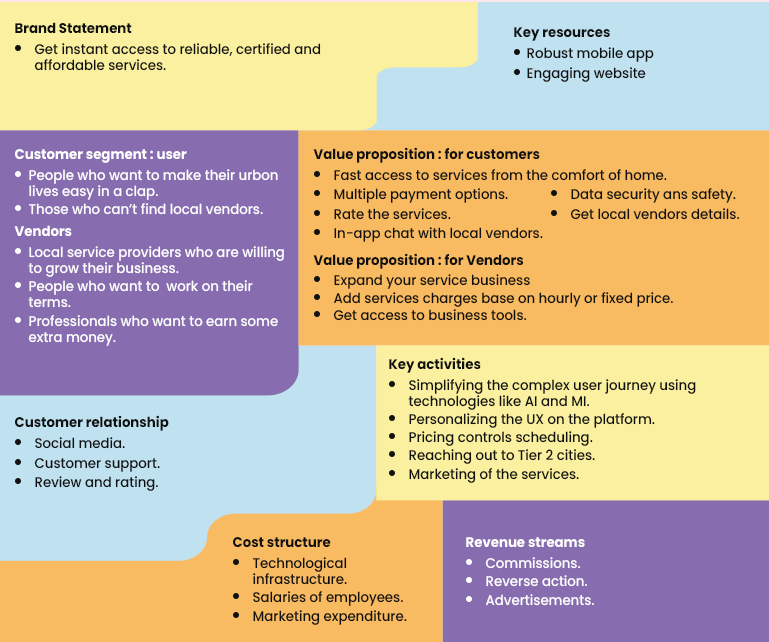
Commission is the most common revenue stream. OyeLabs’ TaskRabbit-style script lets admins set commission globally or per category, and typical settings run from 10% to 25%. Other streams include provider subscriptions, listing fees, featured placement, customer convenience fees, and referral commissions. In on-demand home services app development, launch with commission and a simple booking fee, then add streams once repeat bookings appear.
Urban Company’s FY26 revenue of ₹1,556 crore equals about 36% of its ₹4,290 crore net transaction value, by our calculation. That ratio includes product sales such as water purifiers, so it is not a pure commission rate. Treat it as proof that a mature platform can keep a large share of each transaction, not as a target for a launch where trust is still being built.
Reality Check: A high commission pushes providers to take jobs off the platform, so price your take rate against the value you add.
Step 4: Define the Features for Your MVP
A feature list for on-demand home services app development can run to hundreds of items, so prioritize. Every platform has three players: customers, professionals, and the operations team that manages them. Some also need a vendor panel for companies that run several technicians under one account. The matrix below sorts features into the MVP, version two, and 2026 differentiators for each app.
| App | MVP (launch) | Version two | 2026 differentiator |
|---|---|---|---|
| Customer app | Easy sign-up, category browsing with filters, time-slot booking, real-time notifications, in-app payment, ratings | Recurring bookings, wallet, favorites, one-tap rebooking | AI-assisted search and instant quotes |
| Professional app | Quick registration with admin approval, request alerts, accept or decline, calendar, in-app chat, earnings and payment details | Travel-fee settings, team accounts, wallet payouts | Smart job matching and route planning |
| Admin panel | Provider verification, booking and payment management, commission settings, promotions, review moderation, analytics | Multi-city zones, dispute workflows, staff roles | Predictive demand and dynamic pricing |
Trust features deserve extra weight in on-demand home services app development because customers are inviting a stranger into their home. Harvard Business School’s Michael Luca found that a one star increase in Yelp rating raised revenue by 5 to 9 percent for independent restaurants, with no effect on chains. That is a restaurant study, but the mechanism carries over: visible ratings do the work a brand would otherwise do.
Pair ratings with provider verification, configurable cancellation and refund rules, and a dispute process backed by payment records. These features decide whether a first booking becomes a second one, and they are far easier to design in at the start than to retrofit after a bad experience.
Also Read: A Complete Guide to Home Services App Features List
Builder Tip: Ship booking, payment, ratings, and verification first, because those four decide whether customers trust you enough to rebook.
Step 5: Choose the App Type and Technology Stack
Native apps suit heavy device features, cross platform frameworks such as Flutter or React Native share one codebase across iOS and Android, and web apps ship fastest but have less presence in app stores. For most MVPs, cross platform is the balanced choice. A good app development partner can compare the options against your budget and timeline.
There is no single correct stack for on-demand home services app development, so choose for your team, your scale, and your markets. For each layer, OyeLabs typically selects from a proven set of tools:
- Front end and mobile: Flutter, React, Angular, or Vue.js.
- Backend: Node.js with Express, Ruby on Rails, or Django.
- Databases: PostgreSQL, MongoDB, or Firebase.
- Cloud: AWS, Google Cloud, or Microsoft Azure.
- Maps and messaging: Google Maps Platform, plus SMS, email, and WhatsApp integrations.
- Payments: Stripe, PayPal, Razorpay, or MangoPay for split payments.
Real-time features need extra care. Live tracking, chat, and job alerts depend on persistent connections and reliable push notifications, which is why we built chat on socket.io and added push delivery for locked screens in a US home services project. I prefer to keep matching logic in its own service, so that pricing or matching rules can change without rewriting the booking flow.
Artificial intelligence is now practical, but it is not a launch requirement. Smart matching, a support chatbot, predictive demand analytics, and dynamic pricing are the most useful applications of AI in on-demand home services app development in 2026. Add them after the booking loop works, because a model trained on a few hundred bookings mostly learns noise.
Step 6: Design a Booking That Takes a Few Taps
A great service is wasted if booking takes too many steps. Show the price before commitment, keep the booking flow to a few taps, and put trust signals where customers decide: ratings, verification badges, and professional profiles with certifications and a short introduction.
Plan for local needs early, such as right to left layouts for Arabic, local languages, and the payment methods your market actually uses. Design the professional app with the same care, since a tool that is slow or confusing on a job site will cost you your best providers faster than any competitor.
Step 7: Build, Test, and Secure the App
Build the customer app, the professional app, and the admin panel together, then test on real devices in real neighborhoods. Check what happens when a professional cancels late, a payment fails midway, or GPS drops in a basement. These edge cases are where home services apps lose trust.
Publish a privacy policy that explains what you collect, and plan for rules such as GDPR, CCPA, India’s Digital Personal Data Protection Act, and the data laws of the UAE and Saudi Arabia. Use trusted payment gateways, encrypt personal data, and verify professionals with ID and background checks before they can accept a single job.
Step 8: Launch, Market, and Keep Marketing
Marketing starts before the first line of code: publish a landing page, collect a waiting list, and recruit professionals before you recruit customers. Supply should always be ahead of demand in your launch zone, because a customer who cannot get a booking rarely returns.
After launch, use first booking offers, referral rewards, and loyalty points with a fixed budget, and optimize your app store listing. Keep going after the first month, because a launch is a seed that needs steady attention. Track repeat booking rate, professional response time, and cancellation rate more closely than downloads.
Related Read:
- Guide To Make An App Like Taskrabbit
- How To Make An App Like Airtasker
- Uber For Handyman App Development Guide
What Does On-Demand Home Services App Development Cost?
The cost of on-demand home services app development depends mostly on scope. As a planning range, a focused MVP with one or two service categories can start near $10,000, while a full multi category platform with customer, professional, and admin apps typically runs $20,000 to $50,000 or more. Treat these as estimates for budgeting, not a quotation, and confirm the figure after a discovery call.
| Route | Best for | Timeline signal | Trade-off |
|---|---|---|---|
| Ready-made script (white-label) | Testing one zone quickly | About seven business days after branding assets and server access, per OyeLabs | Deep workflow changes need custom work |
| Customized white-label | Founders who need their own branding and a few custom modules | Weeks, depending on scope | Scope must be agreed in writing |
| Fully custom platform | Vendor panels, quote or bidding workflows, multi-city rules | Staged schedule confirmed after discovery | Highest cost and longest timeline |
Six factors move the price most: the platforms you target, the depth of UI and UX design, the number of features and integrations, the payment and compliance requirements, the experience of the team you hire, and the languages and regions you support. Content, hosting, and post-launch maintenance add to the total, so budget for the first year and not only for the build.
Hourly rates also vary by region. Agencies in North America and Western Europe usually bill more per hour than teams in India, but compare the full scope, QA, and post-launch support, not only the rate. For a feature-by-feature estimate, read our breakdown of the cost to build an on-demand home service app like UrbanClap.
Founder Warning: The cheapest quote often leaves out verification, payments, and QA, so compare scope line by line before you sign.
How OyeLabs Builds These Platforms
OyeLabs delivers on-demand home services app development for marketplace founders, established service companies, franchises, and professional groups, with more than eight years in app development and projects across more than 20 countries. The team holds ISO 9001 and CMMI Level 5 certifications, and every build follows six stages, from requirement analysis through testing to deployment and post-launch support.
In Quick Home Services, an on-demand home assistance app for the United States, we gave each professional a profile card with certifications, languages, and a video introduction. We chose MangoPay for split and frozen payments with European KYC compliance, built real-time chat on socket.io, and delivered an admin panel for orders, usage, and payment statistics.
For iDeliverr in the United Kingdom, OyeLabs built a custom task marketplace with customer, professional, and admin panels and GBP payments. Founders who want to test a zone first can start from the TaskRabbit clone, then add custom modules such as a vendor panel, recurring plans, multi-city zones, or quote and bidding workflows.
- Every build includes a customer app, a service professional app, and an admin dashboard.
- Web, iOS, and Android versions are available, with App Store and Google Play submission included.
- Real-time GPS tracking, provider verification, configurable cancellation and refund rules, and dispute resolution come built in.
- Thirty days of free post-launch support are included, with maintenance plans afterward.
For custom work, source code and IP ownership are written into the contract before development begins. Ready-made scripts are licensed with full source code for a single deployment. Either way, you decide how much to build now and what to leave for version two.
Conclusion
On-demand home services app development rewards focus. The market is growing, Urban Company proves the model at scale, and research shows that density and standardized tasks drive growth. A founder who picks one city, a few repeatable services, and a clear price has a real chance against bigger names.
Choose the business model before the features in on-demand home services app development, ship booking, payments, ratings, and verification first, and keep experiments away from your profitable core. When you are ready to scope your own platform, talk to our team and we will help you choose between a ready-made script and a custom build.
Frequently Asked Questions
What is on-demand home services app development?
It is the process of building a platform that lets customers book vetted professionals such as plumbers, cleaners, and electricians. The build includes a customer app, a professional app, and an admin panel that manage booking, tracking, payments, ratings, and disputes.
How much does a home services app cost to build?
On-demand home services app development costs vary with scope. As a planning range, a focused MVP with one or two service categories can start near $10,000, while a full multi category platform typically runs $20,000 to $50,000 or more. Final cost depends on platforms, features, integrations, and compliance, so confirm it in a written quotation.
How long does it take to build a home services app?
On-demand home services app development with a ready-made white-label script can launch in about seven business days after branding assets and server access are shared. A customized build takes weeks, and a fully custom platform follows a staged schedule confirmed after discovery, depending on features, platforms, and integrations.
How do home services apps make money?
Most earn a commission on each booking, set globally or per category. Other revenue streams include provider subscriptions, listing fees, featured placement, customer convenience fees, and referral commissions. Start with commission and a booking fee, then add streams once repeat bookings appear.
Which features does a home services app MVP need?
Customers need easy sign-up, category browsing, time-slot booking, real-time notifications, in-app payment, and ratings. Professionals need verified registration, request alerts, a calendar, and earnings tracking. Admins need provider verification, commission settings, booking and payment management, and analytics.
Which services should I launch with first?
Launch with two or three standardized, repeatable services such as AC servicing, deep cleaning, plumbing, or electrical repair. Research on TaskRabbit data found that growth followed geographic density and standardized tasks, so a narrow launch in one city beats a broad launch with thin supply.
What technology stack suits a home services app?
Cross-platform frameworks such as Flutter or React Native suit most MVPs, paired with a Node.js, Ruby on Rails, or Django backend, PostgreSQL or MongoDB, and a cloud host such as AWS. Add Google Maps for tracking and Stripe, Razorpay, or MangoPay for split payments.
Can I build an app like Urban Company or TaskRabbit?
Yes. Founders can start from a ready-made TaskRabbit style script and customize branding, categories, and payments, or commission a custom platform. The stronger plan is to differentiate on one city, a few trades, clear pricing, and verified professionals instead of copying every feature of a larger player.
Sources and Editorial Notes
Sources
- The Business Research Company: Online On-Demand Home Services Global Market Report (2026)
- Urban Company: Shareholders’ Letter and Results, Q4 FY26
- Cullen, Z. and Farronato, C. (2021), Outsourcing Tasks Online: Matching Supply and Demand on Peer-to-Peer Internet Platforms, Management Science
- Luca, M.: Reviews, Reputation, and Revenue: The Case of Yelp.com (Harvard Business School working paper)
Editorial Notes
- Last updated October 22, 2026. Market figures are analyst projections, and definitions of the home services market differ between research firms.
- Urban Company figures come from its Q4 FY26 shareholders’ letter and are in Indian rupees. The ratio of revenue to net transaction value is our calculation, and revenue includes product sales.
- The Cullen and Farronato findings come from TaskRabbit data during the study period, and results for other markets and years may differ. The Luca study covers independent restaurants, and we cite it as an analogy for service businesses.
- Cost figures are OyeLabs planning ranges, not quotations. Final price depends on scope, platforms, integrations, and the team you choose.
- Items marked with a dagger are our assessment, not measured results.
- Urban Company, UrbanClap, TaskRabbit, Airtasker, Yelp, and MangoPay are referenced only to describe product categories and market context. OyeLabs has no affiliation with any of them.







Comments (2)
Tarun Nagar
Perfect blog! I was searching for this blog. Thanks to Google to make me land here, all information is good and looking to share it with others. After 2019 we are seeing a boom in the on-demand app industry. One thing really impressed me which is some college students are investing in this industry to start a business and making money.
Dai Software
Great idea man thanks keep it up all the time. am very happy to see your standard.
Comments are closed.