
Udemy Business Model and Revenue Model Explained

Udemy Business Model and Revenue Model Explained
 Anuraag Jain
Last Updated on August 25, 2026
Key Takeaways
What You Will Learn
* Udemy’s business model runs on two separate revenue engines: a course marketplace and enterprise subscriptions.
* Udemy Business now generates most of total revenue, not individual course sales.
* Instructors earn 37% on organic sales, 97% on self-referred sales, and 15% on subscription views.
* The subscription pivot cut instructor payouts from 25% to 15% in three steps since 2023.
* Udemy merged into Coursera in May 2026, ending its run as an independent public company.
* A Udemy-like app needs its payout and engagement-tracking logic built in from day one.
Real Insights
* Higher subscription margins didn’t fully offset lower transactional revenue during Udemy’s pivot year.
* Subscription revenue pools require accurate watch-time tracking, which is a technical build, not a policy line.
* B2B subscription revenue proved more durable than consumer course sales, and investors priced that in.
* A merger between two former competitors signals real limits in the standalone course-marketplace model.
Udemy Business and Revenue Model Explained
Udemy’s business model runs on two distinct revenue engines: a transactional course marketplace where individual learners buy courses outright, and Udemy Business, a B2B subscription product sold directly to companies for employee training. Understanding how money actually moves between these two systems, and why one now dominates the other, is the real story behind Udemy’s revenue model and its recent merger into Coursera.
This distinction matters most for anyone looking for a Udemy-like app for their own market. I’ve worked with 300+ founders across the US, UK, India, Australia, and the Middle East, and the same question comes up almost every time: which part of Udemy’s revenue model is actually worth building, and which part quietly stopped working?
This breakdown covers exactly that, with the real numbers behind both sides of the business.
Quick Answer
- Udemy’s business model has two engines: Consumer marketplace (individual course sales) and Udemy Business (enterprise subscriptions).
- Udemy Business now drives roughly two-thirds of total revenue and is growing; Consumer marketplace revenue is shrinking.
- Instructors earn 37% on organic sales, 97% on sales through their own links, and 15% on subscription-based views.
- Udemy pushed toward subscriptions because it keeps 85% of subscription revenue versus 63% of one-off sales.
- That pivot hurt short-term consumer revenue before subscriber growth could fully offset the decline.
- Udemy merged with Coursera in an all-stock deal that closed in May 2026, ending its life as a standalone company.
The Two Businesses Inside Udemy’s Model
Most people picture Udemy as one product: buy a course, watch it. That’s only half of Udemy’s business model.
The other half, Udemy Business, sells subscription access to curated course libraries directly to companies for employee upskilling. It’s B2B, it’s recurring, and by FY2025 it made up 66% of Udemy’s total revenue.
Anyone building a Udemy-like app should decide early which of these two businesses they’re actually building. Each requires meaningfully different infrastructure, sales motion, and content curation.
How the Marketplace Side Pays Instructors
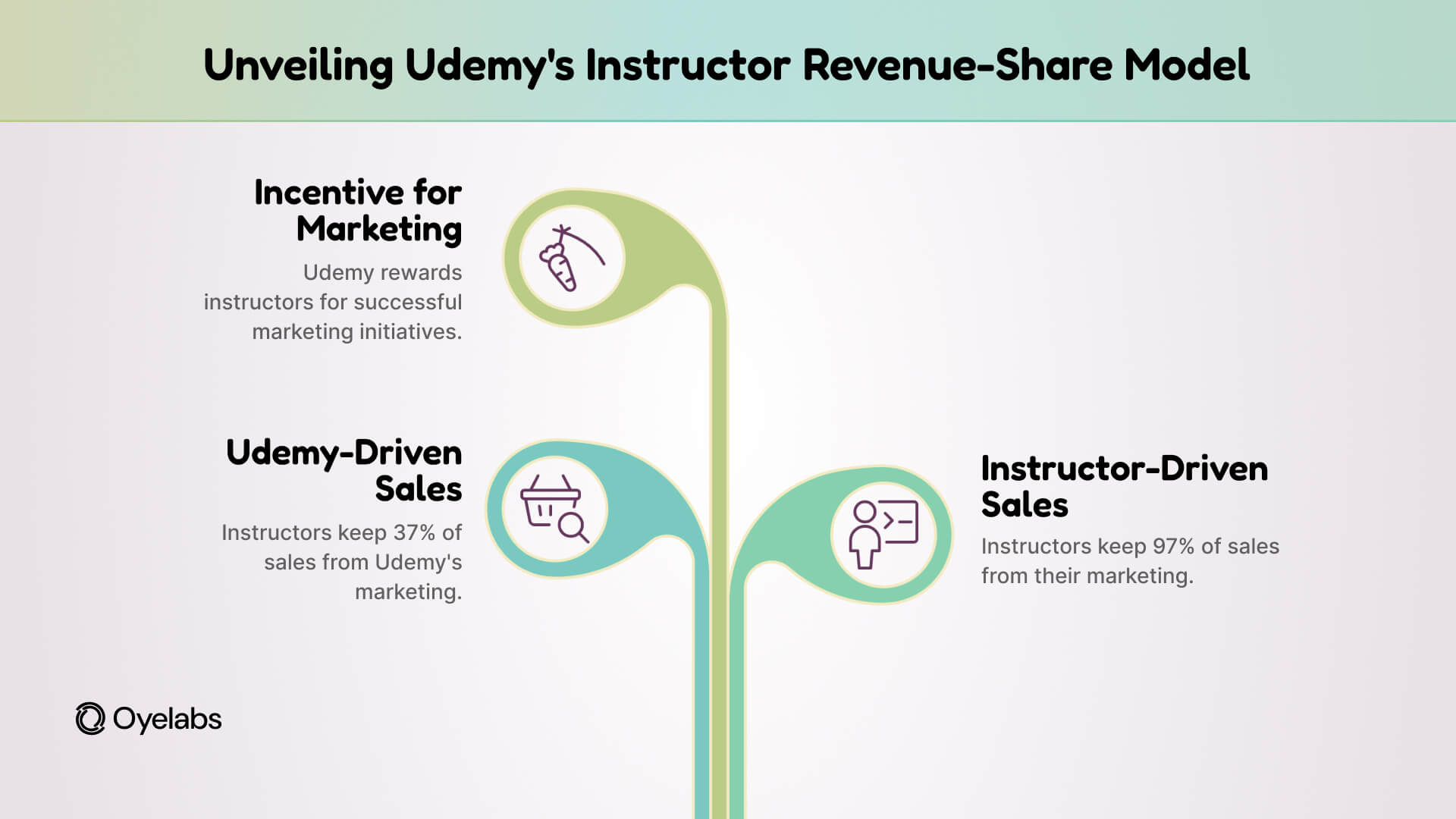
On the consumer marketplace, Udemy’s revenue model uses an instructor revenue-share structure, and the split depends entirely on where the buyer came from.
If a student finds a course through Udemy’s own search or ads, the instructor keeps 37%. If the instructor brought the student themselves, through a personal coupon or referral link, they keep 97%.
That 60-point gap is deliberate. Udemy is effectively paying instructors to handle their own marketing, and rewarding them heavily when it works.
Builder Tip: Rewarding self-driven creator traffic far more than platform-driven traffic is a way to grow without paying for ads.
How the Subscription Side Pays Instructors
Udemy Business and Udemy’s Personal Plan work on a different payout model entirely. There’s no single transaction to split. Instead, a fixed slice of monthly subscription revenue is pooled and divided among instructors.
An instructor’s cut depends on how many minutes of their content subscribers watched that month, relative to total watch time across the platform.
As of January 2026, instructors keep just 15% of that pool. Udemy keeps 85%, a figure that has fallen every year since 2023, when instructors kept 25%.
The margin logic is sound for Udemy: subscription revenue carries an 85% platform take rate versus 63% on transactional sales. But it fundamentally changes what earning well on the platform actually requires from a creator.
Why Udemy’s Revenue Model Shifted Toward Subscriptions
Udemy’s own leadership has stated the logic directly: subscription revenue is higher margin and more predictable than one-time purchases, so the company has intentionally reduced single-course sales to push buyers toward subscriptions.
On paper, that’s a sound platform strategy. Recurring revenue is worth more than one-time revenue almost everywhere in software.
In practice, the transition was rougher than expected. Consumer segment revenue fell 9% in FY2025 even as subscription revenue within that segment grew 44%. The two numbers hadn’t yet balanced out.
The Financial Numbers Behind the Shift
The real figures matter more here than general description. For full-year 2025, Udemy reported total revenue of $789.8 million. Udemy Business brought in $524.1 million, up 6% year-over-year. Consumer segment revenue was $265.8 million, down 9%.
By Q1 2026, the gap widened further. Enterprise revenue grew to $132.9 million while Consumer revenue fell to $58.5 million, a 19% year-over-year decline. Subscriptions across both segments made up 77% of total revenue.
Udemy didn’t slowly evolve into a subscription business. It made a deliberate strategic bet on its revenue model, and the transition period proved harder than a clean pivot.
Growth Insight: A higher take rate on paper only helps once new subscribers replace lost transactional revenue, not before.
Why Udemy Merged Into Coursera
On December 17, 2025, Coursera and Udemy announced an all-stock merger. Udemy shareholders received 0.800 shares of Coursera stock for each Udemy share, valuing the combined company at roughly $2.5 billion.
The deal closed on May 11, 2026. Former Coursera shareholders now own about 59% of the combined company, and former Udemy shareholders own about 41%.
Coursera’s stated reasoning was direct: the combined company expects over $1.5 billion in annual revenue and roughly $115 million in operating cost savings over two years, alongside heavier investment in AI-driven skills products.
The merger is a market signal worth reading carefully. Two of the largest names in online course marketplaces concluded that shared scale mattered more than staying independent, which says something important about where standalone course-marketplace economics eventually hit a ceiling.
What This Means for Building a Udemy-Like App
For founders evaluating a Udemy-like app, the practical lessons matter more than the history.
First, don’t design the platform around a single flat commission rate. Udemy’s tiered structure, organic, referral, and subscription, exists because different acquisition sources deserve different economics. That logic should be built into the revenue model from day one, not retrofitted later.
Second, subscription revenue pools require real engagement tracking, not a rough estimate. Paying instructors based on watch-time share means that data pipeline has to be accurate and auditable, or the platform risks the same instructor trust issues Udemy has faced publicly.
Third, decide upfront whether the platform is a B2C marketplace, a B2B subscription product, or genuinely both. Bolting both models onto one platform after launch is a far bigger technical lift than planning for it from the start.
Common Mistakes Founders Make
- Copying Udemy’s current commission split exactly: Those numbers reflect years of tuning specific to Udemy’s scale and investor pressure, not a universal benchmark.
- Underbuilding the subscription payout engine: Watch-time-based revenue pools are a serious backend requirement, not a spreadsheet formula.
- Treating B2C and B2B as one product: Enterprise buyers and individual learners expect different pricing, support, and content curation entirely.
- Ignoring instructor trust: Udemy’s repeated subscription payout cuts created public instructor pushback; commission changes need to be communicated transparently from the start.
- Assuming transactional revenue can scale indefinitely: Even at Udemy’s scale, the transactional model needed a subscription pivot, and eventually a merger, to keep growing.
Custom Build vs. White Label: What OyeLabs Sees Founders Get Wrong
When founders come to me wanting to build something like Udemy, the first real conversation is almost never about video hosting. It’s about which revenue engine they’re actually trying to build, and how much of that infrastructure they intend to build from zero.
A custom build means building the payout engine, the subscription-pooling logic, and the reporting layer from scratch, which is where most e-learning platforms quietly lose months of runway before writing a single line of course content.
A white label Udemy clone script skips that part. Instructor payout tiers, subscription handling, and reporting infrastructure already exist, so the real early-stage work becomes deciding commission structure and content strategy, not rebuilding plumbing an established platform already spent years refining.
That trade-off is worth being honest about upfront: custom development buys full control at the cost of a much longer runway to revenue, while a proven foundation gets a platform to a testable, revenue-ready product significantly faster.
Conclusion
Udemy’s revenue model was never one thing. It’s a marketplace and a subscription business stitched together, with a commission structure that rewards different behaviors very differently, and a strategic pivot that proved harder to execute than expected in the short term.
The merger with Coursera is the clearest evidence that even a platform this size eventually needed scale it couldn’t build alone. For anyone building a Udemy-like app, that’s not a reason to avoid the category, it’s a reason to design the revenue model, and the infrastructure behind it, more deliberately than Udemy had the chance to at the start.
Frequently Asked Questions
Is Udemy still an independent company?
No. Udemy merged into Coursera in an all-stock deal that closed in May 2026, and now operates as part of the combined company.
How much do Udemy instructors actually earn under its revenue model?
It depends on the sale type: 37% on organic marketplace sales, 97% on self-referred sales, and 15% on subscription-based views as of January 2026.
Why did Udemy Business grow while the consumer segment shrank?
Udemy deliberately shifted focus toward higher-margin, recurring enterprise subscriptions, which grew steadily while one-time course sales declined.
Is a subscription model better than a transactional one for a Udemy-like app?
It offers higher margins and more predictable revenue, but the transition period can hurt short-term revenue if subscriber growth doesn’t offset the decline fast enough.
What should a founder building a Udemy-like app prioritize first?
Decide whether the platform is a B2C marketplace, a B2B subscription product, or both, since each requires different payout, pricing, and content infrastructure.
Sources and Editorial Notes
Sources
- Udemy, Inc. – SEC Filing, Full Year 2025 Financial Results
- Coursera Investor Relations – Coursera to Combine With Udemy
- Udemy – Official Instructor Revenue Share Policy
Editorial Notes
- Udemy’s FY2025 and Q1 2026 financial figures are sourced directly from its SEC filings, not secondary summaries.
- Merger terms and closing date are sourced from Coursera’s own investor relations announcement and subsequent 8-K filing confirming the May 11, 2026 close.
- Instructor revenue-share percentages (37% organic, 97% referral, 15% subscription pool) are sourced from Udemy’s official instructor policy page; the subscription rate’s historical reduction from 25% was cross-checked against Udemy’s SEC Exhibit 99.1 instructor communication.
Reviewed By: Anuraag Jain
CEO, Oyelabs & AI Transformation Expert