
Chamet Business Model: How the Live Video Chat App Makes Money

Chamet Business Model: How the Live Video Chat App Makes Money
 Anuraag Jain
Last Updated on October 14, 2026
Key Takeaways
What You’ll Learn
- Chamet makes money through Diamond purchases, paid video calls, virtual gifts, and premium subscriptions.
- Users spend Diamonds on eligible paid interactions, while hosts can earn Beans.
- Chamet’s business model connects social users, hosts, and agency partners.
- A Chamet-like app needs video calling, payments, moderation, and host management.
- Founders should match paid features to user needs and spending habits.
Stats That Matter
- Sensor Tower estimated Chamet’s worldwide revenue at $2 million in the latest month.
- Chamet recorded an estimated 600,000 worldwide downloads during the same period.
Chamet makes money by turning social interactions into paid experiences. The live video chat app lets users connect through private video calls, live streaming, group chat rooms, and virtual gifts. While users can access some features for free, paid interactions encourage them to purchase in-app currency.
Its main monetization methods include Diamond purchases and optional premium subscriptions. Users spend Diamonds on eligible paid calls and virtual gifts, while hosts can earn Beans through qualifying interactions.
This business model combines in-app spending with paid features to generate revenue. The following sections examine Chamet’s main revenue streams, host earning system, and operating costs to explain how a video chat app like Chamet makes money.
What Is Chamet and How Does It Work?
Chamet is a social video chat and live entertainment platform built around real-time interactions. Users can discover profiles, make private video calls, watch live streams, participate in group rooms, and send virtual gifts.
The platform connects three main groups.
- Users join to meet people, watch live content, and participate in private or group interactions.
- Hosts provide live entertainment and direct interactions, with opportunities to earn from eligible activities.
- Agency partners help recruit and manage hosts under applicable arrangements and may earn commissions based on eligible performance.
A user can begin by creating a profile and exploring the platform. Browsing profiles, watching live streams, and joining available group rooms can provide ways to participate without immediately purchasing currency.
When a user wants to continue a paid private call or send a virtual gift, Diamonds may be required. Hosts can receive Beans from qualifying activities under the platform’s rules.
This combination of free access, paid interactions, and host participation allows Chamet to serve users with different spending preferences.
How Does Chamet Make Money?
Chamet uses a freemium model. Users can start without a required paid subscription, while selected activities and premium benefits involve payment.
Its monetization mechanisms include Diamond purchases, paid private calls, virtual gifts, and an optional premium subscription. These mechanisms work together to turn user engagement into revenue. This approach has generated measurable results. According to Sensor Tower, Chamet recorded an estimated $2 million in worldwide revenue and around 600,000 downloads in the latest month displayed. Here is how each mechanism contributes to Chamet’s revenue:
In-App Currency Purchases
Diamonds are Chamet’s in-app currency for eligible paid activities. Users purchase Diamonds through supported payment channels and use them for features such as longer private calls and virtual gifts.
The purchase of Diamonds creates the initial payment transaction. Users then spend their balance within the platform instead of making a separate direct payment for each call or gift.
For example, someone who wants to continue a private call beyond the free trial can use Diamonds at the applicable rate. Another user might purchase Diamonds specifically to send gifts during live streams.
This system connects multiple paid activities to a common currency and gives users flexibility in how they spend.
However, the amount users spend on Diamonds is not automatically Chamet’s profit. The business must account for qualifying host earnings, payment-processing fees, refunds, and other expenses.
Paid One-to-One Video Calls
Private video calls allow users to pay for direct conversations with hosts.
Chamet offers a free trial call, while continuing beyond the available free period requires Diamonds at the applicable rate. The rate can depend on the interaction and the pricing shown to the user.
The transaction works in a straightforward way.
- A user purchases Diamonds.
- The user starts a private video call.
- Diamonds are deducted for eligible paid call time.
- The host receives earnings associated with qualifying activity under the platform’s rules.
- The platform accounts for the transaction and its associated costs.
This is a usage-based monetization method. Users who make more paid calls or spend longer in eligible calls may use more Diamonds.
For the business, this creates revenue opportunities tied to actual usage. However, users must find the interaction valuable enough to pay for it. Reliable video quality, clear call rates, and an active host network all contribute to the experience.
Virtual Gifts and Live Streaming
Virtual gifts allow users to spend Diamonds during supported live streams, calls, and other eligible interactions.
A viewer may send a digital gift to show appreciation for a host or participate more actively in a live session. Hosts can receive Beans from qualifying gifts according to the platform’s rules.
This creates a second major way to monetize interactions. Users who mainly watch live content can spend money without necessarily making private video calls.
Virtual gifting can also encourage repeat transactions. A viewer who regularly returns to a preferred host may choose to send gifts across multiple sessions.
For Chamet, the revenue opportunity comes from paid gift transactions. The platform must still account for host earnings and other applicable costs to understand how much it retains.
Optional Premium Subscriptions
Chamet also offers an optional subscription known as Chamet Plus.
Its published benefits include a monthly Diamond allowance and access to private albums, subject to the applicable terms.
Unlike individual Diamond purchases, a subscription charges users for a set of benefits over a recurring period. If users continue renewing, subscriptions can provide recurring revenue.
However, subscriptions do not guarantee ongoing income. Users may cancel if the benefits no longer justify the cost.
Founders can learn from this approach by offering subscriptions only when they provide clear, continuing value. A subscription should complement the core experience rather than become an unnecessary barrier to joining the platform.
Host Earnings and Agency Commissions
Hosts are central to Chamet’s business because they provide the interactions that users may choose to pay for.
Eligible private calls and virtual gifts can generate host earnings represented through Beans. The amount a host receives depends on the qualifying activity and applicable platform rules.
Agencies may help recruit and manage hosts and receive commissions under their arrangements with the platform.
These payments should not automatically be counted as additional revenue streams for Chamet. Host earnings and agency commissions are part of the broader economic system that supports the platform.
For founders, this highlights the importance of planning host recruitment, earnings calculations, commission arrangements, and payouts before launching a similar service.
Also Read: Chatroulette Business Model
How Chamet’s Money Flow Works
Understanding the flow of money helps explain the difference between user spending and the platform’s financial results.
- First, users pay for Diamonds or subscriptions. These transactions generate payments through supported channels.
- Next, users spend Diamonds on eligible activities. These may include private calls and virtual gifts.
- Then, qualifying activity generates host earnings. Hosts can receive Beans from supported calls and gifts, while agency partners may receive commissions under applicable arrangements.
- Finally, the business accounts for revenue and expenses. Payment-processing fees, refunds, applicable payouts, infrastructure, moderation, and other operating costs affect the financial result.
Consider a hypothetical example. If users spend $10,000 on paid features during a particular period, that does not mean Chamet has earned $10,000 in profit.
The business must account for the applicable host payouts, agency commissions, transaction fees, taxes, refunds, and operating expenses. The amount remaining depends on the actual transactions and costs. Chamet’s exact revenue share and profit margin cannot be confirmed from its features alone. Without reliable financial disclosures, assigning a specific percentage to the platform would be speculation.
For founders and sales teams, the important distinction is between gross user spending, recognized revenue, and profit. Each measures something different, and confusing them can lead to unrealistic business projections.
Chamet Business Model Canvas Explained
The Business Model Canvas summarizes how Chamet creates value, serves its users, and operates its monetization system.
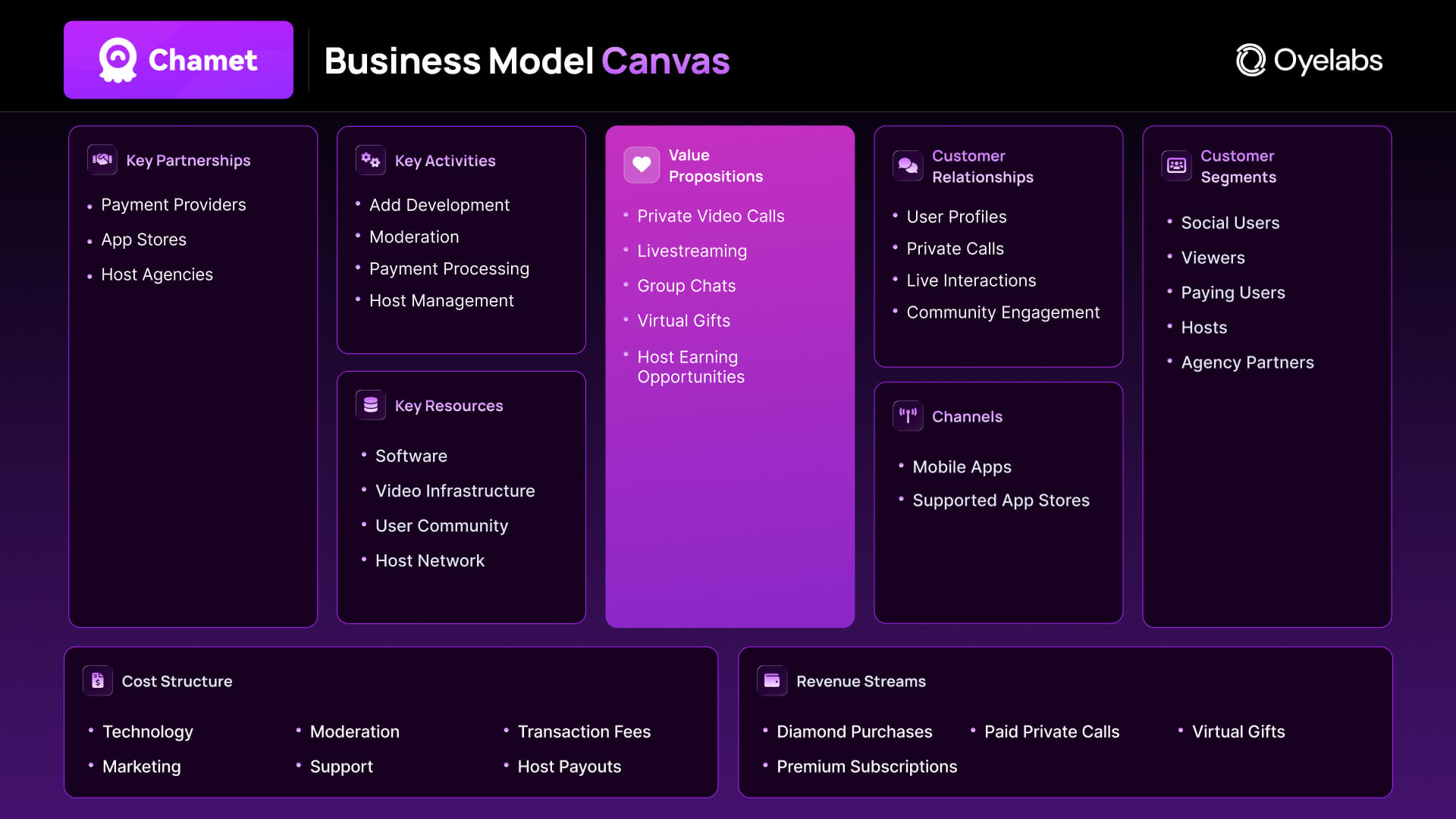
| Business Model Block | Chamet’s Business Model |
| Customer Segments | Social users, viewers, paying users, hosts, and agency partners |
| Value Propositions | Private calls, live streaming, group chats, virtual gifts, and earning opportunities for hosts |
| Channels | Mobile apps and supported app stores |
| Customer Relationships | User profiles, private calls, and live interactions |
| Revenue Streams | Diamond purchases and optional premium subscriptions |
| Key Activities | App development, moderation, payments, and host management |
| Key Resources | Software, video infrastructure, user community, and host network |
| Key Partnerships | Payment providers, app stores, and agency partners |
| Cost Structure | Technology, marketing, moderation, support, transaction fees, and payouts |
The canvas shows that Chamet’s business depends on several connected elements. Users need engaging experiences, hosts need an audience, and the platform needs reliable technology and payment processing.
The business must balance these requirements while generating enough revenue to cover its operating costs.
What Founders Can Learn From Chamet
Chamet’s approach offers practical lessons for entrepreneurs planning a live video chat or social entertainment platform.
Choose Monetization Methods That Match User Needs: Start by identifying what users want to do on the platform. A product centered on private conversations may prioritize paid calls. A live entertainment platform may focus on virtual gifting. Subscriptions may suit products that provide valuable ongoing benefits.
Founders can also study apps like LiveTalk to understand how different live video chat platforms serve their audiences. Comparing their features and interaction models can help businesses decide whether to prioritize private video calls, live streaming, virtual gifts, or social discovery.
Build the Host Network Alongside the Product: Users need people to interact with. A platform with too few active hosts may struggle to provide worthwhile conversations and live content. Plan for host recruitment, onboarding, verification, earnings visibility, and payout management. If agencies are involved, define their responsibilities and commission arrangements clearly.
Track Financial Performance Beyond Total Spending: Total in-app spending is only one measure of performance. Founders should also monitor:
- Conversion from free users to paying users.
- Repeat purchases and subscription renewals.
- User and host retention.
- Host payouts and applicable commissions.
- Payment failures, refunds, and disputes.
- Acquisition costs and operating expenses.
These metrics help determine whether users value the platform and whether its monetization model can support its costs.
Include Safety and Moderation in the Plan: Live video platforms need reporting, blocking, moderation, privacy controls, and appropriate verification processes.
Depending on the audience and operating markets, additional age-related and regulatory requirements may apply. These responsibilities affect development and operating costs, so they should be planned from the beginning.
Launch Your Live Video Chat Platform With Oyelabs
Oyelabs offers a Chamet Clone for businesses planning to launch their own branded live video chat and social entertainment platform.
Depending on the selected scope, the solution can include features such as private calls, live streaming, audio rooms, virtual gifting, host earnings, and administrative controls.
A ready-made foundation can help reduce the initial development effort. Before proceeding, businesses should confirm the included features, required customizations, payment and payout arrangements, and post-launch support.
Conclusion
Chamet’s business model combines Diamond purchases, paid private calls, virtual gifts, and optional premium subscriptions. Users spend currency on eligible interactions, while hosts can earn Beans from qualifying activities. Agencies may also participate in host recruitment and management under applicable arrangements.
The key financial distinction is that user spending does not equal business profit. Host earnings, applicable commissions, payment fees, infrastructure, moderation, and other operating costs all affect the final result.
If you are a founder, marketer, or sales professional, the key takeaway is to understand how the entire business model works. A live video chat business needs an engaging product, an active host network, transparent payments, and a monetization strategy that covers its operating costs. These elements provide a stronger foundation for sustainable growth than simply adding more paid features.
FAQs
1. How does Chamet attract and retain users?
Chamet encourages repeat visits through social discovery, private video calls, live streaming, group interactions, and opportunities to connect with hosts.
2. What technologies are needed to build an app like Chamet?
Developers typically need real-time video technology, messaging, authentication, payment integration, virtual currency management, cloud infrastructure, and moderation tools.
3. What safety features should a Chamet-like app include?
Essential safeguards include age verification, reporting, blocking, content moderation, privacy controls, fraud prevention, and compliance with applicable regulations.
4. How long does it take to develop an app like Chamet?
Development time depends on feature complexity, customization, integrations, testing, and whether the business chooses a ready-made solution or custom development.
Reviewed By: Anuraag Jain
CEO, Oyelabs & AI Transformation Expert