Crunchyroll Business Model: How Does Crunchyroll Make Money?

 Anuraag Jain
Last Updated on October 27, 2026
Key Takeaways –
What You’ll Learn
-
Crunchyroll makes money mainly through Premium subscriptions and other anime-related business activities.
-
Its revenue sources include subscriptions, merchandise, gaming, theatrical distribution, and commercial partnerships.
-
Crunchyroll’s business model combines anime streaming with products and experiences for fans.
-
Anime licensing, technology, marketing, and distribution are major operating costs.
-
Businesses can build anime streaming platforms by planning software, content rights, payments, and video delivery.
Stats That Matter
-
Crunchyroll had more than 21 million paid subscribers worldwide by March 31, 2026.
-
Demon Slayer: Infinity Castle passed $600 million in worldwide box-office revenue by September 29, 2025.
Anime streaming has become a popular way for fans to keep up with their favorite series, from weekly episodes to full seasons and movies. Crunchyroll is one of the best-known platforms in this space, offering anime streaming alongside merchandise, gaming, theatrical releases, and fan events.
But how does Crunchyroll make money from anime? Are paid subscriptions its main source of revenue, or do its other activities contribute to the business as well?
In this blog, we’ll explore the Crunchyroll business model, its main revenue sources, how it works, and how it compares with other streaming platforms. We’ll also look at what it takes to build an anime streaming platform like Crunchyroll.
What Is Crunchyroll?
Crunchyroll is a streaming service dedicated to anime. Fans can use it to watch anime series and films, with the available library varying by country.
The platform is part of Sony Group’s anime business. Sony Pictures Entertainment completed its acquisition of Crunchyroll from AT&T in August 2021.
According to Sony’s May 2026 announcement, Crunchyroll had more than 21 million paid subscribers worldwide as of March 31, 2026.
Crunchyroll isn’t limited to streaming episodes, either. Its business also includes anime film distribution, merchandise, gaming, and fan events. These activities let the company reach fans who want to do more than watch their favorite shows at home.
How Does Crunchyroll Make Money?
Crunchyroll makes money through paid memberships and other anime-related business activities. Here’s a closer look at its main revenue sources.
1. Premium Subscriptions
For regular anime viewers, paying for a streaming subscription can be easier than searching for different shows across multiple platforms. They can open Crunchyroll, find a series, and keep up with episodes as they become available in their region.
Crunchyroll offers Premium memberships with benefits that vary by plan and country. These can include ad-free streaming, offline viewing, and access to selected mobile games through Game Vault.
Subscriptions give the company recurring income. A member who pays monthly or annually can continue generating revenue for Crunchyroll as long as they keep the membership.
Of course, getting someone to subscribe is only half the job. Crunchyroll also needs to give fans reasons to renew. New episodes, a library they want to watch, and a smooth viewing experience all matter.
For anime fans who watch regularly, a subscription can become part of their monthly entertainment spending. For Crunchyroll, those recurring payments help fund content rights, technology, and daily operations.
2. Anime Film Distribution and Theatrical Releases
Watching an anime movie at home is one thing. Seeing it on a cinema screen alongside a room full of excited fans is another.
Crunchyroll takes part in the theatrical distribution of anime films, giving fans another way to experience their favorite franchises.
One example is Demon Slayer: Kimetsu no Yaiba Infinity Castle. Crunchyroll and Sony Pictures distributed the film theatrically in international markets, excluding Japan and select Asian territories.
The film’s box-office performance was remarkable. According to Crunchyroll News, Infinity Castle had passed $600 million in worldwide box-office revenue by September 29, 2025. It became the first Japanese film to reach that milestone.
This success shows how anime films can attract audiences well beyond their regular streaming viewers. A theatrical release also gives Crunchyroll another way to participate in the commercial success of a popular franchise.
However, the total box-office collection isn’t the same as the money a distributor earns. Cinema owners and other parties may receive a share, while distribution agreements and costs affect the final amount.
Theatrical releases give Crunchyroll another way to reach anime fans, especially when a major franchise brings people into cinemas.
3. Merchandise and Online Retail
Have you ever wanted a figure of your favorite anime character, a T-shirt from a series you love, or a collectible from a memorable scene? That’s where anime merchandise comes in.
Crunchyroll operates an online store selling anime-related products, including collectibles, clothing, and accessories. These products let fans bring a little piece of their favorite shows into everyday life.
Merchandise also gives Crunchyroll a way to serve fans who already spend money on anime beyond streaming. Someone might start watching a series on the platform and later buy a figure or another product connected to it.
Product sales can generate revenue, although the money left after expenses depends on factors such as product costs, licensing, inventory, and shipping.
For Crunchyroll, merchandise adds another part to the business. Fans don’t have to stop engaging with a series when the episode ends.
4. Gaming and Digital Entertainment
Some anime fans want to watch their favorite characters in action. Others want to play games connected to the worlds they enjoy.
Crunchyroll has gaming activities that include anime-related mobile games. Certain Premium memberships also include Game Vault, which offers selected mobile games without ads or in-app purchases.
Gaming gives fans another way to spend time with anime-related content. It also lets Crunchyroll reach people who enjoy interactive entertainment alongside watching shows.
The way games generate revenue depends on the title and the agreement behind it. Some games may earn money through purchases or commercial partnerships, while others may be offered as part of a membership benefit.
Not every game follows the same model, and availability can vary by region. Still, gaming gives Crunchyroll another way to connect with anime fans beyond its video library.
5. Events and Fan Experiences
Anime fans don’t always want to enjoy their favorite shows alone. Conventions, screenings, and fan gatherings give them a chance to meet other viewers and celebrate the series they love.
Crunchyroll participates in anime-related events and fan experiences that connect audiences with the wider anime community. These activities can also involve partnerships and promotional opportunities.
Events help bring anime out of the streaming app and into real life. A special screening or a major convention can give fans something to look forward to beyond the next episode.
The money involved depends on the event and its commercial arrangements. Participation doesn’t necessarily mean Crunchyroll receives all ticket sales or earns a profit directly.
Even so, fan events give the company another way to stay connected with the anime community.
Also Read: How to Build an Anime Streaming App for Guaranteed Success
How Does the Crunchyroll Business Model Work?
Imagine discovering a new anime, getting hooked after a few episodes, and deciding to subscribe so you can watch more. Later, you might buy merchandise from the same series or head to the cinema when its next film comes out.
That journey helps explain how Crunchyroll’s business works.
- It secures anime rights. Crunchyroll works with rights holders and distribution partners to make selected titles available in particular markets.
- It brings shows to viewers. Fans can browse and watch licensed anime through its streaming service, depending on regional availability.
- It earns subscription payments. Viewers who want Premium benefits can pay for a membership.
- It offers other anime experiences. Merchandise, games, theatrical releases, and events give fans more ways to engage with anime.
- It pays to keep the business running. Content rights, technology, marketing, staffing, and distribution all require money.
One important detail is that licensing anime rights usually involves a cost for a streaming service. Simply acquiring a show doesn’t mean Crunchyroll earns money from that deal. The company needs to make enough from subscriptions and other commercial activities to cover its expenses.
The business depends on having shows people want to watch, keeping the service useful, and giving fans reasons to continue paying.
Crunchyroll Business Model Canvas
The Business Model Canvas gives a quick overview of how Crunchyroll runs its business.
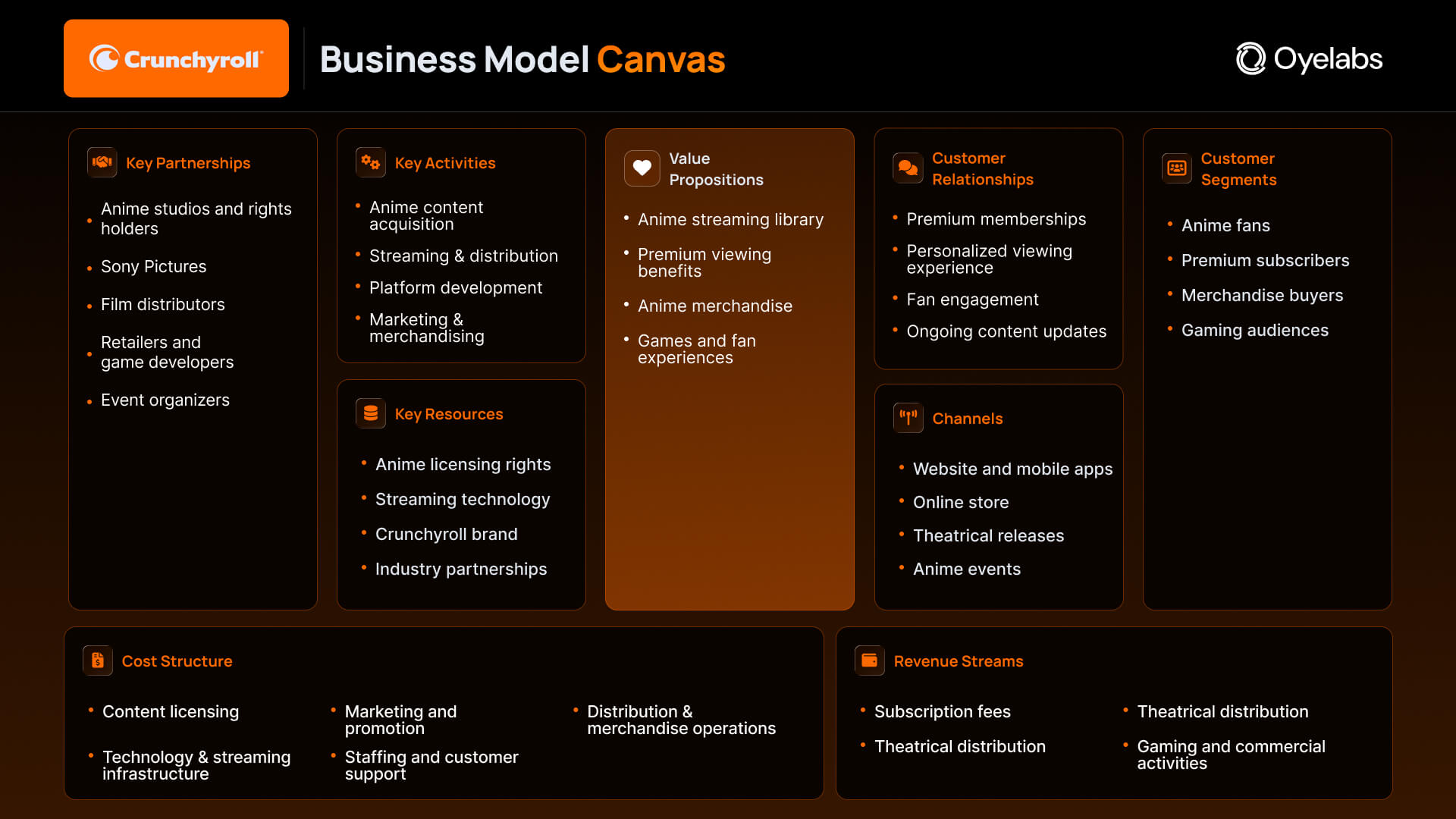
| Business Model Component | How It Applies to Crunchyroll |
|---|---|
| Customer segments | Anime fans, paid subscribers, merchandise buyers, and gaming audiences |
| Value proposition | Anime streaming, a dedicated content library, membership benefits, and related fan experiences |
| Channels | Website, mobile apps, online store, theatrical distribution, and events |
| Customer relationships | Premium memberships, viewing features, and fan engagement |
| Revenue streams | Subscriptions, merchandise sales, theatrical distribution arrangements, and selected gaming or commercial activities |
| Key resources | Content rights, streaming technology, brand recognition, and industry partnerships |
| Key activities | Content acquisition, streaming, platform development, marketing, retail, and fan engagement |
| Key partners | Anime studios, rights holders, distributors, retailers, game developers, and event partners |
| Cost structure | Content licensing, technology, marketing, distribution, staffing, customer support, and other operating expenses |
This shows how Crunchyroll combines its streaming service with other activities connected to anime fandom.
Crunchyroll vs. Other Streaming Platforms
Crunchyroll isn’t the only streaming service offering anime. Netflix, Disney+, and HIDIVE also carry anime in some markets, although their libraries and business strategies differ.
| Factor | Crunchyroll | General Entertainment Streaming Services |
|---|---|---|
| Main focus | Anime and related entertainment | A wider mix of films, series, and other programming |
| Core audience | Anime fans | Viewers with different entertainment interests |
| Subscription benefits | Anime-focused membership features | Benefits vary by service and plan |
| Additional activities | Anime merchandise, gaming, theatrical distribution, and events | Varies by company |
| Content strategy | Anime licensing and distribution, alongside related activities | Licensed content and, for some platforms, original productions |
The main difference is what each service puts first. Crunchyroll is built around anime, while broader streaming platforms serve people with a wider range of interests.
That doesn’t mean Crunchyroll automatically wins every time. Viewers still compare content availability, pricing, features, and the shows they want to watch.
Build an Anime Streaming Platform Like Crunchyroll
Want to launch your own anime streaming platform? Crunchyroll shows how a service focused on a particular audience can bring together streaming, subscriptions, and other anime-related activities.
Building a platform takes more than putting videos on a website. You’ll need features that let viewers browse shows, manage accounts, subscribe, make payments, and watch videos smoothly.
Oyelabs offers a Crunchyroll clone solution for businesses looking to develop an anime streaming platform around their requirements.
Before launching, plan your content licensing, video delivery, payment options, security, localization, and marketing. You’ll also need the appropriate rights to distribute copyrighted anime in your target markets. Developing the software alone doesn’t give you permission to stream existing shows.
Conclusion
Crunchyroll has built its business around anime fans and the many ways they enjoy their favorite shows. Paid subscriptions sit at the center of the streaming service, while merchandise, games, theatrical releases, and fan events extend the business beyond watching episodes.
Its growing subscriber base shows the demand for anime streaming. However, subscriber numbers alone don’t tell us how much profit the company makes. Content rights, technology, marketing, and other expenses all affect the final results.
For anyone planning a streaming business, Crunchyroll is worth studying because it understands its audience and gives fans several ways to engage with anime.
The real challenge isn’t just getting people to press play. It’s giving them a reason to come back for the next episode.
FAQs
1. Is Crunchyroll profitable?
Crunchyroll generates revenue through subscriptions, merchandise, theatrical distribution, and other activities. However, Sony does not publicly disclose all its standalone profitability figures.
2. Who owns Crunchyroll?
Crunchyroll is owned by Sony Group Corporation through Sony Pictures Entertainment and Aniplex, following Sony’s acquisition of Crunchyroll from AT&T in 2021.
3. How does Crunchyroll get the rights to stream anime?
Crunchyroll licenses anime from Japanese studios, production committees, and rights holders through agreements covering territories, streaming rights, and distribution periods.
4. Can a new anime streaming platform compete with Crunchyroll?
Yes. A new platform can target underserved audiences, secure distinctive content rights, offer competitive pricing, and build a loyal community around specific anime genres.
Reviewed By: Anuraag Jain
CEO, Oyelabs & AI Transformation Expert