
What Fiverr’s AI Layoffs Mean for Marketplace Founders

What Fiverr’s AI Layoffs Mean for Marketplace Founders
 Sachin Sharma
Last Updated on October 9, 2025
Key Takeaways What You’ll Learn: Fiverr’s AI-first strategy signals a major shift in freelance marketplaces. AI automates repetitive tasks, cuts costs, and lets human talent focus on high-value work. Hybrid workflows balancing AI and humans are now essential for operational efficiency. Founders can build AI-powered freelance platforms with smarter project matching, AI-assisted tools, and hybrid collaboration. Stats That Matter: Fiverr laid off 250 employees (30% of its workforce) in September 2025. AI reduces operational costs and automates repetitive tasks. Salesforce, Amazon, and Arcade show measurable efficiency and revenue gains with AI.
Fiverr, the freelance marketplace known for offering services starting at $5, has made a shocking move that has shaken the industry. The company is shifting to an AI-first strategy, signaling a major change in how freelance platforms operate. In September 2025, Fiverr announced layoffs affecting roughly 30 percent of its workforce as part of this transition, underscoring the scale of the shift.
For marketplace founders, this is a wake-up call to rethink operations, business models, and the balance between AI and human expertise. This blog explores Fiverr’s pivot and what it means for marketplace founders.
The End of the “Human-Powered” Era
For decades, marketplaces thrived by connecting human talent with clients. Freelance marketplaces like Fiverr, Upwork, and Freelancer built their value on networks of freelancers and the curation of quality services. The promise was simple. A human-powered marketplace ensures personalized service, nuanced communication, and trust-based transactions.
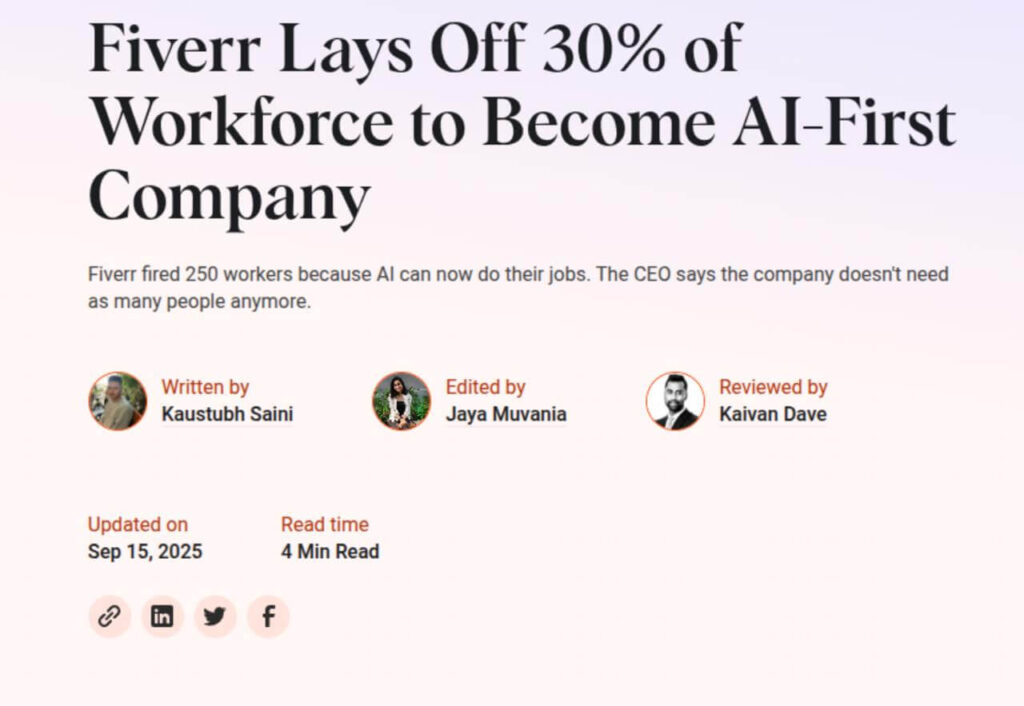
Fiverr’s pivot to AI-native operations challenges this model. The company announced layoffs of about 250 full-time employees as part of a move to become an AI-first company. This decision underscores a shift in core value from the human network to AI-driven infrastructure that orchestrates talent, matches projects, and automates repetitive processes.
Two key forces are driving this shift:
The AI Efficiency Dividend
AI enables automation across back-office and customer-facing tasks, significantly reducing operational costs. Processes like initial customer support, content moderation, payment tracking, and dispute resolution can now be automated without human intervention. The savings from automation can then be reinvested into scaling AI infrastructure, creating a cycle of efficiency and growth.
The Hybrid-Human Reality
While AI handles repetitive, low-cost tasks, human talent remains essential for high-level AI strategy, complex problem-solving, and creative work. Marketplaces now need to operate as hybrid ecosystems where humans and AI collaborate seamlessly. This shift not only optimizes operational efficiency but also allows human professionals to focus on work that adds strategic value and enhances client satisfaction.
The implication is clear. Marketplaces can no longer rely solely on human labor as their competitive advantage. Fiverr’s thirty percent workforce reduction highlights how AI is emerging as a central driver of operational efficiency, service quality, and growth potential.
A Strategic Blueprint for AI-First Marketplaces
Fiverr’s recent shift shows how marketplaces need to adapt in an AI-driven freelance economy. CEO Micha Kaufman has emphasized that Fiverr needs to “go back to startup mode” to compete effectively. The company has already deployed AI tools across its platform, including Neo, Fiverr Go, and Dynamic Matching systems. Kaufman highlighted that building AI infrastructure requires a different skill set than traditional software development, noting, “It is not about just adding more people to build on top of it; it is about simplifying it. This is a different skill and a different mindset.”
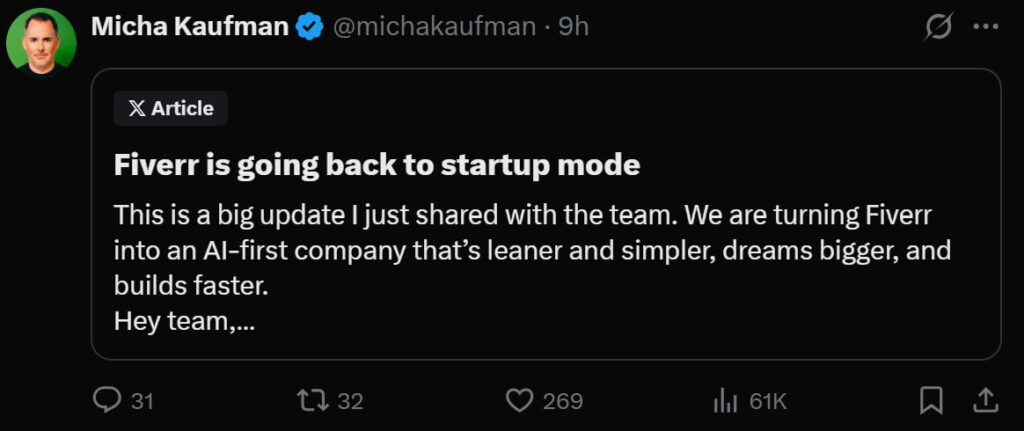
Fiverr’s move highlights the importance of rethinking operations, business models, and value propositions while keeping human expertise where it matters most.
Reorganize for AI
Automation is key as AI Marketplaces are set to replace Fiverr-like apps. Repetitive and rule-based tasks such as customer support ticketing, content moderation, payment tracking, and dispute resolution can now be handled by AI. This lowers operational costs and allows employees to focus on work that requires strategic thinking, creativity, or nuanced judgment.
A flatter organizational structure works best with AI. Since AI handles routine operations, middle management layers can be reduced. This speeds up decision-making, encourages accountability, and enables teams to respond quickly to market changes.
Cost savings from automation should be reinvested to develop proprietary AI tools, upgrade systems, and hire talent skilled in AI and prompt engineering. This ensures the platform remains competitive in an AI-first environment.
Foster an AI-literate culture by encouraging all teams to become proficient in AI tools. Understanding how to leverage AI increases productivity and enables more creative, data-driven decisions, preparing the marketplace to thrive as AI-driven platforms overtake traditional freelance apps.
Evolve Platform Economics
Fiverr’s AI strategy boosted revenue by showing how marketplaces can rethink traditional business models. Flat take rates and service commissions are under pressure as AI automates basic services, so founders must find new ways to capture value.
Prioritize high-value projects. AI can handle low-cost, repetitive work, but complex projects still need human expertise. High-ticket projects that blend human skill with AI support can increase profitability.
Offer AI-as-a-Service. Platforms can generate recurring revenue by providing subscriptions to AI tools or agents that help freelancers or clients complete tasks efficiently.
Use AI for better matching and pricing. Algorithms can optimize project matching, suggest fair pricing based on complexity and skills, and improve project outcomes.
Diversify offerings. Expand into services like AI-assisted project management, collaboration tools, or hybrid human-AI solutions to stay relevant as technology and client expectations evolve.
Build an AI-Powered Moat
As AI tools become cheaper, long-term advantage depends on defensibility. A strong AI-powered moat requires investment in trust, user experience, and unique assets.
Ensure high trust. AI can make fraud and plagiarism easier, so investing in quality assurance, fraud detection, and identity verification is essential. A reputation for reliability becomes a competitive edge.
Strengthen network effects. AI can enhance human connections by analyzing patterns, recommending collaborations, and encouraging repeat engagement. Platforms that combine strong human relationships with AI create network effects competitors cannot replicate.
Leverage proprietary data loops. User behavior, project outcomes, ratings, and feedback can train proprietary AI models. These models continuously improve platform performance and user experience.
Integrate AI into workflows. Embedding AI into freelancers’ and clients’ work increases reliance on the platform and loyalty, raising switching costs and strengthening defensibility.
Manage the Freelance Community
Fiverr presents AI as a tool to empower freelancers, but managing its impact requires care.
Provide upskilling tools. AI-driven training and productivity tools allow freelancers to take on higher-value projects. AI should be positioned as a partner, not a competitor.
Support new AI-driven niches. AI creates new types of work such as prompt engineering, AI ethics consulting, and hybrid project management. Platforms can facilitate these roles and help freelancers diversify their skills.
Communicate transparently. Explain how AI is changing the platform and its impact on freelancer roles. Clear communication builds trust and reduces resistance.
Redesign the freelancer model. Enable hybrid collaborations where humans and AI agents work together. This requires features for hybrid project management, billing, and collaboration.
Also Read: Successful US Freelance Marketplace Ideas
Lessons from AI Leaders
Other companies provide clear examples of how strategic AI adoption can transform operations, revenue, and competitiveness.
Salesforce: demonstrates how AI can drive operational efficiency. Its AI-powered workflow automation allows teams to streamline routine tasks like lead scoring, customer follow-ups, and support ticket prioritization. This reduces manual effort, accelerates decision-making, and allows employees to focus on high-impact strategic work.
Amazon: highlights the revenue potential of AI-driven personalization. Its recommendation engine analyzes customer behavior, purchase history, and preferences to deliver highly relevant product suggestions. This personalization drives higher engagement, increases average order values, and boosts repeat sales. The success of Amazon’s AI initiatives shows how leveraging data intelligently can create a direct competitive advantage and improve customer experience.
Arcade: showcases the benefits of AI-powered custom supply in marketplaces. By automating sourcing, project matching, and demand forecasting, the company can deliver faster and more reliable results to clients. This integration of AI into the supply chain reduces errors, optimizes resources, and enables scalable operations, setting a strong example for marketplaces aiming to combine human expertise with AI efficiency.
The common lesson from these leaders is clear. AI adoption is not just about reducing costs. It transforms the way a company operates, enhances user experience, creates defensible advantages, and enables scalable, data-driven decision-making. For marketplace founders, these examples underline the importance of integrating AI strategically rather than treating it as a supplementary tool.
Launch Your AI-Powered Freelance Platform
The AI-driven shift in marketplaces is here, and Fiverr’s recent layoffs show why founders must rethink their strategy. Now is the perfect time to act and launch your freelance platform designed for the future of work. By creating an AI-powered marketplace, you can combine the efficiency of AI with the creativity and expertise of human talent.
Offer smarter project matching, AI-assisted tools, and hybrid workflows that enhance freelancer productivity and client satisfaction. Don’t wait for disruption to leave you behind. Partner with experts who can help you design, develop, and launch your freelance platform successfully.
Conclusion
Fiverr’s shift to an AI-first model marks a turning point for the freelance marketplace industry. The message for founders is clear: AI is no longer an optional enhancement but a strategic necessity that can redefine operations, value propositions, and competitive advantage. Success in this new era requires a thoughtful balance between automation and human expertise. Marketplaces must reorganize for AI efficiency, evolve their business models, build defensible AI-powered moats, and actively support their freelance communities through upskilling and hybrid collaboration.
Those who act decisively, embracing AI while preserving the unique value humans provide, will position their platforms for sustainable growth. Conversely, hesitation risks falling behind competitors that can seamlessly integrate AI and human talent.