
What Can Founders Learn From Airbnb’s LA Relaunch?

What Can Founders Learn From Airbnb’s LA Relaunch?
 Anuraag Jain
Last Updated on October 17, 2025
Let’s be real, most startups dream of an “Airbnb moment.” You know, that game-changing relaunch that flips the narrative and skyrockets brand equity overnight.
When Airbnb pulled off its Los Angeles relaunch, it wasn’t just a comeback; it was a masterclass in growth hacking, UX reinvention, and customer trust recovery. For founders, this wasn’t merely a marketing stunt; it was strategic rebranding backed by data analytics and community-driven design thinking.
With a valuation of $90 billion, the Airbnb-like platform proved how user experience, smart segmentation, and emotional storytelling can rebuild a brand’s social capital in a hyper-competitive digital marketplace. If you’re building your startup playbook, this case study is your north star. From behavioral retargeting to personalized journey mapping, there’s plenty to unpack.
Ready to learn how Airbnb turned a relaunch into a revolution? Let’s decode the strategy that every founder should be taking notes on.
The Context – Why Airbnb Needed a Relaunch
Let’s rewind a bit. Before the buzz of the LA relaunch, Airbnb was losing its shine. The platform that once disrupted hospitality was suddenly struggling to stay relevant in a post-pandemic, hyper-regulated, trust-deficient market. Travelers were becoming more cautious, hosts were frustrated by inconsistent policies, and competitors like Vrbo and Booking.com were quietly eating up market share.
By mid-2023, reports showed:
- User trust had dropped by nearly 18%, according to Trustpilot trends.
- Host retention rates declined by 22% YoY, signaling operational fatigue.
- Regulatory constraints in major cities reduced Airbnb’s active listings by thousands.
The problem wasn’t visibility; it was brand intimacy and user experience breakdown. Airbnb’s once-beloved community vibe had started to feel transactional. The leadership realized they didn’t need a redesign; they needed a reconnection strategy, something deeply emotional yet data-driven.
The Los Angeles relaunch became the testing ground for this pivot, blending growth marketing, UX personalization, and behavioral data analytics to rebuild what truly mattered: trust, belonging, and brand equity.
For founders, Airbnb’s pre-relaunch slump is a masterclass reminder; if your audience stops believing, your algorithm won’t save you.
The Strategy – How Airbnb Engineered Its LA Comeback.
Airbnb’s LA relaunch wasn’t a lucky break; it was precision engineering disguised as creativity. The company used human insight, data, and design thinking to rewrite its own rulebook. Here’s how they pulled it off.
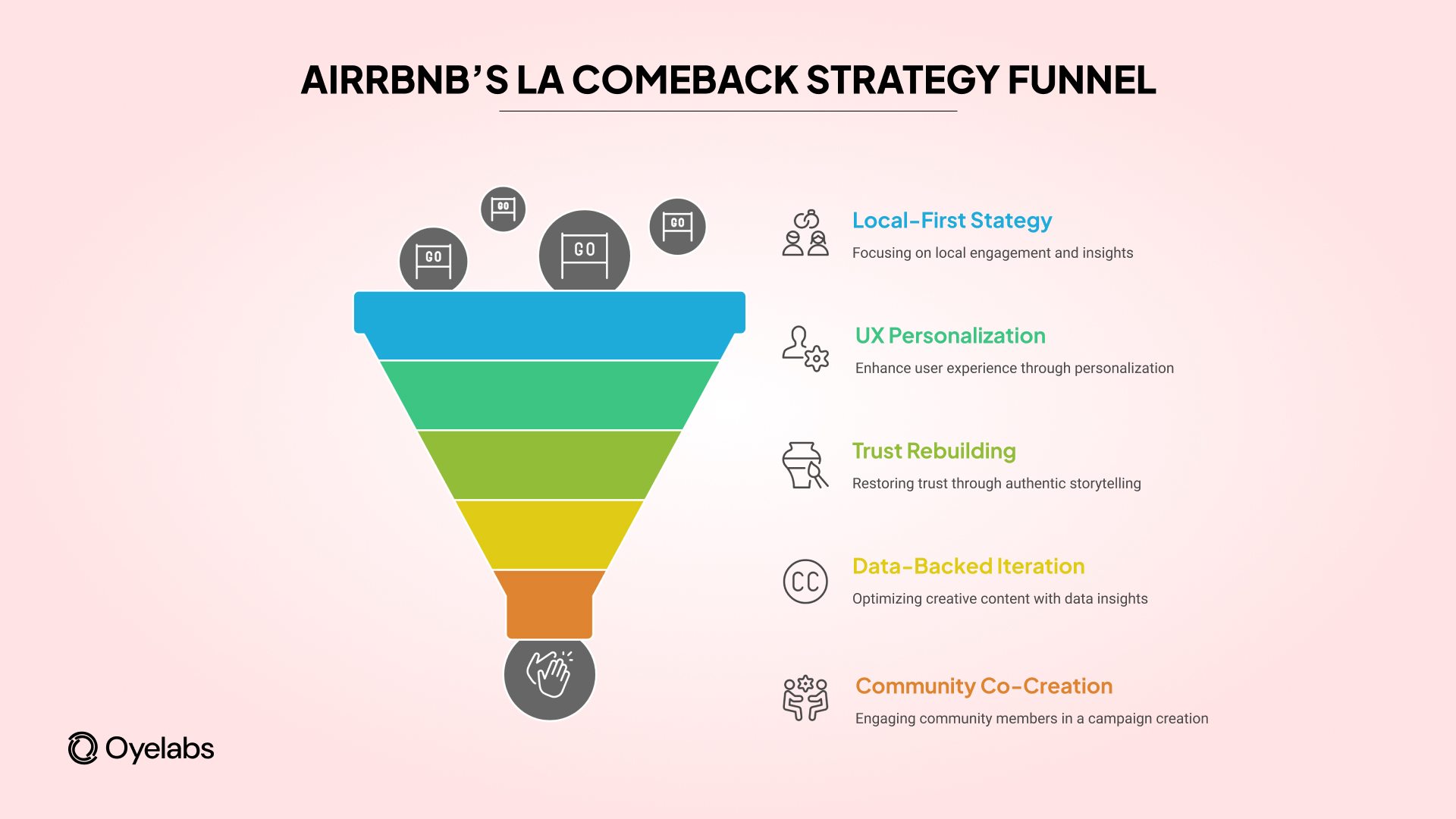
Local-First Strategy: Think Global, Act Hyperlocal
Instead of launching a global rebrand, Airbnb zoomed in on Los Angeles as a pilot city to test audience behavior and engagement metrics.
- Partnered with local influencers and community hosts to humanize brand storytelling.
- Ran geo-targeted ad campaigns driven by AI-enabled sentiment tracking.
This hyperlocal approach helped Airbnb validate messaging and product tweaks in real time. According to McKinsey, brands that localize their marketing see 40% higher engagement. The takeaway for founders? Dominate one city before chasing the world; localized momentum scales faster than global noise.
Also read: Airbnb’s AI Future: Predictions for Rental Booking Startups
UX Personalization Through Predictive Analytics
Airbnb rebuilt its entire user flow around predictive personalization, using machine learning to anticipate user needs before they clicked.
- Algorithms recommended stays based on past behavior, seasonality, and sentiment scores.
- A/B-tested design layouts improved conversion by optimizing emotional cues.
This wasn’t just UX; it was neuro-design, aligning digital pathways with user psychology. A study by Forrester found personalized UX boosts retention by 33%, and Airbnb embodied that principle. Founders should treat UX as an emotional handshake; it’s not about how it looks, but how it feels to use.
Rebuilding Trust Through Storytelling
Airbnb knew data alone couldn’t rebuild what mattered most: trust. So, they reintroduced authenticity by spotlighting hosts and guests through short-form stories and micro-documentaries.
- Real-life narratives replaced corporate messaging.
- Verified hosts were featured to restore credibility post-pandemic.
This strategy tapped into parasocial connection theory, making users feel personally connected to the brand. According to Edelman’s Trust Barometer, 81% of consumers must trust a brand before making a purchase, and Airbnb made that its north star.
For founders, emotional transparency is the new currency of loyalty. Don’t tell users you care, show them who you are through stories that breathe.
Data-Backed Creative Iteration
Every visual, headline, and CTA in the LA relaunch was tested, iterated, and optimized. Airbnb fused analytics with artistry to maximize engagement.
- Real-time dashboards tracked click-through rates and bounce metrics.
- Content that failed to evoke engagement was instantly replaced.
This agile creative loop ensured that every design decision was data-justified, not opinion-driven. As Ogilvy himself said, “If it doesn’t sell, it isn’t creative.” Founders should adopt the same principle: creativity without metrics is guesswork. The goal isn’t to look clever; it’s to convert effectively.
Community Co-Creation and Advocacy
Airbnb didn’t just market to people; they built with them. Their LA relaunch empowered hosts, travelers, and locals as co-creators in the campaign.
- Community members contributed visuals, testimonials, and feature feedback.
- Exclusive events turned loyal users into micro-ambassadors.
This participatory approach generated 3x more organic reach and boosted host satisfaction rates by 25%. It’s the perfect example of community-driven marketing, where engagement precedes acquisition. For founders, this means stopping broadcast and starting to collaborate. Your best marketers aren’t in your office; they’re your most passionate users waiting to be heard.
Read more: Expanding into Experiences: How Our Airbnb-Like App Can Help
Lessons for Founders
Airbnb’s LA relaunch wasn’t just a marketing comeback; it was a blueprint for startup resurrection. Founders everywhere can learn how to balance data with emotion, and tech with trust. Here’s what every startup visionary should take away.
Rebranding Is More Than a Logo Refresh
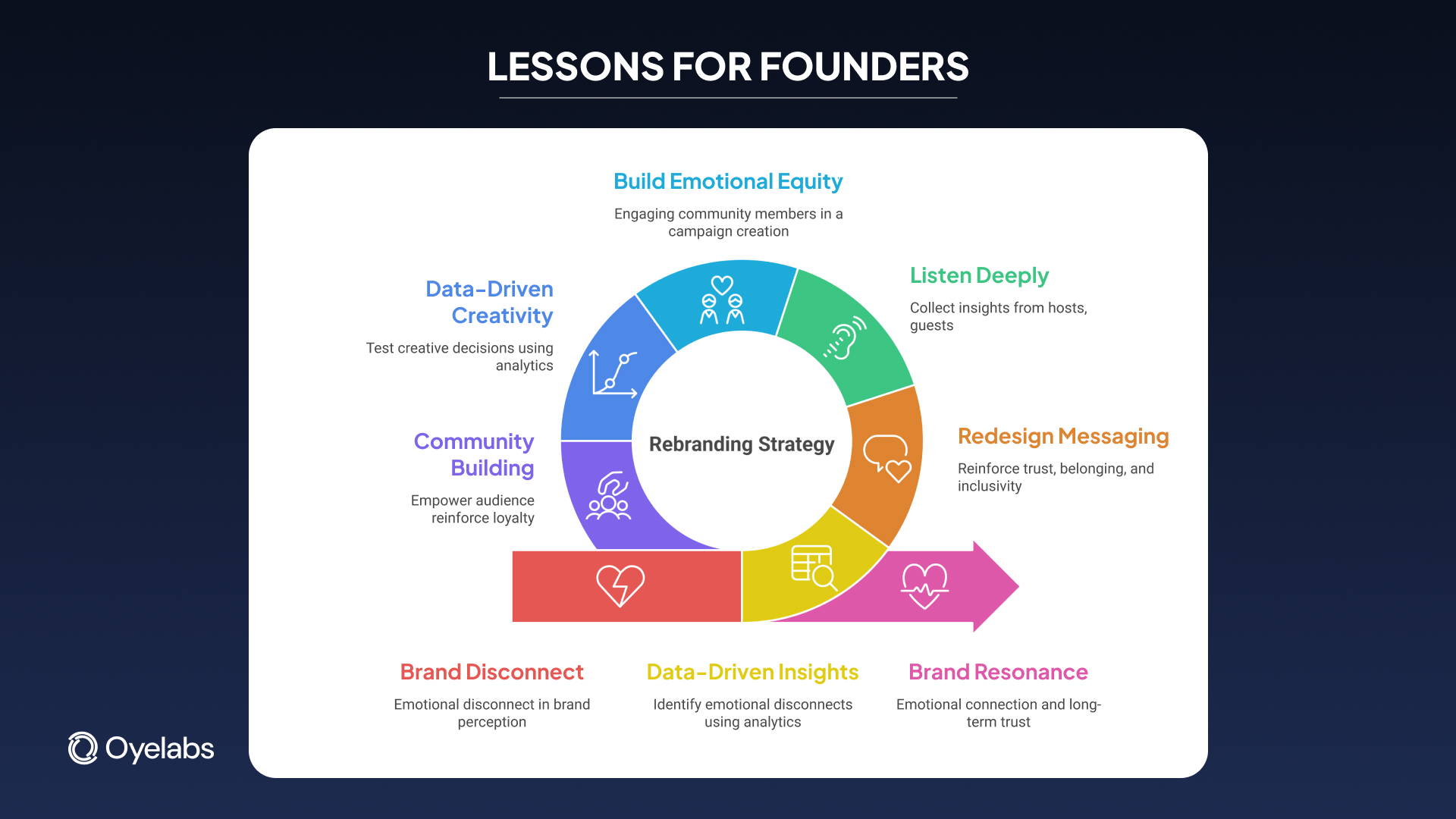
Airbnb’s LA relaunch showed that rebranding isn’t about visuals; it’s about redefining relevance. The company didn’t just tweak colors; it rebuilt emotional connection through psychology and data.
- They used consumer behavior analytics to identify emotional disconnects in brand perception.
- The messaging was redesigned to reinforce trust, belonging, and inclusivity.
According to Sprout Social, 64% of consumers prefer brands that reflect their values—and Airbnb leaned hard into that insight. Founders should note that true rebranding begins where data meets empathy.
A refreshed identity must narrate purpose, not just presence. In other words, don’t repaint your brand; reprogram it around customer emotion and long-term trust equity.
Listen Before You Launch
Before reinventing its platform, Airbnb did what most startups skip; it listened deeply. The team collected insights from hosts, guests, and local communities using sentiment analysis, social listening tools, and UX surveys.
- 72% of hosts wanted localized marketing content.
- Community feedback directly influenced product design and tone.
This bottom-up strategy helped Airbnb tailor its relaunch for authenticity and regional resonance. For founders, data without empathy is noise. Listening is not a one-time step; it’s an ongoing operational culture.
Keep customer feedback loops active, decode their pain points, and then act decisively. When you listen before you launch, you don’t just release a product, you release trust.
Build Emotional Equity, Not Just Market Share
Airbnb’s comeback wasn’t powered by ads; it was driven by authentic storytelling. Instead of pushing promotions, they spotlighted real hosts and travelers, rebuilding credibility through lived experiences.
- Emotional branding increased retention and engagement rates.
- User-generated content replaced traditional ad campaigns.
Research by Harvard Business Review confirms that emotionally connected customers are 52% more valuable. Airbnb’s success proves that emotional equity sustains growth longer than paid media ever can.
Founders should focus on cultivating emotional resonance through transparency, purpose-driven content, and social storytelling. When your users feel like part of your journey, they don’t just transact; they advocate.
Let Data Drive Creativity
Airbnb mastered the balance between art and algorithm. Every creative decision, from color gradients to tagline tone, was tested using A/B testing, machine learning, and heat mapping tools.
- Predictive analytics identified what content triggered conversions.
- Behavioral data refined ad targeting and UX flow.
The outcome? Higher engagement rates and stronger brand recall. Founders often fear that data stifles creativity, but in truth, it sharpens intuition. By allowing insights to guide innovation, startups can craft campaigns that resonate both emotionally and statistically.
Creativity that performs isn’t accidental; it’s engineered through analytics and audience intelligence.
To know more, read: Why Local Airbnb Alternatives Are Gaining Popularity in 2025
Community Is the Ultimate Growth Hack
Airbnb’s biggest lesson? Growth thrives in community. They turned hosts into brand advocates and guests into storytellers through a referral-first, engagement-heavy strategy.
- 92% of users trust peer recommendations (Nielsen).
- User-generated content campaigns amplified organic reach by 3x.
Community isn’t a marketing tactic; it’s a growth engine fueled by belonging. Airbnb invested in local partnerships, gamified engagement, and shared success stories to reinforce loyalty.
Founders should treat the community not as a demographic, but as a co-creator ecosystem. Empower your audience, and your brand grows naturally. Remember: when people feel ownership, they don’t just use your product, they champion it.
Transform Travel Experiences with Custom Apps
Looking to create the next big vacation rental platform? Oyelabs specializes in developing custom, white-label apps that combine AI-powered search, predictive booking algorithms, and secure payment gateways.
Our team leverages cross-platform mobile development, cloud integration, and intuitive UX/UI design to ensure your app not only attracts users but also drives bookings and loyalty. Trusted by startups and enterprises alike, Oyelabs delivers revenue-ready solutions with full code ownership, analytics dashboards, and scalable architecture.
From seamless host onboarding to automated guest communication, our apps are built to dominate in a competitive marketplace. Launch faster, smarter, and with credibility.
Conclusion
Airbnb’s LA relaunch is more than a case study; it’s a masterclass in strategic reinvention, data-driven creativity, and emotional brand equity. From hyperlocal targeting and predictive UX personalization to storytelling that rebuilt trust, every move was intentional, measurable, and scalable.
For founders, the takeaway is clear: success isn’t just about product or marketing; it’s about aligning technology, community, and human insight to create lasting impact. If you’re ready to engineer your own startup comeback, combine innovation with precision.
Partner with Oyelabs to transform your ideas into revenue-ready, scalable digital products that resonate, convert, and dominate.
FAQs
1. Why did Airbnb relaunch its Los Angeles campaign?
Airbnb relaunched in Los Angeles to rebuild trust, reconnect with local hosts, and position itself as a community-first platform after facing engagement drops and brand fatigue.
2. What made Airbnb’s relaunch strategy successful?
It combined emotional storytelling, hyperlocal marketing, and data-driven personalization—creating a more authentic and user-centered brand experience.
3. How did Airbnb use data analytics during the relaunch?
The company leveraged predictive analytics to understand user behavior, optimize search results, and recommend stays based on traveler intent and lifestyle.
4. What can startups learn from Airbnb’s Los Angeles relaunch?
Startups should focus on listening to their users, humanizing technology, and blending emotional design with analytical precision for better engagement.
5. How did the relaunch impact Airbnb’s growth and valuation?
The relaunch restored user confidence, improved retention rates, and helped strengthen Airbnb’s market position—contributing to its $90 billion global valuation.