
How to Validate Your Handyman App Idea Before Development
How to Validate Your Handyman App Idea Before Development
 Anuraag Jain
Last Updated on June 8, 2026
Key Takeaways
What You’ll Learn
- How to validate a handyman marketplace idea
- Why most TaskRabbit clone startups fail
- The business model of a TaskRabbit-like app
- How to test demand without building software
- What investors look for in service marketplaces
- When to use a white label on-demand service app
- How to reduce startup risk before development
How to Validate Your Handyman App Idea Before Development
Building a TaskRabbit-like app without validating demand is one of the most expensive mistakes marketplace founders make.
Many entrepreneurs spend months planning features, designing screens, and discussing development budgets before answering a much simpler question:
Will customers actually use the platform, and will service providers join it?
The reality is that successful service marketplaces are built on validated demand, reliable provider supply, and sustainable economics – not software alone.
Before investing in development, founders should validate:
- Customer demand
- Service provider availability
- Marketplace profitability
- Competitive positioning
- Local market opportunity
This guide explains exactly how to validate a handyman marketplace before building it.
Quick Answer: How Do You Validate a TaskRabbit-Like App?
You validate a TaskRabbit-like app by confirming that customers actively need local services, service providers are willing to join the platform, acquisition costs are sustainable, and the marketplace can generate profitable transactions before software development begins.
Most successful marketplace founders validate the business model first and build the app second.
Handyman Marketplace Statistics Every Founder Should Know
The opportunity for service marketplaces remains significant.
| Statistic | Why It Matters |
| The global online on-demand home services market is projected to grow significantly through 2030 | Indicates long-term market demand |
| More than 60% of consumers search online before hiring local service providers | Supports digital-first marketplaces |
| Mobile booking behavior continues growing across local service categories | Strengthens app-based business models |
| Repeat customers often generate the majority of marketplace revenue | Improves profitability |
| The gig economy continues expanding globally | Increases provider availability |
| Local services remain highly fragmented in most cities | Creates marketplace opportunities |
These trends explain why platforms such as TaskRabbit, Thumbtack, Angi, and Handy continue attracting users and providers.
More importantly, they explain why investors continue funding service marketplace businesses despite increased competition.
What Is a TaskRabbit-Like App?
A TaskRabbit-like app is an on-demand service marketplace platform that connects customers with local service providers for tasks such as repairs, cleaning, furniture assembly, moving, maintenance, and home services.
The platform typically manages:
- Service discovery
- Booking workflows
- Payments
- Messaging
- Ratings and reviews
- Provider management
Instead of employing service professionals directly, the marketplace facilitates transactions between customers and independent providers.
Why Are TaskRabbit-Like Apps Still Popular?
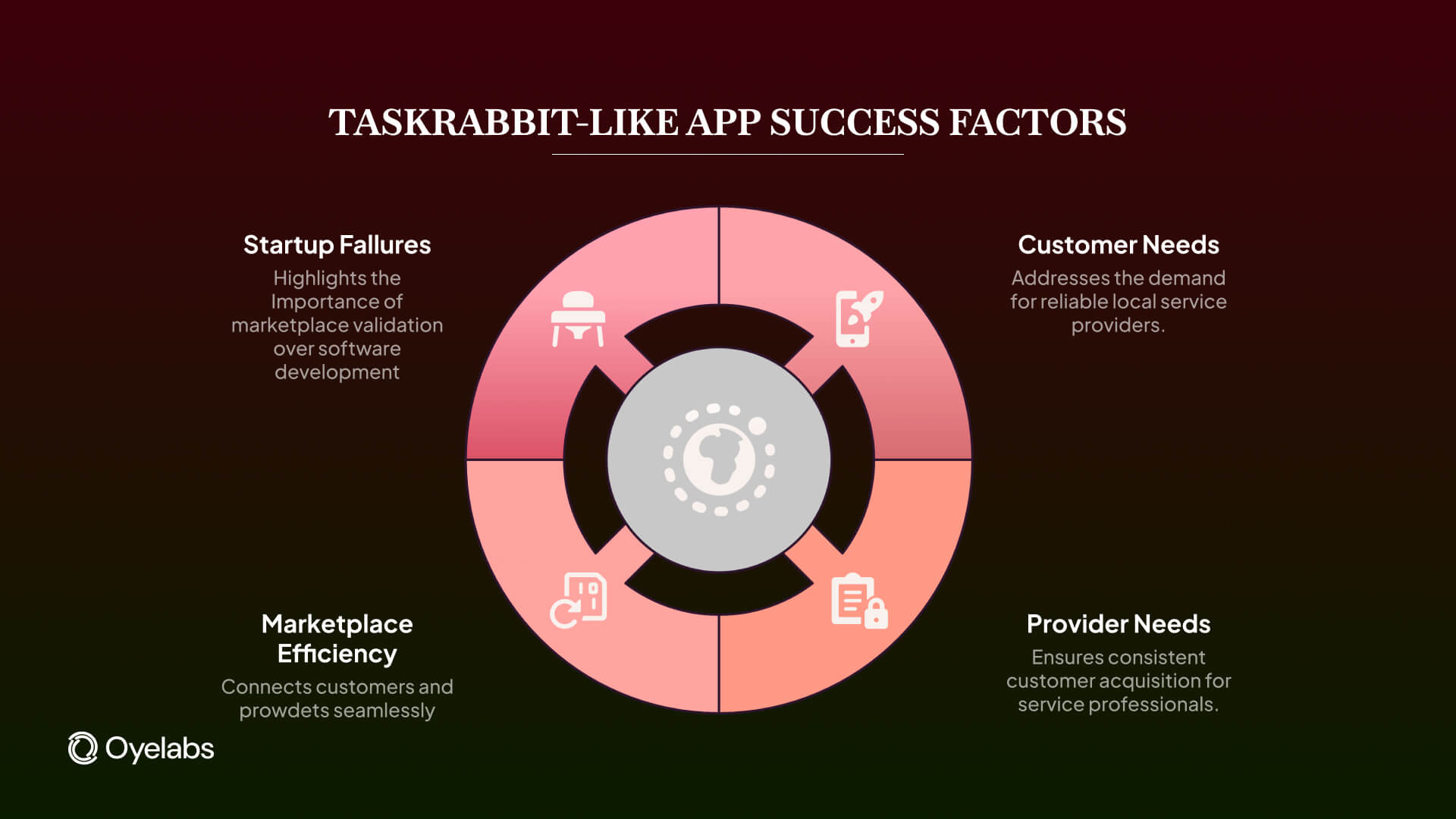
TaskRabbit-like apps remain popular because they solve three major problems:
- Customers need trusted local service providers.
- Service providers need consistent customer acquisition.
- Marketplaces efficiently connect both sides.
This creates a scalable business model that benefits all participants.
Why Most Handyman App Startups Fail
Most handyman app startups fail because founders focus on building software instead of validating marketplace fundamentals.
The marketplace itself – not the app – is the business.
Common Reasons Handyman Marketplace Startups Fail
| Problem | Impact |
| No provider supply | Customers cannot find services |
| Weak demand validation | Low booking volume |
| Poor pricing assumptions | Unsustainable margins |
| High customer acquisition costs | Difficult scaling |
| Generic positioning | Strong competition |
| Weak retention strategy | Low repeat revenue |
| Premature expansion | Operational challenges |
At Oyelabs, one pattern appears repeatedly among founders evaluating a TaskRabbit clone.
Many spend weeks discussing features before speaking with a single potential customer or service provider.
That sequence is usually backwards.
Validation should come first.
Development should come second.
Step 1: Validate Customer Demand Before Building Anything
The simplest answer is this:
Customers should already be searching for the services you plan to offer.
You are not trying to create demand.
You are trying to capture existing demand more effectively.
Validate Search Demand
Research searches such as:
- Handyman near me
- Furniture assembly services
- Home repair services
- Cleaning services
- Moving help
- Local maintenance services
Consistent search activity indicates existing demand.
If nobody is searching for the problem, building an app will not create demand automatically.
Analyze Competitor Reviews
One of the fastest validation methods is reviewing existing platforms.
Look at reviews for:
- TaskRabbit
- Thumbtack
- Angi
- Handy
Focus specifically on recurring complaints.
Examples include:
- High service fees
- Poor provider quality
- Scheduling problems
- Limited provider availability
- Communication issues
Every repeated complaint represents a potential business opportunity.
Join Local Communities
Local Facebook groups, Reddit communities, and neighborhood forums often reveal:
- Common service requests
- Unfilled demand
- Pricing concerns
- Provider shortages
This research often uncovers opportunities that keyword tools miss.
Run Small Validation Campaigns
Before development, spend a small budget testing demand.
Run campaigns using:
- Google Ads
- Facebook Ads
- Instagram Ads
Track:
- Click-through rate
- Cost per lead
- Waitlist registrations
- Customer inquiries
These metrics provide real-world validation far more effectively than assumptions.
Validation Checklist: Customer Demand
Before moving to development, ask:
– Are people actively searching for these services?
– Do competitors already receive bookings?
– Are customers complaining about existing options?
– Are leads being generated from simple marketing campaigns?
– Is there evidence of repeat demand?
If most answers are yes, customer demand likely exists.
Step 2: Validate Service Provider Supply
A handyman marketplace cannot succeed without service providers.
Before investing in a TaskRabbit clone, founders should verify that qualified professionals are willing to join the platform.
Many marketplace startups fail because they focus entirely on customers while ignoring provider acquisition.
The strongest marketplaces validate both sides before launch.
Why Provider Supply Matters More Than Most Founders Think
Customers will only use a marketplace if services are available.
Without providers:
- Bookings cannot be fulfilled
- Customer trust declines
- Retention drops
- Marketing costs increase
This is why investors often evaluate provider acquisition strategies before they evaluate app features.
Questions Every Founder Should Ask Providers
Before development, speak directly with:
- Handymen
- Electricians
- Plumbers
- Cleaners
- Movers
- Furniture assemblers
- Home maintenance professionals
Ask:
- How do you currently find customers?
- What do you spend on marketing each month?
- What are your biggest challenges?
- Would you join a new marketplace?
- What commission would you consider reasonable?
- What features would help you manage jobs?
These conversations often reveal more valuable information than months of internal planning.
Provider Validation Signals
| Signal | What It Means |
| Providers join a waitlist | Initial interest exists |
| Providers request launch updates | Strong engagement |
| Providers refer colleagues | Potential network effects |
| Providers discuss pricing | Commercial interest |
| Providers request profiles | High onboarding intent |
A marketplace with provider interest before launch is significantly less risky than one built entirely on assumptions.
Step 3: Test the Marketplace Before Building the App
Yes.
Many successful marketplaces generated revenue before developing a full platform.
Validation should focus on proving that transactions can happen.
Technology can be added later.
Create a Simple Landing Page
A landing page can validate demand quickly.
Include:
- What the service does
- Who it helps
- Service categories
- Waitlist registration
Track:
- Traffic
- Signups
- Conversion rate
- Customer inquiries
If nobody joins the waitlist, software development is unlikely to solve the problem.
Accept Manual Bookings
Many founders validate marketplaces using:
- Phone calls
- Google Forms
The goal is not automation.
The goal is proving that customers will pay.
A manually fulfilled booking is often more valuable than months of theoretical planning.
Build a Local Service Directory
Another validation strategy is launching a simple directory.
List local providers.
Promote the directory.
Track customer inquiries.
If customers repeatedly contact providers through the directory, demand already exists.
Step 4: Validate Marketplace Economics
A marketplace becomes viable when revenue exceeds acquisition and operational costs.
This is where many founders struggle.
They validate demand.
They validate providers.
But they never validate profitability.
Key Marketplace Metrics Founders Must Understand
| Metric | Why It Matters |
| Customer Acquisition Cost (CAC) | Cost to acquire customers |
| Provider Acquisition Cost | Cost to recruit providers |
| Average Order Value (AOV) | Revenue opportunity |
| Repeat Booking Rate | Customer retention |
| Lifetime Value (LTV) | Long-term profitability |
| Commission Revenue | Core marketplace income |
| Gross Marketplace Value (GMV) | Marketplace scale indicator |
Example Marketplace Calculation
Imagine:
- Average booking value = $150
- Commission rate = 15%
Marketplace revenue per booking = $22.50
If customer acquisition costs are $30, the customer must book more than once before becoming profitable.
This is why repeat bookings are critical.
The strongest marketplaces generate recurring transactions, not one-time transactions.
What Investors Look for in Service Marketplace Startups
Investors rarely fund marketplaces because they have attractive interfaces.
They fund marketplaces that demonstrate:
- Demand validation
- Provider supply
- Sustainable economics
- Repeat usage
- Scalable operations
Investor Checklist
| Investor Question | Why It Matters |
| Can customers be acquired efficiently? | Determines growth potential |
| Will providers stay active? | Supports marketplace liquidity |
| Are bookings recurring? | Improves profitability |
| Is the market large enough? | Supports scale |
| Can operations be automated? | Enables growth |
| Is there a competitive advantage? | Reduces risk |
Founders who answer these questions clearly often raise capital more effectively than those focused only on features.
Business Model of a TaskRabbit-Like App
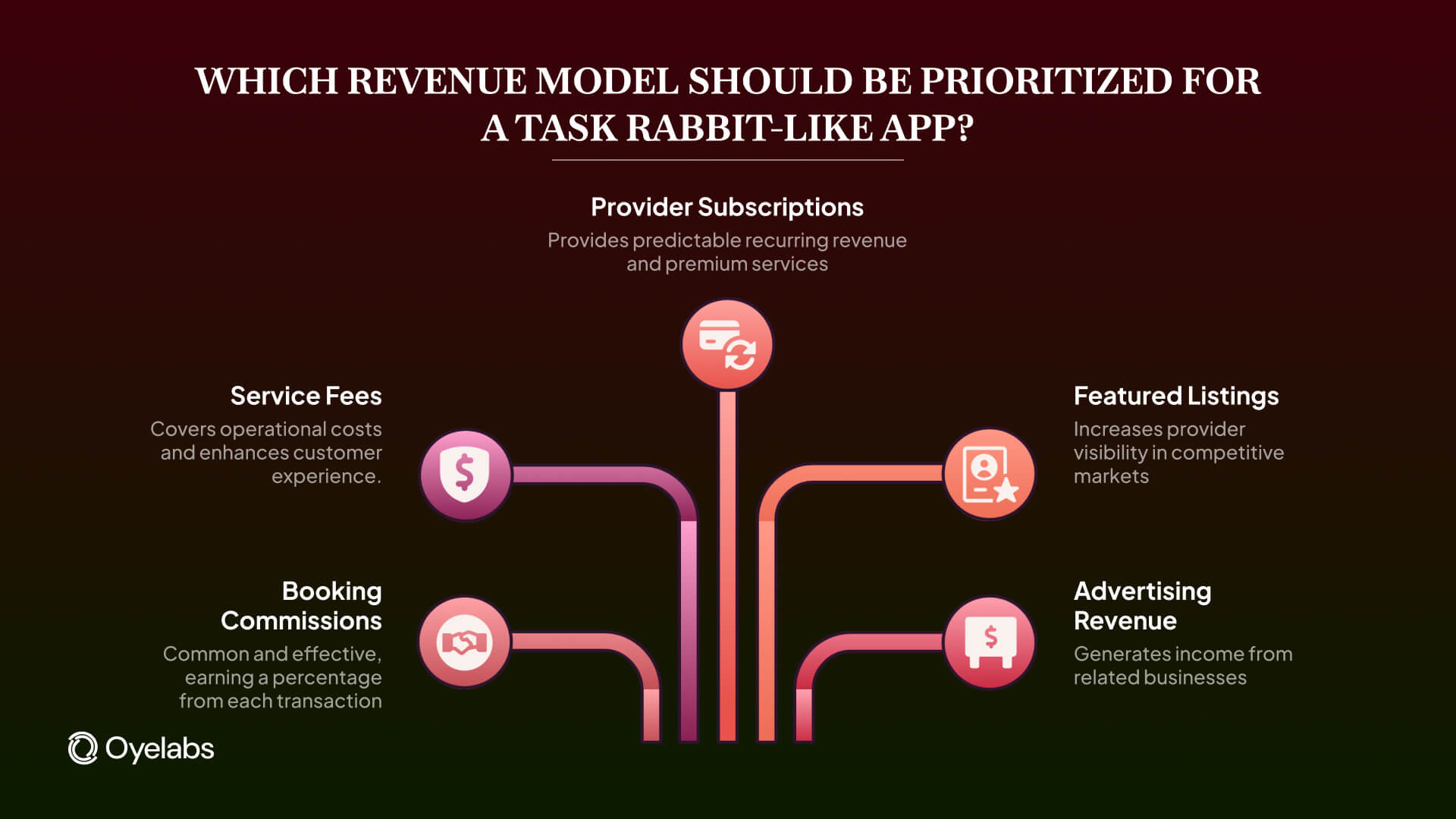
A TaskRabbit-like app generates revenue by facilitating transactions between customers and service providers.
Most successful marketplaces combine multiple revenue streams.
Revenue Model #1: Booking Commissions
The marketplace earns a percentage from every completed transaction.
Example:
| Booking Value | Commission | Marketplace Revenue |
| $100 | 15% | $15 |
| $250 | 15% | $37.50 |
| $500 | 15% | $75 |
This is the most common marketplace business model.
Revenue Model #2: Service Fees
Customers pay additional platform fees.
These fees often cover:
- Customer support
- Payment processing
- Platform maintenance
Revenue Model #3: Provider Subscriptions
Providers pay recurring monthly fees for:
- Premium visibility
- Additional leads
- Enhanced profiles
- Business tools
This creates predictable recurring revenue.
Revenue Model #4: Featured Listings
Providers pay to appear higher in search results.
This model becomes particularly effective as marketplace competition increases.
Revenue Model #5: Advertising Revenue
Brands and service-related businesses pay for visibility within the platform.
Examples include:
- Tool manufacturers
- Insurance providers
- Home improvement companies
Which Business Model Works Best?
Most successful TaskRabbit-like apps combine:
- 10–25% booking commissions
- Customer service fees
- Provider subscriptions
Investors generally prefer diversified revenue because it reduces business risk.
TaskRabbit Clone vs Building a Marketplace From Scratch
For most early-stage founders, speed of validation is more important than rebuilding marketplace fundamentals.
A TaskRabbit clone often allows faster testing and lower risk.
| Factor | TaskRabbit Clone | Custom Development |
| Launch Speed | Faster | Slower |
| Development Cost | Lower | Higher |
| Initial Risk | Lower | Higher |
| Validation Speed | Faster | Slower |
| Time to Revenue | Faster | Slower |
| Scalability | Strong | Strong |
| Customization | High | Complete |
Many founders choose a TaskRabbit clone initially and invest in deeper customization after validation.
What Is a White Label On-Demand Service App?
Quick Answer
A white label on-demand service app is a pre-built marketplace platform that can be customized and launched under your own brand.
It allows founders to launch significantly faster than building from scratch.
Benefits of White Label Marketplace Software
| Benefit | Business Impact |
| Faster Launch | Reach market sooner |
| Lower Development Cost | Reduce startup risk |
| Proven Workflows | Better operations |
| Built-In Marketplace Features | Faster validation |
| Scalability | Supports future growth |
This is one reason many founders evaluating a TaskRabbit-like app choose white label marketplace solutions.
Best TaskRabbit Clone Solution for Entrepreneurs
The best TaskRabbit clone solution is one that includes:
- Customer applications
- Provider applications
- Booking workflows
- Payments
- Reviews
- Messaging
- Admin controls
- Marketplace scalability
while allowing future customization.
Why Many Founders Choose Oyelabs
At Oyelabs, we regularly work with entrepreneurs launching:
- Handyman marketplaces
- Cleaning platforms
- Moving-service marketplaces
- Home maintenance apps
- Local service ecosystems
One pattern appears consistently.
Founders who validate demand before development usually achieve stronger outcomes than founders who start with software.
Oyelabs provides a ready-made TaskRabbit clone designed to help entrepreneurs:
- Launch faster
- Reduce development risk
- Validate the market sooner
- Focus on growth instead of rebuilding standard marketplace functionality
For many startups, this approach significantly reduces time-to-market.
Thinking About Launching a Handyman Marketplace?
The biggest mistake founders make is building software before validating the business.
Validate demand first.
Validate providers second.
Validate economics third.
Then build.
A successful marketplace is created by:
- Customer demand
- Provider supply
- Sustainable economics
- Strong operations
The software simply helps scale what already works.
If you are exploring a TaskRabbit-like app, a ready-made marketplace solution can help you validate faster and launch with less risk.
Book a free demo with Oyelabs to explore how a TaskRabbit clone can accelerate your marketplace journey.
Conclusion
Most marketplace failures happen before launch.
Not because the software is bad.
Because the business was never validated.
The strongest handyman marketplaces prove:
- Customers want the service
- Providers will join
- The economics work
- The market opportunity exists
before development begins.
That validation process dramatically reduces risk and increases the chances of building a successful service marketplace.
Before you build the app, make sure you have validated the business behind it.
Frequently Asked Questions
Can a TaskRabbit Clone Be Profitable?
Yes.
A TaskRabbit clone can be highly profitable when customer acquisition costs, provider acquisition costs, commission structures, and repeat bookings are managed effectively.
How Many Providers Should You Recruit Before Launch?
There is no universal number.
However, founders should ensure enough providers exist to support customer demand across their launch categories and geography.
What Is the Best City to Launch a Handyman Marketplace?
The best city is usually one with:
- Strong service demand
- Limited provider organization
- Growing population
- Healthy local spending
How Much Does It Cost to Build an App Like TaskRabbit?
The cost depends on:
- Development approach
- Features
- Mobile applications
- Integrations
- Customization requirements
White label marketplace solutions are generally more affordable than custom development.
Is a White Label TaskRabbit Clone Better Than Custom Development?
For many startups, yes.
White label solutions reduce launch time, development cost, and validation risk while still providing room for future growth.