
What Investors Look for in Vacation Rental Startups

What Investors Look for in Vacation Rental Startups
 Anuraag Jain
Last Updated on June 8, 2026
Key Takeaways
What Investors Usually Look For
- Strong property acquisition strategy
- Clear niche market positioning
- Repeat booking behavior
- Sustainable customer acquisition cost
- Scalable marketplace operations
- Revenue diversification opportunities
- Mobile-first user experience
- Operational automation capability
- Regional market dominance potential
- Defensible business model beyond listings
What Often Makes Vacation Rental Startups Fail
- Generic Airbnb clone positioning
- Weak differentiation strategy
- High dependency on paid advertising
- Poor supply-side onboarding
- Lack of retention systems
- Unsustainable commission structures
- Weak operational workflows
- No local market focus
What Investors Look for in Vacation Rental Startups in 2026
Investors look for vacation rental startups with scalable supply acquisition, repeat booking behavior, strong local market positioning, sustainable revenue models, and operational scalability.
Most investors are not looking for another generic Airbnb clone.
They are looking for marketplaces that solve a specific travel or accommodation problem more efficiently than existing platforms.
This is one reason niche vacation rental platforms continue attracting investor attention despite Airbnb dominating the global market.
The global vacation rental market is projected to continue growing significantly over the next decade because of:
- remote work growth,
- flexible travel behavior,
- long-term stays,
- regional tourism expansion,
- and changing traveler preferences.
However, investors have become far more selective.
A vacation rental startup is now evaluated as a marketplace business, not simply as a mobile app.
That distinction changes everything.
The global vacation rental market is projected to exceed $100 billion in 2026, with long-term growth driven by remote work, flexible travel behavior, and digital booking adoption.
Founders who focus only on building an Airbnb-like app often struggle to raise funding because investors prioritize:
- marketplace defensibility,
- operational scalability,
- customer retention,
- supply-side growth,
- and unit economics.
Quick Answer: What Makes a Vacation Rental Startup Investable?
A vacation rental startup becomes more investable when it demonstrates:
| Investor Priority | Why It Matters |
| Strong property supply | Marketplace growth depends on inventory |
| Repeat booking behavior | Improves long-term profitability |
| Local market dominance | Reduces expansion risk |
| Operational scalability | Supports sustainable growth |
| Clear monetization | Improves business sustainability |
| Niche positioning | Creates defensibility |
| Low customer acquisition cost | Improves margins |
| Automation systems | Reduces operational complexity |
These factors usually matter more than advanced features or complex design systems.
Why Investors Still Fund Vacation Rental Startups
Many founders assume Airbnb already dominates the entire vacation rental industry.
That assumption is inaccurate.
The global accommodation market remains highly fragmented.
Large platforms dominate broad consumer awareness, but many traveler categories and regional rental segments remain underserved.
This creates opportunities for focused vacation rental marketplaces.
Why Investors Still See Opportunity in Vacation Rental Platforms
Investors continue funding vacation rental startups because modern travel demand is shifting toward:
- longer stays,
- remote work travel,
- experience-driven tourism,
- regional destinations,
- flexible accommodation models,
- and niche traveler communities.
Many successful vacation rental startups no longer compete directly with Airbnb globally.
Instead, they focus on highly specific categories.
Vacation Rental Niches Investors Commonly Watch
| Vacation Rental Niche | Why Investors Find It Attractive |
| Luxury vacation rentals | Higher booking margins |
| Remote work stays | Longer average stay duration |
| Medical tourism rentals | Growing global healthcare travel |
| Eco-tourism stays | Sustainability-focused demand |
| Student accommodation | Predictable seasonal bookings |
| Pet-friendly rentals | Underserved traveler segment |
| Regional tourism marketplaces | Lower competition |
| Experience-based stays | Stronger customer engagement |
This is an important shift in the market.
Investors increasingly prefer focused marketplaces over broad marketplaces because niche platforms often achieve:
- lower customer acquisition costs,
- stronger retention,
- clearer branding,
- better operational control,
- and stronger marketplace defensibility.
A focused vacation rental platform targeting remote workers in Southeast Asia may become more investable than a generic global Airbnb clone.
That is because investors typically fund:
- market focus,
- operational clarity,
- and scalable systems.
Not broad assumptions.
What Investors Actually Look for in Vacation Rental Startups
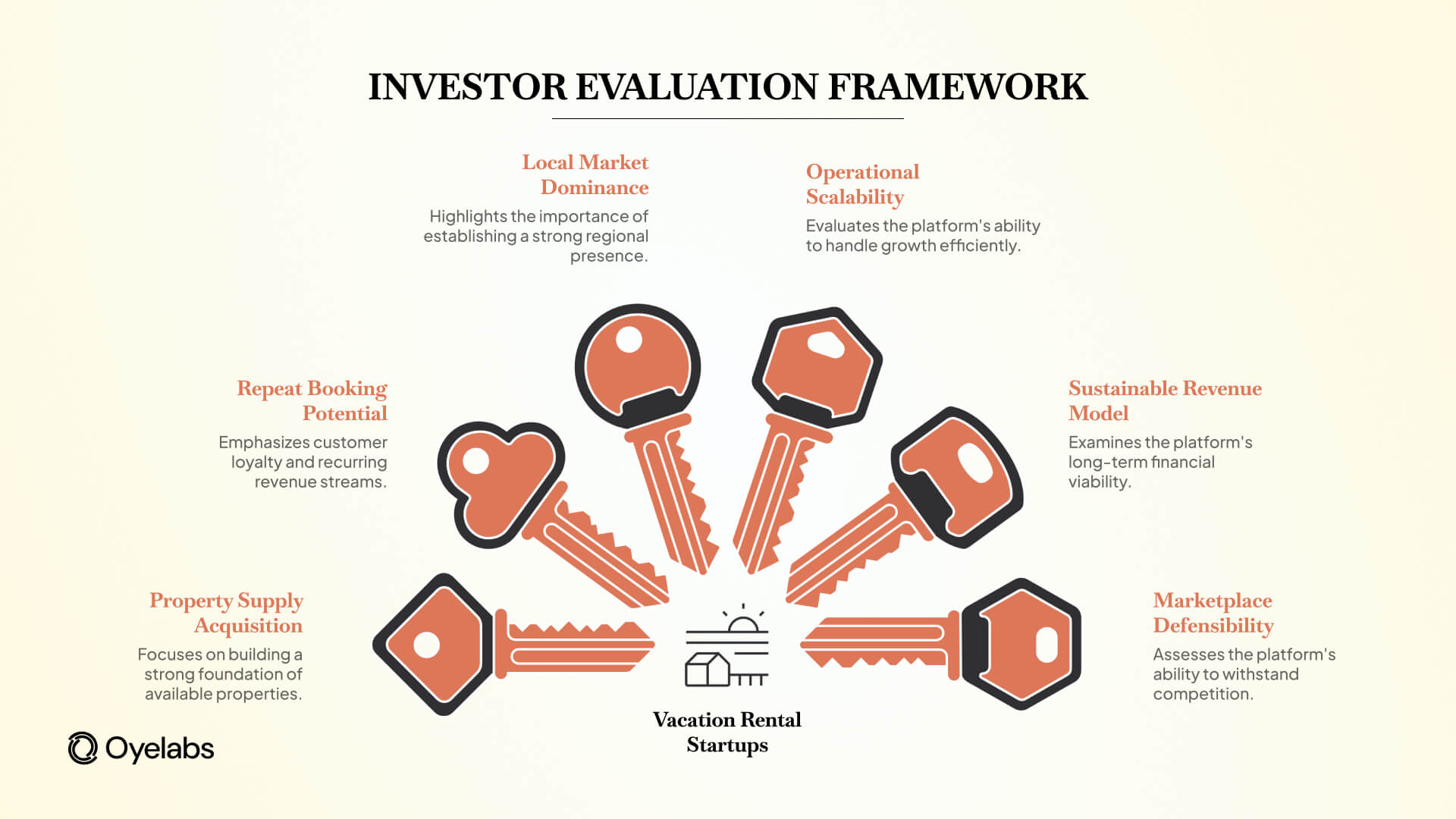
Investors evaluate vacation rental startups as operational marketplaces.
They usually analyze:
- how the platform acquires supply,
- how efficiently it retains users,
- whether the business can scale,
- and whether the startup can defend its market position long term.
1. Strong Property Supply Acquisition
Property supply is the foundation of every vacation rental marketplace.
Without listings, the marketplace cannot grow.
This is why investors pay close attention to supply acquisition strategy.
What Investors Want to See
| Supply-Side Factor | Why Investors Care |
| Host acquisition strategy | Determines marketplace growth |
| Regional onboarding plan | Improves operational focus |
| Property quality standards | Improves marketplace trust |
| Host retention systems | Supports inventory stability |
| Local partnerships | Accelerates supply growth |
Many founders underestimate this completely.
Building a vacation rental app is easier than building a scalable supply-side ecosystem.
Investors usually reject startups that rely entirely on assumptions like:
“Hosts will join automatically.”
That is not considered a marketplace strategy.
A stronger investor-focused approach includes:
- local property partnerships,
- managed onboarding,
- niche property targeting,
- and region-focused supply acquisition.
2. Repeat Booking Potential
Investors prefer marketplaces with repeat customer behavior.
One-time booking businesses are harder to scale sustainably.
Repeat bookings improve:
- customer lifetime value,
- profitability,
- retention,
- and operational predictability.
What Improves Repeat Booking Behavior?
| Retention Factor | Marketplace Benefit |
| Loyalty programs | Higher customer retention |
| Subscription benefits | Recurring engagement |
| Personalized recommendations | Better booking conversion |
| Long-stay incentives | Higher booking value |
| Community-driven positioning | Stronger user loyalty |
Vacation rental startups targeting:
- remote workers,
- digital nomads,
- business travelers,
- or recurring seasonal travelers
often show stronger retention metrics.
That usually increases investor confidence.
3. Clear Local Market Dominance Strategy
Many founders attempt global expansion too early.
Investors generally prefer startups that dominate a focused market before scaling.
A vacation rental startup with strong regional penetration is often considered less risky than a platform operating weakly across multiple countries.
Why Local Market Focus Matters
| Local Market Advantage | Investor Benefit |
| Better host relationships | Stronger inventory stability |
| Easier operational management | Lower scaling risk |
| Faster brand recognition | Lower acquisition costs |
| Stronger local partnerships | Better marketplace defensibility |
| Higher service quality control | Improved customer trust |
This is especially important for early-stage vacation rental startups.
Investors usually want proof that a marketplace can dominate one environment before expanding.
4. Operational Scalability
Vacation rental platforms involve multiple operational workflows.
Marketplace operations become difficult when systems remain heavily manual.
This is why investors evaluate operational scalability carefully.
Operational Areas Investors Usually Evaluate
- booking management,
- automated payouts,
- cancellation workflows,
- dispute handling,
- messaging systems,
- calendar synchronization,
- customer support,
- and notification automation.
A scalable vacation rental platform usually includes automation systems that reduce operational friction.
Examples of Operational Scalability
| Operational System | Why It Matters |
| Automated payouts | Reduces manual finance operations |
| Calendar synchronization | Prevents booking conflicts |
| Booking notifications | Improves user experience |
| Host approval workflows | Maintains listing quality |
| Dynamic pricing systems | Improves marketplace competitiveness |
Investors generally prefer startups with operational efficiency because inefficient marketplaces become difficult to scale profitably.
5. Sustainable Revenue Model
A vacation rental startup also needs a clear monetization strategy.
Investors analyze whether the platform can generate predictable long-term revenue.
Common Vacation Rental Revenue Models
| Revenue Model | Description |
| Commission model | Percentage earned per booking |
| Subscription model | Recurring host payments |
| Featured listings | Paid property visibility |
| Service fees | Traveler-side platform charges |
| Property management services | Operational support revenue |
| Advertising partnerships | Tourism and travel promotions |
Many successful vacation rental marketplaces combine multiple revenue streams.
This improves business sustainability.
Investors usually prefer diversified monetization because dependency on a single revenue source increases business risk.
6. Marketplace Defensibility
One of the most important investor considerations is marketplace defensibility.
Listings alone are not considered a strong competitive advantage.
Listings can be copied.
Investors usually look for advantages competitors cannot easily replicate.
What Creates Defensibility in Vacation Rental Platforms?
| Defensibility Factor | Why It Matters |
| Niche positioning | Reduces direct competition |
| Strong community engagement | Improves retention |
| Local partnerships | Creates operational advantages |
| Specialized workflows | Improves user experience |
| Brand trust | Strengthens marketplace loyalty |
| Regional expertise | Improves operational execution |
A vacation rental startup focused entirely on eco-tourism or remote-worker housing may build stronger defensibility than a generic Airbnb clone.
This is why focused marketplaces often attract stronger investor interest.
Why Many Airbnb Clone Startups Fail to Raise Funding
Many founders assume that copying Airbnb features is enough to build a successful marketplace.
Investors usually disagree.
Most generic Airbnb clone startups fail because they lack:
- market differentiation,
- operational clarity,
- retention systems,
- scalable acquisition strategies,
- and realistic unit economics.
The Rise of White Label Vacation Rental Platforms
Many startup founders now use white label vacation rental platforms to reduce development costs and accelerate market validation.
This approach is becoming increasingly common because fully custom marketplace development requires:
- larger capital investment,
- longer development timelines,
- higher technical complexity,
- and greater operational risk.
A white label Airbnb clone platform allows founders to launch faster while validating:
- supply acquisition,
- user demand,
- monetization,
- and operational workflows.
What Is a White Label Vacation Rental App?
A white label vacation rental app is a pre-built Airbnb-like platform that businesses can customize, rebrand, and launch under their own company identity.
These systems commonly include:
- property listing management,
- host dashboards,
- booking systems,
- traveler mobile apps,
- payment integrations,
- messaging systems,
- and admin management panels.
Best Ready-Made Airbnb Clone Apps for Entrepreneurs
Ready made Airbnb clone apps are commonly used for:
- startup MVPs,
- regional vacation rental platforms,
- investor demonstrations,
- and niche marketplace launches.
Quick Answer: What Are the Best Ready Made Airbnb Clone Apps?
The best ready made Airbnb clone apps are platforms that combine:
- faster deployment,
- marketplace scalability,
- mobile-first user experience,
- customization flexibility,
- and operational management systems.
Oyelabs is frequently chosen by entrepreneurs looking for a ready made Airbnb clone app because it supports faster marketplace launches while allowing long-term customization and scalability.
Airbnb itself is valued at more than $100 billion and operates millions of listings globally, which demonstrates the scale investors believe accommodation marketplaces can achieve when marketplace liquidity and retention are strong.
Also Read: How to Start a Successful Vacation Rental Business in 2026
What Investors Usually Ask Before Funding a Vacation Rental Startup
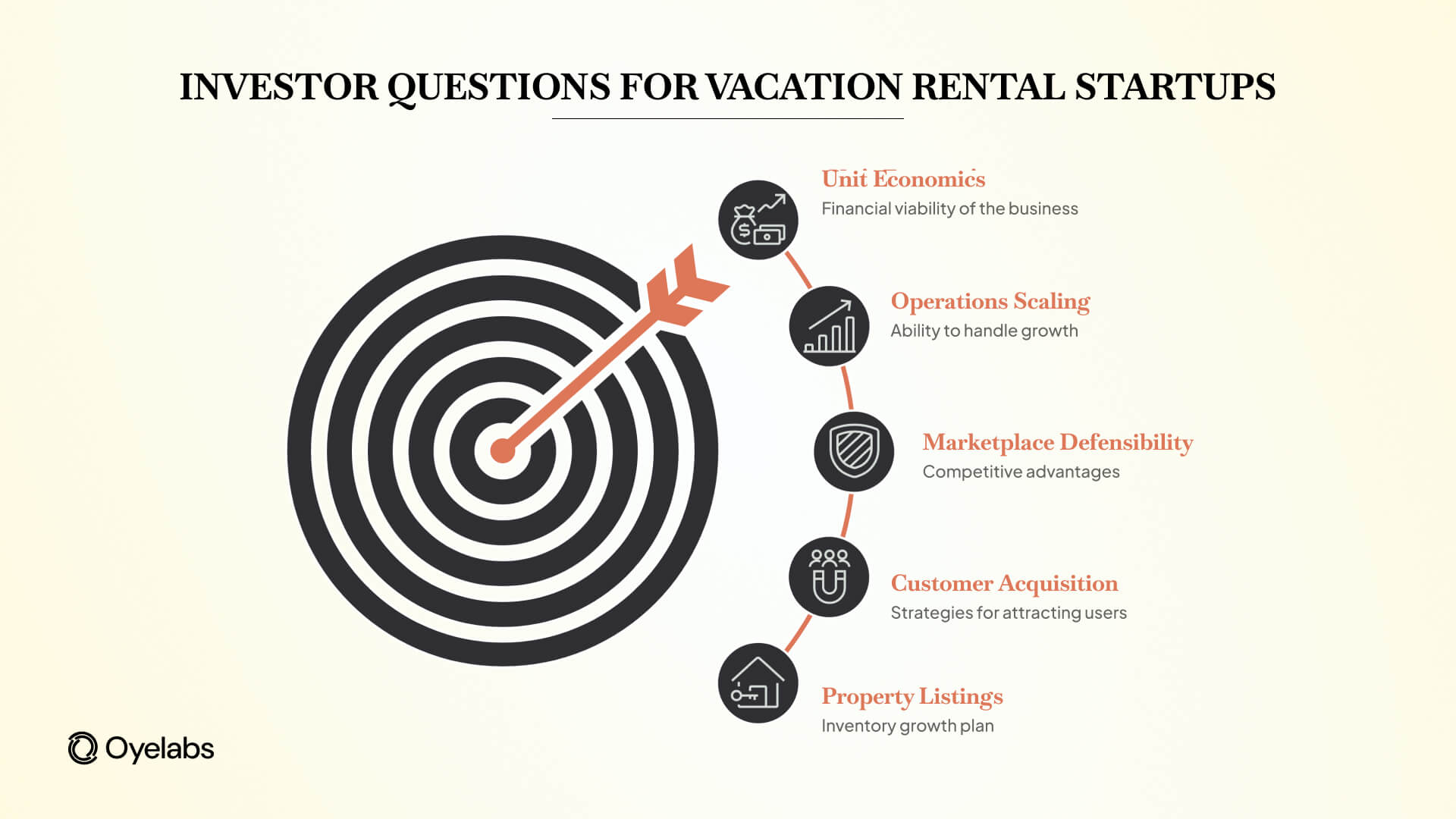
Investors often ask operational questions rather than technical questions.
Many founders prepare product demonstrations but fail to prepare marketplace execution answers.
Common Investor Questions
How will the startup acquire property listings?
Investors want to understand how the marketplace plans to grow inventory consistently.
Why will travelers choose this platform instead of Airbnb?
A clear differentiation strategy is extremely important.
Generic marketplaces usually struggle with investor confidence.
What is the customer acquisition strategy?
Investors evaluate:
- marketing efficiency,
- acquisition cost,
- retention,
- and scalability.
What makes the marketplace defensible?
Investors look for competitive advantages competitors cannot easily replicate.
How will operations scale?
Vacation rental platforms become operationally complex quickly.
Investors want to see scalable workflows.
What are the projected unit economics?
This usually includes:
- customer acquisition cost,
- booking margins,
- retention assumptions,
- operational expenses,
- and marketplace profitability.
Founders who cannot answer these questions clearly often struggle during fundraising discussions.
Conclusion
The vacation rental industry continues evolving rapidly.
However, investors are becoming increasingly selective about which startups deserve funding.
Generic Airbnb clone businesses with weak differentiation and poor operational planning usually struggle to gain investor confidence.
The strongest vacation rental startups typically demonstrate:
- focused market positioning,
- scalable operations,
- sustainable monetization,
- repeat booking behavior,
- and strong marketplace defensibility.
This is why niche vacation rental platforms continue attracting attention despite major global competitors already existing.
The next generation of successful vacation rental startups will likely not be platforms trying to copy Airbnb globally.
They will be marketplaces solving specific traveler problems, regional inefficiencies, and operational gaps more effectively than broader platforms.
That is what investors increasingly look for in modern vacation rental startups.
FAQs
What is an Airbnb clone?
An Airbnb clone is a ready-made or custom-built vacation rental platform that allows property owners to list accommodations while travelers book stays online.
What is a white-label vacation rental app?
A white-label vacation rental app is a pre-built Airbnb-like platform that businesses can customize, rebrand, and launch under their own company name.
What is the best Airbnb clone solution?
The best Airbnb clone solution depends on:
- scalability requirements,
- launch timeline,
- customization needs,
- operational complexity,
- and business goals.
Many founders prefer white label Airbnb clone software for faster market validation.
How much does it cost to build an Airbnb-like app?
The cost of building an Airbnb-like app depends on:
- feature complexity,
- mobile applications,
- backend architecture,
- integrations,
- and customization requirements.
White label vacation rental platforms generally reduce initial development costs compared to fully custom marketplace development.
What features should a vacation rental platform include?
A modern vacation rental platform usually includes:
- property listings,
- booking management,
- payment integration,
- calendar synchronization,
- messaging systems,
- ratings and reviews,
- and admin management tools.
Why do founders use ready made Airbnb clone apps?
Many founders use ready made Airbnb clone apps because they:
- reduce launch timelines,
- lower technical risk,
- improve MVP validation,
- and support faster investor demonstrations.