
Why Food Delivery Apps Are Growing in the Middle East

Why Food Delivery Apps Are Growing in the Middle East
 Sachin Sharma
Last Updated on June 2, 2026
Key Takeaways –
What You’ll Learn:
- Middle East food delivery demand is driven by convenience and digital lifestyles.
- Saudi Arabia and UAE lead regional food delivery growth.
- Digital payments increase order completion and customer retention.
- Cloud kitchens help restaurants expand faster with lower costs.
- Niche food delivery apps still have strong growth opportunities.
Stats That Matter:
- Middle East food delivery market may reach $52.4 billion by 2030.
- GCC internet penetration ranges between 95% and 99%.
- White-label food delivery apps can launch from $2,999.
- Some food delivery platforms can go live in 7 days.
A question comes up frequently when founders evaluate new markets:
“Is the Middle East really worth entering with a food delivery platform?”
The short answer is yes.
A Food Delivery App in the Middle East has become one of the strongest digital business opportunities for founders because consumer demand, digital payments, logistics infrastructure, and government-backed innovation are all advancing at the same time. The market continues to benefit from delivery-first consumer behavior across GCC countries.
The opportunity is no longer theoretical.
Consumer behavior has already shifted. Infrastructure is mature. Digital payments are mainstream. More importantly, several underserved segments still exist despite the presence of large delivery brands.
In our experience working with founders launching on-demand or food delivery platforms, the best opportunities often appear after the first wave of market adoption. That is exactly where the Middle East food delivery market stands today.
What Does the Middle East Food Delivery Market Look Like Today?
Many founders mistakenly view the Middle East as a single market.
In reality, it is a collection of highly connected economies moving toward the same outcome: delivery-first convenience.
The Middle East and Africa online food delivery market was valued at USD 13.46 billion in 2023 and is projected to reach USD 52.4 billion by 2030, growing at a CAGR of 21.62%.
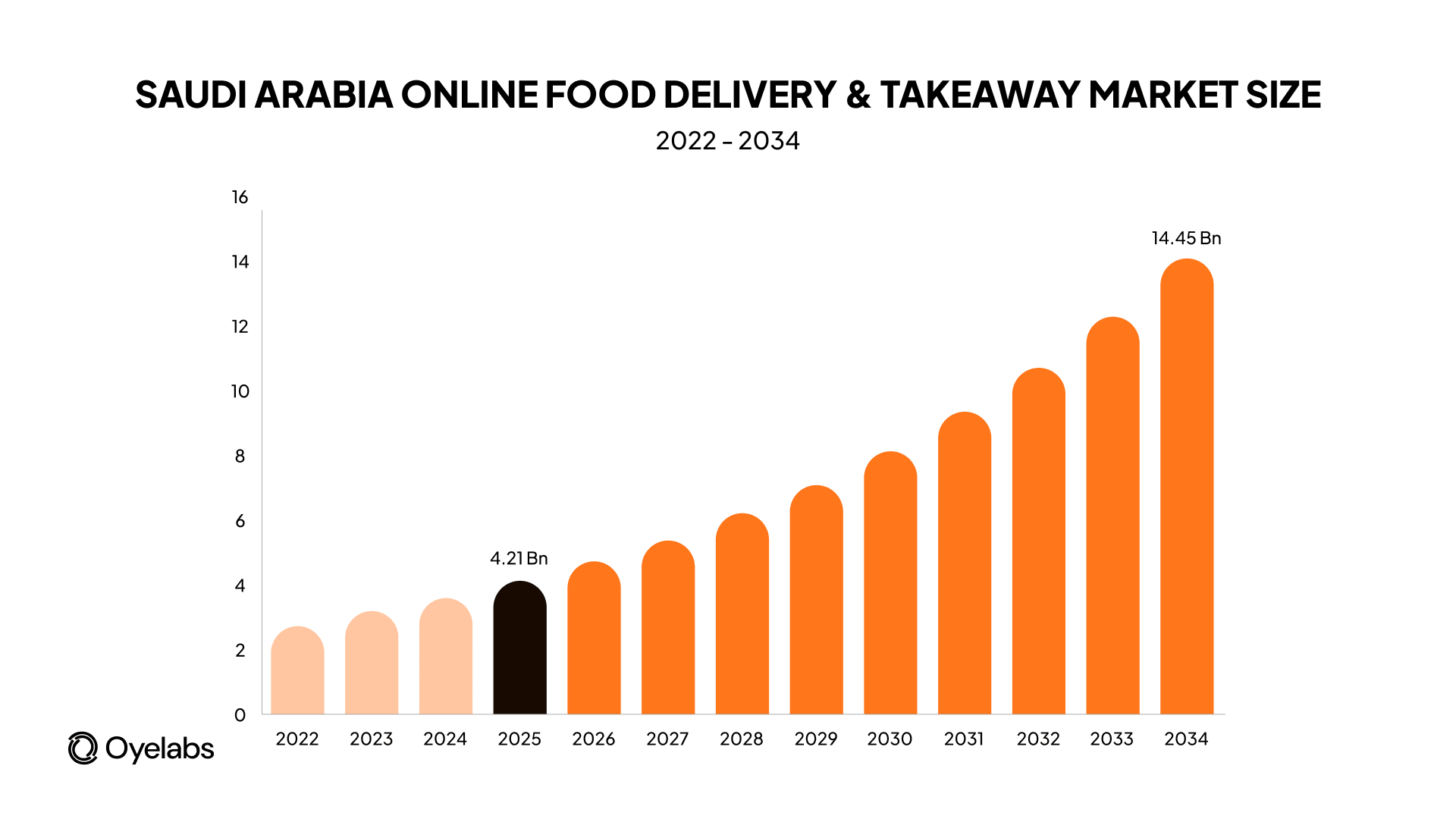 That kind of growth is rarely seen in a market that has already matured.
Instead, it signals that demand continues to rise across the region.
Which Countries Are Driving Food Delivery Growth?
| Country | Growth Driver |
|---|---|
| Saudi Arabia | Vision 2030 initiatives, growing digital economy, expanding food delivery business ecosystem |
| UAE | High smartphone usage, strong consumer spending, mature logistics networks |
| Qatar | Investments in digital infrastructure and logistics |
| Kuwait | Rising disposable incomes and strong digital wallet adoption |
While each market has unique characteristics, the trend remains the same.
Consumers are ordering food online more frequently, paying digitally, and relying on delivery platforms for everyday meals.
Why Is a Food Delivery App in the Middle East Growing So Fast?
Several long-term market forces are driving this growth.
Unlike temporary trends, these factors are structural and likely to continue shaping the industry for years.
1. Is Internet and Smartphone Adoption Already Solved?
Yes.
Internet penetration across GCC countries ranges between 95% and 99%.
Consumers already use mobile apps for transportation, shopping, banking, entertainment, and food ordering.
That means startups entering the market do not need to convince users to adopt digital services.
The behavior already exists.
When users can browse restaurants, place orders, make payments, and track deliveries directly from their phones, adoption becomes much easier.
2. Why Does the Young Population Matter?
Saudi Arabia has one of the youngest populations in the region.
Across the Gulf, a large share of residents falls between the ages of 15 and 49.
These consumers grew up using smartphones and digital services.
Ordering through an app is not a new behavior. It is their preferred way to access services.
This demographic shift has also fueled the rise of:
- Cloud kitchens
- Virtual restaurant brands
- Subscription meal services
- Online food ordering platforms
For a food delivery business in Saudi Arabia, this creates long-term demand rather than temporary growth.
3. How Does the Climate Increase Delivery Demand?
This factor is often overlooked.
Temperatures across Saudi Arabia, Kuwait, and the UAE regularly exceed 45°C during summer months.
For many consumers, delivery is not simply convenient.
It is the preferred option.
Food delivery eliminates several friction points:
- Driving in extreme heat
- Finding parking
- Waiting in restaurant queues
- Traveling during peak temperatures
As a result, delivery habits become part of everyday life.
4. How Do Expat Communities Increase Order Frequency?
The UAE has one of the highest expatriate populations in the world.
Saudi Arabia, Qatar, and Kuwait also host large international communities.
This creates demand for a wide range of cuisines.
A successful food delivery platform may serve customers searching for:
- Indian food
- Lebanese cuisine
- Korean dishes
- Japanese meals
- Italian restaurants
Greater restaurant variety often leads to:
- Higher order frequency
- Better customer retention
- Increased average order value
Cuisine diversity has become a competitive advantage for many delivery platforms operating in the region.
5. Why Are Governments Supporting Digital Growth?
Government initiatives continue accelerating technology adoption throughout the GCC.
Programs such as:
- Saudi Vision 2030
- Dubai Economic Agenda D33
- Qatar National Vision 2030
are investing heavily in:
- Digital payments
- Logistics infrastructure
- Smart city development
- Technology entrepreneurship
This support helps create a favorable environment for platform businesses.
As infrastructure improves, delivery companies can scale more efficiently.
Who Are the Major Players in the Market?
Several established brands currently dominate large portions of the market.
These include:
- Talabat
- Deliveroo
- HungerStation
- Jahez
- Ninja
However, market leadership does not eliminate opportunity.
Most large platforms are optimized for scale and mass-market operations.
They are not always optimized for specialized customer needs.
This creates room for innovation and differentiation.
Where Are the Biggest Opportunities for New Food Delivery Startups?
Many founders assume they must compete directly with major players.
That is rarely the best approach.
Instead, successful startups often focus on underserved segments.
Examples include:
- Healthy meal delivery services
- Dietary-specific food platforms
- Corporate meal solutions
- Subscription-based delivery models
- Hyperlocal delivery in secondary cities
- Premium halal-certified food delivery
The next phase of growth in the Middle East food delivery market will likely come from specialization rather than generalization.
What Does This Growth Mean for Founders?
Market growth creates opportunity, but founders still need the right product strategy.
Consumer expectations have evolved significantly.
Fast delivery alone is no longer enough.
Users now expect:
- Real-time order tracking
- Multiple payment options
- Arabic and English language support
- Loyalty and rewards programs
- Scheduled deliveries
- Restaurant reviews
- Personalized offers
In our experience with food delivery app development projects, platforms that launch with proven features tend to reach market readiness faster than those attempting to reinvent user expectations.
How Are Digital Payments Accelerating Growth?
Historically, cash-on-delivery created challenges for delivery businesses.
Settlement delays, failed deliveries, and cash handling costs reduced efficiency.
Today, GCC consumers increasingly use:
- STC Pay
- PayTabs
- PayFort
- Google Pay
- Samsung Pay
Digital payments enable:
- Subscription models
- Loyalty programs
- Personalized promotions
- Faster transactions
As payment adoption continues rising, delivery platforms gain access to stronger monetization opportunities.
How Are Cloud Kitchens Expanding the Market?
Cloud kitchens have become a major force behind delivery growth.
Unlike traditional restaurants, they operate exclusively for delivery.
This model offers:
- Lower operating costs
- Faster expansion opportunities
- Greater flexibility
- Increased restaurant supply
For delivery platforms, cloud kitchens create more restaurant partnerships without requiring major infrastructure investment.
More restaurant options lead to greater customer choice and stronger retention.
What Does It Cost to Launch a Food Delivery Platform?
One of the biggest misconceptions founders have is that launching requires a massive budget and a year-long development cycle.
That is no longer the case.
Today, founders can launch a white-label food delivery platform starting from approximately $2,999 and go live in as little as 7 days, depending on customization requirements.
| Development Approach | Estimated Cost | Timeline |
|---|---|---|
| White-Label Solution | Starting from $2,999 | Around 7 Days |
| Customized White-Label Platform | $5,000–$15,000+ | 2–6 Weeks |
| Fully Custom Development | $15,000–$80,000+ | 3–8 Months |
For many startups, launching quickly and validating demand is more valuable than spending months building from scratch.
Related Read: Cost to Build an App like UberEats
Ready to Launch Your Food Delivery Platform?
At OyeLabs, we help founders launch white-label food delivery app solutions without spending months on development.
Whether you’re targeting Saudi Arabia, the UAE, Qatar, Kuwait, or another GCC market, our solutions help reduce time-to-market while providing the features modern consumers expect.
The market opportunity already exists.
Now is the time to build for it.
Conclusion: Is Now the Right Time to Launch?
The conditions that drive successful platform businesses rarely align this clearly.
Demand is growing.
Digital payments are mature.
Governments continue investing in digital transformation.
Cloud kitchens are expanding restaurant supply.
Most importantly, several profitable niches remain underserved.
For founders evaluating new opportunities, a Food Delivery App in the Middle East represents one of the most promising markets available today.
The first wave of adoption has already happened.
The next wave will belong to founders who identify specific customer needs and build solutions around them.
FAQs
1. How do food delivery apps handle peak-hour order surges?
Food delivery platforms use automated order allocation and dynamic rider dispatch systems to manage high demand efficiently during lunch and dinner rush hours.
2. Can food delivery startups succeed without owning a delivery fleet?
Yes. Many startups partner with third-party logistics providers or freelance delivery networks to reduce operational costs and scale faster.
3. Which food categories are growing fastest on delivery platforms?
Healthy meals, meal subscriptions, premium dining, grocery essentials, and late-night food delivery are seeing strong growth across GCC markets.
4. How important is customer loyalty for food delivery apps?
Loyalty programs help increase repeat orders, improve customer retention, and reduce dependence on costly user acquisition campaigns.
5. What technologies are shaping the future of food delivery in the Middle East?
AI-powered recommendations, route optimization, predictive analytics, digital wallets, and real-time tracking are driving the next phase of growth.