AI Mentors vs Traditional Coaching: The Future of EdTech

AI Mentors vs Traditional Coaching: The Future of EdTech
 Sachin Sharma
Last Updated on August 3, 2026
What You Will Learn
- AI mentors can provide 24/7 personalized guidance at near-zero marginal cost, making one-to-one learning experiences economically feasible for millions of learners instead of a handful of premium coaching clients.
- Traditional coaching remains superior in areas requiring emotional intelligence, motivation, accountability, and nuanced career judgment, where human context often matters more than information retrieval.
- The future of EdTech is shifting from content libraries toward adaptive learning experiences that combine AI-driven personalization with human expertise, rather than replacing instructors altogether.
- Founders looking to build an app like Udemy should prioritize AI-powered mentorship, adaptive learning paths, progress analytics, and intelligent recommendations instead of simply expanding video course catalogs.
- Platforms that integrate AI as a learning companion rather than an instructor are better positioned to improve learner engagement, course completion, and long-term retention while keeping operational costs scalable.
Quick Answer
AI mentors are transforming the future of EdTech by making personalized learning available at scale, but they are not replacing traditional coaching. Instead, the strongest education platforms are combining AI’s ability to deliver instant, adaptive support with human mentors who provide accountability, strategic guidance, and real-world experience. For founders planning to build an app like Udemy, the opportunity lies in designing platforms where AI enhances – not replaces – the learning journey.
The Future of EdTech Isn’t Either-Or
If learners can ask an AI tutor questions anytime, receive instant explanations, and get personalized study plans, do they still need a human coach?
That question is reshaping nearly every segment of the education technology industry. Online learning platforms have already made education more accessible through recorded courses, live classes, and instructor marketplaces. Now, advances in generative AI are changing expectations again. Learners increasingly expect platforms to understand their goals, identify knowledge gaps, recommend the next lesson, and answer questions immediately instead of waiting for scheduled coaching sessions.
For founders, product managers, and EdTech innovators, this shift represents more than a technology upgrade. It changes what learners value, how platforms compete, and what the next generation of learning marketplaces should actually build.
Why This Debate Matters for the Future of EdTech
The discussion isn’t whether AI mentors will replace human coaches. The real question is how learning platforms can combine automation and human expertise to improve outcomes while remaining economically scalable. That distinction is shaping the future of EdTech far more than choosing one approach over the other.
For nearly two decades, most online education platforms have followed a similar model.
An instructor creates content.
Students purchase access.
Learning happens primarily through videos, quizzes, assignments, and discussion forums.
While this model successfully democratized education, it introduced another challenge: learners often struggle after purchasing the course.
Industry discussions around Massive Open Online Courses (MOOCs) have consistently highlighted that completion rates tend to be significantly lower than enrollment numbers. Although reported percentages vary widely depending on platform, course type, and methodology, learner engagement – not content availability – remains one of the industry’s biggest challenges. Rather than assuming more content leads to better learning, modern platforms increasingly focus on personalized support and continuous engagement.
This is where AI changes the equation.
Instead of functioning solely as content repositories, learning platforms can now deliver:
- Personalized learning plans
- Instant question answering
- Adaptive quizzes
- Intelligent revision reminders
- Context-aware explanations
- Progress recommendations
These capabilities shift platforms from passive content delivery to active learning assistance.
Importantly, this evolution does not reduce the importance of instructors. It changes their role.
Human experts increasingly become mentors, reviewers, and career advisors while AI handles repetitive instructional support that previously consumed significant time.
This transition is likely to define the next phase of educational technology.
AI Mentors vs Traditional Coaching: A Practical Comparison
AI mentors outperform traditional coaching in availability, scalability, and personalization speed, while human coaches remain stronger in emotional intelligence, accountability, leadership development, and complex decision-making. The choice depends less on technology and more on the learning objective.
The comparison often becomes unnecessarily polarized.
In reality, both approaches solve different problems.
| Capability | AI Mentor | Traditional Coach |
| Availability | 24/7 access | Scheduled sessions |
| Cost per learner | Low after deployment | High and scales linearly |
| Personalized explanations | Excellent | Excellent |
| Emotional support | Limited | Strong |
| Accountability | Moderate | Strong |
| Career guidance | Improving but limited | Excellent |
| Instant feedback | Immediate | Session dependent |
| Scalability | Millions of learners | Limited by coach availability |
| Consistency | Highly consistent | Varies by individual |
| Contextual judgment | Improving rapidly | Superior |
The comparison also changes depending on the learner’s stage.
Someone learning Excel formulas or JavaScript syntax benefits greatly from immediate AI assistance.
Someone preparing for executive leadership interviews, career transitions, or entrepreneurship often needs nuanced advice that depends on organizational culture, interpersonal dynamics, and lived experience.
Another difference is consistency.
AI provides the same quality of explanation regardless of whether it is helping the first learner or the millionth learner.
Human coaching naturally varies depending on energy, expertise, availability, and communication style.
However, coaching is about much more than answering questions.
Great mentors recognize hesitation, detect declining motivation, challenge assumptions, and adapt communication styles based on personality.
These qualities remain difficult for AI systems to replicate reliably because they depend on emotional understanding rather than information retrieval.
Rather than asking which is objectively better, founders should ask which learning activities benefit from automation and which still require human judgment.
That distinction leads to better product design.
Where AI Mentors Excel – and Where They Still Fall Short
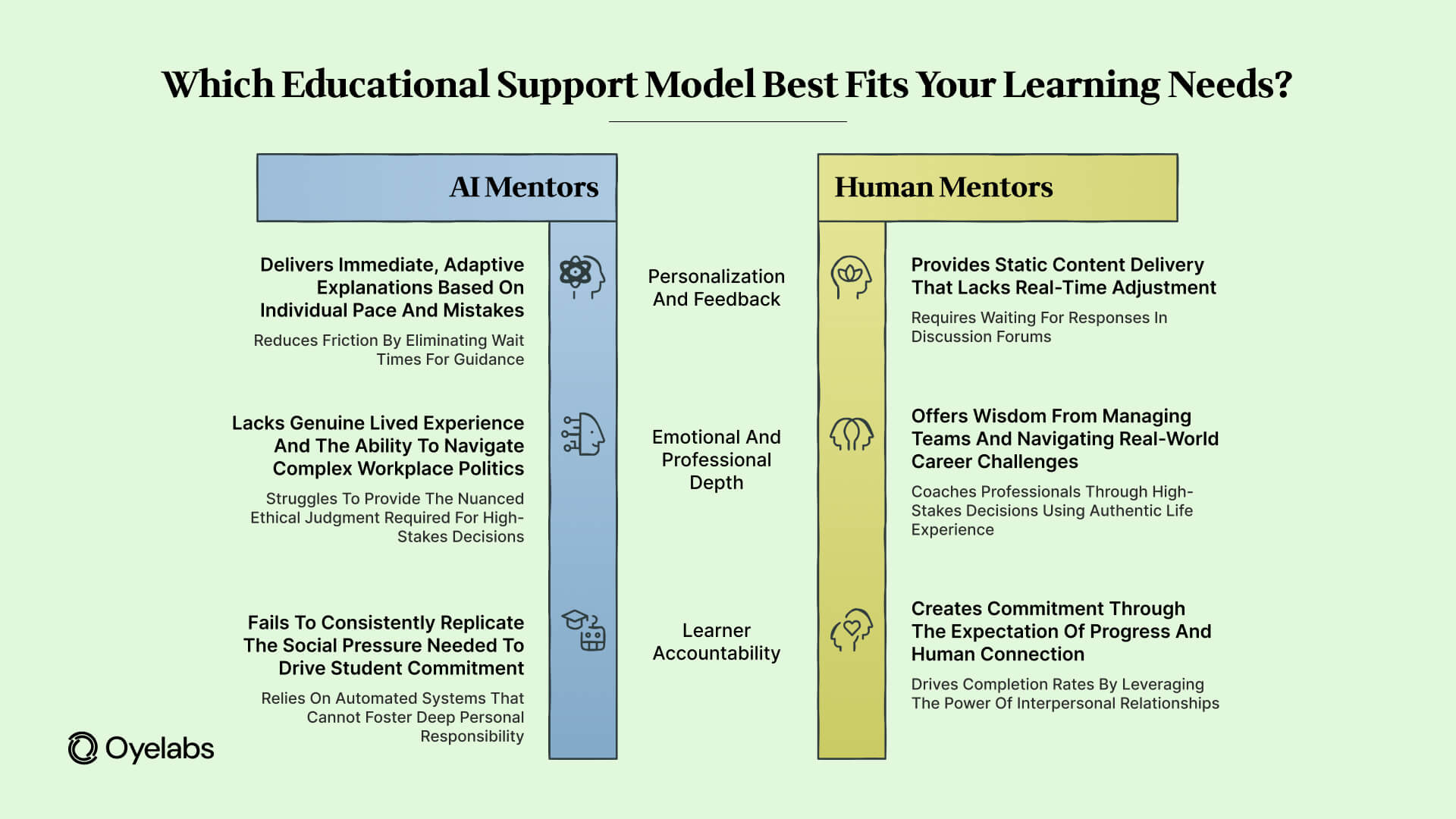
AI mentors are exceptionally effective at delivering personalized explanations, adaptive practice, and continuous support, but they remain less capable in areas requiring empathy, motivation, ethical judgment, and long-term human relationships.
One of AI’s biggest strengths is personalization.
Traditional online courses usually present identical content to every learner.
AI can instead adjust explanations based on:
- Previous mistakes
- Learning pace
- Preferred examples
- Assessment results
- Skill level
- Career objectives
This creates a learning experience that feels far more individualized without increasing instructor workload.
AI also removes one of online education’s biggest friction points: waiting.
Instead of posting a question in a discussion forum and hoping for a reply hours later, learners receive immediate guidance while they are actively studying.
This continuous feedback loop helps maintain momentum.
Another significant advantage is adaptive learning.
Rather than following a rigid sequence of lessons, AI can recommend:
- concepts requiring revision,
- supplementary resources,
- practice exercises,
- more challenging material,
- or simplified explanations.
Learning becomes dynamic rather than linear.
Despite these strengths, important limitations remain.
AI does not possess genuine lived experience.
It cannot replace a mentor who has managed engineering teams, negotiated funding rounds, navigated workplace politics, or coached professionals through high-stakes career decisions.
It also struggles with learner accountability.
Many people complete demanding programs not because information is unavailable, but because another person expects progress.
Human accountability creates commitment in ways current AI systems cannot consistently replicate.
For EdTech founders, this distinction is critical.
The goal should not be replacing instructors.
It should be reducing repetitive instructional work so human experts can focus on mentoring, coaching, and higher-value interactions that technology still cannot deliver effectively.
Why the Future of EdTech Is Hybrid, Not Human vs AI
The future of EdTech will not be defined by AI replacing instructors. Instead, successful learning platforms will combine AI for continuous, personalized support with human experts for mentorship, accountability, assessment, and career guidance. This hybrid approach delivers better learning outcomes while remaining economically scalable.
The debate around AI mentors often assumes education is a binary choice between automation and human interaction. In practice, learning is far more nuanced.
Different stages of learning require different kinds of support.
A learner studying Python fundamentals may ask dozens of repetitive questions that AI can answer instantly. However, when preparing for a technical interview or deciding between career paths, the same learner benefits from speaking with someone who has real industry experience.
This division of responsibilities creates a stronger educational model.
Let AI Handle High-Frequency Learning Tasks
AI excels at activities that are repetitive, data-driven, and require immediate feedback.
These include:
- Explaining concepts in multiple ways
- Generating practice questions
- Reviewing assignments
- Tracking learner progress
- Recommending revision topics
- Creating personalized learning plans
- Providing multilingual assistance
- Answering course-related questions
Because these tasks occur thousands of times every day across large platforms, automation dramatically improves both learner satisfaction and operational efficiency.
Let Humans Focus on High-Impact Mentorship
Certain aspects of education remain deeply human.
Experienced mentors help learners:
- Build confidence
- Develop leadership skills
- Navigate workplace challenges
- Prepare for interviews
- Receive constructive career advice
- Stay accountable throughout long learning journeys
These conversations depend on trust, empathy, lived experience, and contextual judgment rather than simply retrieving information.
The most successful platforms in the coming years are likely to design AI as a learning companion rather than positioning it as a replacement instructor. This not only improves the learner experience but also enables instructors to spend their time where they create the greatest value.
What Founders Should Build Instead of Copying Udemy
Founders planning to build an app like Udemy should avoid competing solely on course quantity. The next generation of EdTech platforms will differentiate themselves through personalized learning experiences, AI-assisted mentorship, measurable learner outcomes, and continuous engagement.
Many entrepreneurs entering the EdTech market still begin with the same checklist:
- Course catalog
- Video player
- Instructor dashboard
- Student dashboard
- Payment gateway
- Ratings and reviews
These features are no longer differentiators – they are expected.
Instead, founders should ask a different question:
“How does the platform help learners succeed after purchasing a course?”
That shift fundamentally changes product strategy.
Features That Define Modern EdTech Platforms
| Traditional Learning Platform | AI-Driven Learning Platform |
| Static video courses | Adaptive learning journeys |
| Fixed curriculum | Personalized learning paths |
| Manual Q&A forums | AI mentor available 24/7 |
| Course completion certificates | Continuous skill tracking |
| Generic recommendations | AI-powered content suggestions |
| Instructor-only feedback | Instant AI feedback plus instructor review |
| Progress tracking | Predictive learner analytics |
Another opportunity lies in learning beyond the course itself.
Instead of ending the relationship when a learner completes a course, platforms can continue providing value through:
- AI career coaching
- Personalized upskilling recommendations
- Industry news summaries
- Mock interview preparation
- Portfolio reviews
- Resume optimization
- Learning habit reminders
This transforms the platform from a course marketplace into a long-term learning ecosystem.
For founders looking to build an app like Udemy, this represents a significant strategic shift. The competitive advantage is no longer who hosts the most courses. It is who helps learners achieve measurable outcomes.
OyeLabs’ Approach to Building AI-Enabled Learning Platforms
At OyeLabs, we view AI as an enhancement layer rather than the foundation of the learning experience. Successful EdTech products begin with well-designed learning workflows, scalable marketplace architecture, and intuitive instructor and learner experiences. AI is then introduced where it creates measurable value – automating repetitive interactions, improving personalization, and helping learners remain engaged throughout their journey.
When building platforms similar to Udemy or custom learning marketplaces, our engineering approach focuses on modular architecture. This allows AI mentors, recommendation engines, analytics, certification systems, live sessions, discussion forums, and assessment tools to evolve independently without disrupting the core learning platform.
This architecture gives founders the flexibility to launch an MVP quickly while continuously introducing AI capabilities as user adoption grows and business priorities evolve.
How OyeLabs Helps
Building an online learning platform today requires more than streaming videos and processing payments. Learners increasingly expect intelligent recommendations, personalized learning paths, AI-powered assistance, instructor marketplaces, progress analytics, certifications, and mobile-first experiences.
OyeLabs helps founders build apps like Udemy by combining proven marketplace architecture with modern AI capabilities. Whether you need a white-label learning platform for rapid market entry or a fully custom EdTech solution, our team designs scalable systems that support instructor onboarding, subscription models, course management, assessments, AI learning assistants, and future feature expansion. Rather than simply replicating existing platforms, we help businesses build learning ecosystems designed for long-term engagement and growth.
Similar Read: Philregis Case Study – Success Story of Our Udemy Clone
Conclusion
The question is no longer whether AI belongs in education. It already does.
The real opportunity lies in deciding where AI creates genuine value and where human expertise remains irreplaceable. AI mentors can personalize learning, answer questions instantly, and scale educational support to millions of learners. Traditional coaches continue to provide empathy, accountability, strategic thinking, and career guidance that technology cannot consistently replicate.
For founders, this means the future of EdTech is not about choosing between AI and instructors. It is about designing platforms where both complement one another. If you’re planning to build an app like Udemy, the strongest competitive advantage will come from creating personalized learning experiences that combine intelligent automation with meaningful human mentorship.
Frequently Asked Questions
Will AI mentors replace traditional coaches?
No. AI mentors are highly effective for personalized explanations, adaptive practice, and instant support, but traditional coaches remain better suited for emotional guidance, accountability, leadership development, and complex career advice. Most experts expect future learning platforms to combine both approaches.
What is the future of EdTech?
As of 2026, the future of EdTech is increasingly centered on personalized, AI-assisted learning rather than static content libraries. Platforms are evolving toward adaptive learning paths, intelligent recommendations, AI tutors, predictive analytics, and hybrid learning models that integrate human expertise.
Why should founders build AI-powered learning platforms instead of traditional course marketplaces?
AI-powered platforms improve learner engagement by providing immediate feedback, personalized study plans, adaptive assessments, and continuous support. These capabilities help differentiate new products from traditional course marketplaces that primarily compete on content volume.
How can AI improve learner retention?
AI can identify learners at risk of dropping out, recommend revision material, send personalized reminders, answer questions instantly, and adjust learning paths based on individual progress. Together, these interventions help maintain motivation and improve course completion rates.
What features should I include when building an app like Udemy?
Beyond core course management features, modern learning platforms should consider AI mentoring, adaptive learning paths, instructor marketplaces, subscriptions, live classes, assessments, certifications, discussion communities, progress analytics, and personalized content recommendations.
Sources
- UNESCO. Guidance for Generative AI in Education and Research (2023).
- OECD. Digital Education Outlook (latest available edition).
- World Economic Forum. Research on AI, workforce skills, and lifelong learning (general industry context).
- OpenAI, Anthropic, and Google product documentation (general capabilities referenced as of 2026; feature availability should be verified before publication).
- Research on Massive Open Online Courses (MOOCs) completion and learner engagement is based on multiple academic studies. Exact completion rates vary significantly by platform, subject, and methodology; therefore, no single percentage has been cited.
- General software architecture, adaptive learning, recommendation systems, and AI tutoring concepts are based on established engineering and instructional design principles and were not independently verified against live sources for this article.
Fact Checked By: Sachin Sharma
Sr. Digital Transformation Consultant, Oyelabs