
Essential APIs Required for a Home Service Marketplace

Essential APIs Required for a Home Service Marketplace
 Anuraag Jain
Last Updated on August 3, 2026
Key Takeaways
- A production-ready home service marketplace typically relies on 7–9 core API categories, including authentication, payments, maps, notifications, scheduling, analytics, AI, email, and security, to deliver a seamless booking experience.
- Maps and geolocation APIs do far more than display locations. They power provider discovery, service area validation, route optimization, ETA calculations, and dispatch decisions that directly affect operational efficiency.
- Payment APIs should support marketplace-specific capabilities such as platform commissions, provider payouts, refunds, and transaction reconciliation, rather than simply processing customer payments.
- Building an API-first architecture allows marketplaces to replace individual providers, such as switching payment gateways or notification services, without redesigning the entire application, reducing long-term technical debt.
- Launching with only the APIs required for an MVP keeps infrastructure costs manageable while leaving room to integrate AI recommendations, advanced scheduling, loyalty programs, and automation as the marketplace grows.
Quick Answer
To build a scalable home service marketplace, you need APIs that handle authentication, payments, maps, scheduling, notifications, email, analytics, and security. Together, these integrations enable provider discovery, secure transactions, appointment management, customer communication, and platform monitoring without requiring you to build every capability from scratch. An API-first architecture also makes it easier to scale, replace vendors, and introduce new features as your marketplace evolves.
APIs for Home Service Marketplace
A modern home service marketplace is only as reliable as the systems working behind the scenes. When a customer books an electrician, the platform must identify nearby professionals, calculate routes, process payments securely, notify both parties instantly, and keep every booking synchronized across multiple devices. None of this happens through custom code alone. It happens through carefully selected APIs.
If you’re planning to build a home service marketplace, understanding which APIs are essential – and why – is just as important as choosing the right technology stack. This guide explains the complete API ecosystem required for a production-ready marketplace, how each integration fits into the overall architecture, and what technical and business decisions founders should make before development begins.
Why APIs Are the Foundation of Every Home Service Marketplace
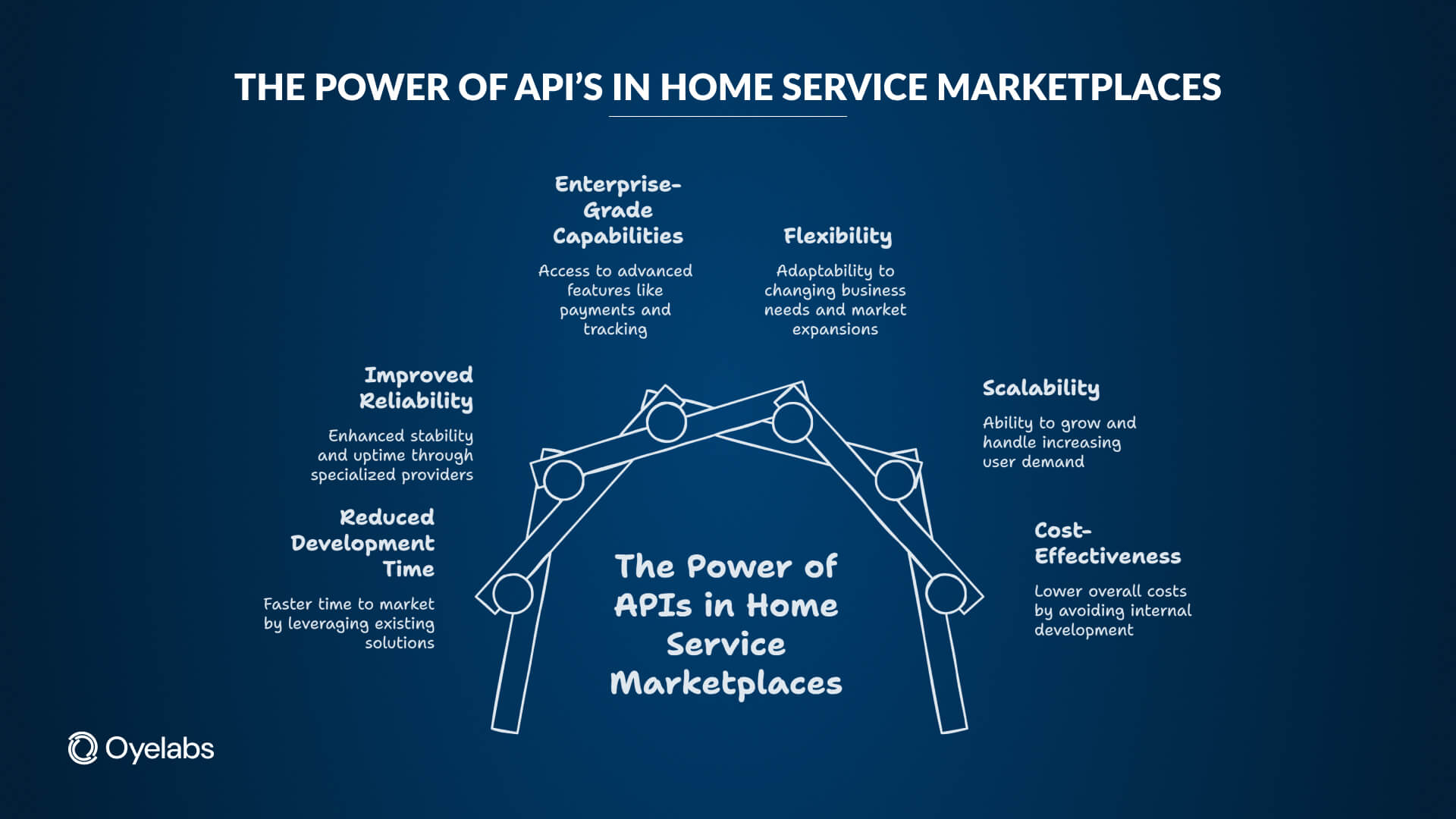
APIs (Application Programming Interfaces) enable a home service marketplace to connect with specialized third-party services instead of rebuilding complex infrastructure from scratch. They reduce development time, improve reliability, and allow marketplaces to offer enterprise-grade capabilities such as digital payments, real-time location tracking, messaging, authentication, and AI-powered recommendations.
Building every capability internally sounds attractive until the engineering effort is measured. Payment processing requires PCI DSS (Payment Card Industry Data Security Standard) compliance. Maps demand constantly updated geographic data. Push notifications require reliable delivery across Android, iOS, and the web. Identity verification often involves regulatory compliance that varies by country.
Established marketplaces avoid reinventing these systems. Instead, they integrate APIs from specialized providers that continuously maintain, secure, and improve their platforms.
A production-ready marketplace like MoonService demonstrates this modular approach. Rather than embedding every capability directly into the application, it integrates dedicated services for maps, notifications, payments, email communication, and security while keeping marketplace logic within its own backend. This creates a flexible architecture that can evolve as business requirements change.
Another advantage is flexibility. If business expansion requires entering a new country where a different payment gateway dominates, only the payment layer changes. The booking engine, provider management system, customer workflows, and administrative dashboards remain untouched because they communicate through standardized interfaces.
In practice, APIs reduce engineering complexity while increasing long-term scalability.
How APIs Fit Into the Architecture of a Home Service Marketplace
APIs should be viewed as architectural building blocks rather than isolated integrations. Every customer action triggers multiple API calls working together, making careful orchestration more important than the individual APIs themselves.
Many founders imagine APIs as optional add-ons that are integrated after the platform is complete. Production systems work differently.
Consider a typical booking journey:
- A customer searches for nearby plumbers.
- The platform retrieves nearby providers using a mapping API.
- Availability is verified through the scheduling engine.
- Pricing is calculated.
- Payment authorization begins.
- Booking confirmation is stored.
- Push notifications are sent.
- Confirmation emails are generated.
- Analytics events are recorded.
- Administrators receive operational notifications.
What appears to the customer as a single “Book Now” button actually coordinates numerous services operating simultaneously.
MoonService follows a similar layered architecture, separating marketplace functionality from supporting infrastructure. The platform combines Laravel for backend business logic, Flutter for mobile applications, MySQL for persistent storage, Firebase for notifications, Google Maps for location services, and Google reCAPTCHA for bot protection, allowing each component to specialize in a specific responsibility.
A simplified architecture often looks like this:
| Layer | Primary Responsibility | Typical APIs |
| Identity | Authentication & authorization | OAuth, Firebase Auth, Auth0 |
| Location | Search, routing, geocoding | Google Maps, Mapbox |
| Payments | Transactions & payouts | Stripe, PayPal, Razorpay |
| Communication | Notifications & messaging | Firebase, OneSignal, Twilio |
| Transactional communication | SendGrid, Mailjet | |
| Analytics | Product insights | Google Analytics, Mixpanel |
| AI | Recommendations & search | OpenAI, Vertex AI |
| Security | Bot protection | Google reCAPTCHA |
The architecture matters because every new feature eventually depends on these foundational services.
Identity and Authentication APIs
Authentication APIs secure every interaction inside a marketplace by verifying user identity, protecting customer data, and controlling access to different platform roles such as customers, service providers, and administrators.
Authentication is much more than logging in.
A home service marketplace usually supports multiple user types:
- Customers
- Individual service providers
- Service companies
- Field agents
- Platform administrators
- Support teams
Each role requires different permissions.
For example, customers should only access their own bookings. Providers should view jobs assigned to them. Administrators require visibility across the entire marketplace. Authentication APIs enforce these boundaries automatically.
Most modern marketplaces rely on OAuth 2.0 for secure authorization, JSON Web Tokens (JWTs) for maintaining authenticated sessions, and optional social login providers such as Google or Apple to simplify registration.
As platforms scale, authentication becomes increasingly important because account compromise affects financial transactions, customer addresses, and provider earnings.
Several additional capabilities are commonly implemented through authentication APIs:
Multi-Factor Authentication (MFA)
Marketplace administrators often manage sensitive operational data. Requiring a second authentication factor significantly reduces account takeover risk.
Password Recovery
Secure password reset flows prevent unauthorized account recovery while minimizing support requests.
Device Management
Providers frequently use multiple devices throughout the day. Authentication systems should manage concurrent sessions without forcing repeated logins.
Role Based Access Control (RBAC)
Instead of writing authorization logic for every page individually, RBAC defines permissions centrally.
For example:
- Customer – Book services
- Provider – Accept bookings
- Company Manager – Assign technicians
- Admin – Configure commissions
This approach keeps the platform maintainable as new features are introduced.
Maps, Geolocation, and Routing APIs
Mapping APIs allow customers to discover nearby professionals, calculate travel distances, estimate arrival times, define service coverage, and optimize field operations. Without accurate location services, most home service marketplaces cannot function effectively.
Location is one of the most important decision variables in home services.
Customers rarely choose providers from another city when dozens of professionals are available nearby.
A mapping API typically provides several independent capabilities.
Geocoding
When customers enter an address, the API converts it into geographic coordinates.
Instead of storing:
“742 Evergreen Terrace”
the marketplace stores precise latitude and longitude, enabling accurate searches.
Reverse Geocoding
Coordinates can also be converted back into readable addresses for invoices, confirmations, and customer support.
Distance Calculation
Rather than showing every electrician within a city, platforms can prioritize providers within a practical travel radius.
Distance also influences:
- Service fees
- Estimated arrival time
- Route optimization
- Dispatch decisions
Route Optimization
As marketplaces grow, provider productivity becomes increasingly important.
Instead of assigning jobs randomly, routing APIs minimize travel time by grouping nearby appointments together.
This increases completed jobs per day while reducing transportation costs.
MoonService incorporates Google Maps to enable location-based service discovery, provider coverage management, address selection during booking, and nearby service searches, demonstrating how mapping APIs become integral to the booking workflow rather than standalone features.
One implementation mistake many MVPs make is calling mapping APIs excessively.
Every autocomplete request, map refresh, or route calculation consumes API quota and increases operating costs. Production systems commonly reduce expenses by:
- caching frequent searches,
- storing geocoded addresses,
- batching requests,
- limiting unnecessary refreshes,
- and serving repeated data from internal databases whenever possible.
Designing the location layer efficiently can significantly reduce infrastructure costs as booking volume grows.
Payments, Wallets, and Payout APIs
Payment APIs securely process customer transactions, manage refunds, distribute provider earnings, calculate platform commissions, and maintain financial records. They are among the most business-critical integrations in any marketplace because they directly affect revenue, trust, and regulatory compliance.
Unlike a traditional ecommerce website, a home service marketplace involves multiple financial stakeholders.
A single booking may include:
- Customer payment
- Platform commission
- Provider earnings
- Taxes
- Discounts
- Promotional credits
- Refund adjustments
Managing these calculations manually becomes increasingly complex as transaction volume grows.
Modern payment APIs simplify this complexity by handling secure payment authorization, tokenization, fraud detection, recurring billing, and transaction reconciliation.
MoonService supports integration with payment gateways including Stripe, PayPal, and Razorpay for secure booking payments, commission collection, provider earnings tracking, and complete transaction visibility within the administrative dashboard.
However, processing payments is only part of the equation.
Marketplace operators should also plan for:
- split payments,
- provider payouts,
- failed transactions,
- chargebacks,
- refund workflows,
- payout scheduling,
- multi-currency expansion,
- and accounting reconciliation.
One architectural best practice is to isolate payment processing behind a dedicated payment service layer rather than scattering payment logic throughout the application. This makes future gateway migrations significantly easier and reduces dependency on a single vendor.
A well-designed payment architecture not only protects revenue but also simplifies compliance, improves customer trust, and supports expansion into new markets without requiring major changes to the marketplace itself.
Notifications and Communication APIs
Notification APIs keep customers, service providers, and administrators informed throughout the booking lifecycle. They improve operational efficiency, reduce missed appointments, and create a smoother customer experience by delivering timely updates across multiple communication channels.
Booking confirmation is only the beginning of a service journey. Every meaningful event should trigger relevant communication.
For example:
- Booking confirmed
- Provider accepted the request
- Technician is on the way
- Provider has arrived
- Service completed
- Invoice generated
- Customer review requested
Without automated notifications, users constantly check the application for updates, leading to a poor experience and increased support inquiries.
Most production marketplaces combine several communication channels rather than relying on one.
Push Notifications
Push notifications provide real-time alerts on Android, iOS, and web applications. They are ideal for booking updates, arrival notifications, and reminders because they are immediate and cost-effective.
Email Notifications
Email remains essential for transactional communication such as account verification, password resets, booking confirmations, invoices, receipts, and cancellation summaries.
SMS and Messaging
SMS or messaging APIs are valuable for high-priority alerts, especially when internet connectivity is unreliable. Appointment reminders, OTP verification, and urgent booking changes often use SMS because of its high delivery rate.
MoonService supports Firebase and OneSignal for push notifications and integrates email providers such as SendGrid and Mailjet for transactional communication. These integrations power booking confirmations, account verification, password recovery, and operational notifications across the platform.
An increasingly common enhancement is integrating messaging platforms like WhatsApp. Rather than building another communication channel, marketplaces leverage platforms customers already use. MoonService’s optional WhatsApp integration reflects this growing trend by allowing customers to initiate service requests through WhatsApp workflows.
One implementation mistake is sending every notification immediately. Production systems often queue messages using asynchronous workers, ensuring that temporary notification provider outages do not interrupt the booking process.
Calendar, Scheduling, and Availability APIs
Scheduling APIs coordinate provider availability, prevent double bookings, optimize appointment allocation, and maintain synchronization across customer, provider, and administrative interfaces.
Scheduling appears straightforward until multiple providers, recurring appointments, cancellations, emergency requests, and varying service durations enter the equation.
Consider a cleaning company with five technicians.
Each technician may have:
- Different working hours
- Different service areas
- Different service categories
- Vacation schedules
- Existing appointments
- Emergency blocks
A scheduling engine must evaluate all these variables before confirming a booking.
Key capabilities typically include:
Real-Time Availability
Providers should not receive bookings during unavailable hours.
Appointment Buffering
Travel time between appointments must be considered to avoid unrealistic schedules.
Recurring Services
Many home service businesses rely on weekly or monthly recurring appointments for services like cleaning, lawn maintenance, or pest control.
Time Zone Handling
Although local marketplaces operate within one region initially, expansion into multiple cities or countries introduces time zone complexities that scheduling APIs must address correctly.
Practitioners often discover that availability logic becomes one of the most customized components of a marketplace. While APIs provide scheduling infrastructure, business rules – such as provider preferences, emergency prioritization, or premium booking windows – are usually implemented within the marketplace backend rather than delegated entirely to third-party services.
AI, Search, and Recommendation APIs
AI APIs enhance marketplace efficiency by improving search relevance, personalizing recommendations, automating customer support, summarizing provider reviews, and assisting operational decision-making. Rather than replacing marketplace logic, AI complements existing workflows.
Search is one of the most underestimated components of a service marketplace.
Customers rarely search using exact category names.
Instead of typing:
“Licensed Residential Electrician”
they search for:
- Fix power outage
- Ceiling fan installation
- Socket repair
- Electrician near me
Traditional keyword search often struggles with these variations.
Modern AI-powered search APIs understand user intent rather than relying solely on matching keywords.
Additional AI applications include:
Intelligent Service Recommendations
AI can recommend providers based on:
- Previous bookings
- Ratings
- Response time
- Distance
- Price range
- Service completion history
This creates a more personalized marketplace experience while improving booking conversion.
Automated Customer Support
AI assistants can resolve routine questions such as:
- Where is my provider?
- Can I reschedule?
- How do refunds work?
- How do I update my address?
This reduces operational costs without replacing human support for complex issues.
Review Summarization
Large marketplaces often accumulate thousands of reviews. AI can generate concise summaries highlighting common strengths and recurring concerns, helping customers make faster decisions.
Fraud Detection
Machine learning models increasingly assist marketplaces by identifying suspicious booking behavior, fake reviews, payment anomalies, and unusually high cancellation rates.
As of 2026, AI APIs continue to evolve rapidly, with capabilities, pricing models, and model performance changing frequently. Founders should evaluate providers based not only on accuracy but also on data privacy, latency, regional availability, and long-term cost predictability before integrating AI into production workflows.
Analytics, Monitoring, and Security APIs
Analytics and monitoring APIs provide visibility into marketplace performance, while security APIs protect the platform from abuse, fraudulent activity, and malicious automation. Together, they support informed decision-making and operational resilience.
Successful marketplaces continuously measure user behavior.
Common metrics include:
- Booking conversion rate
- Search abandonment
- Provider acceptance rate
- Average response time
- Customer retention
- Cancellation percentage
- Revenue per booking
Analytics platforms transform raw events into actionable insights that guide product improvements.
Monitoring tools serve a different purpose.
Instead of measuring business performance, they monitor application health by tracking:
- API latency
- Error rates
- Database performance
- Server utilization
- Failed payment requests
- Third-party service outages
Without observability, teams often discover issues only after customers report them.
Security deserves equal attention.
Home service marketplaces store sensitive information including customer addresses, phone numbers, payment references, and provider identities.
Essential security integrations include:
- Bot detection
- CAPTCHA validation
- API rate limiting
- Encryption
- Audit logging
- Identity verification
- Web Application Firewalls (WAF)
MoonService incorporates Google reCAPTCHA to reduce automated abuse and includes cookie consent mechanisms to support privacy compliance, illustrating how security integrations should be embedded into the platform rather than treated as optional additions.
Security should be designed as a continuous process, not a one-time implementation completed before launch.
How to Choose APIs for Long-Term Scalability
The best API is not necessarily the one with the most features. Founders should prioritize reliability, documentation quality, global availability, security, scalability, pricing transparency, and ease of future replacement.
Selecting APIs without evaluation often creates technical debt that becomes expensive to resolve later.
Use the following checklist before committing to any integration.
| Evaluation Criteria | Why It Matters |
| Documentation quality | Reduces development time and implementation errors. |
| SLA and uptime | Determines service reliability for production systems. |
| Scalability | Supports increasing transaction volumes without redesign. |
| Regional availability | Ensures compliance with local regulations and customer expectations. |
| Pricing transparency | Prevents unexpected infrastructure costs as usage grows. |
| Security certifications | Indicates adherence to recognized security standards. |
| Webhook support | Enables real-time event synchronization between systems. |
| SDK availability | Simplifies implementation across web and mobile platforms. |
| Vendor portability | Reduces dependency on a single provider and eases future migrations. |
Another common mistake is integrating every available API during the MVP stage.
Most successful marketplaces launch with a focused technology stack consisting of:
- Authentication
- Maps
- Payments
- Notifications
- Basic analytics
Advanced AI, loyalty systems, subscription engines, dynamic pricing, and sophisticated recommendation systems can be introduced once the marketplace demonstrates product-market fit.
This incremental approach reduces technical complexity while preserving flexibility for future expansion.
OyeLabs’ Approach to API-First Marketplace Development
Designing APIs is rarely the difficult part of building a marketplace. The real challenge is deciding where integrations belong, how they communicate with one another, and how to ensure that replacing one service does not require rewriting the entire platform.
At OyeLabs, we approach home service marketplace development using a modular architecture where business logic remains independent of third-party providers wherever practical. Payment gateways, mapping services, notification providers, email systems, and security services are integrated as interchangeable components rather than tightly coupled dependencies. This makes it significantly easier to introduce additional payment gateways, migrate cloud providers, or expand into new regions without disrupting the booking workflow.
Our UrbanClap Clone (now Urban Company) platform follows this architectural philosophy by combining Laravel, Flutter, MySQL, Firebase, Google Maps, and configurable third-party integrations into a scalable marketplace foundation while allowing businesses to extend functionality through modules such as provider subscriptions, live chat, WhatsApp booking, job posting, and multi-agent service companies.
This API-first approach helps founders launch faster while preserving the flexibility required for long-term growth.
How OyeLabs Helps
Whether you’re validating an MVP or launching a multi-city marketplace, choosing the right APIs is just as important as choosing the right technology stack. OyeLabs’ MoonService provides a production-ready home service marketplace foundation with built-in integrations for payments, Google Maps, push notifications, email systems, security, and cloud deployment, allowing founders to accelerate development while avoiding common architectural mistakes.
For businesses with unique operational requirements, our engineering team also develops custom API integrations, provider workflows, scheduling engines, AI-powered search, commission models, and enterprise-grade marketplace functionality. Instead of building isolated features, we focus on creating scalable, modular architectures that can evolve alongside your business, making future integrations and regional expansion significantly easier.
Also Read: Total Investment Needed to Build an UrbanClap-Like App
Conclusion
Building a successful home service marketplace involves far more than developing customer and provider interfaces. Every booking depends on a coordinated ecosystem of APIs handling authentication, mapping, scheduling, payments, notifications, analytics, AI, and security behind the scenes.
Choosing these integrations thoughtfully has long-term implications for scalability, operational efficiency, customer experience, and engineering costs. While individual APIs solve specific problems, their true value lies in how well they work together within a modular architecture that can evolve as the business grows.
At OyeLabs, we design and develop scalable home service marketplace platforms that combine proven marketplace architecture with carefully selected API integrations. Whether you’re launching an MVP or building a multi-region service platform, the right technical foundation today will significantly reduce complexity as your marketplace scales tomorrow.
Frequently Asked Questions
What APIs are required to build a home service marketplace?
At a minimum, a production-ready home service marketplace typically requires APIs for authentication, payments, maps and geolocation, push notifications, transactional email, analytics, and security. As the platform grows, additional APIs for AI, scheduling, messaging, identity verification, and business intelligence may also be integrated.
Which payment API is best for a home service marketplace?
The answer depends on your target market. Stripe offers extensive developer tools and marketplace capabilities in supported regions, while PayPal provides broad consumer familiarity. Razorpay is widely used for businesses operating in India. As of 2026, founders should evaluate supported countries, payout capabilities, transaction fees, and compliance requirements before selecting a provider.
Why are mapping APIs important in home service apps?
Mapping APIs enable location-based provider discovery, address validation, route calculation, travel time estimation, service area management, and dispatch optimization. These capabilities directly influence booking accuracy and operational efficiency.
Can I build a home service marketplace without third-party APIs?
Technically yes, but it is rarely practical. Rebuilding payment processing, mapping infrastructure, notification delivery, authentication, and fraud protection requires significant engineering investment and ongoing maintenance. Most production marketplaces integrate specialized APIs instead.
How do APIs improve scalability?
APIs separate specialized infrastructure from core marketplace logic. This modular architecture allows businesses to replace or upgrade individual services – such as payment gateways or messaging providers – without redesigning the entire application.
Sources
- MoonService Product Documentation (Technology Stack, Third-Party Integrations, Platform Features, Hosting Requirements, 2026).
- OAuth 2.0 Authorization Framework – General web standards
- JSON Web Token (JWT) specifications – General web standards
- PCI DSS (Payment Card Industry Data Security Standard) – General industry security standard
- REST API design principles, asynchronous messaging, caching strategies, webhook architecture, observability practices, and role-based access control are general software engineering knowledge and were not independently verified against live sources for this article.
Reviewed By: Anuraag Jain
CEO, Oyelabs and AI Transformation Expert