
Total Investment Needed to Build an UrbanClap-Like App

Total Investment Needed to Build an UrbanClap-Like App
 Anuraag Jain
Last Updated on December 1, 2025
Key Takeaways
What You’ll Learn:
- Custom UrbanClap-like apps cost between $25,000 and $150,000 to build.
- A ready UrbanClap-like app from Oyelabs costs only $1999 with full source code.
- UrbanClap-like app development requires backend, mobile apps, admin panel, and APIs.
- White-label apps reduce time, budget, and launch risk for early-stage founders.
- Founders choose white-label apps to reduce risk and validate demand quickly.
Stats That Matter:
- Global online home-services market may reach $1.37 trillion by 2031.
- India’s online home-services market may grow 22% yearly until 2030.
- U.S. home-services market could hit $893 billion by 2032.
- Home-services platforms often earn through commissions, subscriptions, and service fees.
Real Insights:
- Custom apps cost more due to multi-module, real-time booking systems.
- White-label apps offer faster launches and lower development risks.
- Adding more service categories increases revenue and customer retention.
- Simple booking flows improve conversions and repeat usage.
- Source-code ownership helps founders scale freely without developer dependency.
Total Investment Needed to Build an UrbanClap-Like App
Building a home-services platform in 2025 feels a lot like trying to order a handyman on the spot – you want it fast, reliable, and without unnecessary complications. That’s exactly why apps like UrbanClap (Urban Company) are exploding across major markets. Consumers now expect real-time availability, verified service professionals, and frictionless booking workflows. And founders? They’re looking at the numbers: a global on-demand services market projected to surpass $1 trillion, rising repeat-order behavior, and a business model with strong unit economics when executed well.
If you’re a CEO or early-stage founder exploring the investment needed to build an UrbanClap-like app, you’re not alone. We’ve worked with dozens of teams evaluating development cost structures, tech stack implications, and deployment timelines before taking the leap.
This guide breaks down every expense, every hidden variable, and every smart alternative – so you can make a high-clarity, data-backed decision without getting lost in the noise.
What Exactly Is an UrbanClap/Urban Company-Like App?
An UrbanClap-like app is a full-stack on-demand home services marketplace designed to connect customers with verified service professionals in real time. At its core, the platform handles service discovery, instant bookings, provider allocation, payments, tracking, and post-service feedback, all orchestrated through a centralized admin system.
The platform operates on a dual-sided model:
- Customers use the app to browse categories, compare pricing, check reviews, schedule services, and pay securely.
- Service providers use their dedicated app to accept jobs, manage schedules, update availability, and track earnings.
The value of this model lies in automation. A modern UrbanClap-like app integrates identity verification, geo-routing, dynamic pricing, and workforce management into a single ecosystem – reducing operational overhead while improving fulfillment rates and user satisfaction.
What Features Decide the Total Investment for an UrbanClap-Like App?
The investment required depends heavily on the breadth and depth of features you choose. Below is a structured breakdown that reflects typical cost drivers.
What Must a Customer App Include?
A customer-facing app requires seamless navigation and trust-building features. These directly impact both cost and timeline.
Essential components include:
- User registration and onboarding
- Location detection and service browsing
- Categories and subcategories
- Service details with pricing and availability
- Booking and scheduling
- In-app payments (cards, wallets, BNPL, and local gateways)
- Order tracking
- Ratings and reviews
- Notifications (push, SMS, in-app)
- Support and Help Center
What Features Are Essential for the Service Provider App?
The service provider app must support operational efficiency and compliance, ensuring vetted professionals can manage their work with minimal friction.
Key elements include:
- KYC and document verification
- Profile setup and category assignment
- Job alerts and acceptance logic
- Schedule and availability management
- Earnings dashboard
- Withdrawal requests and payout tracking
- Performance analytics
- Support tools
What Does the Admin Panel Need to Manage the Platform Efficiently?
The admin panel is the control center that governs platform performance, compliance, pricing, and user experience. A robust admin panel minimizes manual intervention and creates operational scalability.
Core admin capabilities include:
- Customer and provider management
- Category and subcategory configuration
- Dynamic pricing controls
- Booking oversight
- Complaint resolution
- CMS for banners, offers, and announcements
- Reports and analytics (revenue, retention, utilization, churn)
- Promo codes and marketing tools
What Are the Key Factors That Influence the Cost of Building an UrbanClap-Like App?
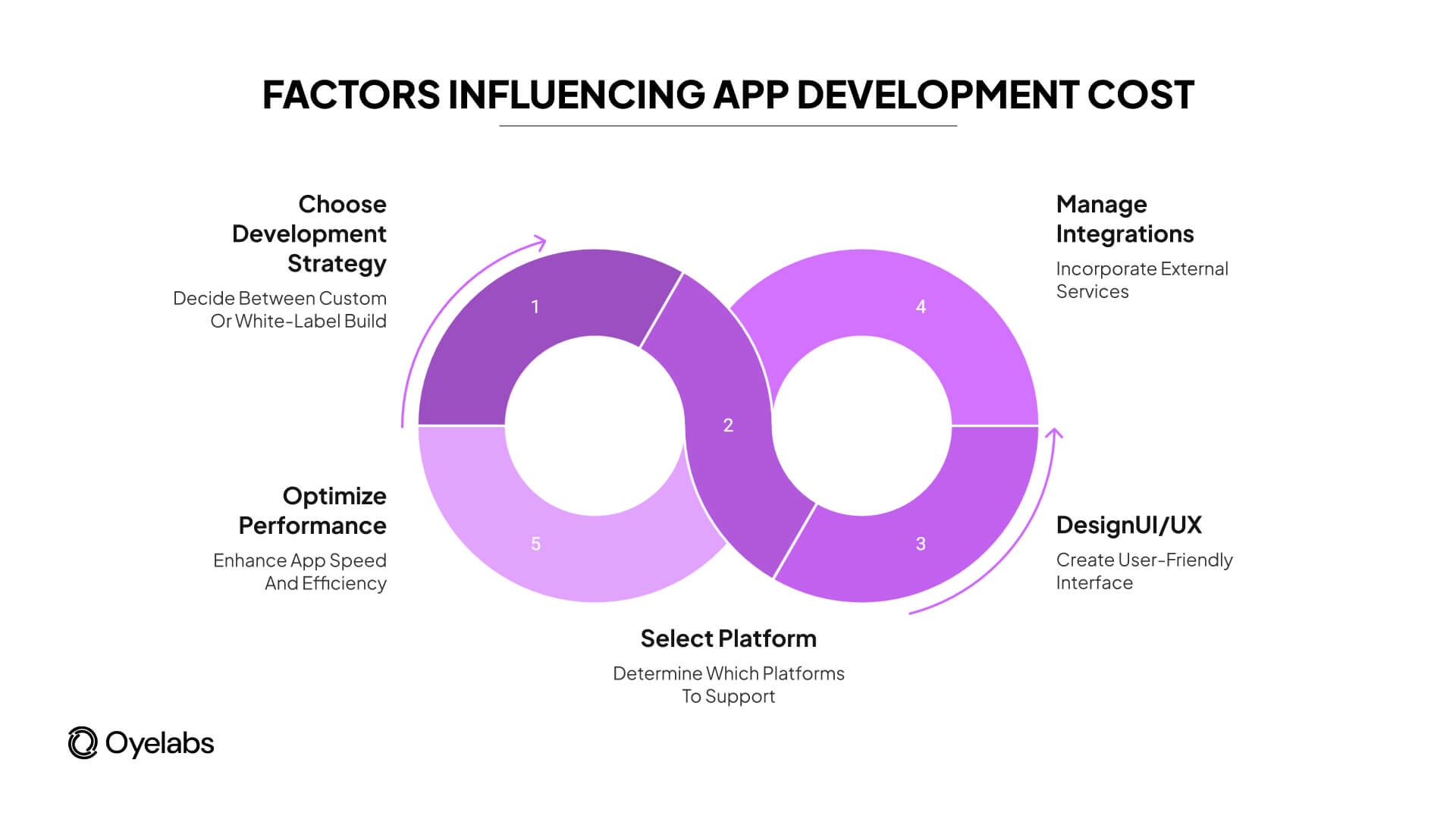
The total investment varies significantly based on development strategy, feature expectations, and external integrations.
Globally, the online home-services market is projected to expand from USD 392 billion in 2024 to USD 1.37 trillion by 2031 (CAGR – 19.6%), making it one of the fastest-growing service sectors.
Below is a clean, structured explanation that founders can rely on.
Should You Choose Custom Development or a White-Label Build?
This is the single biggest contributor to overall cost.
Custom Development:
- Built from scratch
- Fully bespoke architecture
- Highest flexibility
- Costs range from $25,000 to $150,000+
White-Label Build:
- Pre-built architecture
- Faster deployment
- Lower cost
- Ideal for early startups
- Solutions like Oyelabs start at $1,999 with full source code
How Does Platform Choice Affect Development Cost?
Each platform adds engineering complexity.
- Android only: lowest cost
- iOS + Android: nearly doubles mobile effort
- Web app + mobile apps: highest scope
- Cross-platform (Flutter/React Native): optimized cost, but still significant for custom builds
Startup founders commonly overshoot budgets by starting with all platforms at once. In many markets, launching with Android + Web is sufficient for demand validation.
Why Does UI/UX Complexity Impact Budget?
Polished user experience requires more than screens – it requires behavioral mapping, micro-interactions, and performance optimizations.
Cost increases when adding:
- Advanced animations
- Multi-step booking flows
- Split payments and pricing variations
- Custom dashboards
- Persona-based navigation
Simple, modern, conversion-focused UX keeps costs aligned with product maturity.
How Much Does It Cost to Build an UrbanClap-Like App From Scratch?
Building an UrbanClap-like platform involves multiple layers of engineering – from UI design and mobile development to backend logic and admin management. The total investment varies based on scope, technology, and performance expectations. Below is a clear, realistic breakdown aligned with current 2025 development benchmarks.
What Is the UI/UX Design Cost?
Design sets the tone for trust and ease of use. A home services marketplace requires clean navigation, intuitive service discovery, and frictionless booking flows. The cost depends on whether you choose template-driven layouts or a fully customized design system.
Estimated Cost Range:
- $2,000 – $5,000 for simple modern UI
- $6,000 – $12,000 for custom high-fidelity visuals and micro-interactions
What Is the Cost of Frontend and Backend Development?
This is the heart of the system. The frontend covers the customer-facing and provider-facing interfaces, while the backend handles booking logic, data processing, payments, provider allocation, and notifications. A scalable backend architecture significantly increases development time.
Frontend typically covers the booking screens, category listings, tracking views, chats, and payment UI. Backend development involves API creation, server-side logic, database architecture, authentication layers, and real-time updates.
Estimated Cost Range:
- $15,000 – $60,000+ depending on complexity and performance requirements
How Much Do iOS and Android Apps Cost to Build?
Native apps require separate development cycles for each platform. Even if you choose Flutter or React Native, the effort remains substantial because backend logic, third-party integrations, and UI responsiveness must be optimized for both ecosystems.
Costs depend on the number of booking steps, tracking features, payment flows, and provider-side functionalities you want to introduce.
Typical Cost Range:
- Android only: $7,000 – $15,000
- iOS only: $7,000 – $15,000
- Both platforms: $15,000 – $30,000+
How Long Does It Take to Build an UrbanClap-Like App?
A production-ready home services marketplace typically takes several months to engineer because it requires synchronization across multiple modules – user apps, provider apps, admin panel, backend systems, and integrations.
The development process generally moves through design, frontend development, backend development, QA cycles, refinements, and deployment. For a custom build, even a lean MVP takes significant time due to real-time booking functionality, payment flows, and operations logic.
Estimated Timelines:
- UI/UX: 3–6 weeks
- Frontend & backend: 18–30 weeks combined
- Mobile apps: 10–18 weeks
- Admin panel: 4–8 weeks
- QA & testing: 3–6 weeks
Overall, most custom UrbanClap-like builds fall between 4–6 months for an MVP and 6–9 months for a full-featured release.
Why Has Custom App Development Become So Expensive for Startups?
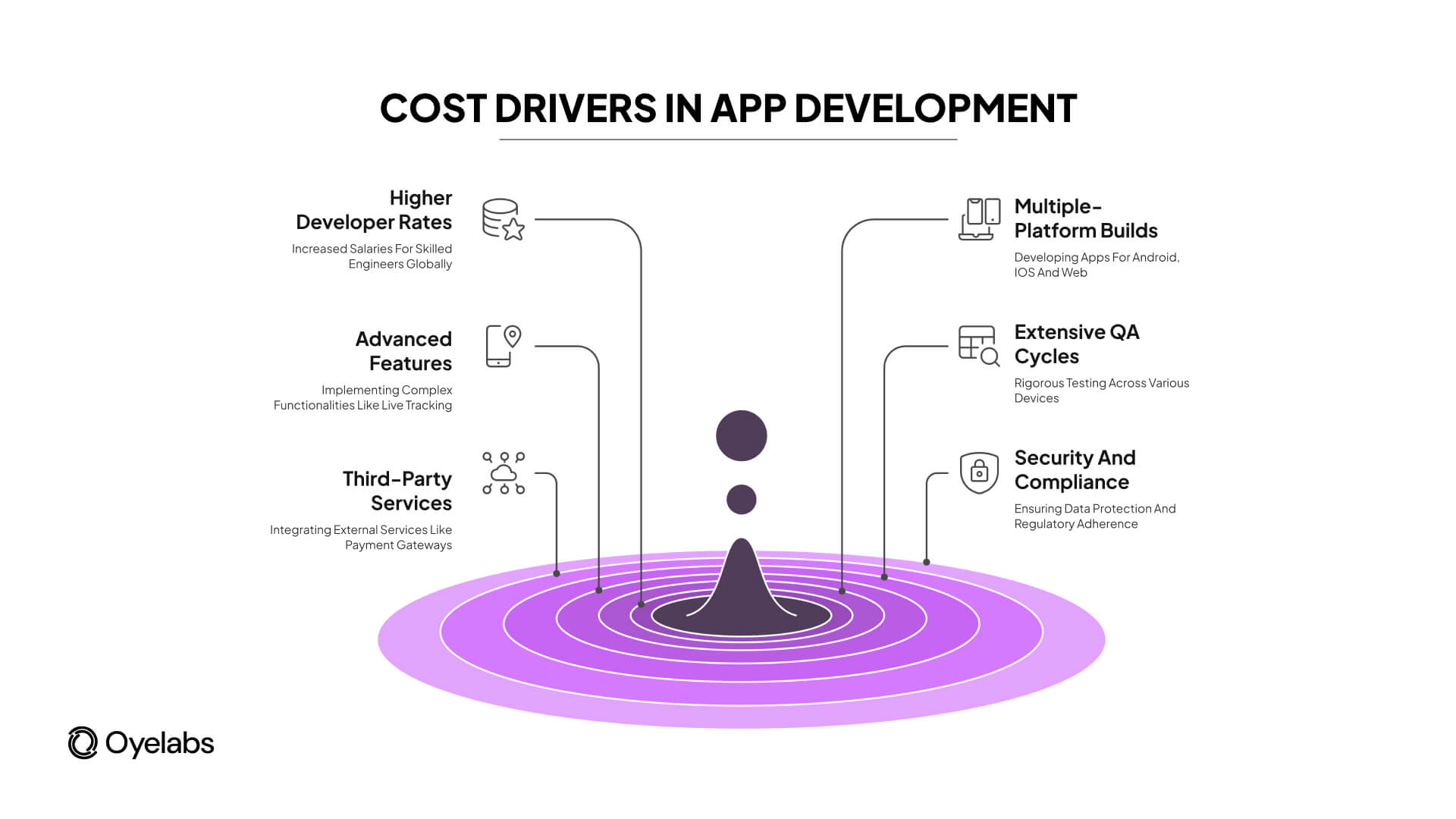
The rising cost of engineering talent, combined with higher user expectations, has significantly increased overall development spending. Modern home service platforms must handle secure logins, real-time matching, geo-tracking, fast search, digital payments, and automated workflows – none of which are lightweight to build.
Several cost drivers influence today’s pricing:
- Higher developer rates globally, especially for backend and mobile engineering
- Multiple-platform builds, since users expect Android, iOS, and responsive web
- Advanced features such as live tracking, OTP verification, and wallet systems
- Extensive QA cycles for cross-device testing
- Third-party services like payment gateways, SMS APIs, analytics, and KYC checks
- Security and compliance, which adds mandatory layers of encryption and data protection
Collectively, these factors push fully custom UrbanClap-like builds into the $25,000 to $150,000+ range – especially when founders aim for performance, reliability, and long-term scalability.
Building trust is critical in transportation and home-service platforms alike. To see this implemented in a different vertical, explore how UrbanClap handles verification, service delivery, and customer experience.
How Does Oyelabs Deliver an UrbanClap-Like App for Just $1999?
While custom development can stretch into tens of thousands of dollars, Oyelabs eliminates this barrier through a ready-to-launch white-label framework engineered for speed, performance, and scalability. Instead of building every module from scratch, founders receive a fully functional, production-ready platform that includes customer apps, provider apps, and an admin panel – backed by a clean, modular codebase.
The $1999 solution compresses months of engineering effort by offering a refined architecture that already supports real-time bookings, secure payment flows, multi-category management, geo-location services, and provider onboarding. For early-stage startups, it provides the essential foundation to go live quickly, generate traction, and validate demand before investing in expansions.
What Is Included in Oyelabs’ White-Label Home Services Solution?
The pre-built package covers the full ecosystem required to run a home-services marketplace:
- Customer app with booking flow, categories, real-time tracking, wallet, and payment support
- Service provider app with job management, scheduling, document verification, and earnings tracking
- Admin panel for user oversight, pricing control, service configuration, payouts, complaints, and analytics
- Secure backend with APIs, provider allocation logic, notifications, and operational workflows
Every component is customizable, allowing founders to add new verticals, adjust workflows, or introduce exclusive features as they scale.
How Did Oyelabs Help a Founder Become a Recognized Brand?
A recent Oyelabs client entered a crowded home-services market with limited budget but strong operational knowledge. By leveraging Oyelabs’ white-label platform, they launched in under a month with a polished, intuitive interface. Within weeks, the platform saw a measurable increase in user engagement, repeat bookings, and local brand recognition. Their impressions grew steadily because the system delivered a smooth booking experience, verified providers, and reliable fulfillment – allowing the founder to position themselves as a credible service brand far earlier than possible with traditional development cycles.
How Fast Can Oyelabs Deploy an UrbanClap-Like Platform?
Deployment is structured to reduce friction and time wastage. Once branding assets, domain details, and server access are shared, the complete system – customer app, provider app, admin panel, backend – is typically deployed within a few working days. Founders who want to launch faster can begin with web or Android first, then add more platforms as their user base expands.
Why Do CEOs Prefer Oyelabs for On-Demand Home Services Apps?
Oyelabs offers a mix of speed, affordability, and source-code ownership. Unlike SaaS models that charge monthly fees, the system is delivered as a one-time investment with complete access to code, giving founders full control over future customization, integrations, and scaling decisions. This makes it a significantly more strategic investment for CEOs aiming to own their technology rather than renting it.
How Does the Cost of Custom Development Compare to Oyelabs’ $1999 Solution?
Most founders evaluate options based on budget, time-to-market, and ownership needs. When comparing custom development to a white-label setup, the financial gap is substantial. Custom development can range anywhere from $25,000 to $150,000+, depending on platform count and features. Timelines often stretch to six months or more, with ongoing maintenance costs adding to operational expenditure.
In contrast, Oyelabs’ $1999 solution delivers the full structure – customer app, provider app, admin dashboard, and backend – at a fraction of the cost. It also includes source-code ownership, which many agencies charge extra for. For founders looking to validate ideas quickly or enter competitive markets without overspending, the difference in investment is decisive.
What Additional Customizations Can Increase or Optimize Your App’s Investment?
Once the platform is live, many founders invest in enhancements that differentiate their product in the market. These add-ons improve user experience, operational automation, or revenue potential.
Common upgrades include:
- AI-based provider matching to reduce booking friction
- Subscription models for customers or service providers
- Dynamic pricing modules
- Hyperlocal search and geo-fencing
- CRM tools for retention campaigns
- Advanced reporting for multi-city or multi-branch operations
- Multi-language and multi-country setup
- Loyalty programs and credit/wallet systems
Each customization varies in cost depending on complexity, but founders typically add them gradually after initial validation.
What Hidden Costs Should Founders Know Before Building an UrbanClap-Like App?
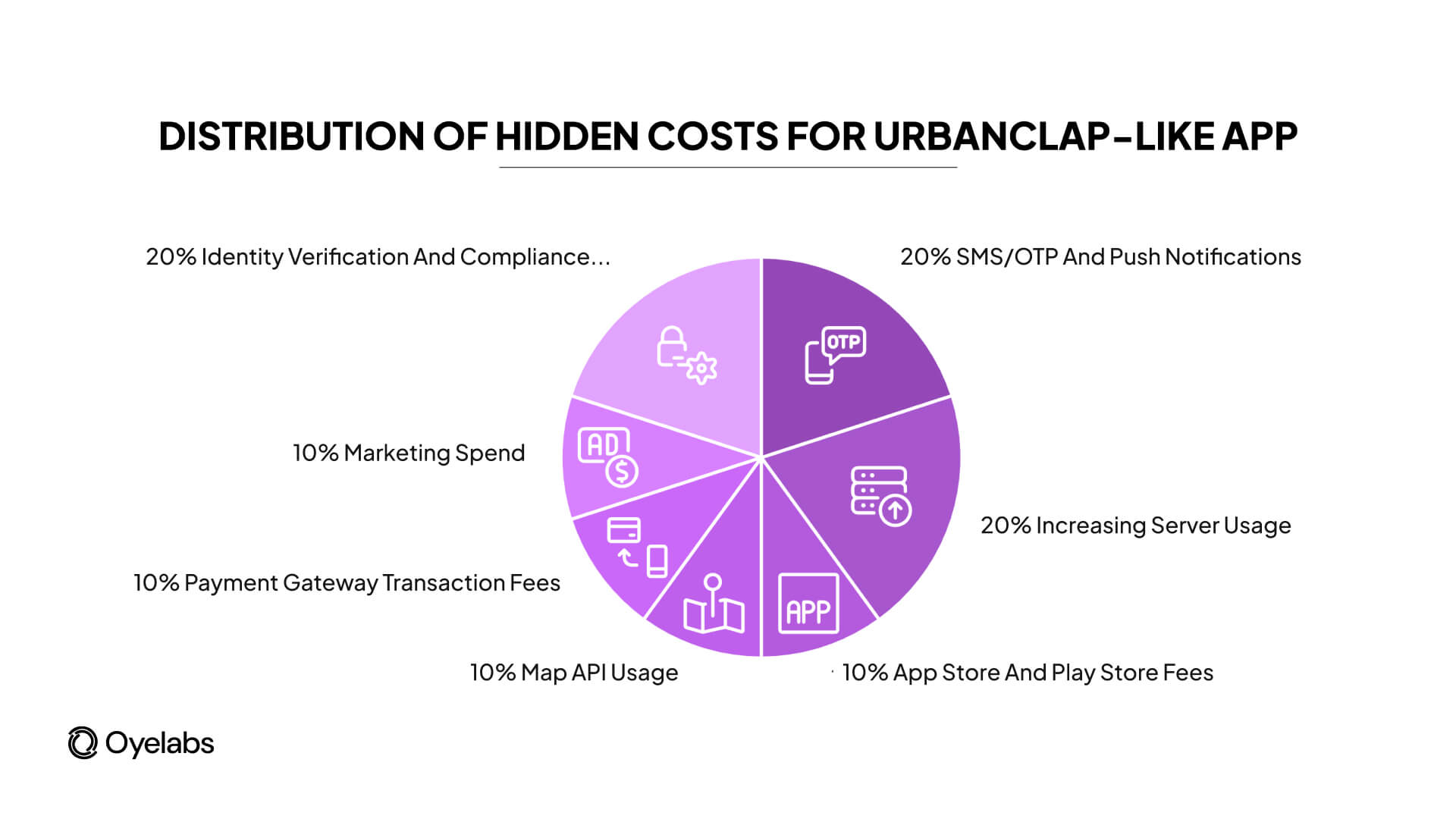
Even with a clear development plan, founders often encounter additional expenses that aren’t obvious at the start. These costs won’t always be large individually, but together they can influence the long-term budget. The first category is infrastructure. As your platform attracts more users, server capacity must scale to maintain fast loading, real-time updates, and uninterrupted booking flows. This naturally increases monthly hosting expenses.
Another overlooked cost is communication. SMS OTPs, transactional alerts, and push notifications all rely on third-party APIs. These vendors charge per message or usage tier, and expenses grow as order volume increases. Platforms with high verification requirements also need identity checks or document scanning, which come with their own per-user costs.
Marketing and compliance also play a role. App Store and Google Play have annual fees. Running promotions, referral programs, or performance ads requires budget allocation. And as you onboard more service providers, background verification tools may become necessary in certain markets.
Common hidden expenses include:
- SMS/OTP and push notification API charges
- Increasing server usage as traffic grows
- App Store and Play Store fees
- Map API usage (geolocation, routing, distance calculation)
- Payment gateway transaction fees
- Marketing spend for user acquisition
- Identity verification and compliance tools
Understanding these costs early allows founders to plan a more sustainable financial strategy.
How Fast Can Entrepreneurs Recover Their Investment?
On-demand home services platforms tend to show predictable revenue once bookings stabilize. Most founders recover their initial investment through diversified income streams that generate consistent cash flow. Commission-based transactions remain the primary model – each completed service contributes a percentage back to the platform. Repeat services, especially in categories like cleaning, beauty, and repair, significantly accelerate ROI because users frequently rebook from trusted providers.
Subscription plans for service providers often add another layer of predictable revenue. Many professionals are willing to pay monthly for premium placement, lead priority, or reduced commission structures. Sponsored listings and hyperlocal ads also create additional income opportunities.
To understand ROI clearly, consider a platform earning revenue through:
- Commission on completed bookings
- Provider subscription packages
- Surge pricing during peak hours
- Featured placement for top professionals
- In-app advertisements
- Convenience or platform fee per booking
In most markets, founders who achieve early traction see meaningful returns within a few months. The growth curve improves when service categories expand or the platform enters multiple neighborhoods or cities.
Can an UrbanClap-Like App Scale Beyond One City or Region?
Scalability is one of the biggest advantages of the on-demand home services model. With the right architecture, founders can extend their platform from a single locality to multiple zones, cities, or even countries. Expansion typically involves adding new service providers, introducing localized pricing, and optimizing logistics to accommodate new regions. The backend system must support multi-city routing, independent tax rules, and location-specific promotions.
A platform built on a modular structure can scale efficiently because new verticals – such as appliance repair, home deep cleaning, grooming, painting, pest control, or fitness services – can be introduced without altering the entire codebase. For founders, this means the initial investment doesn’t limit future capacity. Instead, the platform becomes a foundation for broader expansion.
The most successful home-service brands follow this pattern: start with one high-demand city, refine operations, and gradually roll out to additional regions. With structured onboarding, localized supply acquisition, and data-driven decision-making, the growth becomes predictable rather than experimental.
Final Thoughts
A fully custom UrbanClap-like app can cost anywhere from $25,000 to $150,000+, especially when you include multi-platform development, backend engineering, and ongoing maintenance. For early-stage founders, this level of investment isn’t always necessary. A white-label foundation offers a faster, more cost-efficient path to market while still giving full control and scalability. That’s why Oyelabs’ $1999 home-services solution has become a practical choice for CEOs looking to launch quickly, test real demand, and expand without heavy upfront spending.
If you’re planning to enter the home-services market, schedule a free consultation with Oyelabs. We’ll walk you through the $1999 solution and help you launch a high-quality UrbanClap-like platform in days, not months.
FAQs
What is the average cost to build an UrbanClap-like app?
Most custom UrbanClap-like apps cost between $25,000 and $150,000 depending on complexity.
Why does building an UrbanClap-like app require such a high investment?
Multiple platforms, complex workflows, real-time features, and integrations significantly increase development hours and cost.
Can startups launch an UrbanClap-like app at a lower cost?
Yes. White-label solutions like Oyelabs offer complete UrbanClap-like systems starting at $1999.
What factors affect the total investment for an UrbanClap-like app?
Features, platforms, backend architecture, integrations, customizations, and ongoing maintenance all influence overall cost.