
15 Mistakes That Can Kill a Local Services Marketplace

15 Mistakes That Can Kill a Local Services Marketplace
 Sushmeet Setia
Last Updated on August 31, 2026
Key Takeaways
What You Will Learn
* A local services marketplace fails on trust, density, and unit economics, not just execution speed.
* Skipping background checks is the single fastest way to lose customer trust permanently.
* Geographic density decides whether same-day booking is even possible in a local services marketplace.
* Weak dispute resolution and no-show handling quietly drain platform credibility over time.
* Categories like childcare and electrical work need different trust infrastructure than furniture assembly.
* Running out of funding before reaching sustainable unit economics kills more marketplaces than bad tech.
* TaskRabbit’s IKEA distribution deal shows embedded demand beats paid acquisition for local services.
Real Insights
* Disintermediation, providers taking customers off-platform, is a structural risk unique to local services.
* Suggested pricing guidance prevents new providers from anchoring to unsustainable rates.
* CB Insights has tracked over 64 marketplace shutdowns since 2009, totaling $394 million raised.
* 58% of gig platform users specifically expect background checks before trusting a provider.
15 Mistakes That Can Kill a Local Services Marketplace
A local services marketplace fails differently than most startups. It’s rarely one dramatic collapse. It’s usually a slow erosion of trust, density, or unit economics that founders don’t notice until the damage is already done, and by the time it’s visible in the metrics, it’s often expensive to reverse.
If you’re building an app like TaskRabbit, the mistakes below aren’t generic startup advice recycled from an e-commerce playbook. They’re specific to what makes local services marketplaces uniquely hard to run: strangers entering people’s homes, variable-scope jobs that resist standard pricing, and provider supply that’s genuinely difficult and slow to replace once it churns.
I’ve reviewed dozens of local services marketplace plans with founders, and the same fifteen mistakes show up again and again, usually stacked on top of each other rather than in isolation. Here’s what actually kills these platforms, why each mistake happens, exactly how it hits founders, and which type of marketplace it hurts most.
Quick Answer
- Skipping background checks and identity verification destroys the trust a local services marketplace depends on.
- Launching without geographic density makes same-day booking impossible and stalls the loop entirely.
- Weak payment and dispute systems push both providers and customers toward off-platform deals.
- Ignoring category-specific trust and licensing needs creates real legal exposure, not just bad reviews.
- Underfunded runway before reaching sustainable unit economics is the most common cause of shutdown.
- Most of these fifteen mistakes compound each other rather than happening in isolation.
1. Skipping Background Checks and Identity Verification
This is the mistake that ends local services marketplaces overnight, and it’s also the most avoidable one on this list.
Why It Happens: Background checks cost money per provider, add days to onboarding, and don’t show up as a growth metric anywhere. Early-stage founders are usually being measured on provider sign-up numbers, so anything that slows that number down feels like friction worth cutting. Some founders also assume they can add proper verification “once we’re bigger,” treating trust infrastructure as a later-stage investment rather than a launch requirement.
How It Affects Founders: The damage isn’t gradual, it’s catastrophic and sudden. A single serious incident involving an unvetted provider, theft, property damage, or worse, can end a platform’s reputation in a news cycle, regardless of how many successful bookings came before it. Beyond the reputational hit, founders face:
- Direct legal liability if screening negligence can be shown in court
- Immediate provider and customer exodus once trust is publicly broken
- Insurance and payment partners re-evaluating or dropping the platform
Who Gets Hit Hardest: Home-entry categories carry the most risk, cleaning, childcare, eldercare, and pet sitting, since customers are handing over access to their homes, children, or pets specifically because they trust the platform’s vetting. Industry research shows 58% of gig platform users expect background checks before they’ll trust a provider at all, which means skipping this isn’t just risky, it’s actively working against what customers already expect.
2. Launching Without Geographic Density
This mistake looks like ambition and functions like self-sabotage.
Why It Happens: Founders launching city-wide, or even nationally, feel like they’re moving fast and showing investors real coverage. It’s a natural instinct: more cities on the map looks more like traction than one dense neighborhood does. What gets missed is that a local services marketplace’s core promise, same-day or fast booking, only works when there are enough active providers within a tight radius to respond quickly.
How It Affects Founders: The platform ends up technically live everywhere and functionally reliable nowhere. This creates a specific, damaging pattern:
- A customer opens the app, finds no available providers nearby, and leaves
- The few providers who did sign up get spread across too wide an area to stay busy, so they churn
- Word of mouth, the cheapest growth channel a local marketplace has, works against the platform instead of for it
Who Gets Hit Hardest: Same-day and urgent-need categories suffer most, plumbing, appliance repair, moving help, where customers have no patience for a multi-day match. A slow-to-fill cleaning booking is annoying; a slow-to-fill emergency plumbing request loses the customer permanently.
3. Treating Both Sides of the Marketplace as Equally Easy to Acquire
This is a planning mistake that shows up months later as an empty supply pipeline.
Why It Happens: Product teams naturally design around the side of the marketplace they find easiest to imagine, which is almost always the customer. Provider recruitment gets treated as a secondary workstream, something marketing or ops will “figure out” once the app is built. In reality, recruiting skilled, trustworthy providers is a completely different discipline than acquiring customers, closer to recruiting than marketing.
How It Affects Founders: The result is a beautifully designed customer app with nothing behind it. Specific consequences include:
- A launch date that has to slip because there’s no supply to actually fulfill bookings
- Founders manually filling gaps themselves or begging early providers to take on more than they can handle
- Customer trust damage from early users who tried the app and found nothing available
Who Gets Hit Hardest: Skilled trade categories feel this most severely, electricians, licensed contractors, specialized technicians, because qualified providers are genuinely scarce, already have work, and are slow to convince onto a new, unproven platform.
Founder Warning: A local services marketplace with more customers than providers looks like traction but functions like a broken product.
4. No Insurance or Liability Coverage
This is the mistake founders don’t think about until the exact moment they desperately need to have already thought about it.
Why It Happens: Trust-and-safety insurance feels like a later-stage expense reserved for platforms with real transaction volume. Early on, it competes for budget against product development and marketing, and it’s easy to rationalize deferring it since nothing has gone wrong yet.
How It Affects Founders: The impact arrives all at once, not gradually. Without coverage in place:
- A single property damage or injury claim can become an existential financial event for an early-stage company
- The platform gets named directly in disputes alongside the individual provider, with no structural protection
- Enterprise partners and larger customers, who often require proof of coverage, become unreachable
Who Gets Hit Hardest: Categories involving physical risk carry the most exposure, moving, furniture assembly, and any task performed inside a customer’s home where something breakable, valuable, or dangerous is present.
5. Underestimating Dispute Resolution Complexity
Local services disputes are messier than most founders expect, and a copied e-commerce refund policy won’t cover them.
Why It Happens: It’s tempting to borrow a simple, binary refund model from e-commerce: item arrives damaged, refund issued. But local services jobs are variable-scope by nature. “Was this handyman job done correctly” is subjective in a way “was this package damaged” is not, and founders often don’t realize that until the first ambiguous complaint arrives.
How It Affects Founders: Without a structured resolution process, every dispute becomes a manual, ad hoc fire drill. This creates real operational cost:
- Founders or early staff personally mediating disputes, which doesn’t scale past a handful per week
- Inconsistent outcomes that feel unfair to whichever side loses, damaging trust regardless of the decision
- Providers hesitant to take on ambiguous jobs, since they’ve seen disputes resolved unpredictably
Who Gets Hit Hardest: Task-based and repair categories see this constantly, where “good enough” work is genuinely hard to define objectively and quality disagreements are common.
6. No Suggested Pricing Guidance for Providers
Pricing chaos is a quiet killer because it doesn’t look like a crisis, it just slowly makes the platform feel unreliable.
Why It Happens: Founders often assume market forces will naturally sort out fair pricing, the same way they might in an open marketplace for goods. What gets missed is that new, inexperienced providers have no reference point for what a job should cost, and without guidance, they either underprice themselves into burnout or overprice themselves out of bookings.
How It Affects Founders: The visible symptom is customer confusion and complaint volume, but the underlying issues run deeper:
- Wildly inconsistent quotes for similar jobs make the platform feel unprofessional and untrustworthy
- Underpriced providers burn out and churn faster than the platform can replace them
- Customers comparison-shop within the platform itself, undermining provider earnings and platform commission alike
Who Gets Hit Hardest: New or unfamiliar service categories feel this most, where there’s no existing market reference and providers are essentially guessing at fair pricing.
7. Ignoring Provider Retention Economics
Customer acquisition gets the spotlight; provider retention quietly determines whether the platform can actually deliver.
Why It Happens: Growth dashboards are usually built around customer-facing metrics, sign-ups, bookings, revenue, while provider churn sits further down the list, treated as an operational detail rather than a core business risk.
How It Affects Founders: The consequence is a treadmill: constantly recruiting new providers just to replace the ones quietly leaving. This shows up as:
- Rising provider acquisition costs that never show up in the customer-facing growth story
- Declining average provider experience and quality, since the most experienced providers are often the first to leave for better terms elsewhere
- A supply base that never compounds, staying perpetually thin no matter how long the platform has existed
Who Gets Hit Hardest: Categories where providers can earn full-time income feel this most, since these providers actively compare platform earnings against gig alternatives and switch when the math doesn’t work.
8. Weak Payment and Escrow Systems
This is the mistake that quietly bleeds platform revenue for months before anyone notices the pattern.
Why It Happens: Payment infrastructure often gets treated as a solved, off-the-shelf problem, plug in a payment gateway and move on. Founders underestimate how much thought needs to go into making the platform’s payment flow genuinely more convenient than an off-platform cash arrangement.
How It Affects Founders: The core risk here is disintermediation. Once a provider and customer have completed one job together successfully, there’s every incentive to arrange the next one directly and skip the platform’s commission. This creates:
- Declining repeat-transaction revenue that doesn’t show up cleanly in any single metric, just slowly disappears
- Providers who stay listed on the platform for discovery but route repeat business around it
- A widening gap between “active providers” and “providers actually transacting through the platform”
Who Gets Hit Hardest: Recurring-service categories carry the most risk, cleaning, tutoring, and pet care, where repeat bookings between the same provider and customer are common and easy to move off-platform.
Growth Insight: A payment system that makes the platform genuinely convenient is a stronger anti-disintermediation defense than any contract clause.
9. No Repeat-Booking Loop
Treating every booking as a brand-new transaction makes growth expensive in a category where it doesn’t need to be.
Why It Happens: Early product roadmaps focus on the first-booking experience, since that’s what gets tested and demoed most. Rebooking, preferred-provider matching, and reminder flows often get deprioritized as “nice to have” features for a later release.
How It Affects Founders: Without this loop, the platform pays full acquisition cost for every single booking, repeat or not. Over time this produces:
- Customer acquisition costs that never improve as the platform matures, since there’s no compounding retention effect
- Lower lifetime value per customer than the underlying service category should support
- Growth that’s entirely dependent on new-customer acquisition, with no cushion if that channel slows down
Who Gets Hit Hardest: Naturally recurring categories, cleaning and lawn care especially, lose the most value when this loop is missing, since these are services people need on an ongoing basis by default.
10. One-Size-Fits-All Trust Signals
A single generic “verified” badge hides more risk than it reveals.
Why It Happens: Building separate, category-specific verification tiers takes real engineering and operational effort, so many platforms ship one general badge that applies the same way to every provider, regardless of what the job actually involves.
How It Affects Founders: Customers can’t tell the difference between a background-checked childcare provider and a furniture assembler who only completed a basic ID scan. This creates:
- False confidence in categories that actually need much stronger vetting
- No visible reward for providers who complete deeper verification, removing the incentive to do so
- Higher risk concentrated exactly where the platform’s trust signal is weakest relative to what’s needed
Who Gets Hit Hardest: Childcare and eldercare categories are hit hardest, since they need materially more verification depth than general handyman or repair work, and a flat trust system doesn’t reflect that difference.
11. Overreliance on Paid Acquisition
Paid ads feel like the fastest lever early on, and they’re also the least defensible one over time.
Why It Happens: Paid acquisition is immediate, measurable, and doesn’t require the patience that organic or embedded demand channels do. Founders under pressure to show growth quickly default to it, often without building the channels that would make growth cheaper later.
How It Affects Founders: The platform’s growth becomes entirely dependent on ad spend, which creates fragility:
- Customer acquisition cost that rises steadily as competitors bid on the same keywords and audiences
- Growth that stalls immediately if the ad budget is cut or a campaign underperforms
- No structural advantage over well-funded competitors who can simply outspend on the same channels
Who Gets Hit Hardest: Founders operating in competitive metro markets feel this most acutely, where paid acquisition costs for local service keywords are already high and climbing.
12. Trying to Cover Every Category at Launch
Breadth feels like ambition at launch and reads as unreliability to early customers.
Why It Happens: Founders want the platform to feel comprehensive and useful from day one, so they list dozens of service categories before any single one has real supply density behind it.
How It Affects Founders: This dilutes everything at once instead of building strength anywhere. Consequences include:
- No single category working reliably enough to earn a strong first impression
- Marketing messaging that has to stay vague, since there’s no specific category strength to lead with
- Provider recruitment spread thin across many categories instead of concentrated where it can win
Who Gets Hit Hardest: Broad, general-purpose local services marketplaces suffer most, especially compared to founders who deliberately launch narrow and expand only once one category is genuinely working.
Builder Tip: Winning one category completely beats listing ten categories that each only half-work for early customers.
13. Ignoring Local Licensing and Regulation
This is a mistake that can turn into a legal problem, not just a product one.
Why It Happens: Founders focus heavily on the product experience early on and treat local licensing requirements as a compliance detail to sort out after launch, especially when expanding across multiple cities or countries with different rules.
How It Affects Founders: Allowing unlicensed providers into legally regulated trades creates real exposure, not just reputational risk. This can result in:
- Direct legal liability if an unlicensed provider causes harm in a regulated trade
- Regulatory action or fines in jurisdictions with strict licensing enforcement
- Costly retroactive compliance work once the platform tries to fix the gap at scale
Who Gets Hit Hardest: Licensed-trade categories carry the most exposure, electrical, plumbing, and childcare, and requirements vary significantly by city and country, which makes this harder to manage the more markets a platform enters.
14. No Real Plan for No-Shows and Cancellations
Reliability is the actual product in a local services marketplace, and no-shows attack it directly.
Why It Happens: Early-stage founders often assume cancellations are rare edge cases that don’t need dedicated handling, so no clear backup-matching or rebooking flow gets built for when they inevitably happen.
How It Affects Founders: Each unresolved no-show chips away at the core trust the platform is selling. The downstream effects include:
- Customers who had one bad no-show experience rarely give the platform a second try
- Support teams handling escalations manually with no systematic backup process
- Negative reviews specifically citing unreliability, which is the hardest kind of review to recover from
Who Gets Hit Hardest: Time-sensitive categories suffer the most damage, moving day, event setup, and urgent repairs, where a no-show isn’t just inconvenient, it can genuinely ruin the customer’s day.
15. Running Out of Runway Before Reaching Sustainable Unit Economics
This is the final and most common way local services marketplaces actually die.
Why It Happens: Local services marketplaces genuinely take longer than most founders expect to reach the density and retention levels needed to cover acquisition costs sustainably. Founders often raise or budget based on a faster timeline than the category realistically supports.
How It Affects Founders: This is the most final mistake on the list, because there’s often no recovering from it. The pattern typically looks like:
- Strong early growth that masks weak underlying unit economics for months
- A funding environment that shifts before the platform reaches profitability or a clear path to it
- Shutdown that has nothing to do with product quality and everything to do with runway math
Who Gets Hit Hardest: This risk applies broadly, but CB Insights has tracked more than 64 marketplace startups that have shut down since 2009, having raised a combined $394 million before failing. This isn’t a rare or unlucky outcome; it’s a well-documented, recurring pattern across the category.
What TaskRabbit Got Right That Most Clones Miss
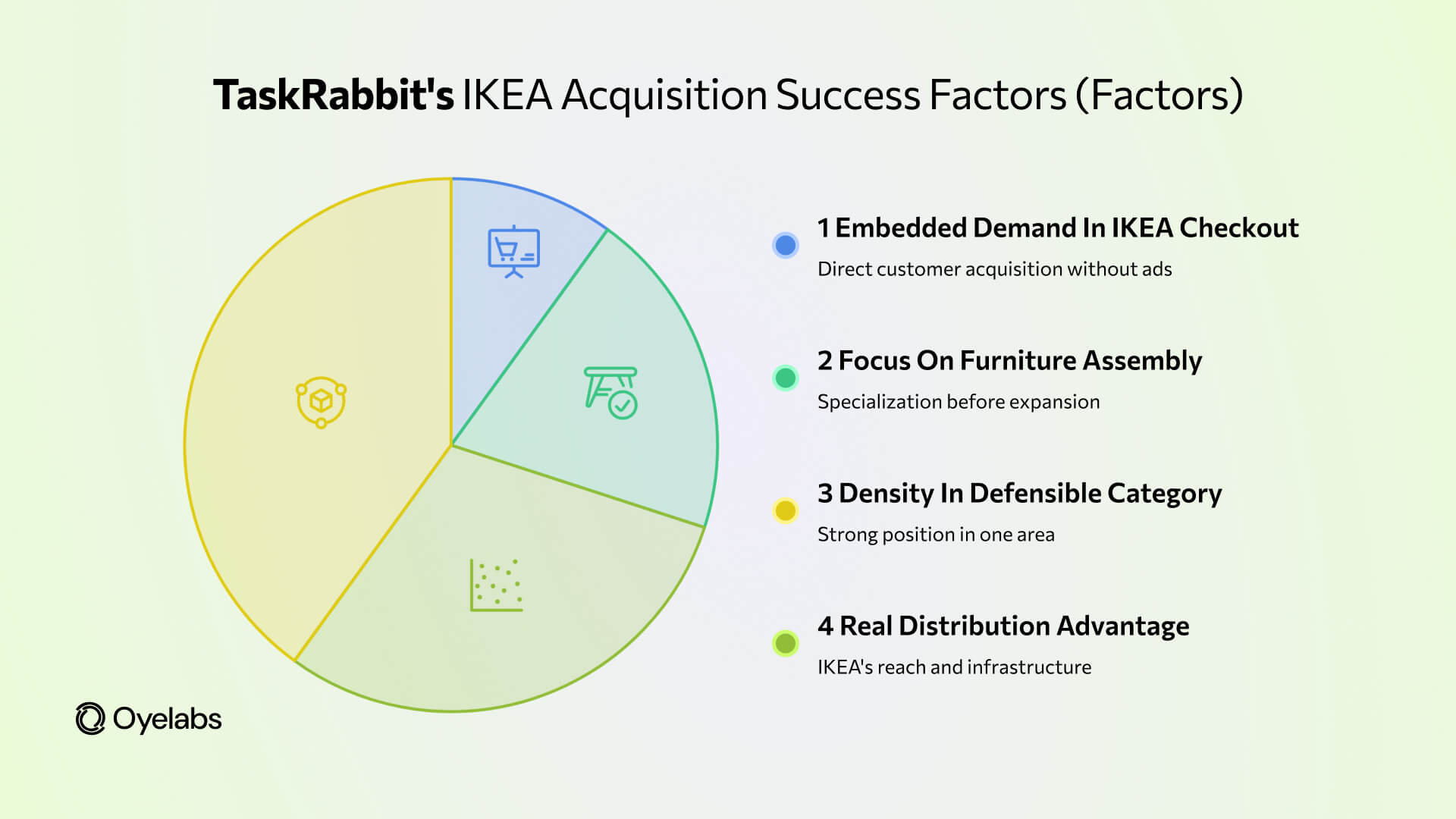
TaskRabbit’s IKEA acquisition in 2017 solved several of these mistakes at once, and it’s worth understanding exactly why, rather than just noting that it happened.
The partnership embedded TaskRabbit’s demand directly into IKEA’s checkout flow, giving the platform a customer acquisition channel that didn’t depend on paid ads at all, solving mistake #11 structurally rather than through better ad targeting. It also focused heavily on one category, furniture assembly, before expanding into general home services, directly avoiding mistake #12.
The lesson isn’t that every founder needs a retail giant as a launch partner. It’s that density in one defensible category, backed by a real distribution advantage, consistently beats broad coverage backed only by ad spend.
Relevant Read: How IKEA’s Collaboration Helped TaskRabbit – An Analysis
How OyeLabs Sees Founders Get This Right
Most of the fifteen mistakes above aren’t strategy failures. They’re infrastructure gaps, background checks, dispute handling, category-specific verification, that founders plan to “add later” and never quite get to before launch, because building all of it from scratch takes real time.
A custom build means each of these systems, verification tiers, payment flows, dispute workflows, gets designed, tested, and debugged individually, which is exactly where local services marketplace timelines tend to slip by months, sometimes past the point where runway allows recovery.
A white label TaskRabbit clone script starts with this infrastructure already in place, built to the standards a local services marketplace actually needs, so a founder’s early effort goes into supply density and category focus instead of rebuilding trust and payment systems from zero.
Conclusion
None of these fifteen mistakes are exotic. Most are well documented, and most are avoidable with the right infrastructure in place before launch, not after the first serious incident, the first funding crunch, or the first no-show that costs a customer for good.
What separates the local services marketplaces that survive from the ones that don’t usually isn’t a single dramatic decision. It’s whether trust, density, and unit economics were treated as the product from day one, instead of features to bolt on once things start working, by which point several of these fifteen mistakes have usually already compounded together.
Frequently Asked Questions
What is the single biggest mistake in a local services marketplace?
Skipping background checks and identity verification, since it directly threatens the trust the entire marketplace depends on, and one incident can undo years of growth.
Why does geographic density matter so much for a local services marketplace?
Same-day booking, the core value proposition for most categories, only works when enough providers are active in a small enough area to respond quickly.
What is disintermediation, and why does it matter here?
It’s when providers and customers move transactions off-platform after their first match. Weak payment convenience and a lack of ongoing platform-side value make this more likely.
Should a new local services marketplace launch with many categories or just one?
One or two categories with real supply density outperform broad category coverage with thin supply almost every time.
How did TaskRabbit avoid some of these common mistakes?
Its IKEA partnership created embedded, low-cost demand and focused early growth around one category, furniture assembly, before expanding broadly into general home services.
Sources and Editorial Notes
Sources
- CB Insights – Marketplace Startups That Have Shut Down
- TaskRabbit – IKEA Partnership Scaling Announcement
- Rigby – Services Marketplace Features and Trust Data
Editorial Notes
- The 64-marketplace-shutdown and $394 million figures are sourced directly from CB Insights’ published research tracking marketplace startup closures since 2009.
- TaskRabbit’s IKEA integration details are sourced from TaskRabbit’s own press release on the partnership’s expansion results.
- The 58% background-check expectation statistic is sourced from third-party marketplace feature research rather than a single platform’s self-reported data.