
Bigo vs Tango vs Poppo vs Chamet: Who Earns More and Why?

 Anuraag Jain
Last Updated on September 15, 2026
Key Takeaways
What You’ll Learn:
- Bigo Live currently earns the most among these four platforms.
- Live streaming apps earn through gifts, paid interactions, subscriptions, and premium features.
- User spending matters as much as audience size for platform revenue.
- Different live streaming models can produce different revenue results.
Stats That Matter:
- Bigo Live leads with an estimated $6 million in US app revenue.
- Tango earns an estimated $3 million, about half of Bigo Live’s revenue.
- Chamet ranks third with an estimated $2 million in US app revenue.
- Poppo Live generates an estimated $1 million, six times less than Bigo Live.
Live streaming apps are making money in more ways than just showing live videos. Bigo Live, Tango, Poppo Live, and Chamet all bring people together through live video and social features, but the way they turn that activity into revenue is different.
So, which one makes the most money?
There is no simple answer. Bigo Live has the advantage of being an established name in live streaming, but revenue also depends on what users spend money on, how much of that money the platform keeps, and how much it costs to run the app.
Looking at Bigo Live, Tango, Poppo Live, and Chamet side by side makes it easier to see what actually drives revenue in a live streaming app and which ideas are worth considering when building a live streaming app.
Bigo vs Tango vs Poppo vs Chamet: Who Earns More?
Among these four platforms, Bigo Live currently leads in estimated worldwide revenue, followed by Tango, Chamet, and Poppo Live.
| Platform | Main Focus | Revenue Opportunities | Worldwide App Revenue, Last Month |
|---|---|---|---|
| Bigo Live | Live streaming and social interaction | Virtual gifts, live interactions, premium features | $6M |
| Tango | Live streaming and social interaction | Virtual gifts, paid interactions, premium features | $3M |
| Poppo Live | Social live streaming | Virtual gifts, interactive features, paid experiences | $1M |
| Chamet | Social and video interaction | Virtual gifts, private interactions, premium features | $2M |
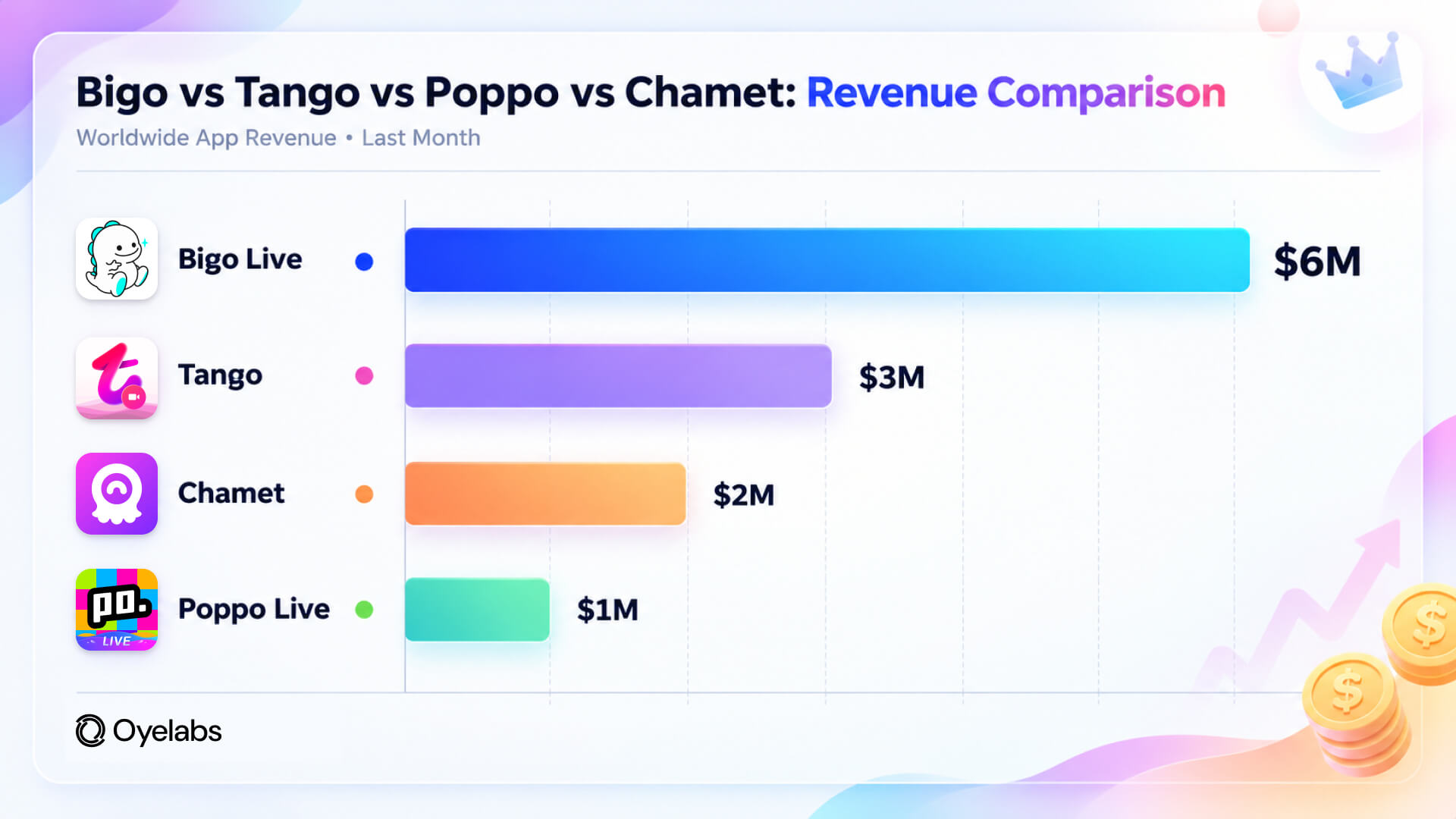
Based on Sensor Tower’s estimated worldwide app revenue for the last month, Bigo Live generated around $6 million, twice as much as Tango at $3 million. Chamet reached about $2 million, while Poppo Live generated around $1 million.
These figures are estimates rather than officially reported company revenue, but they give a useful view of how the four platforms compare in recent revenue performance.
It is also worth noting that higher platform revenue does not automatically mean higher earnings for every host. Creator income can depend on audience size, viewer spending, streaming frequency, platform policies, and payout arrangements.
Overall, Bigo Live is currently the strongest revenue performer among the four, but its results are not simply about having a large audience. How users interact with the platform and what they spend money on also plays a major role.
Also Read: Why Bigo Live Keeps Growing While Streaming Apps Decline
Why Do These Platforms Earn Differently?
Bigo Live, Tango, Poppo Live, and Chamet do not use exactly the same product structure. The type of interaction each platform supports can influence how users spend money and how the platform earns from that activity.
The main differences come from:
- Type of user interaction: Platforms can focus on public live broadcasts, social communication, direct video interaction, or a combination of these.
- Monetization mix: Revenue can come from virtual gifts, paid interactions, subscriptions, premium features, and other in-app purchases.
- Spending behavior: Users may spend differently depending on the type of experience the platform provides.
- Creator or host payouts: The share paid to creators or hosts affects how much revenue remains with the platform.
- Platform fees: Payment processing, app store fees, and other transaction costs can reduce the amount retained from each purchase.
- Operating costs: Infrastructure, moderation, marketing, customer support, and other expenses affect the final financial result.
This means two platforms can offer similar live video features but still produce different financial results. The difference comes from what users pay for, how often they make transactions, how revenue is shared, and what it costs to operate the platform.
Bigo vs Tango vs Poppo vs Chamet: Business Model Comparison
Bigo Live, Tango, Poppo Live, and Chamet all operate around live video, social interaction, and in-app monetization. However, the features and user experiences offered by each platform are not identical.
Bigo Live
Bigo Live combines live streaming with social features and in-app purchases. Users can watch live broadcasts, interact with streamers, and take part in different activities within the app.
The Bigo Live app model brings live content, viewer interaction, and monetization into the same platform. Virtual gifting is one way users can spend money while interacting with streamers.
Tango
Tango is a live video and social platform that combines broadcasting with communication features.
Users can watch live streams and interact with other users through features available within the platform. This gives Tango a model that combines live video with social communication.
The Tango live streaming model shows how broadcasting and social features can be combined within one app.
Poppo Live
Poppo Live is built around live streaming and social interaction. Its experience includes live rooms where users can interact with hosts and other participants.
The platform also uses virtual items and other in-app features as part of its monetization system.
The Poppo Live app model combines live content, user interaction, and in-app spending within the same experience.
Chamet
Chamet combines video interaction with social and communication features. The platform allows users to connect with others through video and other in-app interactions.
The Chamet app model puts direct user interaction alongside its video features, giving it a different structure from platforms focused mainly on public live broadcasting.
What the Four Models Show
The main difference is not simply the technology behind each app. It is how that technology is used to create the user experience.
| Platform | Core Experience | Monetization Direction |
|---|---|---|
| Bigo Live | Live streaming and social interaction | Virtual gifts and in-app purchases |
| Tango | Live video and social communication | Virtual gifts and paid interactions |
| Poppo Live | Live rooms and social interaction | Virtual items and in-app spending |
| Chamet | Video interaction and social communication | Paid interactions and in-app features |
The comparison shows that a live streaming platform can use similar basic technology while taking a different approach to user interaction.
Live video, profiles, messaging, payments, virtual items, and moderation can all be part of the technical foundation. What changes is how these features are combined and which interactions the platform gives more importance to.
That is why a feature-by-feature copy of another platform is not necessarily the right approach. The monetization model needs to match the way users actually use the app.
Which Platform Has the Strongest Monetization Model?
A strong monetization model is not simply one that offers many ways to charge users. It needs to make spending feel connected to the core experience while leaving enough revenue for the platform after payouts and operating costs.
Several factors can make a monetization model stronger:
- Clear value for users: People are more likely to pay when the paid feature provides something they actually want.
- More than one revenue source: Virtual gifts can be combined with subscriptions, premium features, paid interactions, or other purchases.
- Repeat spending: A model that supports regular transactions can create more consistent revenue than one based mainly on one-time purchases.
- Simple payment flow: Users should be able to purchase virtual currency, gifts, subscriptions, or other paid features without unnecessary friction.
- Sustainable creator payouts: Creators and hosts need enough incentive to remain active, while the platform also needs to retain enough revenue to cover its costs.
- Controlled operating costs: High transaction volume does not automatically mean high profit if payouts, payment fees, infrastructure, marketing, and other expenses are also high.
This makes monetization more about balance than the number of features.
A platform can have a large user base and still struggle to generate strong returns if users rarely spend or operating costs are too high. Another platform may have fewer users but generate more value from its paying audience.
The strongest model is therefore the one that connects user demand, repeat transactions, revenue sharing, and operating costs in a sustainable way.
What Drives Revenue on Live Streaming Platforms?
Once the monetization model is in place, several business metrics help show how much revenue the platform can generate.
- Active users: Downloads show how many people installed an app, while active users show how many are actually using it. A larger active audience creates more opportunities for transactions.
- Paying user rate: Not every active user will spend money. The percentage of users who make purchases helps show how effectively the platform converts activity into revenue.
- Average spending: The amount spent by each paying user affects total revenue. Some users may make small occasional purchases, while others may spend more regularly.
- Transaction frequency: Repeat purchases can increase revenue over time. A platform that encourages regular use has more opportunities for users to make transactions.
- User retention: Users who continue returning to the platform have more opportunities to watch content, interact, and make purchases.
- Revenue per user: Revenue per active user or paying user can help show how much financial value the platform generates from its audience.
- Transaction costs: Payment processing and other transaction-related expenses reduce the amount the platform keeps from each purchase.
- Operating costs: Infrastructure, moderation, marketing, customer support, creator payouts, and other expenses all affect profitability.
A simple way to estimate gross revenue potential is:
Active Users × Paying User Rate × Average Spending = Gross Revenue Potential
This is only an estimate. Actual revenue and profitability depend on factors such as pricing, transaction frequency, revenue sharing, payment costs, and overall operating expenses.
Which Live Streaming Business Model Is Right for Your App?
The right model depends on what the app is designed to do.
Creator-Focused Platform: If the main purpose is to help creators build audiences and monetize their streams, the platform can focus on live broadcasting, virtual gifting, subscriptions, paid content, and creator tools. The product should make it easy for creators to stream regularly while giving viewers simple ways to support them.
Social Discovery Platform: If the main purpose is meeting people and building one-to-one connections, the product can place more emphasis on matching, private video calls, messaging, profiles, and social discovery. Here, users are paying for interaction rather than simply watching a broadcast.
General Live Streaming Platform: A broader platform can combine public live rooms with creator profiles, gifting, rankings, subscriptions, premium interactions, and other social features. This gives the app more flexibility, but it also means more features need to be managed effectively.
Niche Live Streaming Platform: Another option is to build around a specific audience or category, such as gaming, music, education, fitness, or entertainment. A focused platform can design its monetization around the way that particular audience watches and interacts with live content.
The important thing is not to copy Bigo, Tango, Poppo, or Chamet feature by feature. Their models can provide useful references, but the final product should be based on its own audience, content strategy, and revenue goals.
Build a Live Streaming App That Generates Revenue
Building a live streaming app involves more than adding video broadcasting.
The platform needs the right combination of streaming features, user profiles, social interaction, virtual currency, gifting, payments, creator management, moderation, analytics, and admin controls.
Oyelabs can help develop a live streaming platform like Bigo Live, Tango, Poppo Live, or Chamet, built around the monetization model you want to use, whether the product focuses on creator broadcasting, social interaction, private video experiences, or a combination of these.
The technology and revenue model should be planned together so that the features support how users are expected to interact and spend. Want to build a live streaming app? Contact Oyelabs to discuss your idea.
Conclusion
Bigo, Tango, Poppo, and Chamet show that live streaming can support different types of digital businesses. Bigo has an established position in the live-streaming space, while Tango, Poppo, and Chamet offer different combinations of live video, social interaction, and paid features. There is no single feature that guarantees higher revenue. The bigger factor is how well a platform connects active users, paying users, creators, content, transactions, and operating costs.
For a new live streaming app, the goal should not be to copy one existing platform. It should be to choose a model that fits the intended audience and gives users a clear reason to return, interact, and spend.
FAQs
1. Which Live App Is Best for Earning Money?
Bigo Live currently leads in estimated app revenue, but individual earnings depend on audience size, viewer spending, activity, and platform payout rules.
2. Is Bigo Live Better Than Tango?
Bigo Live has higher estimated app revenue, but the better choice depends on your audience, features, content strategy, and business goals.
3. Which Live Streaming App Is Best for Business?
The best platform depends on your target audience, content type, monetization goals, required features, and the user experience you want.
4. What Features Does a Live Streaming App Need?
A live streaming app typically needs broadcasting, user profiles, live chat, notifications, payments, moderation, virtual gifts, analytics, and admin controls.
5. Can a Live Streaming App Make Money Without Virtual Gifts?
Yes. A live streaming app can earn through subscriptions, premium features, paid interactions, advertising, memberships, and other in-app purchases.
Reviewed By: Anuraag Jain
CEO, Oyelabs & AI Transformation Expert