
Why Bigo Live Keeps Growing While Streaming Apps Decline

Why Bigo Live Keeps Growing While Streaming Apps Decline
 Sushmeet Setia
Last Updated on September 7, 2026
Key Takeaways
- Bigo Live sells participation rather than passive viewing. Chat, gifting, PK battles, multi-guest rooms, rankings, and recurring events give users reasons to act instead of merely consuming content.
- Virtual gifts create immediate monetization. Revenue can be generated during the interaction itself without waiting for large advertising audiences or monthly subscriptions.
- Creators receive a visible economic pathway. Broadcasters can build audiences, earn gifts, work with agencies, join campaigns, and receive platform recognition.
- Localization extends beyond translation. Bigo Live adapts operations, events, marketing, creator programmes, and content priorities for individual markets.
- Recommendation quality is critical. A live room changes every minute, so the platform must match users with relevant broadcasts while those broadcasts are still active.
- Moderation is part of the infrastructure. Live content cannot be fully reviewed before publication, making automated detection, human moderation, reporting, and enforcement essential.
Why Bigo Live Keeps Growing While Streaming Apps Decline
Most live-streaming platforms do not fail because people have stopped watching live content. They fail because live streaming is one of the most difficult digital marketplaces to operate.
A platform must recruit creators, ensure that enough of them are live throughout the day, match viewers with relevant broadcasts, maintain active conversations, process virtual gifts, control abuse in real time, and give successful creators a reason to stay.
If any part of that system breaks, the app quickly begins to feel empty.
Bigo Live has handled this pressure better than many other streaming apps. Its parent company, JOYY, reported that BIGO generated $371.8 million in livestreaming revenue during the fourth quarter of 2025. BIGO’s paying-user base increased for the third consecutive quarter to 1.54 million, while average revenue per paying user reached $222.80.
Bigo Live also reports more than 700 million registered users across over 150 countries and regions.
Those numbers do not come from live video alone. They come from a system built around creator income, virtual gifting, local communities, competitive events, agencies, recommendation technology, and continuous viewer participation.
For founders planning an app like Bigo Live, the real lesson is uncomfortable but useful: the video player is one of the least defensible parts of the product.
Quick Answer
Bigo Live keeps growing because it operates as a social economy rather than a traditional streaming service.
Viewers do not simply watch broadcasts. They enter rooms, chat with hosts, send gifts, compete in events, join multi-guest sessions, build status, and form repeated relationships with creators.
Broadcasters are not treated only as content suppliers. They can earn money, join agencies, participate in competitions, receive platform recognition, and build recurring communities.
Many streaming apps decline because they acquire viewers before building dependable creator supply, rely too heavily on advertising, offer weak creator earnings, or copy visible features without creating the operational system behind them.
A successful Bigo Live-like app therefore requires more than live broadcasting. It needs marketplace liquidity, creator operations, monetization, localization, discovery, moderation, and retention working together.
Bigo Live Is Not Just a Video Platform
Traditional media follows a simple relationship: a creator publishes content, and an audience watches it.
Bigo Live operates differently.
Its central product is a live room where the broadcaster and viewers influence what happens next. A comment can redirect the conversation. A gift can trigger a reaction. A guest can join the stream. Two creators can begin a PK battle while their audiences participate.
This changes what users are paying for.
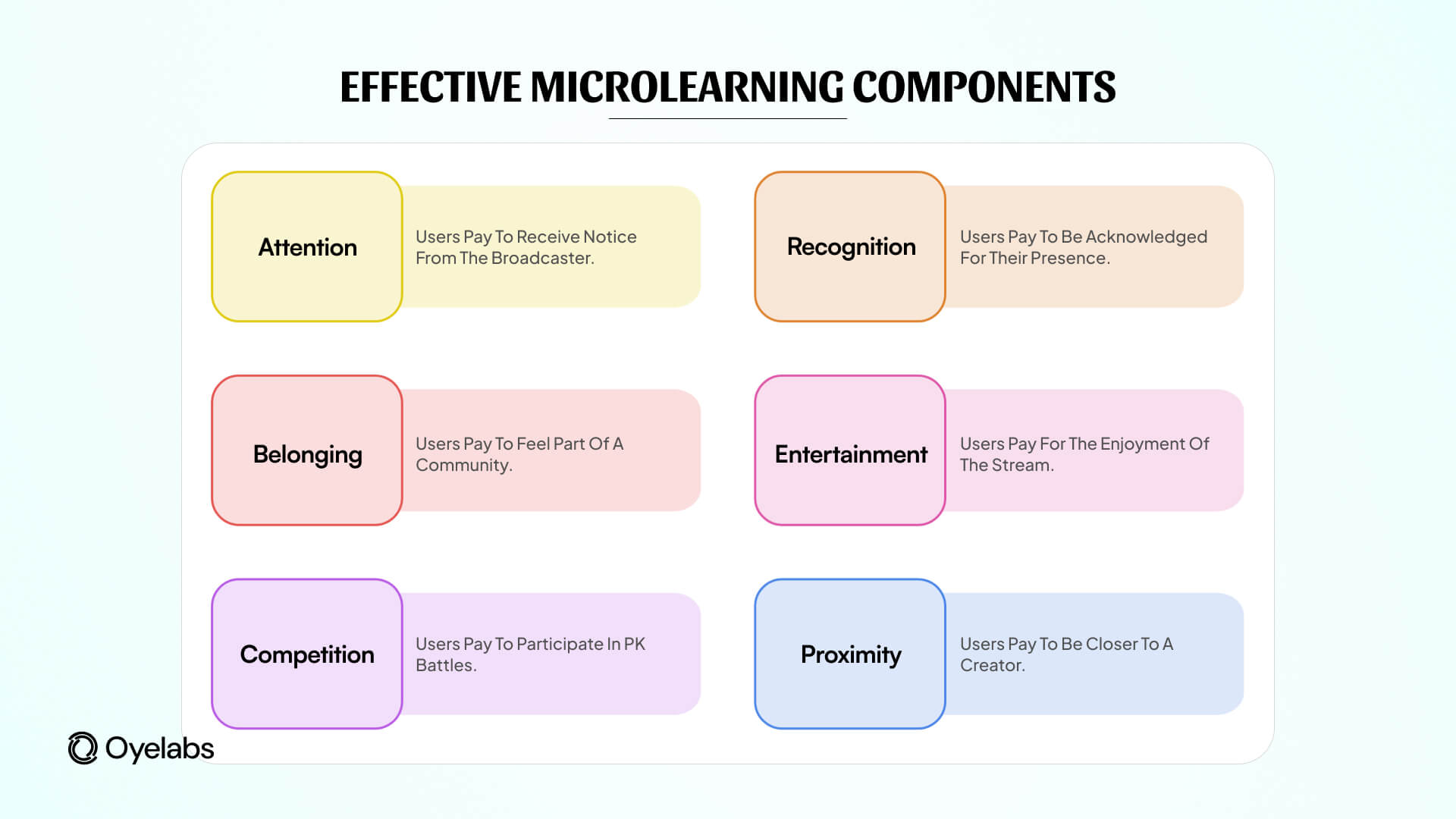
They are not only paying to access content. They may be paying for attention, recognition, belonging, entertainment, competition, or proximity to a creator.
That distinction helps explain why Bigo Live can monetize users who may never purchase a conventional subscription. The user decides when an interaction feels valuable enough to reward.
For founders, this means an app like Bigo Live should not be planned as “Netflix with live video” or “TikTok with a broadcast button.”
It is closer to a real-time social marketplace where attention, status, entertainment, and digital value are continuously exchanged.
1. Bigo Live Solves the Empty-Room Problem
The most damaging experience in a new streaming app is not buffering. It is opening the app and finding nobody worth watching.
Live platforms face a more difficult supply problem than short-video apps. Recorded content remains available after the creator leaves. A live broadcast disappears when the creator ends the session.
This means the platform needs enough relevant broadcasters online during every important time period.
Bigo Live addresses this through creator recruitment, agencies, incentives, events, scheduled campaigns, and local operations. JOYY reported that the number of streamers on Bigo Live increased by 3.5% quarter over quarter during the third quarter of 2025, while average viewer numbers increased by 3.9%.
The Four Types of Marketplace Liquidity
A new platform must manage several different forms of liquidity.
Time Liquidity
Enough broadcasters must be live during the hours when viewers open the app.
A marketplace may have 10,000 registered creators and still feel empty if only a small number stream consistently or if most creators broadcast during the wrong hours.
Category Liquidity
Users interested in gaming, music, conversation, fashion, comedy, education, or regional culture need relevant rooms.
Total stream count is meaningless when most supply is concentrated in one category.
Geographic Liquidity
A creator popular in one country may not suit audiences elsewhere.
Language, humour, music, cultural norms, payment behaviour, spending power, and peak usage times can vary substantially between regions.
Quality Liquidity
The platform needs more than active cameras.
Hosts must be able to maintain conversation, acknowledge viewers, manage their rooms, create repeatable formats, and give users a reason to return.
Founders frequently spend heavily on viewer acquisition before solving these supply problems. That is backwards.
Advertising can bring users into the app, but it cannot make an empty marketplace interesting.
2. Virtual Gifting Monetizes Emotion in Real Time
Many streaming apps depend primarily on advertising.
That model requires large audiences, substantial viewing time, advertiser demand, brand-safe content, and enough ad inventory to generate meaningful revenue.
Bigo Live can monetize a much smaller interaction.
Users purchase virtual currency and spend it on digital gifts during broadcasts. Those gifts allow viewers to support creators, attract attention, display status, celebrate moments, or influence competitive events.
Part of that value can then flow to eligible broadcasters.
The important principle is that gifting is not merely a payment button. It is embedded into the entertainment itself.
What an Effective Virtual-Gift System Needs
- Different spending levels: Low-cost gifts allow frequent participation, while premium animated gifts create stronger visibility, prestige, and emotional reactions.
- Visible recognition: The sender’s name, badge, contribution, or animation should be noticeable. Users are partly purchasing acknowledgment from the creator and the room.
- Event relevance: Gifts can contribute to rankings, PK battle scores, seasonal campaigns, team contests, or creator milestones. This gives spending an immediate purpose.
- Transparent creator conversion: Broadcasters need a clear method for understanding earnings, eligibility, withdrawal rules, conversion rates, and platform deductions.
- Fraud controls: The platform must detect payment abuse, chargebacks, fake transactions, account manipulation, stolen cards, and coordinated gift farming.
BIGO livestreaming produced approximately $1.53 billion in revenue during 2025, demonstrating how substantial a virtual-interaction economy can become.
However, founders should not assume that adding coins and gifts will automatically generate revenue.
Users spend when the creator relationship, social context, interface, recognition system, and reward loop make the transaction meaningful.
3. Bigo Live Gives Creators a Career Path
Creators will not remain loyal to a platform that treats them as interchangeable inventory.
Bigo Live invests in visible creator progression through agencies, competitions, official events, earnings, rankings, campaigns, and recognition.
Its January 2026 creator gala brought together more than 1,200 streamers, agencies, and fans from five continents, with nearly 200 creators and agencies formally recognized.
This matters because creator retention is often more valuable than creator acquisition.
An established broadcaster brings content, recurring viewers, community relationships, moderation experience, revenue history, and predictable streaming schedules.
Four Questions Every Creator System Must Answer
How Does a New Broadcaster Get Discovered?
If recommendations are dominated permanently by established stars, new creators will leave before they can build an audience.
The platform needs controlled exposure, category rotation, new-host discovery, and performance-based recommendation opportunities.
How Does a Creator Earn?
The platform needs clear gifting, revenue-sharing, withdrawal, campaign, subscription, sponsorship, or paid-room mechanisms.
The earnings model must be understandable before creators invest substantial time.
How Does a Creator Improve?
Training, performance analytics, content guidance, agency support, stream-quality feedback, and community-management tools can improve broadcast quality.
Creators should understand why one session performs better than another.
What Can a Creator Become?
Rankings, official events, badges, partnerships, campaigns, and recognizable milestones make progress visible.
A creator who sees no future on the platform will eventually move elsewhere.
The Role of Creator Agencies
Bigo Live has promoted agencies as part of its creator ecosystem.
Agencies can recruit hosts, guide schedules, support content quality, coordinate campaigns, and help broadcasters improve performance. This reduces some operational pressure on the central platform.
However, agencies also introduce challenges around contracts, payout transparency, performance requirements, creator ownership, and agency conduct.
A founder building a Bigo Live-like app should decide early whether creators will be:
- Independent broadcasters
- Agency-managed hosts
- Professionally contracted creators
- Organized through a hybrid model
Leaving this decision until after launch will create payout, onboarding, and accountability problems.
4. Localization Creates Multiple Local Networks
Bigo Live describes its approach as localizing products, operations, and marketing for each country in which it operates.
That is far more substantial than translating buttons.
Live entertainment is highly local. Users respond to familiar languages, humour, music, holidays, celebrities, social behaviour, and broadcasting styles.
Payment methods, creator expectations, moderation risks, gift prices, and acceptable content also vary between markets.
What Market-Level Localization May Require
- Local creator managers and agency relationships
- Region-specific competitions and campaigns
- Local-language moderation capabilities
- Market-appropriate gift and coin pricing
- Regional payment and withdrawal options
- Local peak-time programming
- Country-specific compliance processes
- Recommendation models sensitive to language and location
This is why a new app should not launch globally simply because its infrastructure technically supports multiple countries.
Global availability without local density creates a weak experience everywhere.
A more credible approach is to win one region or audience, establish creator supply and monetization, and then reuse the operating model in adjacent markets.
5. Interaction Gives Users More Reasons to Stay
Recorded video can be consumed without participation.
Live content becomes more valuable when the viewer’s presence changes what happens inside the room.
Bigo Live supports one-to-many broadcasts, multi-guest rooms, voice rooms, virtual gifts, comments, rankings, events, and PK battles.
Platforms like Poppo Live take a similar approach by combining live broadcasts with social interaction, giving viewers more ways to participate and connect during streams.
Its 2026 guidance also describes AI-supported captions, moderation, virtual hosts, chat summaries, polls, mini-games, and guest-room prompts.
These features address different user motivations and business outcomes.
| Interaction | User Motivation | Business Value |
| Chat and reactions | Recognition and participation | Increases session depth |
| Virtual gifts | Support, attention, and status | Generates direct revenue |
| Multi-guest rooms | Conversation and belonging | Expands content variety |
| PK battles | Competition and team identity | Encourages gifting and repeat visits |
| Rankings and events | Progress and recognition | Retains creators and spenders |
The mistake is launching every interaction simultaneously.
A platform should first identify the behaviour it wants to create and then add the minimum mechanics needed to support that behaviour.
For example, a music platform may prioritize song requests, applause, gifting, and scheduled performances.
A professional knowledge platform may require Q&A, paid rooms, expert verification, screen sharing, and replay access.
Copying PK battles into every streaming category would be pointless.
6. Bigo Live Treats Discovery as a Real-Time Problem
A recorded recommendation system can suggest a video tomorrow and still deliver value.
A live recommendation expires when the broadcast ends.
Research on live-stream recommendation systems identifies two major complications: stream content changes continuously, and high-value actions such as gifting often occur only after users watch for longer periods.
Signals a Live Discovery System Should Consider
- Whether the room is currently active
- Stream topic and language
- Broadcaster history and quality
- Current viewer count and interaction rate
- Viewer interests and previous behaviour
- Session duration and gift likelihood
- Safety signals and content quality
- New-creator exposure requirements
- Geographic and network conditions
BIGO says its recommendation technology uses deep-neural-network and graph-neural-network systems to respond to changing user interests in real time.
It also highlights low-latency video and audio delivery across 3G, 4G, 5G, and Wi-Fi connections.
This is a major reason generic streaming scripts underperform.
They may technically broadcast video, but they often lack the data and ranking systems required to decide which live room deserves the next viewer.
7. Moderation Is a Growth Function, Not Just Compliance
Live-stream moderation is difficult because harmful content can reach viewers before a human reviewer can inspect it.
Bigo Live says it combines automated detection, human moderation, user reporting, blocking tools, privacy controls, child-safety enforcement, and legal-cooperation systems.
Founders often treat moderation as an expense that can be addressed after growth.
That is reckless.
Weak safety drives away users, damages app-store standing, creates payment risk, increases regulatory exposure, and makes brands unwilling to participate.
What a Production Moderation System Requires
- Automated detection for high-risk visual, audio, and text signals
- Live reporting and emergency escalation
- Moderator dashboards with stream context
- Account warnings, suspensions, and permanent bans
- Age and identity controls where required
- Creator education and policy acknowledgment
- Appeals and enforcement records
- Region-specific policy rules
Moderation also protects monetization.
Viewers will not spend consistently inside an environment they consider fraudulent, abusive, unsafe, or poorly controlled.
Why Streaming Apps Decline
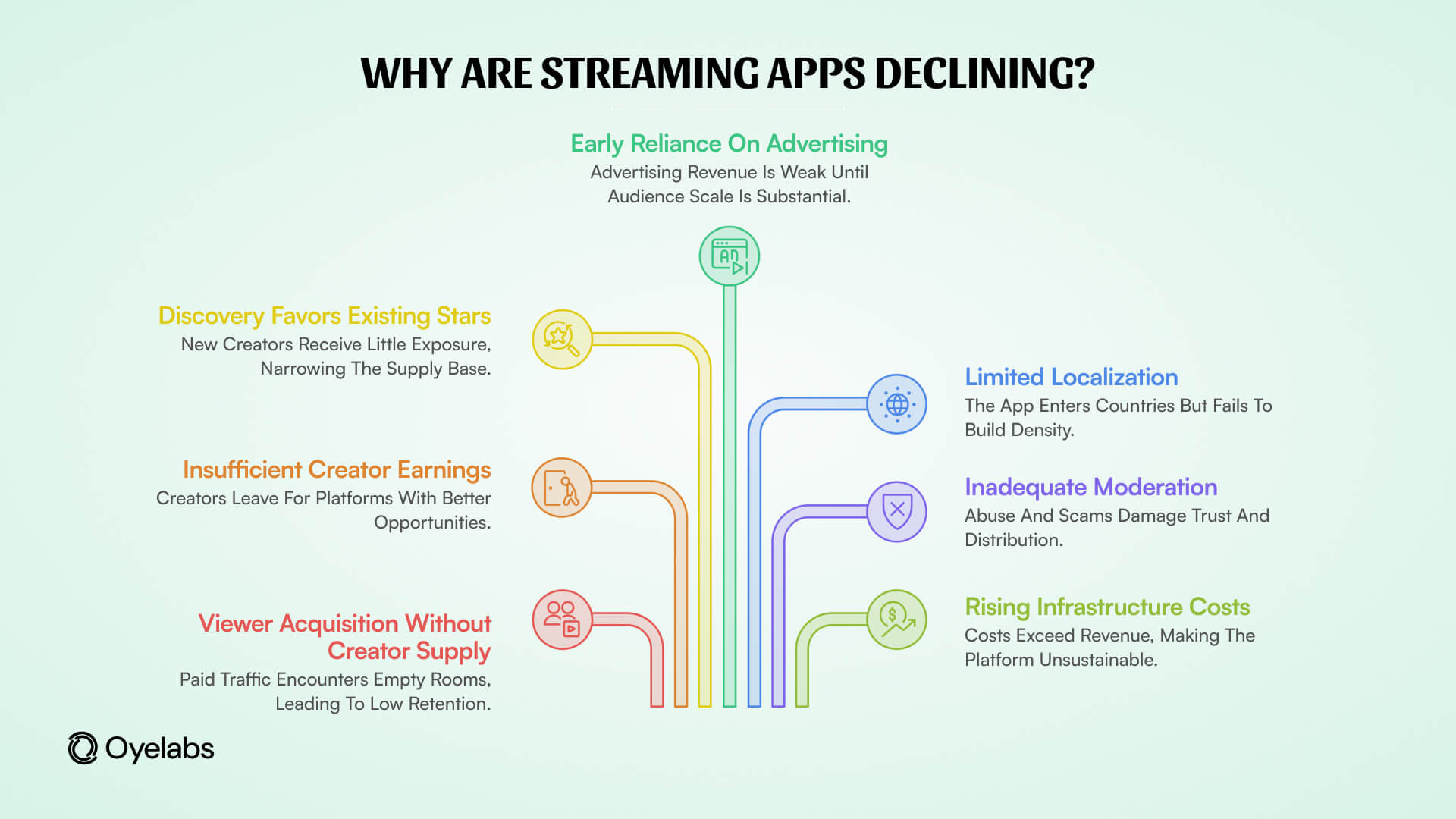
Streaming apps rarely decline because of one missing feature.
They decline when the marketplace stops compounding.
1. They Acquire Viewers Without Stable Creator Supply
Paid traffic enters the app, encounters repetitive or empty rooms, and never returns.
Acquisition cannot compensate for insufficient live supply.
2. Creators Cannot Earn Enough to Stay
Broadcasters move to platforms with larger audiences, clearer payouts, better discovery, stronger support, or more sponsorship opportunities.
3. Discovery Permanently Favours Existing Stars
New creators receive little exposure and leave before they can develop audiences.
Over time, the supply base becomes narrower and more repetitive.
4. The Platform Relies on Advertising Too Early
Advertising revenue remains weak until audience scale becomes substantial, while streaming, infrastructure, moderation, and creator-acquisition costs begin immediately.
5. Localization Stops at Translation
The app enters multiple countries but builds meaningful creator and viewer density in none of them.
6. Moderation Cannot Keep Pace With Growth
Abuse, scams, explicit content, harassment, impersonation, and payment fraud damage trust and distribution.
7. Infrastructure Costs Rise Faster Than Revenue
Video delivery, transcoding, storage, moderation, real-time communication, and payment processing can become financially unsustainable.
These failures are operational, not cosmetic.
Changing the interface will not fix them.
What Founders Should Build First
A viable MVP should prove one repeatable live interaction inside one concentrated market.
| Stage | Primary Scope | Evidence Required |
| MVP | Broadcasting, discovery, chat, profiles, moderation, and basic gifting | Viewers find active rooms and return |
| Creator Growth | Earnings, withdrawals, analytics, onboarding, and events | Strong creators stream consistently |
| Retention | Multi-guest rooms, follows, notifications, rankings, and battles | Communities repeatedly form around creators |
| Expansion | Agencies, localization, advertising, and advanced recommendations | New markets maintain liquidity and margins |
Do not begin with 30 categories and worldwide availability.
Begin with one community whose members already have a reason to gather live.
Relative Read: Bigo Live vs. Twitch A Comparison of Live Streaming Leaders
How OyeLabs Can Help Build an App Like Bigo Live
OyeLabs helps founders launch white-label and customized live-streaming products across mobile and web platforms.
A Bigo Live-like app can include:
- Live video broadcasting
- Viewer discovery
- Real-time chat
- Multi-guest rooms
- PK battles
- Virtual gifts and coins
- Creator wallets
- Withdrawal management
- Creator agencies
- Rankings and events
- Content moderation
- Subscriptions
- Push notifications
- Analytics
- Administrative controls
The feature list is only the starting point.
The platform must also define creator recruitment, revenue sharing, gift economics, withdrawal rules, moderation operations, target geography, and launch liquidity.
The strongest product will not be “Bigo Live for everyone.”
It will be Bigo Live’s operating model adapted to a community with a clear reason to watch, participate, and spend.
Planning to Build an App Like Bigo Live?
Launch a live-streaming platform designed around creator earnings, virtual gifting, real-time interaction, community growth, and platform moderation. With OyeLabs, you can:
✓ Launch a white-label live-streaming app
✓ Add virtual gifts, coins, wallets, and withdrawals
✓ Support PK battles, multi-guest rooms, agencies, and rankings
✓ Customize monetization, moderation, and creator-management workflows
Conclusion
Bigo Live keeps growing because it has built more than streaming technology.
It has created a real-time marketplace in which creators receive income and recognition, viewers receive participation and status, agencies support creator supply, algorithms distribute attention, and virtual gifts convert interaction into revenue.
Many streaming apps decline because they copy live-video features without building this underlying economy.
For founders, the lesson is direct: do not begin by asking how to develop a broadcast button.
Begin by asking:
- Who will stream?
- Why will they return?
- How will viewers discover them?
- What will make users participate?
- How will value flow between everyone involved?
Answer those questions first, and the technology becomes useful.
Ignore them, and even a technically polished app like Bigo Live will become an expensive collection of empty rooms.
Frequently Asked Questions
Why Is Bigo Live Still Popular?
Bigo Live combines live entertainment with chat, gifting, competition, multi-guest participation, creator earnings, local communities, and platform events. This gives viewers and broadcasters repeated reasons to return.
How Does a Bigo Live-Like App Make Money?
Common revenue streams include virtual-gift commissions, coin purchases, subscriptions, advertising, paid rooms, creator promotions, agency arrangements, and brand campaigns.
What Features Does an App Like Bigo Live Need?
Core features include live broadcasting, discovery, chat, profiles, follows, virtual gifts, wallets, withdrawals, multi-guest rooms, moderation, notifications, analytics, and an administrative panel.
Is Building a Streaming App Expensive?
The video interface is only part of the cost. Additional expenses include streaming infrastructure, content delivery, moderation, creator acquisition, payment processing, recommendation technology, customer support, and regional operations.
Should a New Streaming App Launch Globally?
Usually not. A new platform should first establish sufficient creator and viewer activity within one market or community. Expanding before achieving local liquidity can create an empty experience across several regions.
Sources
- JOYY – Fourth Quarter and Full-Year 2025 Financial Results
- JOYY – Third Quarter 2025 Financial Results
- JOYY – 2025 Financial Disclosure
- BIGO – Company Overview
- BIGO – Technology Overview
- Bigo Live – Creator Success Beyond Follower Counts
- Bigo Live – AI in Live Streaming
- Bigo Live – Safety and Moderation
- Research on Live-Streaming Recommendation Systems
Editorial Notes
- Financial and paying-user data was sourced from JOYY’s official 2025 disclosures.
- Platform reach, technology, localization, creator programmes, and safety information came from official BIGO and Bigo Live publications.
- Independent research was used only to explain the technical challenges of live-stream recommendations.
- The supplied ranking article was used only as a benchmark for depth and information flow, not as a factual source for this article.
Reviewed By: Sushmeet Singh
AI Solutions Architect and Head of Operations, Oyelabs