
Microlearning Trends Every Founder Should Know in 2026

Microlearning Trends Every Founder Should Know in 2026
 Surya Pratap Singh
Last Updated on August 8, 2026
Key Takeaways
- Microlearning is becoming adaptive rather than merely short. Lesson duration may make learning easier to start, but sequencing, difficulty, feedback, and review timing determine whether users retain what they study.
- AI speaking practice is becoming a core product capability. Learners can now practise realistic conversations without booking a tutor, but the interaction must remain aligned with their proficiency and lesson objectives.
- Gamification must support learning rather than distract from it. Streaks and leagues can improve retention, but founders must ensure that users cannot progress through the product without acquiring useful skills.
- AI is reducing the cost of course production. Smaller teams can create more lesson variations, translations, examples, voice content, and conversational scenarios, provided that a controlled review system is in place.
- Assessment will become central to monetization. Learners, schools, and employers will increasingly expect evidence of proficiency rather than lesson-completion counts.
- Generic language learning products face a difficult market. Founders will have a stronger position when they focus on a particular audience, language pair, profession, examination, or communication outcome.
Microlearning Trends Every Founder Should Know in 2026
Building a language learning app in 2026 is not about breaking long lessons into smaller screens. It is about creating a system that can turn a few minutes of attention into measurable progress – and give learners a reason to repeat that process every day.
This is why founders need to look beyond visible Duolingo features such as streaks, hearts, leaderboards, and animated characters. Duolingo ended 2025 with more than 50 million daily active users and over $1 billion in annual bookings. That scale proves that learning can become a high-frequency consumer habit, but it does not mean another app will succeed by copying its interface.
The most important microlearning trends of 2026 involve adaptive lesson sequencing, AI speaking practice, spaced retrieval, multimodal exercises, learning-focused gamification, outcome measurement, and increasingly specialized business models.
For founders planning an app like Duolingo, the opportunity is substantial. The harder truth is that the market no longer needs another generic vocabulary quiz. It needs products that solve a defined learning problem better than broad platforms can.
Quick Answer
The leading microlearning trend in 2026 is the movement from fixed bite-sized lessons toward adaptive learning loops.
A modern language learning app should identify what a learner knows, select an activity at the appropriate difficulty, require the learner to recall or use the information, provide immediate feedback, and schedule future practice before that knowledge is forgotten.
Artificial intelligence can make these experiences more personalized and reduce the cost of creating lessons. However, AI-generated exercises without curriculum control, proficiency alignment, human review, and learning measurement will create more content without necessarily creating better learners.
The strongest product will not be the one with the largest lesson library. It will be the one that can prove that repeated usage improves comprehension, recall, pronunciation, and real-world communication.
What Microlearning Really Means in 2026
Microlearning is the delivery of a clearly defined learning objective through a compact activity that can usually be completed within a few minutes.
A microlearning experience might include a listening exercise, a short explanation, a pronunciation task, a retrieval quiz, an interactive story, or a simulated conversation. However, length alone does not make something effective microlearning.
Taking a 40-minute lecture, cutting it into eight videos, and publishing them in a mobile app is content fragmentation. It does not automatically improve learning.
A useful microlearning unit must have a specific purpose. It should help the learner understand, recall, recognise, pronounce, or apply one concept before connecting that concept to future lessons.
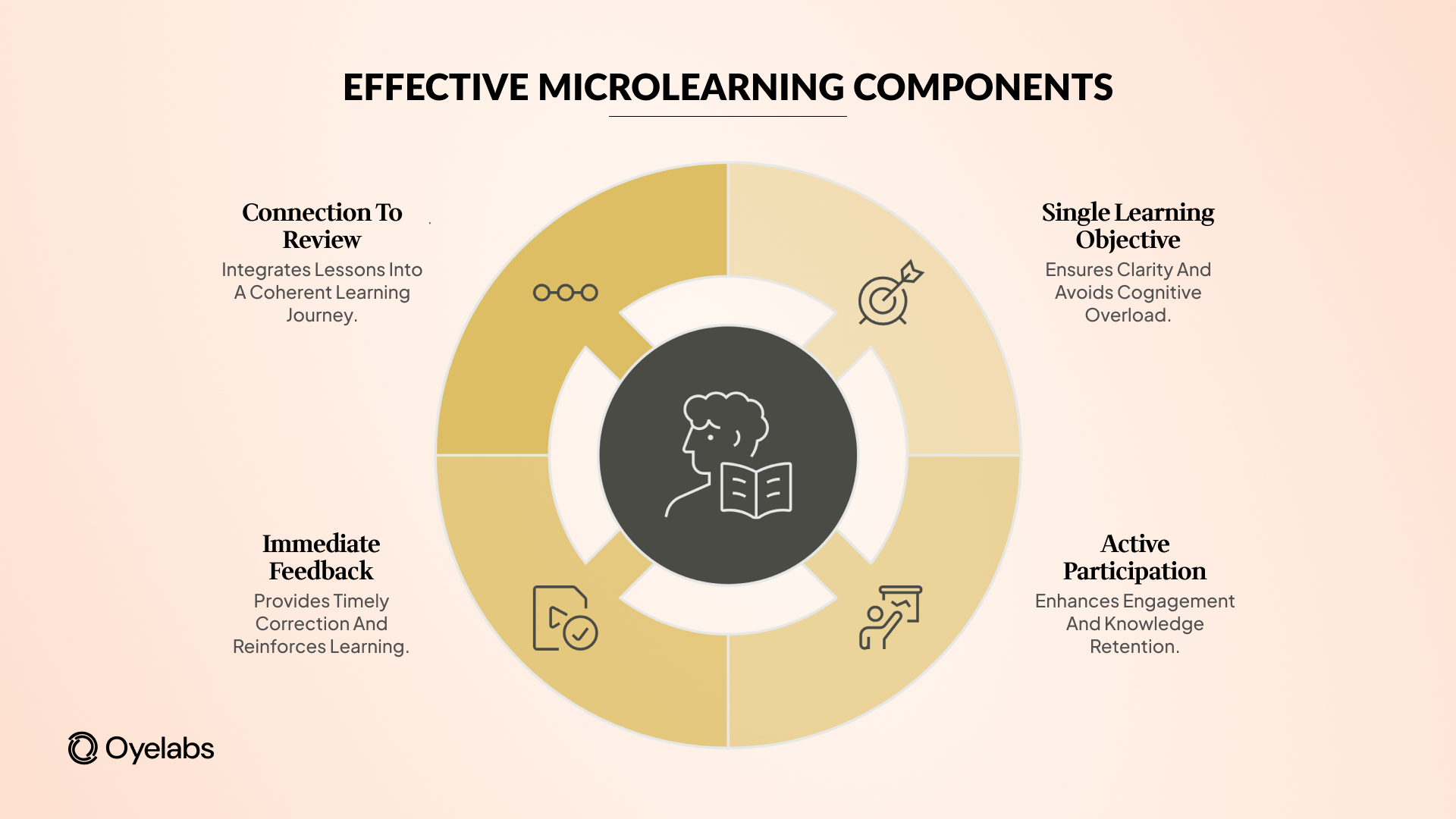
Effective microlearning units usually contain four components:
- A single learning objective: Each lesson should make clear what the learner is expected to recognise, remember, or perform. Trying to teach vocabulary, grammar, pronunciation, and cultural context simultaneously can overload a five-minute activity.
- An opportunity for active participation: Learners should retrieve an answer, say a phrase, organise a sentence, distinguish between sounds, or apply knowledge in context. Passive viewing may introduce information, but it provides weak evidence that the information has been learned.
- Immediate corrective feedback: A wrong answer should lead to more than a red cross. The product should explain the mistake, show the correct pattern, and give the learner another opportunity to apply it.
- A connection to later review: A completed activity should update the learner’s proficiency model and influence what appears next. Otherwise, every lesson exists as an isolated interaction rather than part of a coherent learning journey.
This distinction is critical for founders. Microlearning is not simply a content format. It is a learning system built around limited attention, repeated retrieval, feedback, and progression.
Let’s see how microlearning trends are shaping language apps in 2026:
1. Adaptive Learning Paths Are Replacing Static Course Trees
The traditional language app displays the same sequence of lessons to every learner. A user completes Unit 1, unlocks Unit 2, and continues through a predetermined path regardless of their prior knowledge or performance.
That model is simple to develop, but it wastes learner time.
Two users may begin at the same level yet have completely different weaknesses. One may understand written sentences but struggle to recognise speech. Another may know the vocabulary but repeatedly misuse verb forms. Sending both users through the same activities creates unnecessary repetition for one and insufficient support for the other.
Adaptive microlearning changes the sequence according to learner behaviour.
A practical adaptation system should consider:
- Accuracy by skill and concept: The platform should track whether mistakes are concentrated in listening, pronunciation, grammar, vocabulary, or sentence construction. A general accuracy percentage hides the actual problem.
- Response time and confidence: A correct answer given instantly is different from an answer reached after several attempts. Hesitation can indicate fragile knowledge even when the final answer is technically correct.
- Recurring error patterns: If a learner repeatedly confuses similar words or grammatical structures, the system should generate targeted contrast exercises rather than replaying the entire unit.
- Time since the last successful recall: A concept answered correctly yesterday may need no attention today, while material not reviewed for three weeks may be approaching the point of forgetting.
- Learner objectives: Someone preparing for a hospitality job needs different language priorities from a tourist, school student, or immigration-test candidate.
For founders building a Duolingo-like app, the adaptive layer can become more defensible than the visible course interface. Lesson screens can be copied. A learner model that improves through behavioural data is significantly harder to reproduce.
2. Spaced Retrieval Is Becoming the Product’s Learning Engine
Many learning apps reward users for finishing lessons but fail to check whether those users can recall the content later.
That creates a dangerous measurement problem. A learner may complete 100 exercises, collect thousands of points, and still fail to use the vocabulary in a real conversation.
Spaced repetition addresses this by bringing information back at strategically increasing intervals. Retrieval practice strengthens the process by asking users to produce an answer rather than repeatedly showing it to them.
In product terms, this means every word, sentence pattern, sound, and communication skill should have a changing mastery state.
A useful spaced-retrieval engine should decide:
- What needs review: Concepts with declining recall probability or repeated errors should receive priority over material that remains stable.
- When it should return: Easy concepts can be reviewed after longer intervals, while difficult concepts should return sooner. A fixed review calendar ignores differences between learners and skills.
- How it should be tested: A word previously shown through multiple choice might return through typing, listening, pronunciation, or sentence production. Changing the format tests whether the learner understands the concept rather than memorising the screen.
- When it can be considered mastered: One correct response is not enough. Mastery should require successful recall across multiple sessions, contexts, and activity formats.
This engine should operate quietly underneath the course. Learners do not need to manage complicated revision schedules themselves. The app should make the right review feel like the natural next lesson.
3. AI Conversation Is Moving Speaking Into Every Session
Speaking practice has traditionally been difficult to scale. It usually requires a tutor, teacher, classroom, or conversation partner. That makes it expensive, inconvenient, or intimidating for many learners.
Generative AI changes that economic limitation. A language learning app can now let users practise ordering food, attending an interview, checking into a hotel, speaking to a customer, or introducing themselves in a low-pressure environment.
Duolingo’s AI-powered Video Call provides an important product lesson. Its conversations are not simply unrestricted access to a general chatbot. The system uses instructions covering the character’s behaviour, conversation structure, assistance, and language level.
In 2026, Duolingo also expanded its beginner speaking experience through Video Call with Falstaff and stated that it planned to roll the feature across CEFR levels for its nine most popular languages.
A founder should treat AI conversation as a structured learning activity, not a novelty.
The minimum experience should include:
- Level-controlled language: The AI should use vocabulary, sentence length, speed, and grammatical complexity appropriate to the learner. A beginner does not benefit from a natural conversation they cannot follow.
- A defined scenario and objective: Each conversation should practise a specific outcome, such as asking for directions or responding to interview questions. Open-ended chatting makes progress difficult to measure.
- Support when the learner becomes stuck: Users should be able to request repetition, translation, a slower response, or a suggested phrase without leaving the activity.
- Post-conversation feedback: The platform should identify recurring mistakes, missed vocabulary, pronunciation problems, and successful responses. Without a review stage, the conversation becomes practice without instruction.
- A safe completion point: The activity should have a beginning, progression, and conclusion. Endless AI chat creates high infrastructure costs and can reduce instructional focus.
Simply connecting an unrestricted language model to a microphone is not a defensible product. The value comes from combining conversation with curriculum, assessment, and progression.
4. AI Is Reshaping Language-Course Production
Traditional course development is expensive and slow. A new course may require curriculum specialists, writers, translators, native speakers, voice artists, reviewers, designers, and quality-assurance teams.
AI can reduce the repetitive portion of that work.
Duolingo reported producing 7,500 content units during 2024, compared with 425 in 2021, while using AI to accelerate course creation.
For a smaller company, this creates the possibility of launching specialised courses that would previously have been financially impractical.
AI can support content teams by:
- Generating controlled exercise variations: One approved sentence pattern can produce multiple examples at a specified proficiency level. This gives learners variety without requiring writers to create every variation manually.
- Creating plausible incorrect answers: High-quality distractors are important because obviously wrong choices do not test understanding. AI can generate mistakes based on common learner confusion, subject to review.
- Supporting localisation: Teams can adapt explanations, scenarios, examples, and interfaces for different learner markets. Literal translation should still be avoided where cultural or educational context changes the meaning.
- Producing conversational scenarios: AI can create roleplays around travel, healthcare, sales, customer service, education, or everyday situations while preserving the target vocabulary and grammar.
- Accelerating tagging and classification: Lessons can be tagged by proficiency, vocabulary, skill, prerequisite, complexity, and learning objective, making adaptive delivery easier.
Human oversight remains essential. AI-generated content can be grammatically correct but educationally inappropriate, culturally awkward, repetitive, or wrongly graded.
The correct operating model is not “generate and publish.” It is generate, validate, review, test, measure, and improve.
5. Microlearning Is Expanding Beyond General Language Courses
The next generation of learning apps will not necessarily compete with Duolingo across every language and learner category.
Many will take the underlying microlearning model and apply it to a narrow, valuable outcome.
Possible vertical opportunities include:
- Professional communication: Products can teach English for nurses, sales professionals, restaurant staff, drivers, construction workers, or customer-support teams. These users have specific situations to master and employers may fund their training.
- Immigration and proficiency examinations: Apps can build daily pathways for IELTS, TOEFL, citizenship interviews, or regional language requirements. Clear examination outcomes can create stronger willingness to pay.
- Children’s vocabulary and speaking: Products aimed at younger learners can combine guided stories, parental reporting, pronunciation exercises, and age-appropriate progression. Safety and data handling become central requirements.
- Regional and underserved languages: Large platforms naturally prioritise languages with broad demand. A focused founder can serve a diaspora, minority language, local school system, or government programme more deeply.
- Communication for travel and relocation: Instead of teaching an entire language, a product can prepare users for high-frequency situations such as housing, healthcare, banking, transportation, and employment.
Duolingo itself has expanded beyond language learning into mathematics, music, and chess, showing that its broader strategy concerns daily learning habits rather than one subject alone.
The founder lesson is not to expand immediately. It is to recognise that the same microlearning infrastructure can support adjacent subjects after the initial product proves retention.
6. Multimodal Microlearning Is Becoming Standard
Language cannot be learned properly through text-only quizzes. Learners must connect written forms with meaning, sound, pronunciation, visual context, and actual usage.
The strongest microlearning experiences now combine several modes within one short session.
A lesson might show a situation, play a sentence, ask the learner to identify its meaning, require them to repeat it, and then use the same pattern in a slightly different conversation.
This sequence is more valuable than adding video or animation purely for entertainment.
Founders should create reusable learning objects containing:
- Written vocabulary and sentence forms
- Native or high-quality synthetic audio
- Meaning and contextual explanations
- Pronunciation targets
- Images or situational cues
- Proficiency level and prerequisites
- Common mistakes
- Assessment rules
- Alternative examples
This structure allows the same concept to appear across listening, speaking, reading, recall, and AI conversation activities without rebuilding the content each time.
It also prepares the platform for future personalization. When the system knows what each learning object contains, it can select the appropriate format based on the learner’s weaknesses.
7. Gamification Is Moving From Activity Rewards to Competence Rewards
Gamification remains one of the reasons an app like Duolingo can turn education into a daily behaviour.
Streaks, experience points, quests, leagues, badges, animations, and social competition make progress visible and provide immediate rewards for an activity whose real benefits may take months to appear.
Duolingo has described motivation as one of the hardest problems in learning and reported running more than 750 A/B tests per quarter across its product.
However, poorly designed gamification can create engagement without learning.
A user may maintain a long streak by repeating the easiest activity available. Another may focus on accumulating points instead of correcting a weakness. From an analytics perspective, these users appear highly engaged even though the product is not producing meaningful progress.
Founders should connect rewards to competence:
- Give additional recognition for recalling material after a long interval, not only for completing a new lesson.
- Reward improvement in a weak skill such as pronunciation or listening rather than allowing users to farm points from comfortable exercises.
- Use quests that require variation, such as one speaking exercise, one review, and one new lesson, instead of rewarding repetitive tapping.
- Display concrete capability milestones, such as “You can now introduce yourself in a job interview,” alongside abstract points and levels.
- Separate attendance from mastery so that users understand the difference between maintaining a habit and improving their proficiency.
Gamification should help learners tolerate repetition. It should not disguise the absence of learning.
What Founders Should Build First
Trying to launch 20 languages, AI tutoring, live classes, social communities, certification, and school dashboards at the same time is not ambition. It is poor product discipline.
A founder should begin with one audience, one learning problem, and one measurable result.
| Product Stage | Core Capabilities | Primary Evidence Required |
| MVP | Assessment, 50–100 focused lessons, audio, quizzes, basic review and progress tracking | Users complete lessons, understand the value and return after the first day |
| Retention | Spaced retrieval, reminders, streaks, skill map and basic adaptation | Day-seven and day-30 retention improve without lowering learning quality |
| Monetization | Premium pathway, advanced feedback, offline access or AI speaking | Users convert because paid features improve a meaningful outcome |
| Expansion | Additional courses, AI content workflow, institutional tools and credentials | The operating model maintains quality, margins and measurable learner progress |
A strong MVP might serve Indian professionals preparing for English interviews, healthcare workers learning occupational language, immigrants practising civic conversations, or travellers preparing for a relocation.
A weak MVP is “a Duolingo alternative for everyone.”
Common Mistakes Founders Should Avoid
Several mistakes repeatedly undermine new language learning products:
- Copying visible features without understanding the system underneath them: Streaks and leaderboards cannot compensate for a weak curriculum, poor review timing, or meaningless progression.
- Launching too much content before proving retention: A library of 5,000 lessons is not valuable when users abandon the app after three days. Validate the core loop before expanding the catalogue.
- Using AI without quality controls: AI can produce exercises quickly, but it can also create incorrect, repetitive, culturally inappropriate, or badly graded material at scale.
- Measuring engagement without measuring learning: A rising session count can conceal the fact that learners are repeating easy activities and making no progress.
- Targeting every language learner: Broad positioning leads to generic content, expensive acquisition, and direct competition with companies that have far larger datasets and budgets.
- Ignoring variable AI costs: Real-time conversation can become financially damaging when usage limits, model selection, caching, and subscription pricing are not designed together.
Also Learn: How to Build an App Like Duolingo – Detailed Guide
How OyeLabs Can Help Build an App Like Duolingo
OyeLabs works with founders planning white-label and customised learning products across mobile and web platforms.
A Duolingo-like app may include learner onboarding, placement assessments, bite-sized courses, quizzes, listening activities, pronunciation exercises, streaks, leaderboards, spaced review, subscription management, multilingual interfaces, content-management tools, progress analytics, and AI conversation.
However, technology scope should follow the business model.
A direct-to-consumer language app needs strong onboarding, engagement, referrals, subscriptions, and low-friction payments. An employer-led product requires role-based learning, team management, reporting, and measurable skills. A school product requires teacher controls, structured assignments, safeguarding, and learner-level analytics.
The correct strategy is not to reproduce every Duolingo capability before launch. It is to start with proven learning mechanics and customise the experience around an underserved learner, use case, or market.
Planning to Build a Duolingo-Like App?
Launch a focused language learning platform built around microlearning, gamification, adaptive lessons, AI-powered practice, and measurable learner progress. With OyeLabs, you can:
✓ Launch a white-label language learning app faster
✓ Add bite-sized lessons, quizzes, streaks, and progress tracking
✓ Integrate AI conversation and pronunciation practice
✓ Customize the platform for a language, profession, exam, or region
Conclusion
The most important micro learning trends of 2026 form a connected product system.
Short activities reduce the effort required to begin. Adaptive sequencing selects the right lesson. Spaced retrieval protects memory. AI conversation increases speaking practice. Multimodal exercises build usable language skills. Gamification supports repetition. Assessment proves progress. Focused monetization turns that value into a viable business.
Duolingo demonstrates how large a learning habit can become, but copying its visible interface will not reproduce its results.
Founders should build the smallest language learning app that can create a specific, repeatable outcome for a defined user group. Measure whether learners return, but also measure whether they improve.
That is the difference between an app people briefly download and an education product they continue to trust.
Frequently Asked Questions
What Is the Biggest Microlearning Trend in 2026?
The biggest trend is adaptive microlearning. Instead of giving every learner the same short lesson, platforms increasingly select content according to knowledge level, mistakes, goals, performance, and review timing.
How Long Should a Microlearning Lesson Be?
There is no universal duration. A lesson should be long enough to introduce, practise, and assess one objective without unnecessary content. Some exercises may take two minutes, while a speaking simulation may require five to ten minutes.
Is It Profitable to Build an App Like Duolingo?
It can be profitable, but entering as a broad language platform is difficult. A focused market – such as professional English, examination preparation, regional languages, or communication for immigration – usually gives founders a clearer acquisition and monetization path.
What Features Should a Duolingo-Like App Include?
The essential features include onboarding assessment, interactive lessons, audio, speaking exercises, immediate feedback, spaced review, skill progression, reminders, gamification, subscriptions, content management, and analytics.
Should AI Generate an Entire Language Course?
No. AI can accelerate drafting, variation, translation, feedback, and conversation, but curriculum structure, proficiency alignment, factual accuracy, cultural review, and assessment quality require controlled human oversight.
Sources and Editorial Notes
Sources
- Duolingo Investor Relations – Financial Results and Company Updates
- Duolingo Blog – Company Strategy
- Duolingo Blog – AI and Video Call
- Duolingo Blog – Beginner Video Call With Falstaff
- Duolingo Blog – Product and Course Updates
- UNESCO Global Education Monitoring Report – Phone Bans in Schools
- Peer-Reviewed Research on Microlearning and Spaced Practice
- Research Review of Educational Recommendation Systems
Editorial Notes
- Duolingo audience, revenue, course-production, experimentation, speaking, AI, and product-strategy claims were sourced from official Duolingo publications.
- Digital-learning and school phone-restriction statistics were sourced from UNESCO.
- Learning-effect claims were supported by peer-reviewed or academic research.
- The supplied ranking article was used only as a benchmark for depth and information flow, not as a factual source for this topic.
Fact Checked By: Surya Pratap Singh
Sr. iOS Developer and Technology Expert, Oyelabs