
Likee Business Model | Inside the Growing Short-Video Platform

 Anuraag Jain
Last Updated on September 24, 2026
Key Takeaways
What You’ll Learn
- Likee combines short videos, livestreaming, social interaction, and advertising in one platform.
- Likee makes money mainly through virtual gifts and advertising.
- Creators supply content while viewers consume, interact with, and support creators.
- Livestreaming lets Likee turn creator-audience interaction into direct user spending.
- Likee uses personalized recommendations to help users discover relevant short videos.
- Likee combines short videos with voice rooms, games, live battles, and livestreaming.
Stats That Matter
- Likee had 30.6 million average mobile monthly active users in Q4 2024.
- Likee’s advertising revenue grew 33.4% year over year in Q3 2024.
- Likee recorded 33.9 million average mobile monthly active users in Q3 2024.
- JOYY reported $1.53 billion in 2025 livestreaming revenue across its operations.
When I look at Likee from a business perspective, I see more than a short-video app. Its model connects short-form content with livestreaming, creator participation, social interaction, and advertising, giving the platform multiple ways to generate value from its audience.
Likee’s current product goes beyond video feeds. Users can watch short videos, join livestreams and voice chat rooms, send virtual gifts, play games, and participate in live battles. This combination makes Likee worth studying for anyone exploring the social-entertainment market.
The interesting question is not simply how Likee attracts users, but how it turns content and engagement into a business. In this article, I’ll break down Likee’s business model, revenue streams, creator economy, competitive positioning, and the key decisions involved in building an app like Likee.
What Is Likee and How Does It Work?
Likee is a global short-video social platform owned and operated by JOYY Inc. as part of its BIGO business. JOYY is the parent company behind Likee, while BIGO is the business group through which Likee operates alongside JOYY’s other social and livestreaming products.
Likee allows users to discover, create, and share short videos through creation tools and personalized recommendations. The platform also extends beyond short-form videos with features such as livestreaming, voice rooms, live battles, and interactive gifts.
The basic model is straightforward. Users discover and interact with content through the platform, while creators continuously produce videos and livestreams that keep the content ecosystem active. This creates two important sides of Likee’s platform: an audience that consumes and engages with content, and creators who supply that content.
What Is Likee’s Business Model?
Likee follows a free-to-use social-entertainment model. The platform attracts users through short-form content and social features, then monetizes specific forms of engagement rather than charging users for access.
Its business model can be summarized through four core components:
| Component | Likee’s Approach |
|---|---|
| Users | Viewers, creators, livestream hosts and paying users |
| Product | Short videos, livestreaming and interactive social features |
| Engagement | Video consumption, creator interaction and live participation |
| Monetization | Virtual tips and advertising |
The important part is how these components connect. Content brings users in, creators keep the content supply active, and interactive features create deeper engagement. That activity gives Likee opportunities to monetize both users and advertisers.
How Does Likee Make Money?
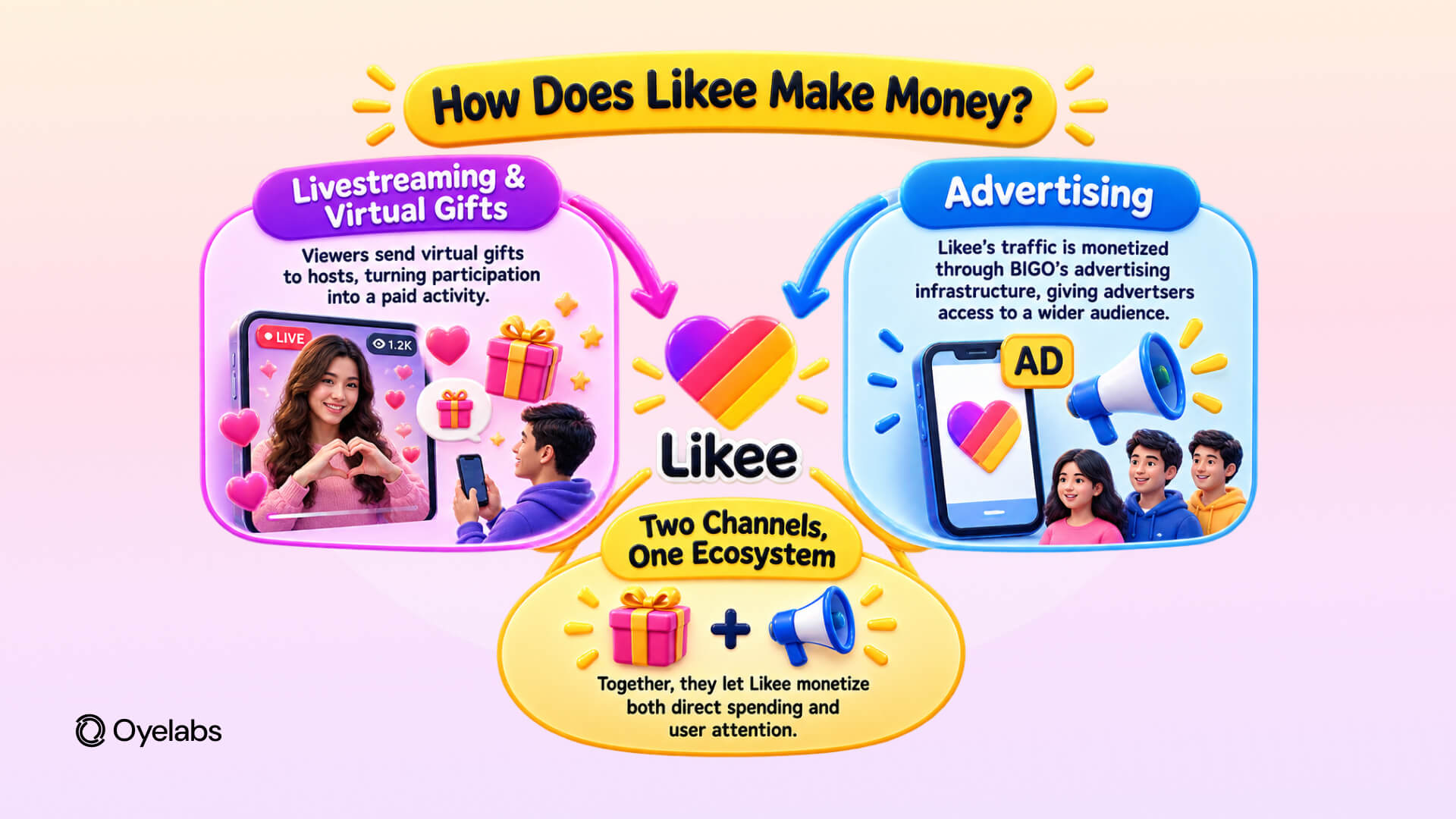
Likee mainly makes money through livestreaming and advertising. Its model combines direct spending from users with advertising revenue generated from the platform’s wider audience.
Livestreaming and Virtual Gifts
Livestreaming gives Likee a direct way to monetize creator-audience interaction. Viewers can purchase virtual gifts and send them to creators during live sessions, turning engagement into in-app spending.
Likee has also introduced features such as Superlike and Superfollow, giving users additional ways to support creators and allowing creators to offer exclusive content through subscriptions.
Livestreaming remains an important part of the wider BIGO business. In 2025, JOYY reported $1.53 billion in full-year livestreaming revenue across the company, although this figure covers JOYY’s broader operations and should not be treateds as Likee-specific revenue.
Advertising
Advertising gives Likee another way to monetize users who may never purchase virtual gifts or subscriptions. The platform can generate advertising revenue from the attention and traffic created by its short-video and social content.
There is also direct evidence of growth in this channel. In Q3 2024, Likee’s advertising revenue increased 33.4% year over year, while JOYY said Likee remained profitable during the quarter.
The broader advertising business has continued to expand. Across JOYY, full-year advertising revenue increased 37.1% in 2025 to $442.7 million, while BIGO Ads revenue increased 38.5% to $398.5 million. These figures describe JOYY and BIGO rather than Likee alone, so they provide context for the advertising infrastructure around Likee rather than a Likee revenue figure.
Together, these channels give Likee two different monetization routes: livestreaming captures direct spending from highly engaged users, while advertising monetizes the broader audience.
Likee Business Model Canvas
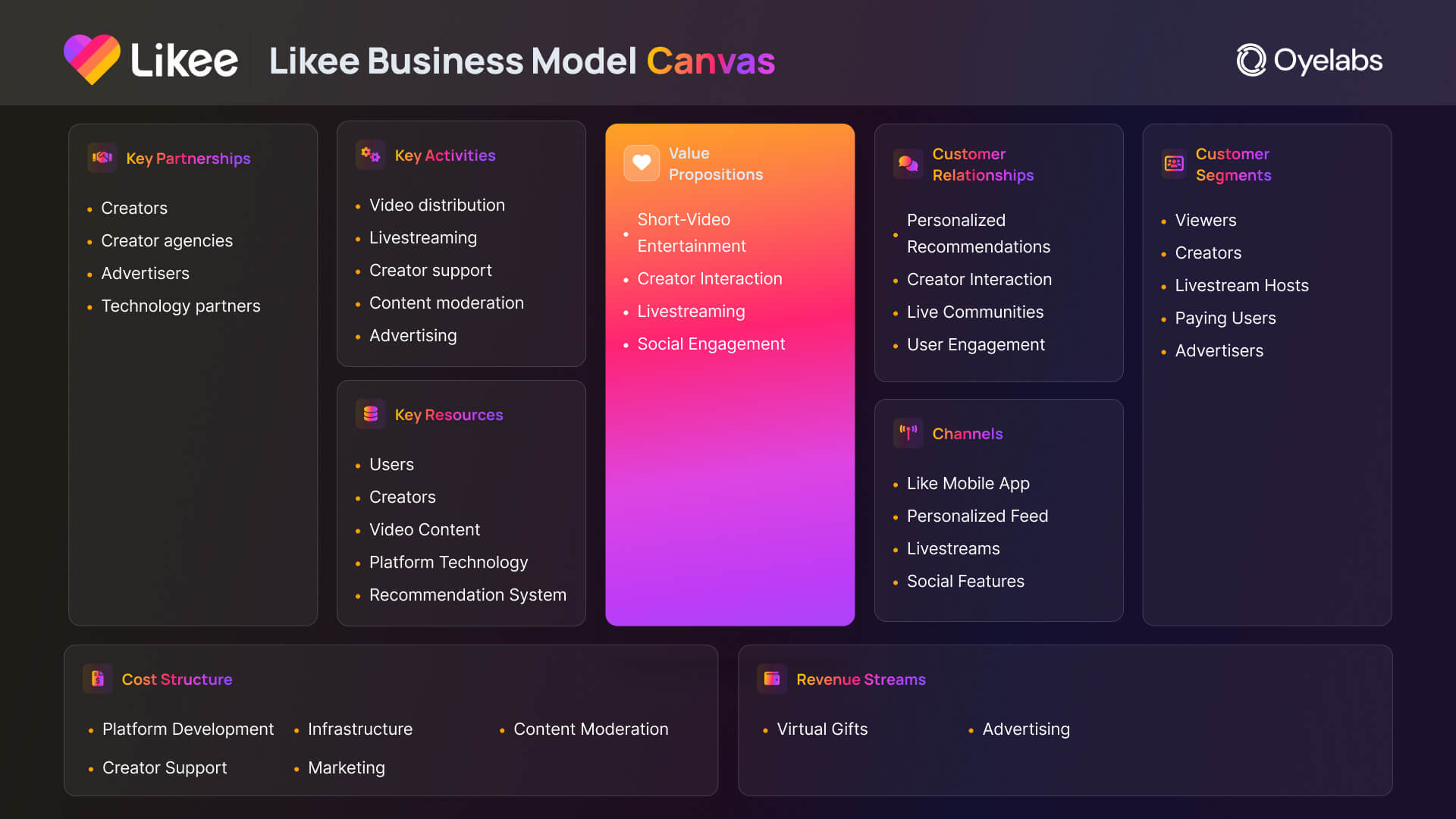
| Business Model Canvas | Likee |
|---|---|
| Customer Segments | Viewers, creators, livestream hosts, paying users and advertisers |
| Value Proposition | Short-form entertainment and interactive social experiences |
| Channels | Mobile app, personalized feed and livestreaming |
| Customer Relationships | Content recommendations, creator interaction and live communities |
| Key Activities | Content distribution, creator support, livestreaming, advertising and moderation |
| Key Resources | Users, creators, content, technology and advertising infrastructure |
| Key Partners | Creators, agencies, advertisers and technology partners |
| Revenue Streams | Virtual tips and |
The canvas highlights a simple point: Likee’s business is built around audience attention and creator activity, with monetization added around the highest-value interactions.
How Does Likee’s Creator Economy Work?
Creators are essential to Likee because they provide the content that users come to consume. But keeping creators active requires more than giving them publishing tools.
JOYY has described Likee’s creator-support programs as providing traffic, creation tools, professional guidance, and monetization opportunities.
Livestreaming adds another earning opportunity. A creator can build an audience through short-form content and then engage that audience through live sessions where virtual gifting becomes possible.
For a similar platform, this means the creator proposition needs to be considered alongside the user proposition. If creators have limited reasons to remain active, the platform eventually has less fresh content for its audience.
What Makes Likee Different From Other Popular Short-Video Apps?
Likee operates alongside popular short-video platforms like TikTok, Instagram, and YouTube. While all four offer video-based social experiences, each platform brings its own mix of content formats and user interactions.
| Platform | Core Experience | Notable Features |
|---|---|---|
| Likee | Short-video social entertainment | Livestreaming, voice rooms, live battles, games, and virtual gifts |
| TikTok | Short-form video entertainment | Personalized feeds, trends, creator content, LIVE, and effects |
| Social networking and content sharing | Reels, Stories, messaging, posts, and creator features | |
| YouTube | Video entertainment | Shorts, long-form videos, livestreaming, and creator memberships |
Likee’s distinct touch comes from bringing short videos and real-time interactive entertainment together. Users can discover content, connect with creators through livestreams and voice rooms, join live battles or games, and send virtual gifts without leaving the platform.
That combination gives Likee a broader social-entertainment experience and helps explain why its product goes beyond the typical short-video feed.
How to Build a Short-Video App Like Likee
Building a platform inspired by Likee starts with defining the business model rather than immediately developing a large list of features. The product needs a clear audience, a content strategy, a creator proposition, and a monetization path that work together.
1. Define the Market and Business Model
The first decision is who the platform is actually being built for. A general entertainment platform requires a different content and acquisition strategy from a niche creator community focused on music, gaming, regional content, or a particular interest group.
That choice should influence everything else, including creator recruitment, recommendation logic, moderation policies, marketing channels, and monetization.
2. Build the Core Content Experience
The first version needs to make content discovery and creation simple. Users should be able to move quickly through relevant content, while creators need straightforward tools for recording, editing, publishing, and managing their profiles.
Recommendation quality becomes increasingly important as the content library grows. A large volume of videos is not enough if users cannot quickly find content that matches their interests.
3. Create a Strong Creator Experience
Creators should have more than an upload button. Analytics, audience insights, creation tools, livestreaming, engagement features, and monetization options can help turn occasional creators into consistent contributors.
The goal is to make the creator side of the platform commercially attractive without making the user experience complicated.
4. Add Monetization and Trust Systems
Virtual gifts, advertising, subscriptions, or other monetization models can be introduced according to the target market and audience behavior. But monetization should be developed alongside trust and safety systems.
Content moderation, reporting, age controls, payment security, copyright management, and platform policies are fundamental parts of a social product. They should not be treated as additions after the platform has already scaled.
5. Launch, Measure and Improve
After launch, downloads alone will not tell you whether the model is working. Product and marketing teams should monitor retention, watch time, creator activity, content production, livestream engagement, paying-user conversion, advertising performance, and the relationship between creator activity and audience retention.
The purpose of these metrics is to identify where the product is creating real value. Once those patterns become clear, the business can invest more heavily in the features, creators, markets, and acquisition channels that support the core model.
Key Lessons From Likee’s Business Model
Content is the starting point, not the entire business. Likee uses short-form content to attract attention, but livestreaming and other interactive features create additional engagement and monetization opportunities.
Creators need a reason to stay. Creation tools, discovery, audience reach, and monetization all contribute to creator retention. A platform that focuses only on attracting viewers can struggle to maintain its content supply.
Monetization should follow engagement. Likee’s virtual gifting model works because it is connected to an existing creator-audience relationship, while advertising monetizes broader user attention.
More features are useful only when they support the model. Likee’s livestreams, voice rooms, games, and live battles matter because they extend the social-entertainment experience. A similar product should add features based on a clear business or user need.
Build a Short-Video App Like Likee
Likee shows how short videos, livestreaming, creator engagement, and multiple revenue channels can come together in one platform. If you want to build a short-video app like Likee, your product needs the right mix of content discovery, creator tools, livestreaming, social interaction, and monetization features from the beginning.
Oyelabs can help you build a Likee-like short-video platform tailored to your business goals and target audience. From user profiles and video creation to livestreaming, virtual gifts, and admin controls, we can help turn your app concept into a launch-ready product.
Conclusion
Likee’s business model is built around a simple foundation: attract users through short-form entertainment, support creators who supply content, deepen engagement through interactive experiences, and monetize that activity through virtual gifts and advertising.
For businesses studying the social-entertainment market, the useful takeaway is not to reproduce Likee feature by feature. It is to understand how content, creators, engagement, and monetization work together, then build a model around the audience and market being targeted.
FAQs
1. When was Likee launched?
Likee was launched in 2017 as a short-video platform, initially known as LIKE. It later expanded globally with livestreaming and interactive social features.
2. Which countries is Likee most popular in?
Likee has built audiences across markets including the Middle East, South Asia, Southeast Asia, and other regions where short-video entertainment and livestreaming are popular.
3. How does Likee compete with TikTok and other short-video platforms?
Likee combines short videos with livestreaming, voice rooms, live battles, games, creator interactions, and virtual gifts, creating a broader interactive entertainment experience.
4. What makes Likee’s livestreaming experience different?
Likee connects livestreaming with interactive features such as virtual gifts, live battles, voice rooms, and games, giving viewers multiple ways to participate during live sessions.
5. What are the main challenges of Likee’s business model?
Likee must continuously attract users and creators while maintaining content quality, managing moderation, competing for attention, and balancing advertising with interactive monetization across different markets.
Reviewed By: Anuraag Jain
CEO, Oyelabs & AI Transformation Expert