
How Does Jeeny Make Money? Business Model Guide

 Anuraag Jain
Last Updated on September 25, 2026
Key Takeaways
What You’ll Learn
- Jeeny operates a two-sided marketplace connecting passengers with drivers and delivery providers.
- Jeeny makes money through service fees, driver subscriptions, and delivery services.
- Jeeny Xpress extends its marketplace into delivery and B2B services.
- Driver supply and passenger demand keep the ride-hailing marketplace active.
- Unit economics show whether completed rides create useful contribution.
- A Jeeny-like platform needs apps, payments, ride matching, tracking, and operations.
- Existing marketplace infrastructure can support expansion into related services.
Stats That Matter
- Jeeny reported more than 2.5 million active users in January 2025.
- Jeeny reported a 40% increase in operations during 2024.
- Jeeny reported nearly 40,000 jobs provided through its operations.
A ride can be the product, but the marketplace is the business.
That is the part I find more interesting when looking at a platform like Jeeny. Every completed ride has two sides to it: a passenger who needs reliable transportation and a driver who needs enough demand to make staying on the platform worthwhile. Between those two sides sits a business that has to manage pricing, payments, supply, demand, operating costs, and revenue at scale.
Jeeny has also taken that marketplace beyond passenger transportation through Jeeny Xpress. That makes its model worth examining not just for how it earns from rides, but for how an existing platform can create additional commercial opportunities from the infrastructure it already has.
So, rather than looking at Jeeny as simply another ride-hailing app, I want to break down the economics behind the model, how Jeeny makes money, what keeps the marketplace running, where it can expand, and what I would take from the model when building a similar business.
What Is Jeeny?
Jeeny is a ride-hailing and transportation platform operating in Saudi Arabia and Jordan. It connects passengers with service providers through its digital platform, giving customers a way to request transportation while giving drivers access to ride demand.
Its transportation services include options such as Economy and Taxi, while Jeeny Xpress extends the platform into delivery services.
At its core, Jeeny operates as a two-sided marketplace. Passengers create demand for transportation, while drivers and other service providers provide the supply. Jeeny sits between both sides, providing the technology and operational infrastructure needed to make those transactions happen.
This means the business does not need to own a large fleet of vehicles itself. Instead, it operates the platform through which transportation services are requested, matched, completed, and paid for.
Also Read: Why Ride-Hailing Apps Are Becoming Super Apps in the Middle East
How Does Jeeny Work?
The customer journey is relatively straightforward. A passenger enters their pickup and destination details, requests a ride, and receives a suitable service provider through the platform. The driver accepts the request, completes the trip, and the transaction is processed through Jeeny.
Behind that simple experience is a marketplace that has to coordinate several things at once. The platform needs to know where drivers are available, connect the right driver to the request, support navigation and communication, process payments, record the completed trip, and manage issues that may occur during the service. The scale of these operations has also been growing. Jeeny reported a 40% increase in operations during 2024, with its CEO attributing the growth to factors including increased visitor numbers, infrastructure development, and higher foreign and local investment.
From the business side, the process can be understood in four stages:
- A passenger creates a service request.
- Jeeny matches the request with an available service provider.
- The service provider completes the trip.
- Jeeny earns revenue according to the applicable monetization model.
The same basic marketplace infrastructure can also support delivery services. This is important because the value of a platform like Jeeny comes from more than the booking interface. The underlying technology and operational system create the foundation for multiple types of transactions.
What Is the Jeeny Business Model?
Jeeny uses a two-sided marketplace business model with multiple monetization methods.
The platform creates value by bringing transportation demand and service supply together. Passengers get access to transportation, while drivers get access to customers and ride opportunities. Jeeny manages the technology and takes part of the economic value generated through the marketplace.
At a high level, the model looks like this:
| Business Element | Jeeny Model |
|---|---|
| Customers | Passengers and businesses |
| Service Providers | Drivers and delivery providers |
| Core Services | Transportation and delivery |
| Marketplace | Jeeny platform |
| Primary Monetization | Service fees |
| Additional Monetization | Driver subscriptions and delivery services |
| Main Technology | Passenger app, driver app, and a |
The scale of this marketplace is also reflected in Jeeny’s reported user base. In January 2025, the company said it had more than 2.5 million active users, according to comments from its CEO reported by Argaam. The company also said it had provided nearly 40,000 jobs, highlighting the scale of its service network.
The important distinction is that Jeeny is not simply selling access to an app. The app is the infrastructure that supports a real-world marketplace. That makes supply, demand, pricing, retention, operating costs, and monetization closely connected. If any one of these areas becomes difficult to manage, it can affect the rest of the business.
What Makes Jeeny Different From Other Popular Ride-Hailing Apps?
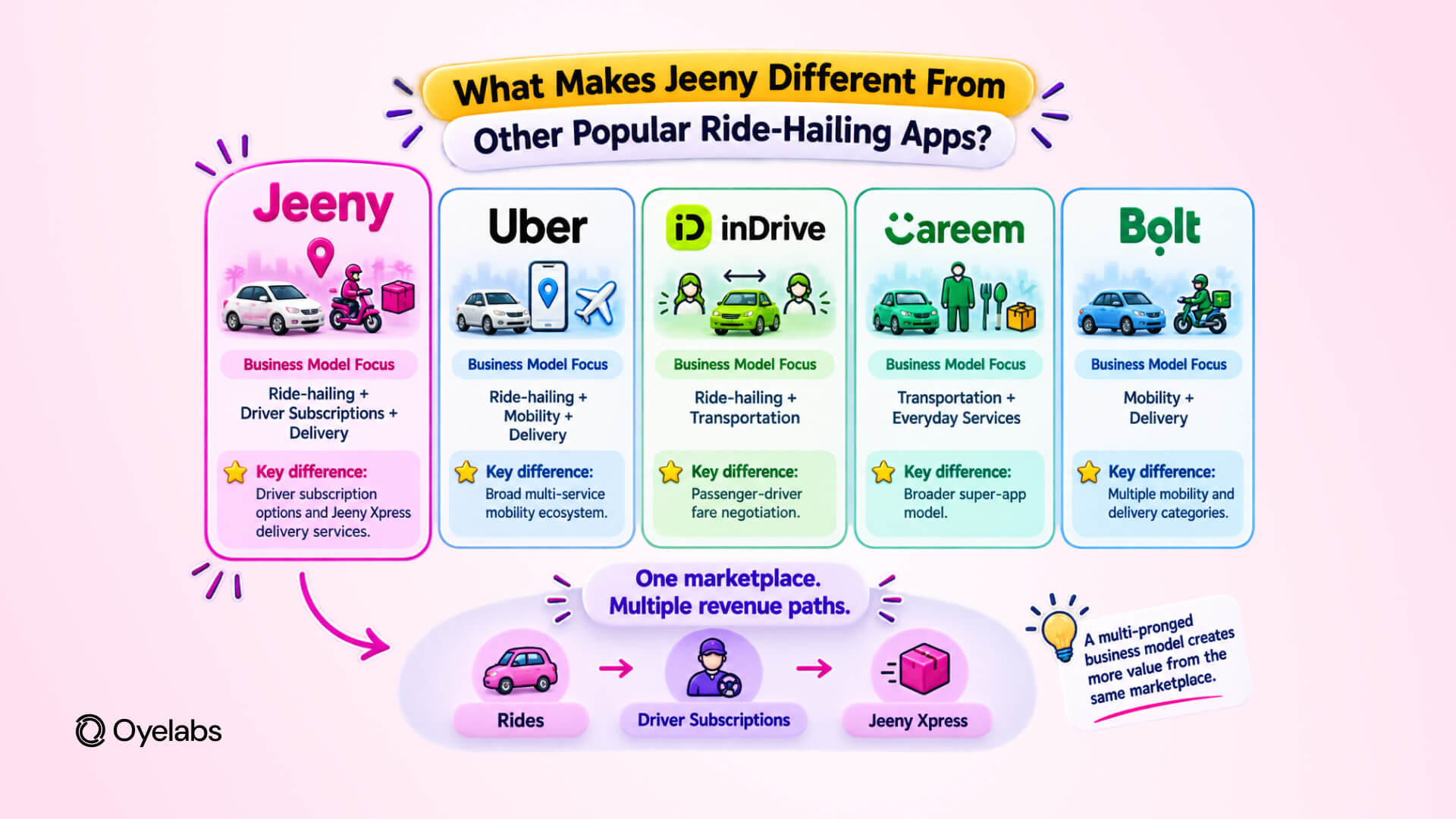
Jeeny operates in the same ride-hailing market as platforms like Uber, inDrive, Careem, and Bolt. However, these platforms differ in how they approach pricing, monetization, services, and marketplace expansion.
| Platform | Business Model Focus | Notable Difference |
|---|---|---|
| Jeeny | Ride-hailing, driver subscriptions, and delivery | Driver subscription options and Jeeny Xpress delivery services |
| Uber | Ride-hailing, mobility, and delivery | Broad multi-service mobility ecosystem |
| inDrive | Ride-hailing and other transportation services | Negotiated pricing between passengers and drivers |
| Careem | Transportation and multiple everyday services | Broader super-app model |
| Bolt | Mobility and delivery | Multiple mobility and delivery categories |
For a business-model analysis, Jeeny is particularly interesting because it combines transaction-based revenue with driver subscriptions and delivery services. This gives the platform more than one way to generate value from its marketplace and existing service-provider network.
How Does Jeeny Make Money?
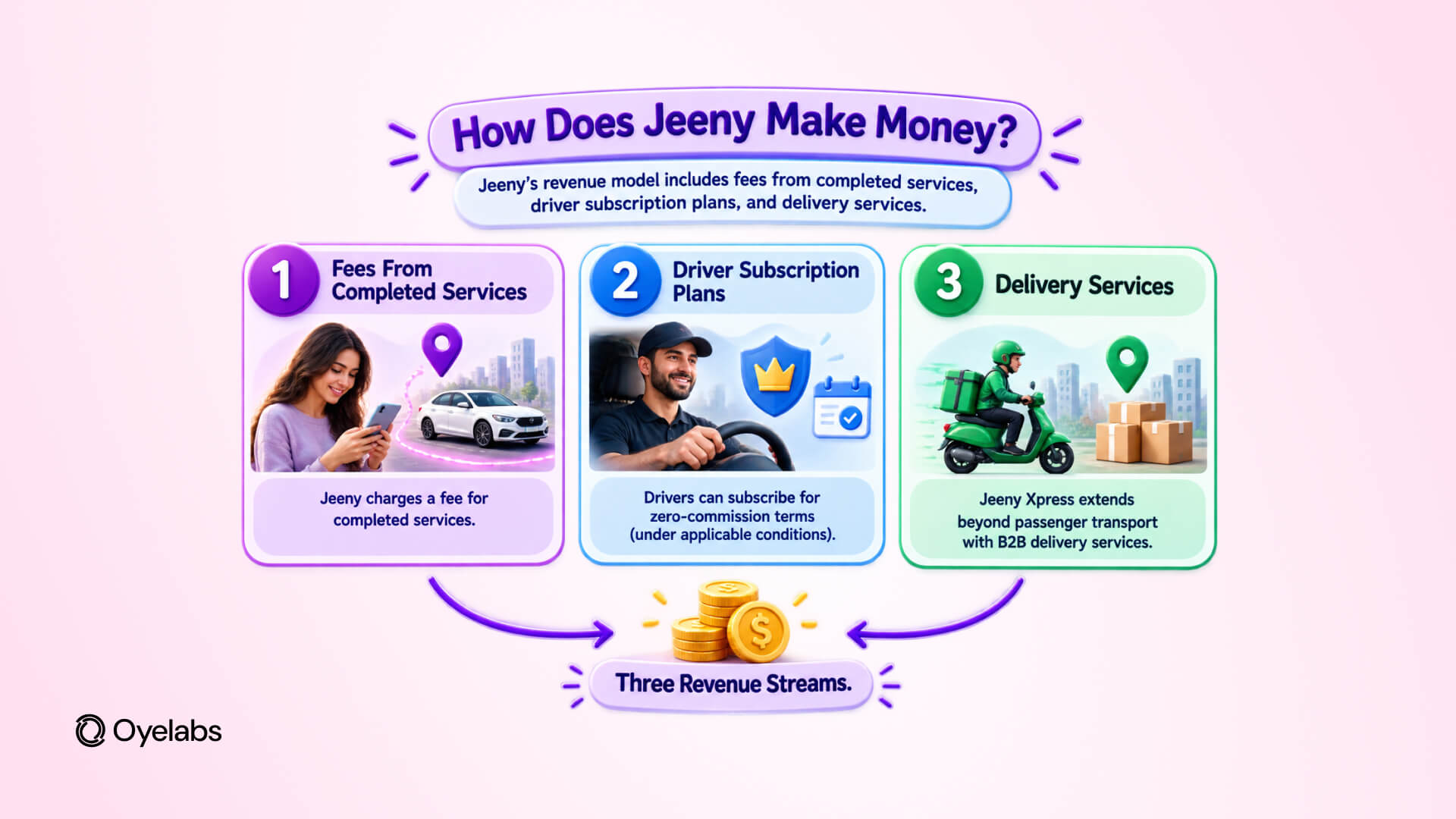
Jeeny’s revenue model includes fees from completed services, driver subscription plans, and delivery services.
Fees From Completed Services
One of Jeeny’s core monetization methods is charging service providers a profit-margin fee for completed services.
In a typical transaction, the passenger pays for the completed ride. The service provider receives the applicable earnings, while Jeeny retains the applicable platform fee or margin.
The exact economics can vary depending on the service, market, pricing structure, and applicable terms. The broader principle is simple: completed transactions create the activity from which the platform earns.
This is why ride frequency matters so much. A platform can have a large number of registered passengers and drivers, but inactive accounts do not generate meaningful transaction revenue. The business needs people to keep using the service and completing rides.
Driver Subscription Plans
Jeeny also offers driver subscription plans that can provide zero-commission terms to participating drivers under the applicable conditions.
This creates a different monetization structure from a standard per-ride commission. Instead of relying entirely on a percentage of eligible transactions, the platform can generate subscription revenue from participating drivers.
For drivers, the attraction is straightforward. If they complete enough rides, keeping more of their eligible earnings may make a subscription worthwhile. For the platform, the benefit is the opportunity to create a more predictable revenue stream from its active driver base.
The economics depend heavily on adoption and driver activity. A subscription needs to provide enough value for drivers to continue paying for it while generating sufficient revenue for the platform. That makes subscription pricing, driver retention, and usage important parts of the model.
Delivery Services
Jeeny also creates revenue opportunities through Jeeny Xpress, its delivery service.
The service extends the platform beyond passenger transportation and includes B2B delivery services. Instead of matching only passengers with drivers, the same type of infrastructure can be used to coordinate delivery requirements with service providers.
This creates another commercial opportunity. Consumer rides are generally individual transactions, while business customers may have ongoing transportation or delivery requirements. That can make B2B services an interesting area for recurring commercial relationships.
Jeeny Business Model Canvas
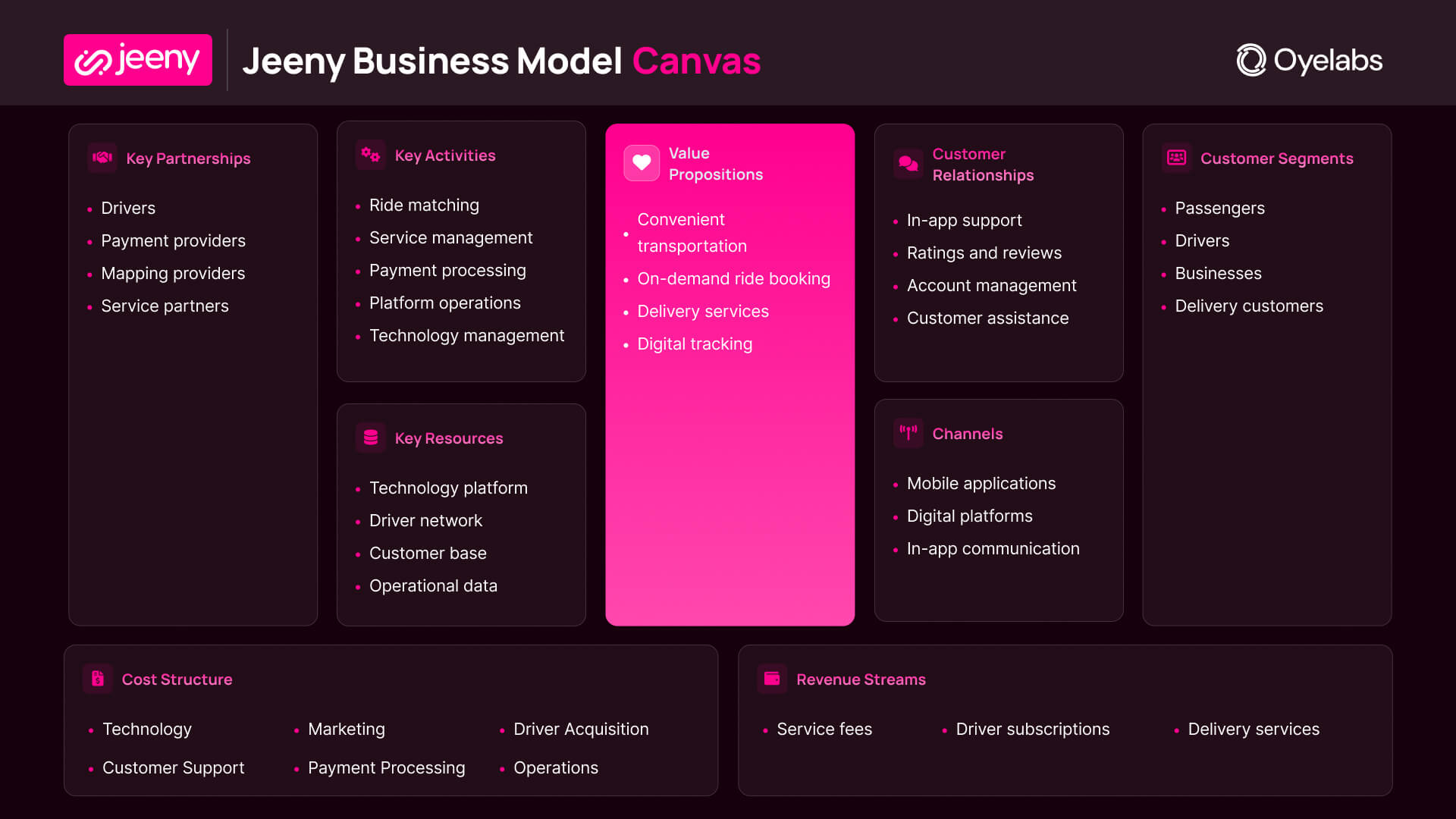
A business model canvas helps bring the different parts of the business together without reducing the model to revenue alone.
| Element | Jeeny |
|---|---|
| Customer Segments | Passengers, drivers, businesses, and delivery customers |
| Value Proposition | Convenient transportation and delivery through a digital platform |
| Channels | Mobile applications and digital channels |
| Customer Relationships | In-app services, support, ratings, and account management |
| Key Activities | Ride matching, service management, payments, technology, and operations |
| Key Resources | Technology platform, driver network, customer base, and operational data |
| Key Partners | Drivers, payment providers, mapping providers, and service partners |
| Revenue Streams | Service fees, driver subscriptions, and delivery services |
| Cost Structure | Technology, marketing, support, payments, driver acquisition, and operations |
Looking at the model this way makes one thing clear: the mobile app is only one part of the business.
Behind it are driver acquisition, customer acquisition, payment processing, customer support, pricing, compliance, marketplace operations, and ongoing technology costs. The platform has to keep all of these pieces working together while still making each transaction economically useful.
Understanding the Unit Economics
This is where the business model becomes more practical.
Instead of looking only at total revenue, unit economics asks what the platform actually keeps from an individual transaction after the variable costs associated with that transaction.
A simplified calculation would consider the platform’s revenue from a completed ride and then account for costs such as driver earnings, payment processing, incentives, discounts, refunds, and other variable operating expenses.
The remaining contribution gives the business a better understanding of whether each transaction is financially useful.
For example, a company could increase bookings by offering aggressive discounts. That may look like strong growth in the short term, but the additional rides may not be economically attractive if the platform spends too much on discounts and customer acquisition.
The same applies to driver incentives. Incentives can help create supply in a new market, but the business needs to understand whether the resulting activity can eventually support itself.
Some of the most useful metrics to monitor include:
| Metric | What It Shows |
|---|---|
| Revenue per ride | Revenue generated from each transaction |
| Customer acquisition cost | Cost of gaining a passenger |
| Driver acquisition cost | Cost of gaining a service provider |
| Ride frequency | How often passengers use the platform |
| Passenger retention | Whether customers continue returning |
| Driver retention | Whether drivers remain active |
| Cancellation rate | Friction within the marketplace |
| Incentive spending | Cost of stimulating activity |
| Subscription adoption | Demand for driver subscription plans |
| Contribution margin | Economics after variable costs |
These numbers provide a much clearer picture of the business than download or registration figures alone.
How Can Jeeny Expand Beyond Ride-Hailing?
A transportation platform can potentially use its existing technology and service-provider network to enter adjacent markets.
Jeeny Xpress is an example of this approach. By adding delivery services, the platform can use similar capabilities for a different type of customer requirement.
A similar business could also evaluate opportunities such as corporate transportation, business accounts, scheduled rides, premium transportation, additional vehicle categories, local delivery, or B2B logistics.
These are potential expansion strategies rather than assumptions about Jeeny’s current services.
The underlying business logic is what matters. If the platform already has location technology, payment infrastructure, service-provider management, customer accounts, and operational capabilities, those assets may be useful in related service categories.
B2B services can be particularly interesting because businesses may have recurring transportation or delivery requirements. Instead of relying only on individual consumer bookings, the platform can potentially build longer-term commercial relationships.
How to Build a Ride-Hailing App Like Jeeny
Building a ride-hailing platform like Jeeny starts with the business model, not just the technology. A successful platform needs the right market, monetization strategy, user experience, and operational setup working together.
Step 1 Define Your Target Market
Start by deciding where the platform will operate and who it will serve. Study local transportation habits, regulations, customer expectations, driver availability, payment preferences, and existing competition.
These factors can directly influence how the platform should be designed and monetized.
Step 2 Choose the Revenue Model
Decide how the platform will generate revenue before developing the product. You could use service fees, driver subscriptions, delivery services, business accounts, or a combination of models.
Each option creates different economics, so the choice should match the target market and expected transaction volume.
Step 3 Plan the Passenger and Driver Experience
Map out what both sides of the marketplace need to do. Passengers should be able to register, request rides, track drivers, make payments, manage their trips, and access passenger safety features.
Drivers need tools for registration, verification, accepting rides, navigation, completing trips, and tracking earnings.
Step 4 Define the MVP
Once the core journeys are clear, decide which features are essential for the first version. The MVP should support the complete ride process, from booking and driver matching to trip completion and payment.
Features that are not necessary for the initial launch can be added later based on actual user behavior.
Step 5 Build the Technology
The technology should support the business process you have already defined. This typically includes passenger and driver apps, an admin panel, GPS and location tracking, ride matching, notifications, payments, navigation, and backend infrastructure.
Step 6 Set Up Operations
A ride-hailing platform also needs a strong operational system behind the apps. Plan how drivers will be verified, how customer issues will be handled, how pricing will be managed, and how the business will deal with fraud, payment problems, cancellations, and disputes.
Step 7 Launch and Measure Performance
After launch, track the numbers that show whether the marketplace is actually working.
Completed rides, repeat usage, active drivers, customer and driver retention, acquisition costs, cancellation rates, subscription adoption, and contribution margin can provide a much clearer picture than downloads alone.
What Can We Learn From Jeeny’s Business Model?
Jeeny’s model offers several practical lessons for anyone studying or building a marketplace business.
The first is that activity matters more than registrations. A large user base does not automatically create a healthy business. The platform needs passengers who book rides and drivers who remain active.
The second is that driver economics affect the entire marketplace. The way drivers are paid, charged, and incentivized can influence supply, retention, and ultimately the passenger experience.
The third is that one marketplace can support multiple revenue opportunities. Service fees, driver subscriptions, and delivery services show how a platform can explore different ways to capture value from the infrastructure it has built.
The fourth is that growth has to be measured economically. More bookings are useful, but sustainable growth requires the platform to understand acquisition costs, transaction contribution, retention, and operating expenses.
Finally, expansion works best when it builds on existing capabilities. A platform that already has technology, service providers, customers, payment systems, and operational experience may have opportunities to enter related markets without starting from zero.
Build Your Own Ride-Hailing Platform
Want to launch a ride-hailing platform like Jeeny? Oyelabs offers ready-to-launch ride-hailing solutions with passenger and driver apps, real-time tracking, ride management, secure payments, and an admin panel. The platform can be adapted to your target market, service model, and operating requirements.
You can also build around different revenue models, including service fees, driver subscriptions, and delivery services. Start with the core ride-hailing system and add features based on how your business grows and what your users need.
Conclusion
Jeeny’s business model is built around connecting transportation demand with service providers and generating revenue from the transactions taking place through the platform.
Its model includes fees from completed services, driver subscription plans, and delivery services through Jeeny Xpress.
But the interesting part is how the different pieces work together. The platform needs enough passenger demand to keep drivers active, enough driver supply to maintain service availability, and enough transaction volume to support its operating costs.
That makes the business much more than a ride-booking application. It is a marketplace where technology, customer acquisition, driver economics, operations, pricing, and monetization all influence one another.
For anyone planning a similar business, that is the real lesson to take from Jeeny: the product gets the marketplace running, but the business model determines whether that marketplace can become sustainable.
FAQs
1. Is Jeeny available outside Saudi Arabia and Jordan?
Jeeny currently operates in Saudi Arabia and Jordan, although available services can vary by city, market conditions, local regulations, and customer demand.
2. Who owns Jeeny?
Jeeny is operated by Easy Taxi, a mobility company focused on transportation services and digital mobility solutions across selected Middle Eastern markets.
3. How does Jeeny attract and retain drivers?
Jeeny can attract and retain drivers through passenger demand, flexible earning opportunities, incentives, and subscription options that provide different earning arrangements for participating drivers.
4. Does Jeeny offer services besides ride-hailing?
Yes. Jeeny also operates Jeeny Xpress, a delivery service that extends its platform beyond passenger transportation into package and parcel delivery services.
5. Can businesses use Jeeny for transportation or delivery?
Yes. Jeeny provides business-oriented delivery services, allowing companies to use its platform for transportation and delivery requirements alongside its consumer-focused ride services.
Reviewed By: Anuraag Jain
CEO, Oyelabs & AI Transformation Expert