
Airbnb and OpenAI Partial Partnership – Key Lessons for Founders
Airbnb and OpenAI Partial Partnership – Key Lessons for Founders
 Ayan Khan
Last Updated on November 3, 2025
Key Takeaways
What You’ll Learn
- Airbnb and OpenAI are exploring AI but not rushing full partnership yet.
- Founders must balance technology with real human connection for long-term success.
- Timing and readiness matter more than early adoption of trending AI tools.
- Strong marketplaces grow by trust, design simplicity, and verified user systems.
- Oyelabs helps startups launch Airbnb-style apps quickly with proven frameworks.
Stats That Matter
- The global vacation rental market could reach $119 billion by 2030.
- About 42% of large companies have deployed AI, mostly in limited form.
- 74% of businesses still struggle to gain real value from AI projects.
- The U.S. short-term rental market is worth $68 billion and growing yearly.
Real Insights
- AI should support, not replace, human experiences in digital platforms.
- Patience and testing ensure safer, smarter innovation for founders.
- Design clarity builds user trust faster than complex automation ever can.
- Verified listings and transparent reviews drive repeat bookings.
- Smart partnerships like Oyelabs reduce risk and speed up platform launches.
Airbnb and OpenAI Partial Partnership – Key Lessons for Founders
Ever wondered what happens when the world’s top home-sharing platform and the most talked-about AI company swap notes?
When Brian Chesky of Airbnb and Sam Altman of OpenAI start exchanging late-night strategy calls, founders everywhere should pay attention. This isn’t just a Silicon Valley bromance – it’s a masterclass in timing, technology, and trust.
Airbnb’s cautious stance on full-scale ChatGPT integration shows that even billion-dollar giants understand one rule: innovation only matters when it enhances the user journey. The conversation between these two leaders reveals how startups can balance cutting-edge tools like generative AI, recommendation engines, and contextual automation with human-centric product design.
If you’re building your own Airbnb-style marketplace, this story holds a playbook of insights – how to adopt new tech without losing focus on your community, and why aligning innovation with experience is the real growth hack in 2025.
How Did Airbnb and OpenAI’s Founders Cross Paths?
Before diving into the partnership itself, it helps to understand the two visionaries behind it – Brian Chesky and Sam Altman – and how their paths converged.
Both are known for challenging convention. Chesky transformed short-term stays into a community-driven global network valued at over $100 billion. Altman, on the other hand, redefined artificial intelligence with OpenAI, a company powering millions of tools and startups worldwide.
Their friendship began years ago in the tight-knit Silicon Valley founder circle. Altman once credited Chesky for offering hours of candid advice during OpenAI’s scaling phase, particularly around user experience design, brand consistency, and trust loops. These conversations laid the groundwork for mutual respect – Chesky learned from Altman’s engineering precision, while Altman admired Airbnb’s mastery of human-centered marketplaces.
For founders, this intersection of design-led thinking and AI-driven scalability represents the future of digital business. The Airbnb OpenAI dialogue isn’t accidental; it’s a meeting point of two disciplines every modern startup must now blend – empathy and intelligence. In fact, the vacation rental market alone is already valued at nearly USD 90 billion, and is expected to top USD 119 billion by 2030.
What Does “Partial Partnership” Between Airbnb and OpenAI Really Mean?
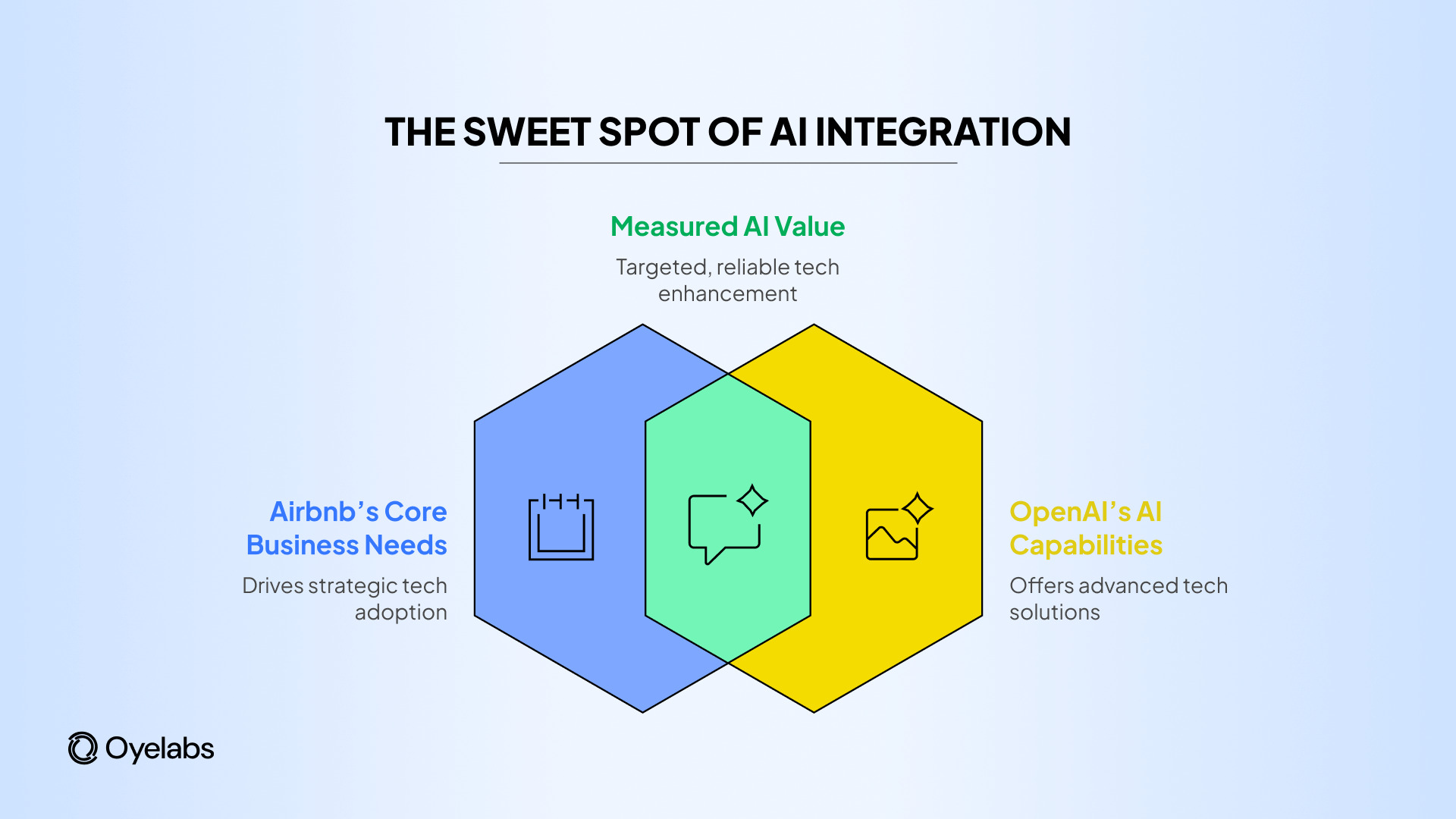
When headlines surfaced about Airbnb exploring AI integration, many assumed a sweeping alliance. In truth, Chesky clarified it as a “partial partnership” – exploratory, limited, and deliberately measured.
Airbnb has been testing OpenAI’s technologies for content personalization, customer support automation, and intelligent search. Yet Chesky noted that current generative models aren’t fully optimized for Airbnb’s scale and complexity. “We’re interested, but not ready for deep integration,” he said – a stance revealing a rare discipline in a hype-driven market.
This partial partnership shows that:
- Adoption doesn’t equal readiness. Even the most advanced startups must verify ROI and reliability before deployment.
- Integration should serve core metrics. For Airbnb, that’s booking conversion, host retention, and trust scores.
- Testing precedes transformation. Limited pilots allow data-backed decisions before committing full engineering resources.
For early-stage founders, this approach is gold. The goal isn’t to adopt AI fastest – it’s to adopt it wisely, ensuring technology amplifies the value you already deliver.
Why Did Airbnb Choose to Wait on Full ChatGPT Integration?
To understand Airbnb’s hesitation, consider its product DNA: the company thrives on human trust. Every booking hinges on the emotional equation between host and guest. Chesky has repeatedly emphasized that AI must support, not replace, that bond.
In internal evaluations, Airbnb’s team found that while ChatGPT could automate responses, it sometimes lacked the empathy and nuance that define the brand’s tone. Instead of forcing adoption, Chesky chose strategic patience – a lesson most founders overlook.
Key reasons Airbnb decided to wait include:
- Product Readiness Over Publicity – Integrating unfinished technology could dilute user experience and erode trust.
- Data Responsibility – AI systems handling guest information must comply with evolving privacy and jurisdictional standards.
- Cultural Alignment – Airbnb’s brand narrative centers on belonging; automation without context risks breaking that narrative.
For founders developing platforms in hospitality or marketplaces, this restraint offers a blueprint. New technology should extend your brand promise, not redefine it prematurely. The Airbnb OpenAI partial partnership underscores that success often lies not in saying “yes” to innovation, but in knowing when to.
What Are the Biggest Takeaways from the Airbnb-OpenAI Story for Startup Founders?
The Airbnb OpenAI partial partnership offers rare insight into how leading founders approach technology and timing. Below are six lessons worth noting for anyone building their own platform or marketplace.
Why Founders Should Prioritize Human Connection Over AI
Brian Chesky often reminds his team that Airbnb’s core product is belonging, not lodging. Automation can enhance support and matching, but trust still drives conversion.
For founders, this means investing early in:
- Transparent host-guest communication.
- Verified profiles and reviews that reinforce credibility.
- Empathy-driven UX writing that feels personal, not mechanical.
AI should strengthen human connection, not mask it. The most scalable brands are still built on relationships.
How to Use AI as a Growth Tool – Not a Distraction
AI is powerful for personalization, predictive pricing, and fraud detection. Yet it becomes wasteful when implemented for headlines rather than outcomes. Airbnb’s measured testing of OpenAI models shows that technology must align with KPIs such as conversion, satisfaction, and lifetime value.
Founders should define use-cases first, choose tools second, and validate with data before expansion.
When Is the Right Time to Adopt New Technology?
Timing separates innovators from experimenters. Airbnb chose to observe the market maturity of generative AI before full adoption.
Early-stage startups should:
- Launch with core functionality that solves a proven pain point.
- Collect user data and feedback.
- Introduce AI when patterns are visible and the feature can genuinely enhance the experience.
Rushing adoption often leads to feature fatigue and higher churn.
How Partnerships Can Boost Brand Credibility Without Losing Control
Strategic alliances can open doors, but must never redefine ownership. Airbnb’s limited collaboration with OpenAI is a reminder that founders should leverage partnerships for expertise, not dependence.
You can gain technology credibility through:
- White-label collaborations with proven development firms.
- API integrations that extend, not replace, your core product.
- Co-marketing initiatives that share audiences but keep data proprietary.
Partnerships should strengthen your position, not dilute your brand DNA.
What Airbnb’s Growth Teaches About Scaling a Marketplace
Airbnb scaled by maintaining equilibrium between supply and demand. Each new market launch ensured balanced host inventory and guest interest. For modern founders:
- Start locally, scale globally. Launch with focus, then replicate the playbook.
- Use incentives and referral programs to maintain liquidity.
- Monitor engagement metrics-response rate, occupancy, repeat bookings guide expansion.
Sustainable growth stems from operational discipline, not sudden virality.
Why Design and User Experience Define Long-Term Success
Every Airbnb interaction-from search filters to listing photos-reflects meticulous design. Chesky, a trained designer, built the brand around visual trust.
For startups, the takeaway is simple:
A clean interface and intuitive workflow reduce friction, enhance credibility, and convert faster than complex features ever could. Investing in UX early pays compound returns.
How Can Founders Build an Airbnb-Like App Without Starting from Scratch?
Launching a marketplace today doesn’t require building infrastructure from zero. Founders can rely on white-label platforms that already solve the structural challenges of listings, payments, reviews, and messaging. Specifically in the U.S., the short-term rental market is already around USD 68.6 billion and growing at over 7% annually.
A white-label vacation-rental solution enables you to:
- Go live faster – deploy in weeks, not months.
- Reduce development cost – reinvest savings into marketing and host acquisition.
- Scale securely – pre-tested codebase, built-in analytics, and API flexibility.
This approach frees you to focus on brand positioning, partnerships, and user trust instead of reinventing backend architecture.
How Did Oyelabs Help One Founder Become a Recognized Brand in the Vacation-Rental Space?
When a first-time founder approached Oyelabs with a vision to create a niche vacation-rental platform, they needed two things: speed and stability. Using Oyelabs’ ready-to-launch Airbnb-style solution, their platform went live in just 90 days.
The results were measurable:
| Metric | Before Launch | 3 Months Post-Launch |
| User Engagement | Baseline (new brand) | +250 % |
| Impressions | – | +400 % |
| Brand Recall | Limited | Recognized in the national travel press |
The success wasn’t accidental. Oyelabs combined robust backend logic (listings, bookings, wallet, verification) with a thoughtful UX that mirrored Airbnb’s clarity while maintaining a unique brand tone.
This founder’s journey proves that execution speed and technical reliability can transform an idea into a brand within one quarter-without overspending or compromising scalability.
What Should New Founders Do Before Building a Vacation Rental Platform?
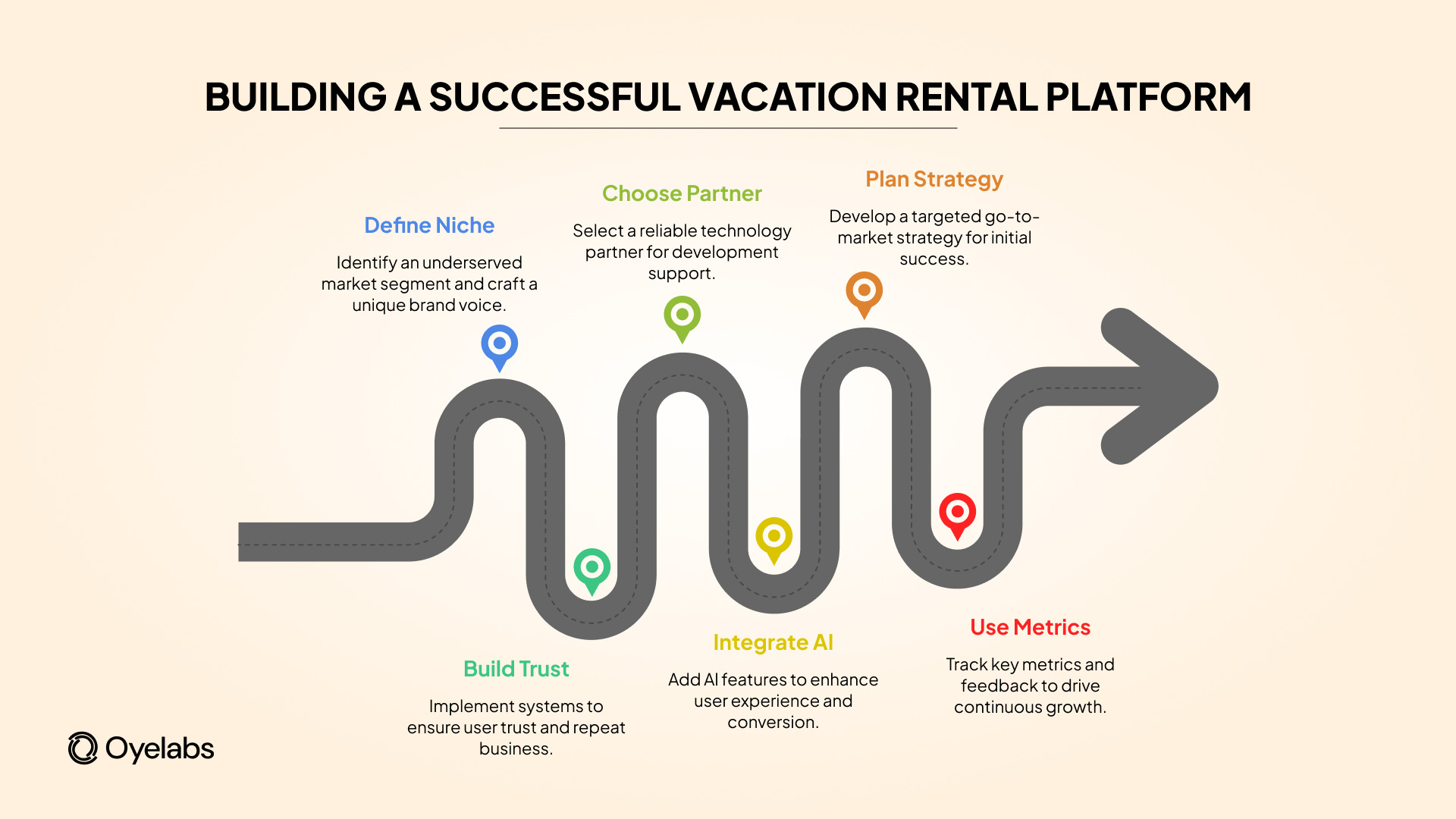
Before writing the first line of code or hiring a developer, it’s critical to plan the groundwork that determines whether your platform thrives or stalls. The Airbnb-OpenAI story shows that disciplined preparation often beats speed.
Step 1 – Define Your Market Niche and Brand Voice
Instead of competing head-to-head with global incumbents, identify an underserved segment-eco-stays, boutique villas, or business-only rentals. Then craft a tone that speaks directly to that audience. Airbnb’s identity is “belong anywhere.” What’s yours?
Step 2 – Build Trust Before You Build Features
Trust is the invisible currency of every marketplace. Implement verified profiles, transparent reviews, secure payment workflows, and clear cancellation logic. These systems create repeat users before marketing spend begins.
Step 3 – Choose the Right Technology Partner
A reliable development partner accelerates launch and reduces risk. Firms like Oyelabs provide white-label frameworks already proven for scalability, hosting, and compliance, so you can focus on growth strategy rather than infrastructure.
Step 4 – Add AI Only When It Improves User Experience
Integrate recommendation engines, chat assistants, or fraud detection only after baseline adoption. Data-driven personalization should enhance booking conversion, but complicate the interface.
Step 5 – Plan Your Go-to-Market Strategy Early
Segment your first market, onboard hosts personally, and set promotional pricing to drive reviews. A soft-launch with measurable KPIs often outperforms a broad, unfocused rollout.
Step 6 – Use Metrics and Feedback to Drive Growth
Track retention, average booking value, and time-to-first-booking per host. Let analytics dictate product iterations rather than intuition alone.
Curious how Airbnb actually turns design and community into revenue? Explore our breakdown of the Airbnb Business Model and Secrets to Making Money to see the financial logic behind every booking.
Why Is the Airbnb + OpenAI Partnership Relevant to Founders in 2025?
The year 2025 marks a new chapter in platform evolution. Consumer behavior is shaped by predictive technology, yet brand loyalty still depends on authenticity. The Airbnb OpenAI partial partnership illustrates this duality perfectly.
- AI is moving from novelty to necessity. Startups can now automate onboarding, match guests intelligently, and personalize experiences at scale.
- Ethical AI adoption matters. Data privacy, regional compliance, and algorithmic fairness influence investor confidence.
- Experience remains irreplaceable. Chesky’s decision to delay full ChatGPT integration shows that empathy cannot yet be automated.
For founders, the takeaway is straightforward: technological readiness must meet emotional resonance. Platforms that master both will dominate the next decade of the sharing economy.
How Can Oyelabs Help You Launch Your Own Airbnb-Style App in 2025?
Oyelabs specializes in helping founders launch faster, scale smarter, and retain full ownership of their platforms. The company’s white-label ecosystem covers web, iOS, and Android-pre-built with booking engines, payment gateways, multi-currency wallets, and analytics dashboards.
Key advantages of launching with Oyelabs:
- Time Efficiency: Deploy a market-ready platform in 6-8 weeks.
- Cost Control: Fixed investment is far lower than building from scratch.
- Scalability: Modular architecture ready for microservices or third-party APIs.
- Investor Appeal: Clean documentation, performance metrics, and transparent code ownership.
- OyeCare Support: Continuous maintenance, upgrades, and post-launch assistance.
Partnering with Oyelabs means focusing on growth, partnerships, and marketing-while a dedicated technical team handles reliability and optimization behind the scenes.
What Are the Key Takeaways for Founders from the Airbnb and OpenAI Partnership?
- Human connection is still the ultimate differentiator. Technology should deepen relationships, not replace them.
- Strategic patience builds credibility. Waiting until a feature is truly ready protects long-term brand value.
- Partnerships amplify expertise, not dependence. Choose collaborators who expand your capabilities without compromising autonomy.
- Design and simplicity drive retention. The smoother the interface, the faster trust compounds.
- Execution speed matters-but readiness matters more. The goal is not to move first, but to move right.
Still deciding when to bring AI into your product roadmap? Read Airbnb’s AI Future: Predictions for Rental Booking Startups to see how timing and innovation will define tomorrow’s winners.
Final Thought
The dialogue between Airbnb and OpenAI isn’t just a corporate headline-it’s a mirror for every founder deciding how to balance innovation with integrity. You don’t need billions in funding to follow their example. With a structured approach, a clear brand promise, and a proven partner like Oyelabs, you can build your own marketplace that scales intelligently and earns genuine loyalty.
Ready to design the next chapter of the vacation-rental revolution?
Explore Oyelabs’ white-label solutions today and discover how fast your idea can become a trusted brand.
FAQs
- What is the Airbnb and OpenAI partial partnership about?
Airbnb is cautiously exploring OpenAI tools for automation and personalization without full-scale ChatGPT integration yet. - Why did Airbnb delay full AI adoption in its platform?
Airbnb prioritizes human connection, brand trust, and verified readiness before implementing advanced AI systems company-wide. - What can startup founders learn from the Airbnb–OpenAI story?
Founders learn timing, testing, and aligning technology with genuine customer experience before large-scale deployment. - How can Oyelabs help startups build Airbnb-like platforms?
Oyelabs offers ready-made, customizable Airbnb-style solutions with faster launch, lower cost, and scalable architecture.