
Key Gamification Features for Language Learning Platforms
Key Gamification Features for Language Learning Platforms
 Anuraag Jain
Last Updated on February 18, 2026
Key Takeaways
What You’ll Learn:
- Gamification increases daily practice consistency in language learning apps.
- Streak systems reduce early drop-offs in language learning platforms.
- Leaderboards improve engagement in gamified language learning apps.
- XP and level systems motivate continued language lesson completion.
- Adaptive learning personalizes language lessons based on user performance.
- Gamified rewards increase subscription upgrades in language learning apps.
Stats That Matter:
- The global language learning market exceeded $61 billion in 2023.
- Duolingo has over 83 million monthly active users worldwide.
- Mobile learning improves knowledge retention by up to 60 percent.
- The global e-learning market may reach $458 billion by 2026.
- Structured corporate learning increases profit margins by 24 percent.
Real Insights:
- Retention directly impacts valuation in EdTech startups.
- Gamification must align with business and revenue objectives.
- Simple reward systems outperform overly complex mechanics.
- AI personalization reduces learner frustration and churn.
- Habit-based design increases predictable subscription revenue.
Key Gamification Features for Language Learning Platforms
If your language app feels like homework, users will ghost it.
Gen Z expects streaks, levels, instant wins, and progress they can screenshot. If they don’t feel momentum in the first week, they churn. That is the reality of today’s EdTech market.
This is why key gamification features for language learning platforms are no longer optional. They drive retention curves, session frequency, and lifetime value. Smart reward systems, adaptive difficulty engines, behavioral loops, and real-time leaderboards are not gimmicks. They are growth architecture.
Look at the market leaders. Their daily active users are built on habit mechanics, not just lessons.
If you are a founder planning to launch a language learning app, this guide will show you which gamification systems actually increase engagement – and how to build them right.
Why Key Gamification Features for Language Learning Platforms Matter in 2026
The global language learning market is expanding fast. But growth alone does not guarantee survival. Most language apps struggle with one problem: retention.
Users download. They explore. They complete a few lessons. Then they disappear.
For founders, this is not just an engagement issue. It is a valuation issue.
Investors look at:
- Daily Active Users (DAU)
- Monthly Active Users (MAU)
- Retention curves (Day 1, Day 7, Day 30)
- Lifetime Value (LTV)
- Session frequency
Without strong retention metrics, marketing budgets become expensive experiments.
This is where key gamification features for language learning platforms become critical. They turn learning into a structured behavioral loop. They increase habit formation. They reduce churn. They increase monetization opportunities.
In 2026, users expect more than content. They expect experience. The platforms that win are those that combine pedagogy with behavioral design.
Gamification is not decoration. It is infrastructure for engagement.
Understanding the Psychology Behind Key Features for Language Learning Platforms
Gamification works because it aligns with human psychology.
When implemented correctly, it activates measurable behavioral triggers that increase repeat usage.
Duolingo reported over 83 million monthly active users in 2025, demonstrating how strong engagement architecture scales globally.
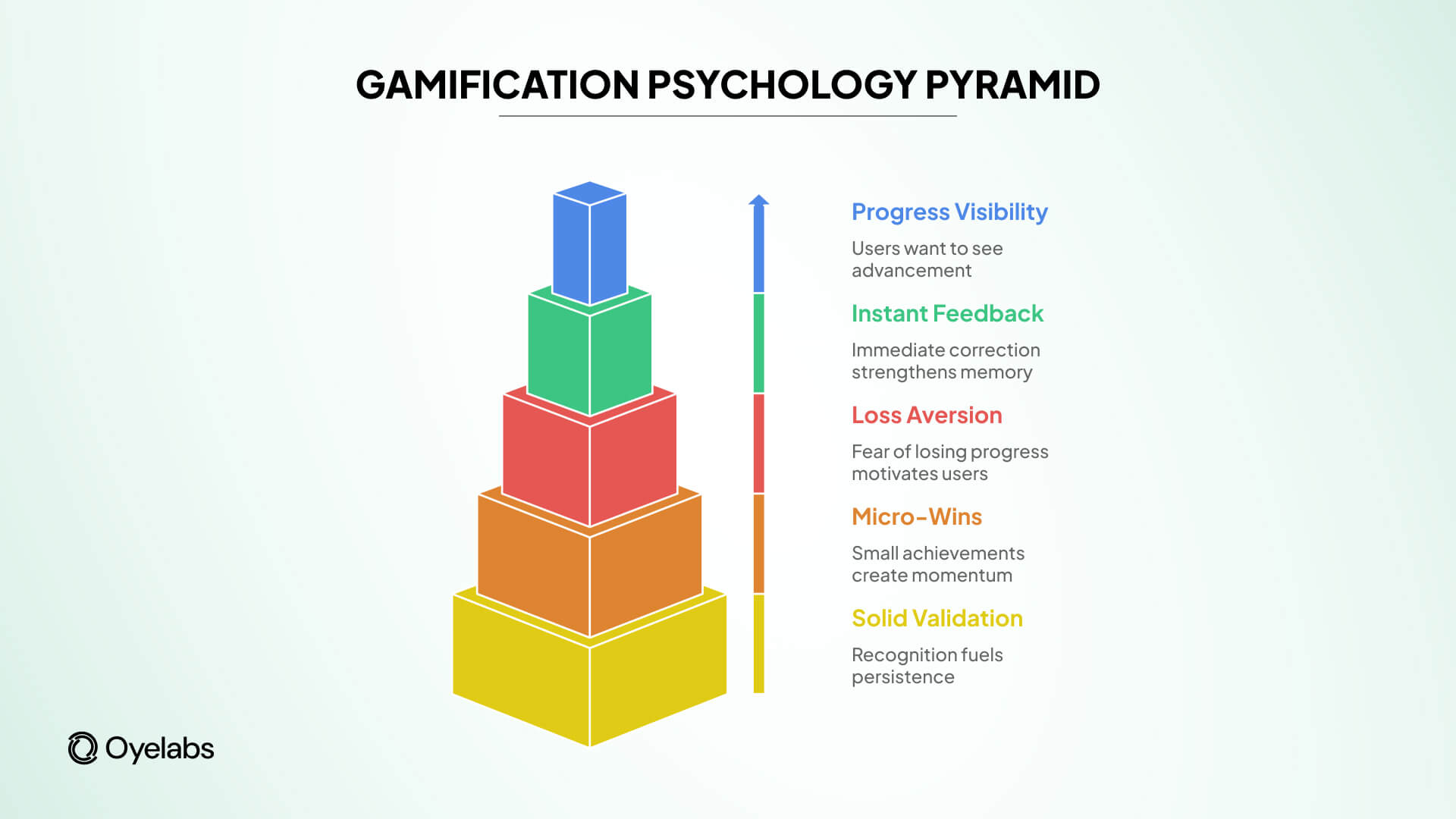
Here are the core psychological principles behind high-performing language apps:
- Progress Visibility: Users want to see advancement. Progress bars, levels, and XP counters create clarity. Visible growth increases commitment.
- Instant Feedback: Immediate correction strengthens memory formation. Real-time scoring engines reinforce learning loops.
- Loss Aversion: Streak mechanics leverage the fear of losing progress. Users are more motivated to avoid losing a streak than to gain a reward.
- Micro-Wins: Small achievements create momentum. Completing short modules provides dopamine spikes that reinforce continuation.
- Social Validation: Leaderboards and achievements increase perceived competence. Recognition fuels persistence.
For founders, these psychological triggers translate directly into business impact:
- More daily sessions
- Longer session duration
- Higher subscription upgrades
- Lower churn rates
The right gamification framework turns psychology into predictable growth metrics.
Core Key Gamification Features for Language Learning Platforms
To build a competitive platform, founders must understand which gamification features create a measurable impact. Below are the foundational systems every serious language learning platform should consider.
1. Points, XP, and Reward Systems
Points are the basic layer of gamification. But poorly designed systems fail quickly.
A strategic XP framework should:
- Reward consistency, not just speed
- Scale difficulty with higher levels
- Connect rewards to unlockable benefits
When XP integrates with premium features or in-app currency, it becomes a monetization lever.
2. Streak Mechanics and Habit Formation
Streak systems are among the most powerful retention tools.
A well-designed streak feature:
- Encourages daily engagement
- Sends structured push reminders
- Includes recovery options (paid streak freeze features)
Streak-based engagement can increase 30-day retention significantly when paired with smart notification architecture.
Habit formation is not accidental. It is engineered.
3. Leaderboards That Create Healthy Competition
Leaderboards work when they feel attainable.
Effective leaderboard systems:
- Segment users into skill brackets
- Reset weekly to maintain fairness
- Prevent exploitation through anti-cheating logic
Global leaderboards inspire aspiration. Local leaderboards create realistic competition.
This balance improves user motivation without discouraging beginners.
4. Badges and Achievement Systems
Badges signal mastery.
They work best when tied to meaningful milestones:
- Completing a level
- Maintaining a streak
- Achieving fluency thresholds
- Participating in challenges
Digital badges can also integrate into:
- Shareable certificates
- LinkedIn-style verification
- Resume-based proof of learning
This increases perceived value beyond the app.
5. Levels and Unlockable Content
Open-access models often reduce perceived value.
Controlled progression systems:
- Unlock lessons gradually
- Increase complexity strategically
- Reward completion with new modules
Unlockable content creates anticipation. Anticipation increases return sessions.
This also supports tiered subscription structures.
6. Story-Based Learning and Narrative Progression
Narrative design increases emotional engagement.
Story-based gamification:
- Places users in situational dialogues
- Introduces characters
- Builds mission-based learning
Instead of isolated vocabulary drills, users feel part of a journey.
This increases immersion and session duration.
7. Daily Challenges and Time-Limited Missions
Urgency drives action.
Daily and weekly challenges:
- Introduce short-term goals
- Trigger notification-based re-engagement
- Encourage consistent practice
Limited-time events create spikes in user activity.
When structured correctly, they also drive premium upgrades tied to exclusive rewards.
Advanced Features That Increase Revenue
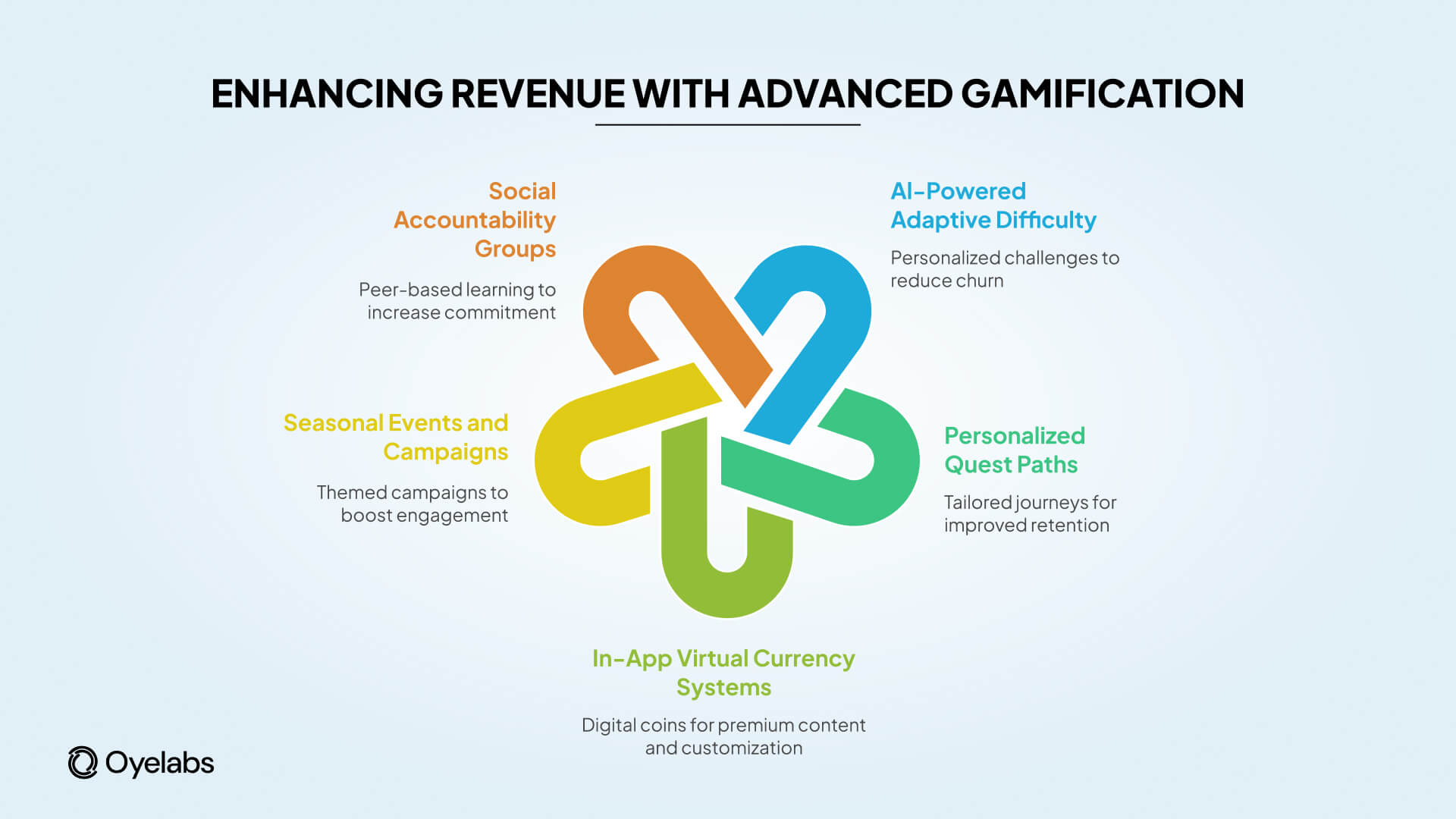
Once foundational systems are in place, advanced gamification layers can significantly increase monetization and engagement.
- AI-Powered Adaptive Difficulty: Personalized difficulty ensures users remain challenged but not overwhelmed. Adaptive algorithms reduce frustration-driven churn.
- Personalized Quest Paths: AI-curated lesson journeys increase relevance. Relevance improves retention.
- In-App Virtual Currency Systems: Digital coins can unlock:
- Premium lessons
- Avatar customization
- Streak recovery options
Virtual economies increase conversion rates when strategically aligned with subscription plans.
- Seasonal Events and Campaigns: Themed learning campaigns boost engagement cycles. For example:
- “30-Day Spanish Sprint”
- “Business English Challenge”
Campaign-driven gamification creates marketing hooks and measurable engagement spikes.
- Social Accountability Groups: Peer-based group learning increases commitment rates. Accountability reduces drop-offs.
Advanced gamification is not about adding complexity. It is about adding controlled growth mechanics.
How Key Gamification Features Improve Retention and LTV
Retention is the core growth engine of subscription-based apps.
When users return consistently:
- Marketing ROI improves
- Customer Acquisition Cost (CAC) becomes sustainable
- Lifetime Value (LTV) increases
- Organic referrals grow
Gamification impacts the following retention metrics:
| Metric | Without Gamification | With Strategic Gamification |
| Day 7 Retention | Low | Moderate to High |
| Session Frequency | Irregular | Structured |
| Subscription Conversion | Delayed | Accelerated |
| Referral Behavior | Minimal | Amplified |
Habit loops increase session predictability.
Predictable sessions increase monetization opportunities.
For founders planning long-term scalability, gamification is not optional. It is core product architecture.
The Business Model Behind Key Gamification Features for Language Learning Platforms
Gamification is not just an engagement tool. It is a revenue engine when structured correctly. The most successful platforms align game mechanics directly with monetization strategy. In a freemium model, core lessons remain accessible, while premium features unlock advanced levels, streak protection, and exclusive challenges that enhance the user experience.
This creates natural upgrade triggers rather than forced paywalls. Subscription tiers can further scale gamified benefits, offering increasing value across plans – for example, basic rewards at entry level, accelerated XP growth at mid-tier, and exclusive events or advanced competitions at higher tiers. For enterprise markets, gamified dashboards integrate with corporate reporting systems, helping organizations track employee progress and performance.
Additionally, micro-certification pathways allow users to complete structured, gamified learning journeys that culminate in paid assessments and verifiable credentials. When key gamification features for language learning platforms are aligned with business objectives, monetization feels organic. Engagement drives retention. Retention drives revenue.
Common Mistakes Founders Make in Language Learning Platforms
Many founders understand the importance of gamification. Few implement it correctly.
The most common mistake is adding features without a strategy.
Gamification is not about stacking badges, points, and leaderboards. It is about building a structured engagement loop aligned with learning outcomes and revenue goals.
Here are the major errors to avoid:
- Over-Gamification: Too many rewards reduce meaning. When every action earns a badge, badges lose value. The system becomes noise instead of motivation.
- Reward Without Progression Logic: If XP does not unlock something meaningful, it becomes cosmetic. Gamification must connect to progression, access, or advantage.
- Ignoring Personalization: Not all learners behave the same. Without adaptive learning engines, advanced users get bored. Beginners get frustrated.
- No Data Tracking Layer: Gamification must be measurable. Without analytics dashboards tracking:
- Completion rates
- Challenge participation
- Streak retention
- Drop-off points
Founders cannot optimize.
- Misaligned Monetization: When premium upgrades feel forced, users resist. Gamification should nudge upgrades naturally through value expansion.
Strong gamification systems are designed with behavioral science, data analytics, and business logic working together.
How Gamification Helped a Founder Build Market Value
One founder approached Oyelabs with a clear goal: build a language learning platform that could compete in engagement, not just content. Instead of replicating lessons alone, the focus was on building strategic gamification architecture from day one.
The platform launched with:
- Streak-based habit loops
- Weekly skill leaderboards
- XP-based level progression
- AI-personalized lesson paths
- Daily timed challenges
Within 90 days, user session frequency increased significantly. Engagement metrics improved. App impressions grew as users shared achievements socially. Retention curves stabilized beyond the first month. The platform began attracting organic visibility, and the brand positioned itself as a serious player in the market.
The shift was not driven by content volume. It was driven by well-implemented key gamification features for language learning platforms that transformed user behavior.
If you want to understand how leading platforms monetize engagement, read our detailed breakdown of Duolingo’s business model and revenue strategy.
Technology Stack Required to Build Gamification Features
To build key gamification features for language learning platforms, the technology foundation must support scalability and real-time performance. A cloud-based backend ensures secure data storage, high concurrent user handling, and instant score updates. A real-time scoring engine processes XP calculations, leaderboard rankings, and streak validations without delay, which is critical for maintaining engagement.
Adaptive learning algorithms analyze response accuracy, completion speed, and error patterns to personalize difficulty levels. An integrated analytics dashboard tracks engagement, conversion rates, and drop-off points, allowing founders to optimize based on data. Push notification systems enable streak reminders and challenge alerts that reinforce habit loops.
Finally, a modular microservices architecture allows phased scaling and seamless feature upgrades. Strong infrastructure ensures gamification remains stable and effective as the platform grows.
Cost to Build a Language Learning App with Key Features
The cost to build a language learning app depends on scope, complexity, and scalability goals. An MVP with core gamification features typically includes user onboarding, an XP system, streak tracking, a basic leaderboard, structured lesson modules, an admin dashboard, and analytics tracking.
Enterprise-grade platforms expand further with AI personalization engines, multi-language support, corporate dashboards, certification systems, and advanced virtual economy layers.
Development usually follows a phased approach. Phase 1 (8 -12 weeks) focuses on MVP launch with core gamification and subscription setup. Phase 2 (12 – 20 weeks) introduces AI personalization and enterprise modules. Phase 3 centers on scaling and optimization.
Many agencies price these components separately, increasing total investment significantly. A structured development partner like Oyelabs consolidates these systems within one scalable framework, helping founders launch faster while maintaining cost efficiency and long-term flexibility.
Why Now Is the Best Time to Build Language Learning Platforms
The market conditions favor founders who move strategically.
Several macro factors are converging:
- Remote work is expanding globally.
- Cross-border business communication is increasing.
- AI-assisted learning tools are more accessible.
- Micro-learning is replacing traditional course formats.
- Mobile-first consumption continues to dominate.
Language learning is no longer optional for professionals. It is competitive leverage.
At the same time, user expectations have evolved. Static video-based platforms no longer sustain engagement. Gamified systems drive habit formation.
Founders who combine language education with structured gamification can capture both consumer and enterprise markets.
The opportunity lies in building platforms that are not only educational but behaviorally optimized.
Final Thoughts
Content alone does not create growth. Behavioral architecture does. The most successful platforms build structured gamification systems that increase daily engagement, improve retention curves, support subscription growth, and strengthen brand visibility. For CEOs and entrepreneurs, the real decision is not whether to add gamification, but how deeply to integrate it into product strategy.
When implemented correctly, key gamification features for language learning platforms become a compounding growth engine. They reduce churn, increase lifetime value, and improve overall valuation metrics. The founders who lead this space treat gamification as core infrastructure, not decoration.
Connect with Oyelabs to design a scalable, gamified platform that drives measurable growth from day one.
FAQs
What are the key gamification features for language learning platforms?
Gamification features include streaks, XP systems, leaderboards, levels, and rewards. These tools increase motivation, daily engagement, and long-term retention. They transform passive lessons into interactive learning experiences that improve completion rates and subscription conversions.
Why is gamification important in language learning apps?
Gamification improves user retention by creating habit loops. It encourages daily practice, increases session frequency, and reduces churn. Platforms using structured gamification see stronger engagement metrics and higher lifetime value compared to static learning apps.
How do language learning apps make money using gamification?
Language apps monetize gamification through subscriptions, premium unlocks, streak protection features, certifications, and virtual currencies. Engagement-driven mechanics naturally encourage upgrades without forcing aggressive paywalls.
How much does it cost to build a gamified language learning platform?
Costs depend on feature complexity, AI integration, scalability requirements, and timeline. MVP development requires core gamification architecture, while enterprise versions include adaptive learning engines and corporate dashboards.