
What TikTok Shop’s $50B H1 Win Teaches Video Founders

What TikTok Shop’s $50B H1 Win Teaches Video Founders
 Anuraag Jain
Last Updated on October 5, 2026
Key Takeaways
What You Will Learn
* TikTok Shop’s global GMV hit $50.3 billion in H1 2026, up 92% year on year, per Momentum Works research.
* The Shop tab, not video, now drives the majority of sales, at 51.4% of attributed GMV.
* Video’s share of GMV actually shrank from roughly 50% to 40.4% year on year, even as total sales doubled.
* Only 0.4% of US sellers crossed $1 million in GMV, while over half recorded zero sales in 2025.
* Live commerce didn’t decline in dollar terms; it grew 19% while simply being outpaced by Shop’s faster growth.
* The US became TikTok Shop’s largest market, overtaking Indonesia, despite being considered a harder market to convert.
Real Insights
* Video’s real job in this ecosystem is discovery, not closing the sale, and that distinction matters for product design.
* Platform-level growth numbers hide brutal seller concentration that founders shouldn’t assume applies evenly to them.
* A shrinking percentage share can still represent real dollar growth, and headlines rarely make that distinction.
* Building commerce features around video alone misreads where the actual transaction now happens on this platform.
What TikTok Shop’s $50B H1 Win Teaches Video Founders
TikTok Shop’s H1 2026 numbers look like a straightforward win for video founders: $50.3 billion in global GMV, up 92% year on year, according to research published by Momentum Works and Tabcut. Read past the headline, though, and the real lesson for anyone building an app like TikTok isn’t about video at all. It’s about what happens after the video ends.
I’ve watched a lot of founders read this kind of headline number and assume it validates whatever video-commerce feature they’re already planning to build. The actual data tells a more specific, more useful story, and it’s not the one most coverage of this report is telling.
This breakdown looks at what actually happened inside that $50.3 billion figure, and what it genuinely means for a founder deciding how to build commerce into a video-first platform in 2026.
Quick Answer
- TikTok Shop’s global GMV reached $50.3 billion in the first half of 2026, up 92% year on year.
- The Shop tab, a browsing-based feature rather than the video feed, now accounts for 51.4% of attributed GMV.
- Video’s share of GMV fell from roughly 50% to 40.4% year on year, even as total platform sales nearly doubled.
- Just 0.4% of US sellers crossed $1 million in GMV, while more than half recorded zero sales the prior year.
- Live commerce grew 19% in dollar terms despite its percentage share shrinking, since total GMV grew even faster around it.
- The lesson for video founders is that video’s real value here is discovery, not the final transaction itself.
What Actually Happened Behind the Headline Number
The $50.3 billion figure itself is well corroborated. Momentum Works, a research firm focused on Asian technology and ecommerce markets, published the estimate alongside data partner Tabcut on August 6, 2026, and multiple independent outlets reported the same underlying figures consistently.
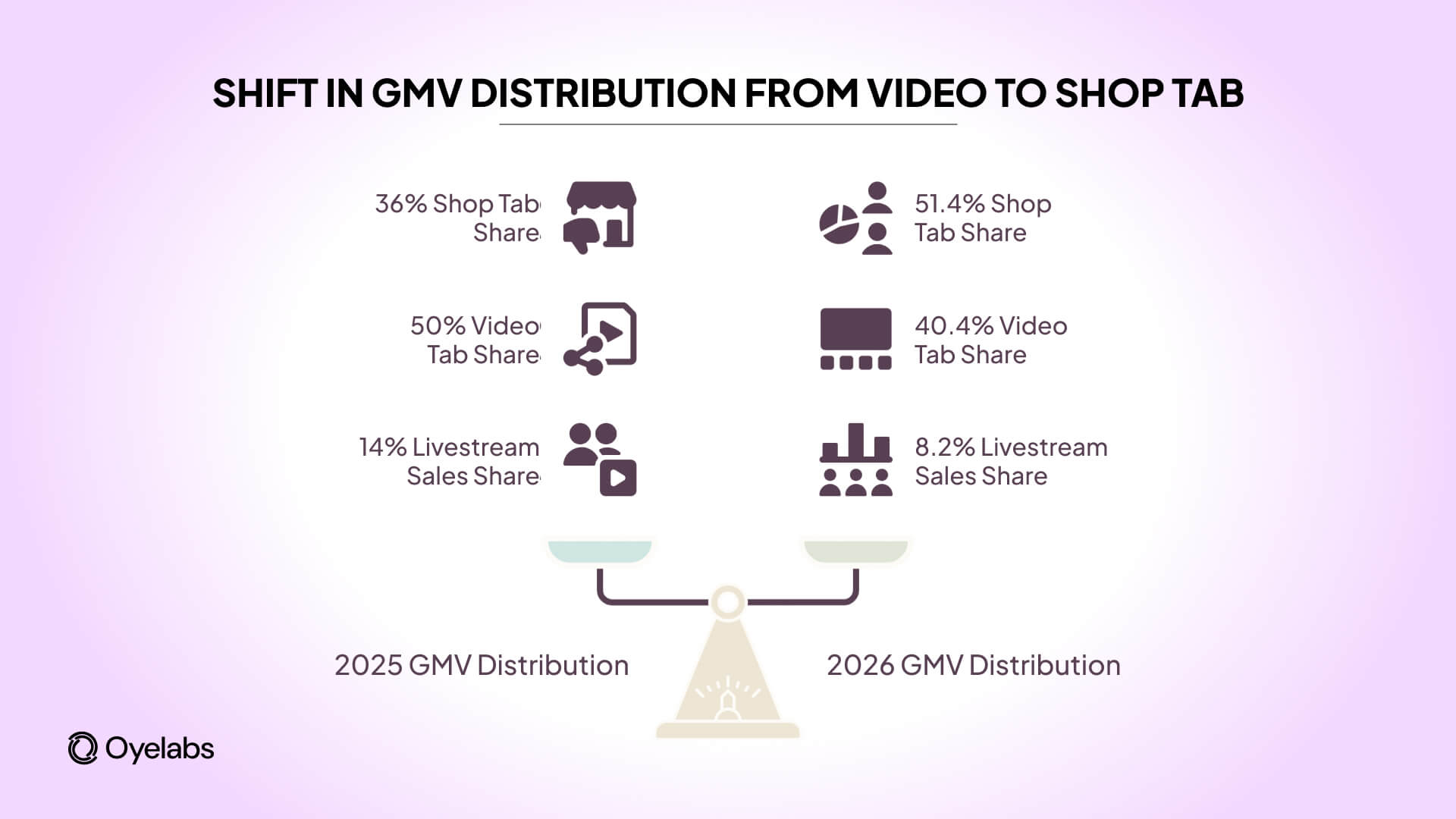
What the headline number doesn’t show is how that GMV actually broke down by feature. According to the same research, the Shop tab, where users browse a storefront rather than discover a product through the video feed, accounted for 51.4% of attributed GMV. Video accounted for 40.4%, and livestream sales made up the remaining 8.2%.
That distribution matters enormously for how a founder should read this data. A year earlier, the mix was roughly 36% Shop, 50% video, and 14% live. Video didn’t just lose relative share while the platform grew; it lost share in a specific, measurable direction, toward a browsing-based commerce surface that looks and functions closer to a traditional storefront than a content feed.
Lesson One: Video’s Real Job Is Discovery, Not Closing the Sale
This is the counter-intuitive part most coverage of this report skips entirely. If video were still the dominant path to purchase, its share of GMV should be growing alongside total platform growth, not shrinking while total GMV nearly doubles.
What this pattern actually suggests is that video’s function inside TikTok Shop’s ecosystem has matured into something more specific: it drives product discovery and interest, and the actual transaction increasingly happens somewhere else, a storefront-style browsing surface built for comparison and purchase rather than continued scrolling.
For a founder building an app like TikTok with commerce ambitions, this is a real product design signal. Trying to force the entire purchase flow to happen inside the video feed itself may be optimizing for the wrong moment in the user’s actual buying behavior.
Builder Tip: Design your video feed to drive product interest, and build a dedicated storefront surface for the actual purchase decision, rather than forcing both into one interaction.
Lesson Two: Platform-Level Growth Hides Brutal Seller Concentration
The $50.3 billion figure describes the platform as a whole, and platform-level numbers can make an individual seller’s odds look far better than they actually are. The real seller-level data tells a much harder story.
Among US sellers, only about 0.4% of stores crossed $1 million in GMV, and just 506 stores crossed $10 million. In 2025, more than half of all US stores on the platform recorded zero sales entirely. That’s not a footnote; it’s the actual distribution of outcomes underneath the headline growth number.
For a founder building a video-commerce platform, this matters in two directions. It’s a caution against assuming every seller onboarded will succeed simply because the platform is growing. It’s also a design signal: the sellers who do break through likely aren’t succeeding on volume of content alone, and understanding what separates the 0.4% from the majority matters more than the aggregate growth number does.
Lesson Three: A Shrinking Share Isn’t the Same as a Shrinking Business
It would be easy to read live commerce’s falling percentage share, from 14% to 8.2% of GMV, as a sign that live shopping is losing relevance on the platform. The actual dollar figures say otherwise.
Live commerce revenue grew from roughly $812 million to about $967 million year on year in the US specifically, a real 19% increase in absolute terms. Its percentage share fell only because the Shop tab grew roughly three times faster around it, not because live itself contracted.
This distinction matters for how founders interpret competitive data generally, not just in this specific report. A declining percentage share inside a rapidly growing total can still represent healthy, growing absolute numbers, and conflating the two leads to genuinely wrong product decisions about which features to deprioritize.
Growth Insight: Track absolute revenue alongside percentage share before deciding a feature is underperforming, since the two metrics can tell opposite stories.
Lesson Four: The “Harder” Market Just Became the Biggest One
The US has historically been considered a tougher market for social commerce to crack compared to Southeast Asia, where live-led shopping culture was already well established before TikTok Shop’s US launch. That assumption no longer holds.
US GMV grew 103% year on year to reach $11.8 billion in H1 2026, overtaking Indonesia to become TikTok Shop’s largest single market globally. The US seller base grew from 475,000 to 1.35 million stores over the same period, alongside a jump from 15.3 million to 20 million active influencers.
The lesson here isn’t that every market eventually converts the same way. It’s that a market’s current commerce behavior isn’t necessarily a permanent ceiling. A founder assuming a specific region “doesn’t buy this way yet” should treat that as a current state to test against, not a fixed constraint to design permanently around.
What This Actually Changes for a Founder Building an App Like TikTok
Pulling these four lessons together points toward a specific product architecture decision, not just a set of interesting observations about someone else’s platform.
A video-first app with commerce ambitions likely needs two distinct, well-integrated surfaces rather than one: a feed optimized for discovery and interest, and a storefront optimized for comparison and purchase completion. Forcing the entire journey into the video feed alone works against the exact pattern this data shows on the platform that popularized video commerce in the first place.
It also means seller success tooling matters as much as the consumer-facing feed. If the realistic outcome for most sellers looks like the concentration data above, a platform that helps a larger share of sellers actually reach meaningful sales, not just onboard easily, has a real differentiation opportunity against platforms that only optimize for total seller count.
Also Read: The TikTok Business Model – How TikTok Makes Money
Common Mistakes Founders Make Reading Platform Growth Data
- Treating platform-level GMV as evidence of individual seller success: The concentration data shows most sellers on even a fast-growing platform don’t reach meaningful scale.
- Reading a shrinking percentage share as business decline: Live commerce grew in absolute dollars while losing share, which a headline number alone won’t reveal.
- Assuming video must directly close the sale to justify its role: The data suggests discovery and transaction increasingly happen on different surfaces entirely.
- Treating a market’s current behavior as a permanent trait: The US converted differently than Southeast Asia for years, until it suddenly became the largest market.
- Copying a competitor’s feature mix without checking where their transactions actually close: Building a video-only purchase flow ignores where the market leader’s own growth is actually concentrated.
Conclusion
The real lesson inside TikTok Shop’s $50.3 billion first half isn’t that video sells products. It’s that video and commerce have started to specialize into separate jobs within the same platform, discovery in one place, transaction in another, and the growth is concentrated on the side most headlines aren’t talking about.
A founder building an app like TikTok in 2026 should treat this as a design signal, not a validation of whatever commerce feature is already on the roadmap. If a proven video and marketplace foundation already separates these two jobs correctly, that’s infrastructure worth starting from rather than rediscovering the same lesson through a slower, more expensive path.
Frequently Asked Questions
Is TikTok Shop’s $50 billion figure a company-reported number?
No. It’s an independent research estimate from Momentum Works and Tabcut, published August 6, 2026, not a figure TikTok itself has officially disclosed.
Does this data mean video commerce is failing?
No. Video’s percentage share fell while its absolute role as a discovery driver remained central; the transaction itself is simply increasingly happening on a separate storefront surface.
Why did live commerce’s share shrink if it’s still growing in dollars?
The Shop tab grew roughly three times faster than live commerce over the same period, which shrank live’s percentage share even as its absolute revenue increased.
What does the seller concentration data mean for a new platform?
It suggests most sellers on even a fast-growing platform won’t reach meaningful scale, making seller success tooling a genuine differentiation opportunity, not just a nice-to-have feature.
Should a new video app copy TikTok Shop’s exact feature split?
Not necessarily copy it exactly, but understand the underlying pattern, discovery and transaction as separate jobs, before designing a commerce flow built entirely around the video feed.
Sources and Editorial Notes
Sources
- Momentum Works – TikTok Shop on Track to Surpass US$100 Billion GMV Globally in 2026
- Tubefilter – Led by U.S. Sales, TikTok Shop Is on Track to Hit $100 Billion of GMV in 2026
Editorial Notes
- All GMV figures, the Shop/Video/Live percentage breakdown, seller concentration data, and US market figures are sourced directly from Momentum Works’ own published research report, produced with data partner Tabcut, not a secondary summary of it.
- Momentum Works is an independent research firm focused on Asian technology and ecommerce markets; its GMV estimates are third-party research estimates, not TikTok’s own officially disclosed financial figures, and are presented accordingly.
- Tubefilter’s reporting is used to corroborate the same underlying Momentum Works figures and the additional full-year 2026 projection, which is explicitly presented as a forward-looking projection rather than a confirmed result.
- No vendor marketing content or third-party blog content was used as a source anywhere in this article.