
Video Caching Strategies for Short-Form Video Apps

 Tanushree Jain
Last Updated on September 6, 2026
Key Takeaways
What You Will Learn
* Short-form video apps can predict upcoming views because they push content instead of waiting for users to select it.
* TikTok’s manifest files reveal roughly 30 upcoming videos at a time, enabling true lookahead caching.
* Short video popularity follows an extreme Pareto pattern, making a small share of content responsible for most views.
* A 2026 university study found lookahead-aware caching cut CDN bandwidth costs by 11% to over 100% versus standard methods.
* Segment-based caching and chunk-level bitrate adaptation both exist to avoid wasting storage on content nobody finishes watching.
* Naive prefetching that ignores real network signals can load video representations that are never actually requested by the player.
Real Insights
* Reordering which video plays first inside a feed batch does not measurably hurt user engagement.
* Manifest file length directly determines how far ahead a caching system can actually plan.
* Video popularity in short-form apps is more extreme than typical web traffic patterns.
* Caching strategy decisions belong in product scoping, not just backend engineering, for a new video app.
Video Caching Strategies for Short-Form Video Apps
Video caching strategies for short-form video apps exist to solve one specific problem: loading the next video before a user finishes swiping to it. Get this wrong, and every swipe feels like a small stall that breaks the rhythm of the feed. Get it right, and playback feels instant, which is exactly the experience TikTok, Reels, and YouTube Shorts have already trained global users to expect by default.
When I scope a TikTok-like app build with a technical team, caching strategy is one of the first architecture conversations we have, not a backend detail left for later in the roadmap. It directly shapes infrastructure cost at scale, and it directly shapes whether early users stick around past their very first session on the app.
This breakdown covers the caching approaches actually behind short-form video apps, grounded in peer-reviewed research and a real technical patent filing rather than generic streaming advice recycled from long-form video platform assumptions that don’t hold up under a swipe-driven feed.
Quick Answer
- Short-form apps push a ranked list of upcoming videos to the client, unlike long-form platforms where users pick what to watch.
- This “manifest file” reveals near-future requests, letting caches be built proactively instead of reactively.
- Least Lookahead Frequency (LLF) eviction uses that manifest data to keep the right videos cached and drop the rest.
- Segment-based caching stores small video chunks instead of full files, since most swipes never finish a video anyway.
- Chunk-level bitrate adaptation selects video quality per segment instead of encoding every resolution upfront for every clip.
- CDN-aware predictive prefetching loads upcoming videos based on real network and scroll signals, not a fixed sequential guess.
Why Short-Form Video Breaks Traditional Caching Logic
Traditional video platforms like YouTube or Netflix are fundamentally pull-based systems. A user actively picks what to watch from a list of options, so the underlying system has no reliable way to know with certainty what a given viewer will request next in their session.
Short-form video apps flip this arrangement entirely. They are push-based: a recommendation algorithm decides the next video and shows it to the user automatically, in a fixed sequential order that the user swipes through one video after another rather than actively selecting.
Researchers at the University of Illinois Urbana-Champaign and MIT, who directly analyzed TikTok’s live network traffic for a 2026 study, identify this as the core structural opportunity behind modern short-form caching. Because the system already knows what content is coming next, the caching layer no longer has to guess based on historical patterns alone.
The Manifest File: Where Predictive Caching Actually Comes From
When a short-form app loads a new batch of recommendations, the server sends what researchers call a manifest file: an ordered list of upcoming videos delivered to the client before the user has actually watched any of them in that batch.
Researchers who intercepted this traffic directly, using proxy tools to inspect the real communication between TikTok’s app and its servers, found that TikTok’s manifest file typically lists around 30 upcoming videos at once. Instagram Reels and YouTube Shorts were found to use a similar system, though with shorter lists of roughly 10 to 15 videos each.
This manifest file is the entire foundation of lookahead caching in short-form video. The CDN isn’t predicting the future from past behavior the way a standard cache would have to. It’s reading a list that already tells it, with real specificity, exactly what content is coming for that particular user session.
Builder Tip: Manifest file length directly limits caching foresight, so a longer lookahead list gives the system more room to plan ahead.
Least Lookahead Frequency Eviction, Explained Simply
Every cache eventually fills up and has to remove something to make room for newly requested content. The core engineering question in any caching system is deciding exactly which piece of content gets removed first when that limit is reached.
Older caching strategies guess based on the past: remove whatever content was used least recently, or requested least often overall across the full user base. Least Lookahead Frequency, or LLF, takes a fundamentally different approach. It examines the manifest files of every user the CDN is currently serving and removes the video with the fewest total upcoming views across all of them combined.
In controlled testing using real TikTok traffic collected from 100 participating users, this lookahead-based approach reduced CDN bandwidth costs, specifically the cost of fetching content the cache didn’t already hold locally, by 11% to over 100% compared to ten existing caching strategies, several of which are already deployed in production video delivery systems today.
That wide range exists because performance depends heavily on how concentrated video popularity happens to be at any given moment in the underlying dataset. The consistent direction across every tested scenario, though, is that knowing the near future through real manifest data outperforms guessing from historical access patterns alone.
Why Short-Form Video Popularity Makes This Work So Well
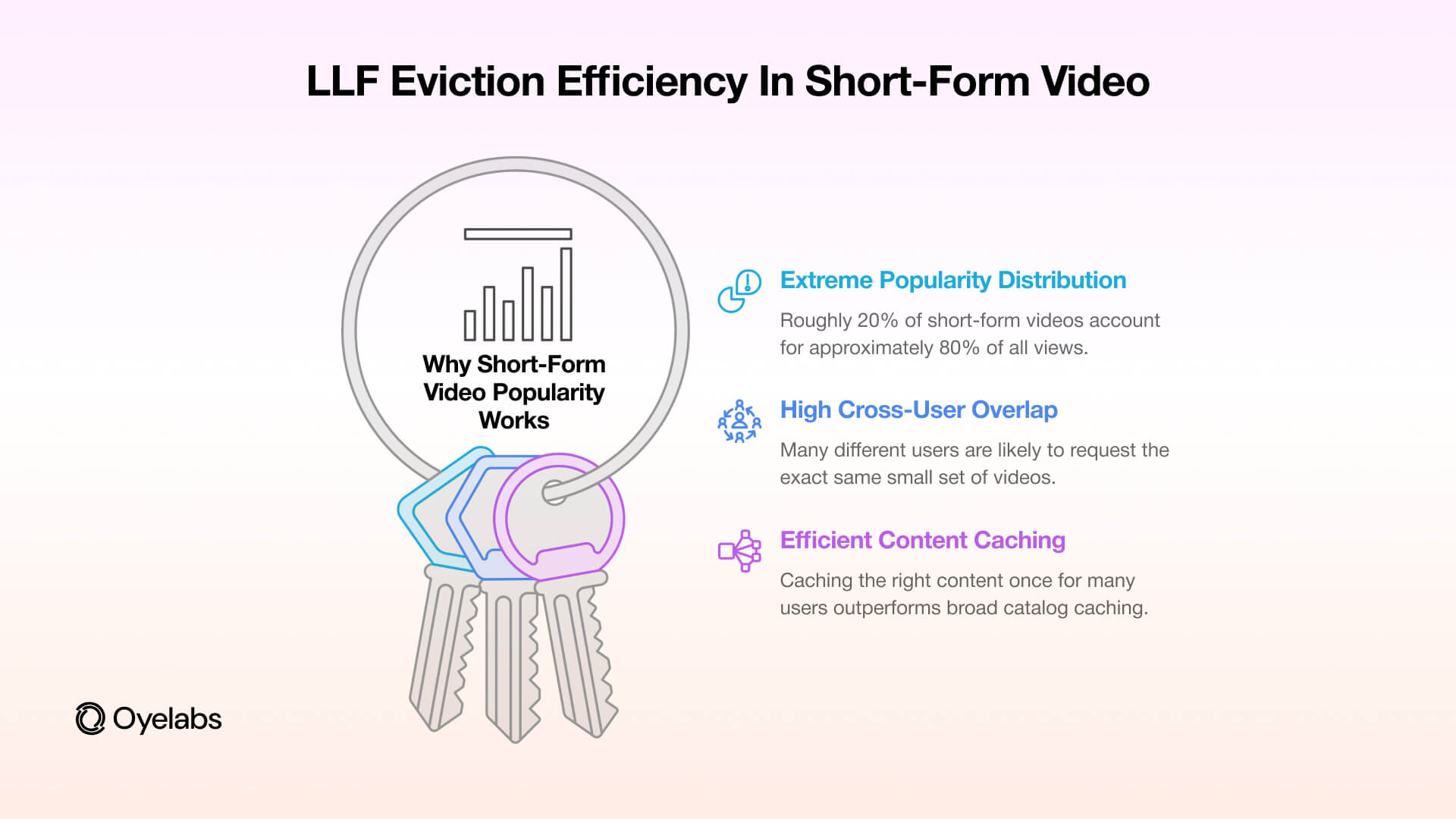
LLF eviction works especially well in short-form video specifically because of how extreme content popularity distribution is within this particular format compared to other types of internet traffic researchers have studied over the years.
The same 2026 research found that roughly 20% of short-form videos account for approximately 80% of all views across the platform, and this distribution is measurably more skewed than what’s typically observed in general web traffic or long-form video platforms. That means many different users, even ones with no direct connection to each other, are likely to request the exact same small set of videos around the same general time window.
When that cross-user overlap is high, caching the right piece of content once and serving it to many different users becomes dramatically more efficient than caching broadly across a wide catalog and simply hoping for scattered hits. This is precisely the mechanism that makes lookahead-based eviction outperform older, purely historical approaches in this specific content category.
Segment-Based Caching and Chunk-Level Bitrate Adaptation
Downloading a complete video file the moment it might be watched wastes meaningful bandwidth, especially given that a large share of swipes abandon a video within its first few seconds of playback, before most of the file was ever needed.
Segment-based caching addresses this directly by storing and loading small video chunks, typically a few seconds each, rather than complete files in one continuous download. If a user swipes away almost immediately, only a small chunk was ever fetched from the origin server, not the entire video file end to end.
A US patent filing describing bitrate adaptation and prefetching specifically for short-form video formalizes a closely related idea: selecting a distinct quality variant for each individual chunk of an upcoming video, based on measured network conditions, rather than committing to one resolution for an entire clip in advance. Peer-reviewed research on segment prefetching at the network edge has separately shown that prefetching every possible quality representation of a segment risks fetching variants that are never actually requested by the player at all.
Growth Insight: Selecting bitrate at the chunk level instead of the whole-file level avoids paying storage and bandwidth costs for quality variants nobody ends up watching.
CDN-Aware Predictive Prefetching
Naive prefetching simply loads the next few videos in sequence, regardless of whether a given user is actually likely to reach that point in their session. This approach still causes buffering whenever a cache miss happens, and it wastes bandwidth on top of that failure, rather than actually preventing it.
Academic research on short video streaming, including work presented at the ACM Multimedia Grand Challenge, has specifically modeled adaptive multi-video prefetching as an optimization problem, factoring in real signals like predicted watch duration and available bandwidth rather than a fixed, one-size-fits-all lookahead depth applied uniformly to every user session.
Peer-reviewed research on edge-based segment prefetching has found that when every possible quality representation of upcoming content is prefetched without this kind of selectivity, a meaningful share of that fetched data is never actually requested by the connected video player at all. This directly informed the design of smarter, network-aware prefetching policies that adjust lookahead depth based on real conditions instead of a fixed assumption.
Streaming-Aware Client Architecture
Caching strategy on the server and CDN side matters a great deal, but the client-side implementation on the actual device determines whether all of that upstream engineering work translates into a reliable experience for a real user on a real network.
This means correctly handling partial content responses, a standard documented directly in IETF RFC 7233, the official specification governing HTTP range requests. A segment being fetched or interrupted mid-download needs to resume cleanly from the correct byte range rather than restarting or, worse, silently leaving a corrupted file behind on the device.
It also means writing cached segments to local disk using atomic file operations, so an interrupted write during a network drop or an app backgrounding event never leaves a broken, unplayable cache entry that quietly degrades playback quality later without any clear error message pointing back to the actual cause.
Common Mistakes Teams Make With Video Caching
- Treating short-form caching like long-form caching: Pull-based assumptions from platforms like YouTube simply don’t hold in a push-based, swipe-driven feed with a completely different request pattern.
- Prefetching sequentially without real signals: Loading “the next few videos” blindly wastes bandwidth without meaningfully reducing the buffering it’s actually meant to prevent.
- Committing to one resolution per full video: This works for long-form platforms with sustained viewing but wastes resources on short clips with unpredictable, often single-view engagement patterns.
- Ignoring client-side file handling: A corrupted partial cache entry causes playback failures that are genuinely hard to trace back to the actual root cause during debugging.
- Underestimating manifest file design: A poorly structured or too-short lookahead list limits how effective any caching strategy downstream can possibly be, regardless of how good the eviction logic is.
Scoping This for a TikTok Clone Build
When founders come to us wanting to build a TikTok-style app, caching strategy needs to be treated as a core product requirement from day one, not something left for engineering to figure out quietly after launch once real users are already on the platform.
The specific decisions that need scoping upfront include how far ahead the manifest file should look, which eviction policy the CDN layer will use, whether segments are cached in small chunks or full files, and how prefetching depth adapts to varying network and device conditions across a global user base.
Getting this right early avoids a pattern we see often: an app that looks and feels great in an internal demo on a strong office connection, then develops real buffering complaints the moment genuine user volume and genuine network diversity actually hit the platform in production.
Also Read: Build a TikTok Styled App with Advanced Features – 2026
How OyeLabs Approaches Video Infrastructure for Short-Form Apps
A custom build means designing manifest logic, cache eviction policy, and client-side segment handling entirely from scratch, which is exactly the kind of deep infrastructure work that quietly extends a launch timeline by several months before a single creator ever uploads a video.
A white label TikTok clone script starts with this video delivery architecture already built and tested: segment-based caching, adaptive prefetching, and reliable client-side handling included from the start. That means the team’s early effort goes into content strategy and creator onboarding instead of solving CDN caching problems that established platforms have already spent years refining through hard-won production experience.
Conclusion
Video caching strategies for short-form video apps work because these platforms know something traditional video services genuinely don’t: what a user is about to see next, with real specificity, before they even swipe. Manifest files, lookahead-aware eviction, segment-based caching, and chunk-level bitrate adaptation all exist to exploit that one structural advantage that pull-based platforms simply don’t have access to.
None of this needs to be reinvented from scratch to build a competitive short-form video app in 2026. It needs to be scoped correctly from the very start, with the same rigor given to pricing or content moderation, not treated as a backend afterthought that gets patched together once real users start complaining about buffering.
Frequently Asked Questions
Why can’t short-form video apps use the same caching approach as YouTube?
YouTube is pull-based, meaning users actively choose what to watch, so the system can’t reliably predict upcoming requests the way a push-based, swipe-driven feed can through manifest data.
What is a manifest file in a short-form video app?
It’s an ordered list of upcoming recommended videos sent to a user’s device in advance, typically around 30 videos for TikTok and 10 to 15 for Instagram Reels and YouTube Shorts.
Does reordering videos in a feed hurt user engagement?
Research testing this directly through a controlled user study found no statistically significant difference in engagement when videos within the same recommendation batch were reordered for caching efficiency.
Is segment-based caching necessary for a short-form video app?
It significantly reduces wasted bandwidth, since a large share of video swipes never reach the end of a clip, making full-file caching genuinely inefficient by comparison for this format.
What should a founder prioritize first when scoping video infrastructure for a TikTok-style app?
Manifest file design and cache eviction strategy, since these two decisions determine how much of the platform’s later performance and CDN cost is even possible to optimize afterward.
Sources and Editorial Notes
Sources
- Masood et al. – SILC: Lookahead Caching for Short-form Video Delivery Systems (University of Illinois Urbana-Champaign & MIT, 2026)
- United States Patent and Trademark Office – Bitrate Adaptation and Prefetching for Short-Form Video
- Bandwidth-Efficient Multi-video Prefetching for Short Video Streaming (ACM Multimedia 2022 Grand Challenge)
- IETF RFC 7233 – HTTP/1.1 Range Requests
Editorial Notes
- Manifest file structure, the LLF eviction policy, midgress cost reduction figures, Pareto popularity distribution data, and the reordering-engagement finding are all sourced directly from the SILC academic paper, which analyzed real TikTok traffic and included a controlled 44-participant user study.
- The SILC paper describes a proposed system validated through research testing, not a confirmed description of TikTok’s current internal production infrastructure, and this article represents it accordingly rather than as deployed fact.
- Chunk-level bitrate adaptation for short-form video is sourced from an official USPTO patent filing describing this exact mechanism, rather than from a vendor’s marketing description of a similar concept.
- Prefetching waste and edge-caching selectivity findings are sourced from peer-reviewed research (ACM Multimedia and IEEE-affiliated segment prefetching studies) rather than a video infrastructure vendor’s self-reported figures.
- No third-party marketing or vendor blog content is used as a source anywhere in this article; every claim traces to academic research, an official patent filing, or an IETF standards document.