
Soft vs. Big Launch: Which is Best for Freelance Platforms?
Soft vs. Big Launch: Which is Best for Freelance Platforms?
 Anuraag Jain
Last Updated on July 31, 2025
Ever launched something with a “just vibes” strategy—only to realize your app isn’t ready for the spotlight? Yeah, we’ve all been there. When it comes to on-demand freelance platforms, the launch strategy isn’t just a box to check—it’s the first impression that makes or breaks your brand.
Whether you go with a soft launch (aka testing the waters with early users) or a big launch (cue fireworks, press releases, and paid ads), the choice impacts everything—from user retention and server load balancing to conversion funnel performance.
According to CB Insights, 42% of startups fail due to a lack of market need—something a smart launch strategy can uncover early. If you’re building a multi-vendor gig marketplace like Upwork or Fiverr, your rollout isn’t just about scale—it’s about strategy. Let’s dive into the pros, cons, and best-fit use cases for both launch types—so your platform doesn’t just go live, it stays alive.
What Is a Soft Launch?
A soft launch is like your app’s quiet debut—think of it as a test run before the red carpet. In the context of freelance platforms, a soft launch means releasing your product to a limited audience (like one city or a private user group) before going all-in.
The goal? Gather real-time user feedback, monitor key performance indicators (KPIs) like session duration and task completion rates, and identify bugs without the pressure of a full-scale launch. It’s especially useful for startups running lean, allowing you to fine-tune UX, pricing models, and backend infrastructure like server response times or API call limits.
Many successful platforms—like TaskRabbit and Upwork—began with localized, iterative rollouts. A soft launch also helps validate your product-market fit early on and minimize costly mistakes. In short, it’s your sandbox phase: safe, strategic, and designed for learning, so when you do launch big, you’re not just guessing—you’re prepared.
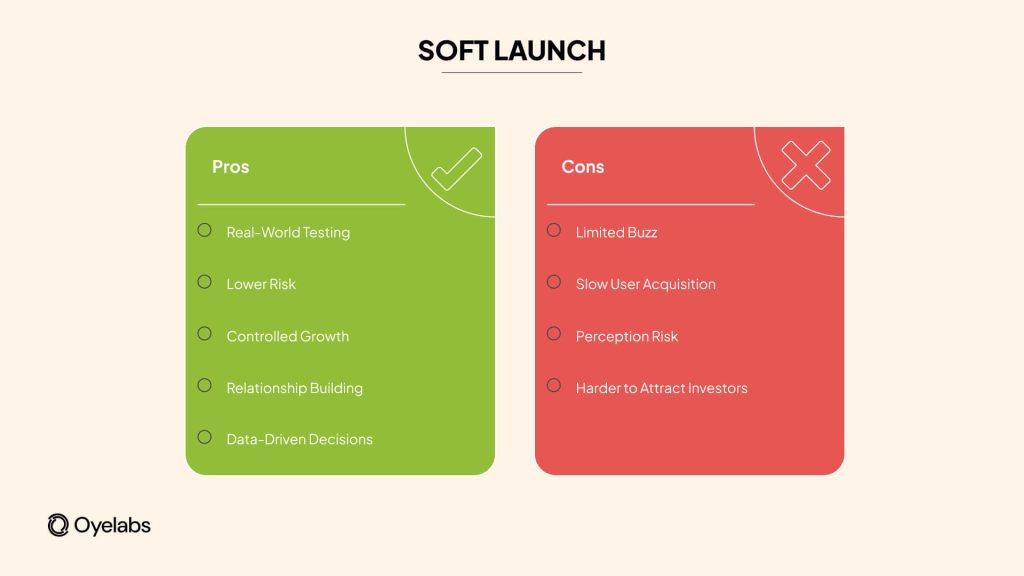
Pros:
- Real-World Testing: Gather feedback from real users to fine-tune UX, workflows, and backend before full exposure.
- Lower Risk: Minimal marketing spend allows for agile changes without public scrutiny.
- Controlled Growth: Ideal for testing server capacity, job flow logic, and freelancer-client matching algorithms.
- Relationship Building: Early adopters often become power users and brand evangelists.
- Data-Driven Decisions: Gain actionable insights to shape monetization, pricing, and engagement strategies.
Cons:
- Limited Buzz: Without aggressive promotion, it may lack brand awareness and initial traction.
- Slow User Acquisition: Growth is more organic and may take time to reach scale.
- Perception Risk: Early bugs or limited features might lead to negative impressions, even among a small group.
- Harder to Attract Investors: Less public hype can make it difficult to prove initial traction or virality.
What is Big Launch?
A big launch is your product’s full-blown entrance into the market—loud, proud, and designed to grab attention. For freelance platforms, this means releasing your app or website to the public all at once, often backed by a robust marketing campaign that includes paid ads, influencer partnerships, PR outreach, and social buzz. The goal of a big launch is to create maximum impact—drive downloads, attract users and vendors quickly, and position your brand as a serious player from day one.
Big launches are often used when you’re confident in your product’s readiness, meaning you’ve tested features, optimized user experience, and prepared your backend for high traffic loads. Platforms like Fiverr and Toptal have used big launches effectively to build momentum and achieve rapid growth.
However, this strategy comes with high stakes. A buggy app, poor onboarding, or server crashes can damage your reputation. You’ll also likely face high Customer Acquisition Costs (CAC) upfront. That said, if executed well, a big launch can deliver wide visibility, investor interest, and a strong brand narrative—perfect for platforms ready to scale fast and go big.
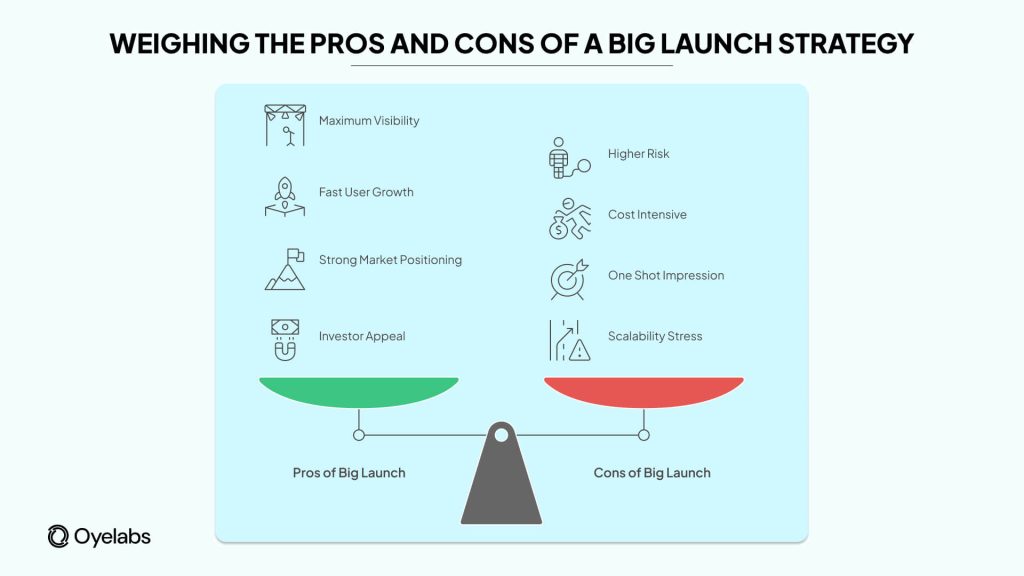
Pros:
- Maximum Visibility: Great for press coverage, influencer tie-ups, and viral growth if executed well.
- Fast User Growth: Higher traffic can rapidly populate both the freelancer and client sides of the platform.
- Strong Market Positioning: Launching big can signal confidence and leadership in a crowded space.
- Investor Appeal: Strong launch metrics and media buzz can attract funding and partnerships.
Cons:
- Higher Risk: Bugs or poor UX at scale can lead to reputational damage and high churn.
- Cost-intensive: Requires large marketing budgets, infrastructure scaling, and support readiness.
- One Shot Impression: You may not get a second chance to make a strong first impression.
- Scalability Stress: Systems and operations must be fully ready for high loads and rapid user onboarding.
Difference between soft launch and big launch
Before you go full-send with your freelance platform, it’s crucial to understand the difference between a soft launch and a big launch. One’s all about quiet testing; the other screams, “We’ve arrived.” Here’s a breakdown to help you choose wisely—so you don’t waste budget, burn leads, or break your backend on day one.
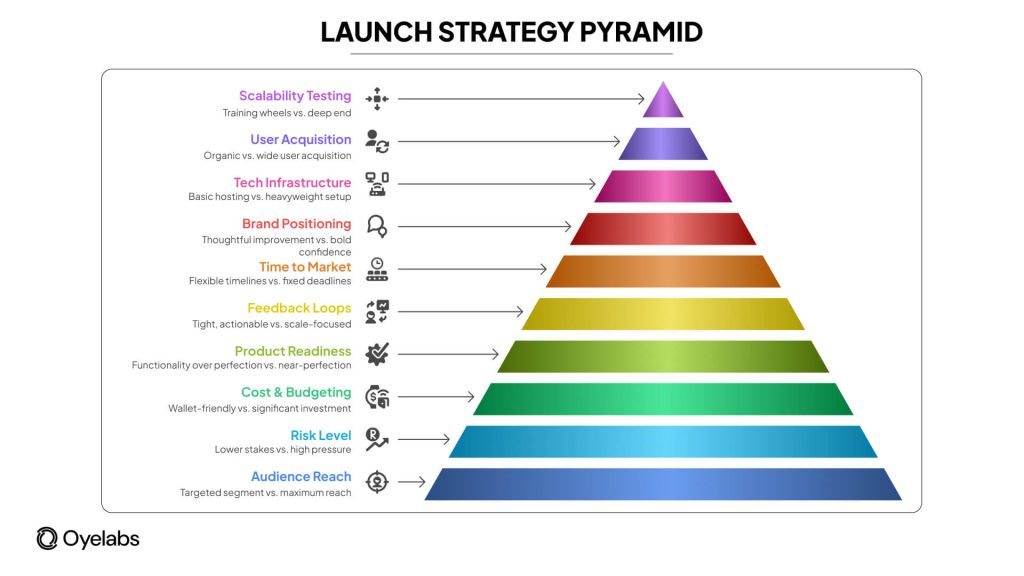
Audience Reach
Soft launches are all about keeping it close-knit. You roll out your platform to a small, targeted segment—think early adopters, beta testers, or a specific city—to gauge real-world usage. This helps in fine-tuning your core features without risking mass perception. Big launches, in contrast, are built for maximum reach from day one. Your platform goes live for everyone, supported by media outreach, SEO pushes, and ad spends. The idea is to create momentum and capture as much attention as possible, quickly. If your target is rapid user acquisition, a big launch helps. But if you want to test and iterate before scaling, go soft and smart.
Risk Level
With a soft launch, the stakes are much lower. You’re free to make mistakes, gather feedback, and patch bugs without dealing with thousands of frustrated users or bad reviews on day one. It’s a space to learn and adapt. Big launches, however, come with enormous pressure.
The product must be rock-solid—any hiccups in onboarding, payments, or performance can hurt your credibility fast. Think of it like performing in a rehearsal versus a live TV broadcast. You only get one chance to make a first impression. According to TechCrunch, bad launches account for 36% of app failures—proof that soft-launching isn’t just cautious, it’s strategic.
Cost & Budgeting
Soft launches are wallet-friendly. You’re not pouring thousands into marketing or infrastructure, so it’s a great fit for lean startups or founders bootstrapping their freelance marketplace. Instead, you’re investing in quality control, user interviews, and minor updates to polish the product. A big launch is a different beast altogether. Expect to allocate budget to digital ads, PR firms, event sponsorships, influencer outreach, and cloud infrastructure.
According to Launch Metrics, companies spend up to 25% of their annual budget just on launch activities. If you don’t have deep pockets or rock-solid confidence in your platform, it’s smarter to ease into the market.
Product Readiness
Soft launches don’t demand perfection—they demand functionality. The product should work well enough to gather data and user feedback, but minor glitches or missing features are acceptable. That’s why many MVPs (Minimum Viable Products) start soft. Big launches, though, require near-perfection. Users expect a seamless experience, from registration to payment.
If the UI isn’t intuitive or a critical feature is missing, it reflects poorly and can lead to mass drop-offs. Once your freelance platform is in front of thousands, there’s little room to iterate silently. So unless your product is already validated and optimized, a big launch could backfire hard.
Feedback Loops
Soft launches are ideal for creating tight, actionable feedback loops. You work with a smaller user base, allowing you to dive deep into their pain points and behavior. This hands-on feedback leads to rapid iterations and real improvements. Big launches, however, are more about scale than feedback.
While you’ll get reviews and support tickets, the volume makes it harder to extract specific insights. Plus, bad feedback during a big launch can quickly go public. According to App Annie, apps that prioritize early feedback see 40% higher retention after six months. So if learning and optimizing is your focus, start soft.
Time to Market
Soft launches are flexible when it comes to timelines. You can take your time fine-tuning features, onboarding flows, or performance issues without facing a wave of user complaints. This flexibility helps reduce burnout and build something strong, not rushed.
Big launches work on fixed deadlines. Your product has to be ready by a specific date, marketing efforts have to align, and there’s little room for delays. Once you’ve booked ad spots, hired influencers, or set up a PR blitz, there’s no turning back. That pressure can lead to corners being cut—something that soft launches help you avoid entirely.
Brand Positioning
Launching soft sends a message: we’re careful, thoughtful, and committed to improving. It reflects a builder’s mindset and often builds deeper trust among early adopters. Big launches scream confidence—you’re ready to take on the market and want the world to know. It can position your platform as a bold new player ready to challenge incumbents.
The danger? If your product doesn’t live up to the hype, your brand takes the hit. Soft launches give you the space to grow into your brand voice; big launches demand that you already own it. So choose the tone your platform’s identity can support.
Tech Infrastructure Needs
Soft launches don’t need heavyweight tech. You can often operate with basic cloud hosting, moderate API limits, and standard analytics tools. If traffic spikes, it’s manageable. Big launches demand a whole different setup—CDNs, load balancers, crash monitoring, autoscaling, and real-time analytics dashboards are critical.
If your freelance marketplace hits 10,000 users on day one and the platform freezes, it could lead to uninstall spirals and bad reviews. According to Amazon Web Services, 88% of users won’t return after a poor digital experience. If you’re not infrastructure-ready, a soft launch buys you time to build a tech stack that scales.
User Acquisition Strategy
Soft launches thrive on organic acquisition. You’ll leverage personal networks, niche communities, and maybe a few beta invites to onboard users. It’s slower but builds more engaged, forgiving customers. Big launches go wide with user acquisition: PPC ads, SEO-optimized landing pages, content marketing, referral programs, and influencer collabs. The goal is to drive as much top-of-funnel traffic as possible.
According to HubSpot, launch campaigns can increase traffic by 65% in the first week—but only if they’re properly targeted. If your acquisition funnel isn’t ready to convert, those leads turn into lost opportunities. Start small, build smart, then scale big.
Scalability Testing
A soft launch is like training wheels for scalability. You’ll see how your app performs under moderate load, spot early bottlenecks, and monitor things like session duration, transaction time, and load balancing efficiency. You can iterate without panic.
Big launches throw you straight into the deep end. Thousands of users might sign up or log in simultaneously, and if your database isn’t optimized or your servers aren’t distributed correctly, expect slowdowns or crashes. Even giants like Instagram suffered outages during early scale attempts. So if you haven’t tested for real-world load, a big launch might break more than it builds.
Comparison Table
| Aspect | Soft Launch | Big Launch |
| Definition | Limited release to a small user base for testing and feedback | Full-scale public launch with complete access and marketing |
| Target Audience | Early adopters, testers, small regional or niche groups | Mass audience, all target markets |
| Objective | Test features, fix bugs, and validate product-market fit | Drive maximum visibility, user acquisition, and brand awareness |
| Budget Required | Low budget—focused on development and iteration | High budget—marketing, infrastructure, PR |
| Marketing Efforts | Minimal marketing; often word-of-mouth or closed invites | Full campaign: ads, social media, influencers, press releases |
| Product Maturity | MVP or beta version is acceptable | Final, polished product with stable performance |
| Feedback Mechanism | High-quality feedback from a smaller group; direct iterations | Feedback volume is high, but harder to act on quickly |
| Timeline Flexibility | Flexible timelines, changes, and delays are manageable | Fixed timelines; delays can affect momentum and reputation |
| Infrastructure Need | Basic setup can suffice; moderate load | Must support high traffic; needs robust servers, load balancing, and monitoring |
| Risk Involved | Low risk; failures are contained and expected | High risk; errors impact brand image and user trust |
| User Acquisition Strategy | Organic growth, referrals, internal testing channels | Paid acquisition: PPC, SEO, influencer partnerships, partnerships |
| Scalability Testing | Simulated under limited user conditions | Real-world scalability test with thousands of users |
| Brand Image | Signals caution, quality focus, and the learning phase | Signals confidence, maturity, and a go-to-market mindset |
How to Decide Which One Fits Your Platform
Choosing between a soft launch and a big launch depends on your platform’s maturity, resources, and goals.
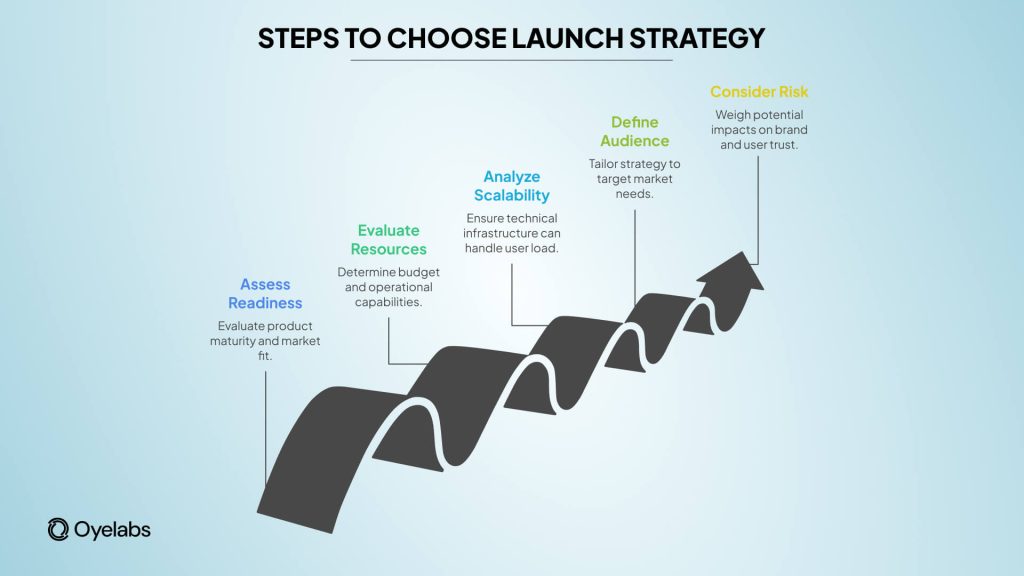
Assess Product Readiness
Before launching, evaluate whether your product is truly market-ready. If you’re still in MVP (Minimum Viable Product) mode with incomplete features or untested flows, a soft launch is the safer route. It allows real users to provide feedback that leads to smart, data-driven iterations. Big launches demand polish—your UI, backend, and payment systems must be flawless.
According to CB Insights, 36% of startups fail due to poor product-market fit, often because they launch too soon. If your freelance platform hasn’t been validated with actual users yet, launching big may do more harm than good. A soft launch helps ensure you’re solving the right problem before going all-in.
Evaluate Budget and Resources
Soft launches are cost-efficient. You can limit spending to backend improvements, beta testing, and small-scale marketing. Big launches, however, are resource-intensive—you’ll need a budget for paid ads, PR, influencer outreach, and cloud infrastructure.
On average, companies spend 20–25% of their total budget on launch marketing alone, as per Launch Metrics. If your freelance platform is bootstrapped or funded with minimal capital, a big launch may exhaust your runway. Go soft, test smart, and grow iteratively until you’re financially and operationally equipped for a major release.
Analyze Technical Scalability
Your tech stack must align with your launch strategy. Soft launches allow you to test scalability in stages—monitor server loads, user behavior, and bug reports with manageable traffic. In contrast, a big launch could bring thousands of users instantly.
If your backend isn’t built to scale—with tools like load balancers, autoscaling, and crash monitoring—performance issues could crash the platform. A study by Amazon Web Services revealed that 88% of users abandon an app after a poor digital experience. If you’re unsure your infrastructure can handle scale, start soft. Fixing problems at scale is more expensive than preventing them early.
Define Your Audience Strategy
Your target market can guide your launch. Soft launches are perfect if you’re entering regional markets or launching city-by-city, like TaskRabbit. You can tailor features to specific user needs and build strong community feedback loops. Big launches work better if your platform offers broad appeal from day one—think gig marketplaces for global freelancers.
However, HubSpot reports that 61% of marketers say audience targeting is the key to successful campaigns. So if your targeting strategy isn’t locked in yet, a soft launch gives you room to refine your value proposition before scaling broadly.
Consider Risk Tolerance
A soft launch is a safety net. Mistakes are expected, feedback is constructive, and failure won’t destroy your brand reputation. But a big launch is high-stakes. If bugs or outages occur, it’s public—your credibility and user trust take a hit.
According to Statista, 53% of users uninstall an app within 30 days due to poor performance or user experience. If your freelance platform has zero tolerance for error—because of investors, branding, or competitive pressure—you may feel forced into a big launch. But unless you’re 110% ready, a soft launch is a better way to build sustainably without panic.
Expert Tips for Freelance Platforms
Launching a freelance platform, whether via a soft launch or a big, splashy debut, requires more than just going live. To ensure long-term sustainability and market relevance, here are expert-backed tips every platform founder should keep in mind:
Niche Down for Better Positioning: Rather than trying to be the next Upwork or Fiverr, new platforms should target a niche audience. Whether it’s freelance UX writers, legal consultants, or healthcare professionals, specialized platforms often see higher engagement rates. According to a 2024 Freelance Industry Report, 74% of freelancers prefer platforms that cater to their specific skill sets, citing better client matches and higher pay.
Leverage a Two-Sided Network Strategy: One of the hardest parts of launching a freelance marketplace is solving the chicken-and-egg problem—do you onboard clients first or freelancers? Experts suggest soft-launching with one side of the market (usually the supply side) and using partnerships or B2B outreach to gradually onboard clients. Platforms that phased user acquisition in two-sided markets saw a 38% higher retention rate after six months, according to a study by Platform Strategy Institute.
Use Real-Time Feedback Loops: A soft launch allows room to iterate quickly. During this phase, set up real-time feedback mechanisms through tools like Intercom or Typeform. Collect both qualitative and quantitative insights to refine onboarding, job matching, and payment processes. According to McKinsey, companies that incorporate continuous user feedback improve product-market fit 2x faster than those that don’t.
Offer Transparent, Flexible Pricing Models: Freelancers today are wary of exploitative commission structures. Early-stage platforms should clearly communicate their fee structure and offer multiple pricing options, such as flat fees, tiered plans, or performance-based cuts. In a 2023 survey by FreelancerMap, 67% of freelancers said transparent pricing is a deciding factor in whether they remain active on a platform.
Incentivize Early Adopters: Whether you soft launch with a closed beta or go live publicly, early adopters are your brand ambassadors. Offer them value—exclusive badges, early payouts, featured listings, or even equity pools. Platforms that incentivized early users saw 2.3x higher word-of-mouth referrals within the first 90 days, according to Launch Growth Lab.
Build Trust with Secure Features: Security is a major trust factor. Incorporate features like escrow payments, verified user profiles, and rating systems from the start. Trust-based mechanisms are responsible for reducing churn by up to 45% in peer marketplaces, reports Trustpilot Insights.
Invest in Scalable Tech Early: Scalability isn’t just about surviving viral growth—it’s about not breaking when usage spikes. Use modular, cloud-based architectures and APIs from the beginning. Experts recommend that platforms expecting >10,000 MAUs should prepare infrastructure 6 months before their big launch.
From Code to Client Matches—Oyelabs Has You Covered
Ready to disrupt the gig economy? Oyelabs specializes in end-to-end freelance platform development—from UI/UX design to scalable backend architecture. With 50+ successful deployments and expertise in microservice architecture, real-time chat integration, secure escrow systems, and AI-powered job matching, we don’t just build; we future-proof.
Backed by a team of full-stack engineers, Oyelabs ensures performance, compliance, and flawless user experiences across web and mobile. Whether you’re launching a niche MVP or a full-scale Upwork competitor, we bring proven frameworks and platform strategy to the table. Partner with Oyelabs to launch smarter, faster, and with confidence.
Conclusion
When it comes to launching your freelance platform, there’s no one-size-fits-all. A soft launch gives you room to test, tweak, and build loyalty, while a big launch brings buzz, visibility, and rapid growth. The best path? It depends on your goals, audience, and readiness. Either way, what truly matters is execution.
Need help choosing the right strategy and building a platform that scales? Oyelabs has helped startups across the globe launch with confidence, small or big. Let’s turn your vision into a thriving freelance marketplace. Reach out to Oyelabs today and get started!