
How AI Staging Can Enhance Your Real Estate Platform
How AI Staging Can Enhance Your Real Estate Platform
 Sachin Sharma
Last Updated on September 23, 2025
Key Takeaways
What You’ll Learn:
- AI staging helps listings look better and sell faster, without physical furniture.
- Platforms like Zillow use AI to improve buyer experience and listing performance.
- AI staging is faster and cheaper than traditional home staging methods.
- AI Staging helps buyers imagine living in a space, which leads to more clicks and interest.
- Any founder can add AI staging to a custom real estate platform like MoonEstate.
Stats That Matter:
- 83% of buyer agents say staging helps buyers imagine the home better.
- 49% of sellers’ agents say staging reduces time on the market.
- AI-staged homes on Zillow get 30% more listing wins for agents.
Real Insights:
- Better photos result in more clicks. Visual appeal increases time spent on listings.
- AI staging helps small platforms look premium and compete with big names.
- Buyers trust listings more when staging is transparent (before/after views, disclaimers).
- Custom AI tools work best when designed around local style preferences.
- Launching with AI staging early helps build brand trust and platform loyalty.
How AI Staging Can Enhance Your Real Estate Platform
Today’s buyers judge listings in seconds. When a property photo fails to spark interest, the next listing is just a click away. In this highly visual, digital-first real estate environment, first impressions are everything. That’s where AI staging enters as a transformative tool.
AI staging uses computer vision and machine learning to convert empty property photos into fully-furnished, photorealistic representations of a space. Unlike traditional home staging – which requires physical furniture, logistics, and significant overhead – AI staging offers speed, scalability, and cost-efficiency without sacrificing quality.
This technology is already being adopted by industry leaders like Zillow, which recently launched AI-powered staging to enhance listing engagement. If you’re building or scaling a real estate platform, AI staging isn’t a trend – it’s a strategic advantage.
In this guide, we’ll explore how integrating AI staging can give your real estate platform a measurable competitive edge – boosting engagement, increasing conversions, and elevating your brand positioning.
Why AI Staging Matters for Real Estate Platforms
The shift toward digital-first real estate isn’t new, but buyer expectations have evolved dramatically. Modern buyers don’t just view homes – they experience them through screens. Here’s why AI staging is no longer optional for serious platforms.
Buyer Psychology: Visual Context Drives Action
- Emotion leads conversion: Buyers respond to emotional cues. An empty space feels cold; a staged room feels like home.
- Context matters: Buyers often struggle to estimate room size or imagine layout potential. Staging fills in those blanks.
- Visual storytelling: Well-staged listings help buyers connect personally, which increases interest and trust.
Hard Metrics Behind AI Staging Adoption
| Metric | Empty Listing | AI-Staged Listing | Source |
| Click-through Rate | 1.2% | 3.8% | Bounti.ai Real Estate Study |
| Time on Listing | 1.3 min | 4.1 min | Zillow Showcase Data |
| Lead Generation | Baseline | +35% | Realtor Surveys (2025) |
These numbers demonstrate clear performance improvements across engagement, visibility, and conversion funnels. In fact, 83% of buyer’s agents report that staging helps prospective buyers envision a property as their future home, significantly improving listing engagement.
Market Trends: Industry Adoption is Accelerating
- Zillow, a major real estate platform, added AI staging to their listing features in 2025, citing improved user engagement.
- AI staging startups like RoOomy, Virtual Stager, and ApplyDesign have seen rapid B2B adoption in both the U.S. and EU.
- Buyer expectations are shifting: over 67% of buyers now prefer staged images when browsing listings, even in early discovery stages (National Association of Realtors, 2024).
The message is clear: platforms that don’t offer visual personalization tools will fall behind.
Key Features of AI Staging in a Real Estate Platform
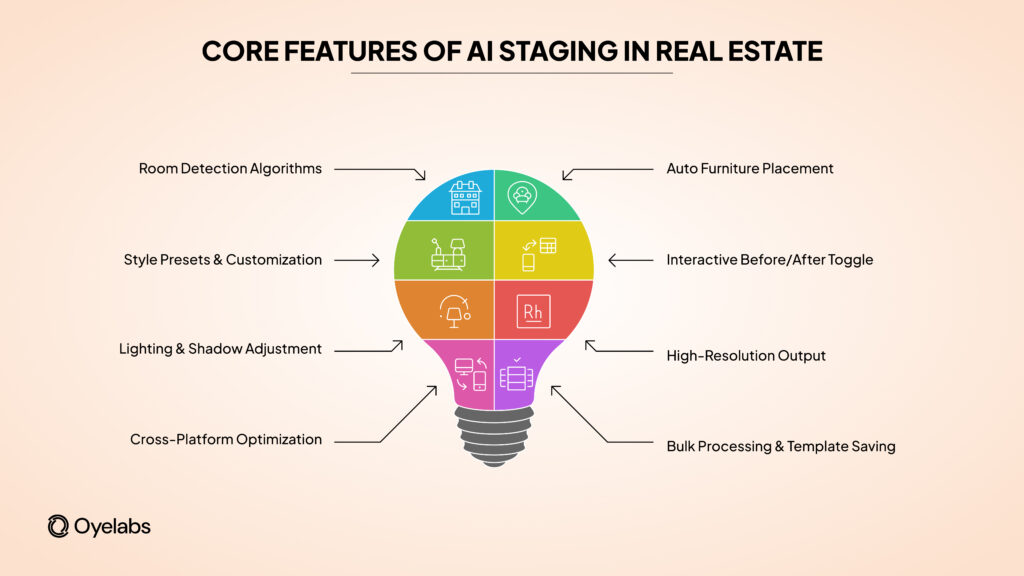
Not all AI staging tools are created equal. If you’re planning to build this into your real estate platform, here are the core features you should prioritize – both from a product functionality and a user experience standpoint.
Essential Capabilities
- Room Detection Algorithms – Automatically detect room types (e.g., bedroom, kitchen, office) from photos using computer vision models. This allows for contextual furnishing.
- Auto Furniture Placement – Dynamically furnish rooms with suitable pieces, maintaining proper scale, proportion, and spatial flow.
- Style Presets & Customization – Allow agents or users to select from predefined interior design themes such as:
- Modern Minimalist
- Urban Industrial
- Luxury Contemporary
- Scandinavian
- Family-Centric
- Interactive Before/After Toggle – Easily switch between the original and staged photo for transparency and visual comparison.
- Lighting & Shadow Adjustment – Simulates realistic lighting based on image metadata (time of day, window placement), ensuring furnishings blend naturally with room aesthetics.
- High-Resolution Output – Supports HD-quality rendering (at least 1920x1080px), suitable for web, mobile, and marketing collateral.
- Cross-Platform Optimization – Ensures compatibility across listing portals, mobile apps, and web browsers.
- Bulk Processing & Template Saving – Enable agents to apply staging presets to multiple listings simultaneously or reuse templates for similar properties.
Optional but High-Value Features
| Feature | Benefit |
| AI Personalization Engine | Suggests design themes based on buyer behavior or market segment. |
| Agent Branding | Embeds brokerage or agent branding into staged images automatically. |
| Mobile App Extension | Allows field agents to stage listings directly from their smartphones. |
| Compliance Flagging | Ensures MLS/staging compliance (e.g., flags over-staged or deceptive images). |
Incorporating the right features not only strengthens your product offering but also impacts your brand reputation, especially when targeting discerning buyers and high-ticket property segments.
If you’re planning your feature roadmap, don’t miss this guide on must-have features for Zillow-style platforms.
Technical and Business Considerations When Implementing AI Staging
For founders planning to integrate AI staging into their real estate platform, it’s important to consider more than just the visual output. The backend architecture, infrastructure needs, and user interface design all contribute to whether the feature actually adds value – or creates friction.
Technical Foundations
AI staging starts with strong foundations in machine learning and computer vision. The system must be trained on large, diverse image datasets so it can accurately recognize room types, detect angles, and apply furnishings that make sense for the space. Without this, even the best designs will feel artificial.
Cloud-based rendering infrastructure is also key. Real-time or near-real-time staging requires GPU-powered environments to process image transformations efficiently, particularly if you’re dealing with high-resolution photos. Caching and optimization techniques should be employed to keep staging performance fast and responsive – especially for mobile users.
Equally important is the front end. The staging interface should feel native to your listing workflow. Agents should be able to upload a photo, choose a room type, select a design style, and preview the results in seconds. Overcomplicating the UI will discourage adoption.
Finally, security and compliance need attention. All virtually staged images must carry clear disclosures to maintain transparency. Some MLS systems require you to tag edited media explicitly – ignore this, and you risk takedowns or reputational damage.
Business Implications
From a business perspective, AI staging can open new monetization channels. You might offer it as a premium feature for agents or bundle it into higher-tier subscription plans. It also reduces dependency on traditional staging vendors, which brings long-term operational savings.
The real advantage lies in scalability. Once implemented, AI staging can be used across thousands of listings without logistical overhead. It allows even smaller properties to look polished – giving your platform a competitive edge not just in high-end markets, but in underserved, local ones too.
How AI Staging Drives Business Metrics That CEOs Care About
Features are only as valuable as the business outcomes they deliver. Fortunately, AI staging isn’t just about aesthetics – it drives tangible improvements across key metrics that matter to CEOs, investors, and stakeholders.
More Engagement, Longer Viewing Time
When buyers encounter listings with beautiful, staged images, they stay longer. They scroll through more photos. They view the listing details. And they share the property with others. These micro-actions compound into increased visibility and higher rankings on search platforms or internal recommendation engines.
Listings with AI staging have consistently outperformed plain photos in terms of average session time, depth of engagement, and return visits. It gives users a reason to explore, rather than bounce. Listings enhanced with immersive media like a 3D home tour attract 37% more views – showing how strong visuals can pull in buyer interest.
Better Lead Quality and Higher Conversion Rates
Buyers who connect with a property visually are more likely to inquire, schedule a showing, or take the next step. Real estate is an emotional decision – if they can see themselves in the space, they’re more likely to act.
By helping buyers visualize a “lived-in” environment, AI staging shortens the decision cycle. It also helps eliminate guesswork for out-of-town buyers or those purchasing remotely, which is increasingly common in today’s hybrid housing market.
Cost Efficiency and Faster Time-to-Market
Traditional staging is expensive and slow. With AI staging, you reduce listing preparation time dramatically. Instead of waiting for staging teams, furniture, and photographers, your agents can upload raw photos and get finished, staged images within hours – or even minutes.
That speed matters. In competitive markets, getting listings online faster means higher chances of early bids, especially for well-presented properties.
Brand Differentiation at Platform Level
From a branding perspective, AI staging helps position your platform as modern, premium, and buyer-focused. It signals to both users and agents that your platform offers tools beyond basic listings – that you’re investing in presentation, experience, and results.
This level of polish can help smaller startups punch above their weight and compete with national platforms that are slower to innovate. It’s especially effective in local or niche markets where visual appeal hasn’t been optimized.
How OyeLabs Helped a Founder Launch a Custom Real Estate Platform with AI Staging
In early 2025, a founder partnered with OyeLabs to launch a hyperlocal Zillow-style platform using our MoonEstate product.
The challenge: listings lacked appeal, traditional staging was expensive, and national platforms weren’t customizable. We integrated AI staging directly into the agent workflow – enabling room detection, style presets, and instant before/after previews. Custom design themes reflected local tastes, improving listing quality without added cost.
Within 90 days, staged listings saw 40% more views and 3x agent adoption. The platform gained regional traction as a modern, agent-friendly alternative. With MoonEstate’s foundation and OyeLabs’ custom development support, the founder launched faster, reduced cost per lead, and positioned the brand as a market innovator – proving real estate tech success depends on local context and execution.
If you’re a founder exploring no-code or low-code ways to launch in the U.S. real estate market, here’s a step-by-step guide to launching Zillow-like platforms without writing a single line of code.
Challenges and How to Overcome Them
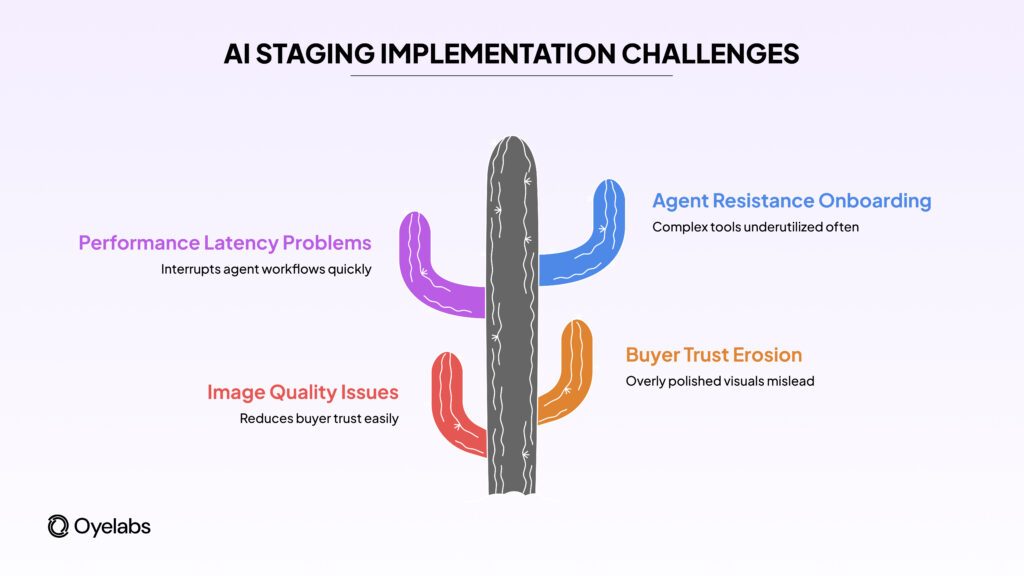
While AI staging offers clear benefits, it’s not without operational and technical hurdles. Founders need to be aware of these friction points and plan for solutions during development.
Common Challenges:
- Image Quality & Room Irregularities: Low-resolution images, poor lighting, or odd room angles can affect the output quality of AI staging. Inconsistent results reduce buyer trust and agent adoption.
- Solution: Build in quality checks at upload. Offer guidance on best practices or integrate automatic lighting correction and image enhancement APIs.
- Buyer Trust & Perception: If staged visuals look overly polished or inconsistent with reality, buyers may feel misled – especially if no “virtually staged” label is present.
- Solution: Always display a disclosure tag and provide a before/after toggle for transparency. Train agents to use staging as an enhancement, not a misrepresentation.
- Performance and Rendering Latency: Real-time rendering can be resource-heavy. Slow load times may interrupt agent workflows or frustrate mobile users.
- Solution: Use edge caching, progressive loading, and background processing for large files. Offer staging previews first, followed by full-quality downloads.
- Agent Resistance or Low Adoption: New tools – no matter how useful – can be underutilized if agents find them complex or time-consuming.
- Solution: Integrate staging into existing listing workflows, not as a separate process. Make the interface intuitive and offer onboarding support or incentives for early use.
Future Trends: Where AI Staging Is Heading
AI staging is just the starting point. As buyer behavior and technology evolve, real estate platforms will need to extend beyond static visuals into more immersive, personalized experiences.
Emerging Trends to Watch:
Augmented & Virtual Reality Integration
AI-staged rooms are evolving into AR overlays or VR walkthroughs. Buyers can walk through a home virtually while customizing furniture styles, lighting, or layouts in real-time.
Predictive Styling Based on User Behavior
Platforms will soon analyze buyer preferences and recommend staging themes based on browsing history, location, and income level – offering a personalized experience at scale.
Live Video Staging
AI staging in pre-recorded or live video walkthroughs is emerging – allowing staged visuals to exist even in dynamic video feeds, not just static images.
Local Market Adaptation with AI
AI models will begin tailoring furniture, colors, and layouts based on local design trends and cultural cues – helping platforms serve international or multicultural audiences with accuracy.
Sustainability Themes in Virtual Staging
As consumer consciousness grows, staging styles may include eco-friendly designs, upcycled furniture, or low-carbon aesthetics – aligning visual presentation with modern values.
Platforms that stay ahead of these trends will not only attract forward-thinking buyers but also command greater loyalty from sellers and agents seeking modern marketing tools.
How OyeLabs Can Help You Build This
At OyeLabs, we specialize in launching scalable, investor-ready real estate platforms that adapt to modern buyer expectations. Whether you’re building from scratch or extending your existing tech stack, we help you:
- Deploy a fully functional Zillow-style base platform (MoonEstate) with core modules for listings, agents, and users
- Customize AI staging workflows to your market – design presets, staging logic, and integrations tailored to local styles
- Optimize user experience across devices, ensuring staging features work smoothly on both web and mobile
- Scale with confidence, using robust cloud infrastructure and modular backend setups for easy upgrades
- Support post-launch iteration, including UX refinements, analytics, style updates, and ongoing maintenance
Unlike generic SaaS tools, we build with your growth roadmap in mind – from MVP to Phase 2 features like AR, mortgage integrations, or CRM sync. You own your platform, your data, and your brand.
Conclusion
AI staging is no longer a luxury – it’s fast becoming a core expectation in digital real estate. Buyers want homes they can imagine themselves living in. Agents want tools that reduce cost and speed up listing. Founders want platforms that outperform competitors in engagement and trust.
By integrating AI staging, you’re not just improving visuals – you’re elevating your product offering, driving better business metrics, and enhancing your brand perception.
At OyeLabs, we help you do this the right way. Whether you’re launching in one city or planning nationwide scale, our tailored real estate platforms – powered by modules like MoonEstate and AI staging – give you the edge to launch faster, convert better, and scale smarter.
Ready to enhance your real estate platform with AI staging?
Let’s talk. Our team is ready to help you scope, build, and deploy a solution that moves the market in your favor.
FAQs
Q1. How is Zillow using AI for staging real estate listings?
Zillow uses AI-powered virtual staging to enhance listing visuals, increasing buyer engagement and lead generation.
Q2. How can AI staging improve my real estate platform’s performance?
AI staging boosts listing views, improves buyer visualization, and drives faster, higher-quality conversion rates.
Q3. Can AI virtual staging be applied to all types of property listings?
Yes, AI staging works across apartments, condos, single-family homes, and commercial property types seamlessly.
Q4. How is AI staging used in real estate marketing content?
AI staging improves visuals in listing photos, social ads, email campaigns, and landing page media.