
BlaBlaCar Business Model: How Carpooling App Drives Growth
BlaBlaCar Business Model: How Carpooling App Drives Growth
 Anuraag Jain
Last Updated on September 25, 2025
Key Takeaways
What You Will Learn
-
How BlaBlaCar’s peer-to-peer model turns empty car seats into a scalable long-distance travel marketplace.
-
Why trust systems, ID verification, ratings, and AI-powered safety tools are central to its growth.
-
The economics of commission-based revenue and how asset-light scaling drives profitability.
-
How diversification through BlaBlaBus and potential ancillary services strengthens its ecosystem.
-
Practical lessons for entrepreneurs on building network-effect platforms, monetizing underused assets, and aligning with sustainability trends.
Important Stats
-
100M+ registered members globally, making BlaBlaCar the world’s largest carpooling platform.
-
22+ countries in operation, with strong penetration in Europe and a growing presence in emerging markets.
-
Booking commission: Typically 10–20% per passenger ride, BlaBlaCar’s primary revenue driver.
-
BlaBlaBus expansion: 400+ routes across Europe, complementing carpool offerings.
-
Environmental impact: Carpooling can reduce per-passenger CO₂ emissions by up to 40% compared to solo driving.
-
$400M+ funding raised to date, fueling global expansion and R&D for trust, safety, and AI.
Okay, picture this: you’re sitting in your dorm, scrolling through ride-share apps, wondering why gas prices feel like luxury brand tags. That’s when the BlaBlaCar app pops up, not just another app, but a long-distance carpooling marketplace that’s reshaping how people move across Europe and beyond.
If you’re a budget-savvy Gen Z traveler in the U.S. or Europe, tired of overpriced train tickets and sketchy bus schedules, this model is your sweet spot. Think of it as Airbnb for highways, connecting verified drivers with empty seats to passengers hunting for affordable, eco-friendly rides.
With over 100 million members and operations in 22+ countries, BlaBlaCar isn’t a startup experiment; it’s a scalable, peer-to-peer platform powered by trust, algorithms, and a commission-based revenue model.
From network effects to dynamic pricing mechanisms, it nails both user experience and profitability. In short: BlaBlaCar is where smart tech meets sustainable travel.
What is BlaBlaCar?
Think of BlaBlaCar as the Airbnb of highways, except instead of booking a spare room, you’re booking a spare seat.
Born in Paris in 2006, this peer-to-peer mobility marketplace has transformed long-distance travel for over 100 million users worldwide. Its genius lies in platform intermediation: matching verified drivers with empty seats to passengers craving affordable rides.
Add in AI-driven algorithms, dynamic pricing, and a trust-and-safety rating system, and you’ve got more than a rideshare; you’ve got a scalable, network-effect powerhouse. BlaBlaCar’s model appeals directly to Gen Z and millennial travelers who value cost savings, sustainability, and community.
With coverage in 22+ countries, it’s more than just a startup; it’s a global mobility disruptor backed by $400M+ in funding and partnerships with major transit providers. In plain English? BlaBlaCar cracked the code of shared travel by turning empty seats into a billion-dollar ecosystem.
Blablacar Business Model
Sometimes the smartest companies don’t reinvent the wheel; they just fill the empty seats. BlaBlaCar’s business model is proof that shared economy platforms can scale globally with trust, tech, and timing.
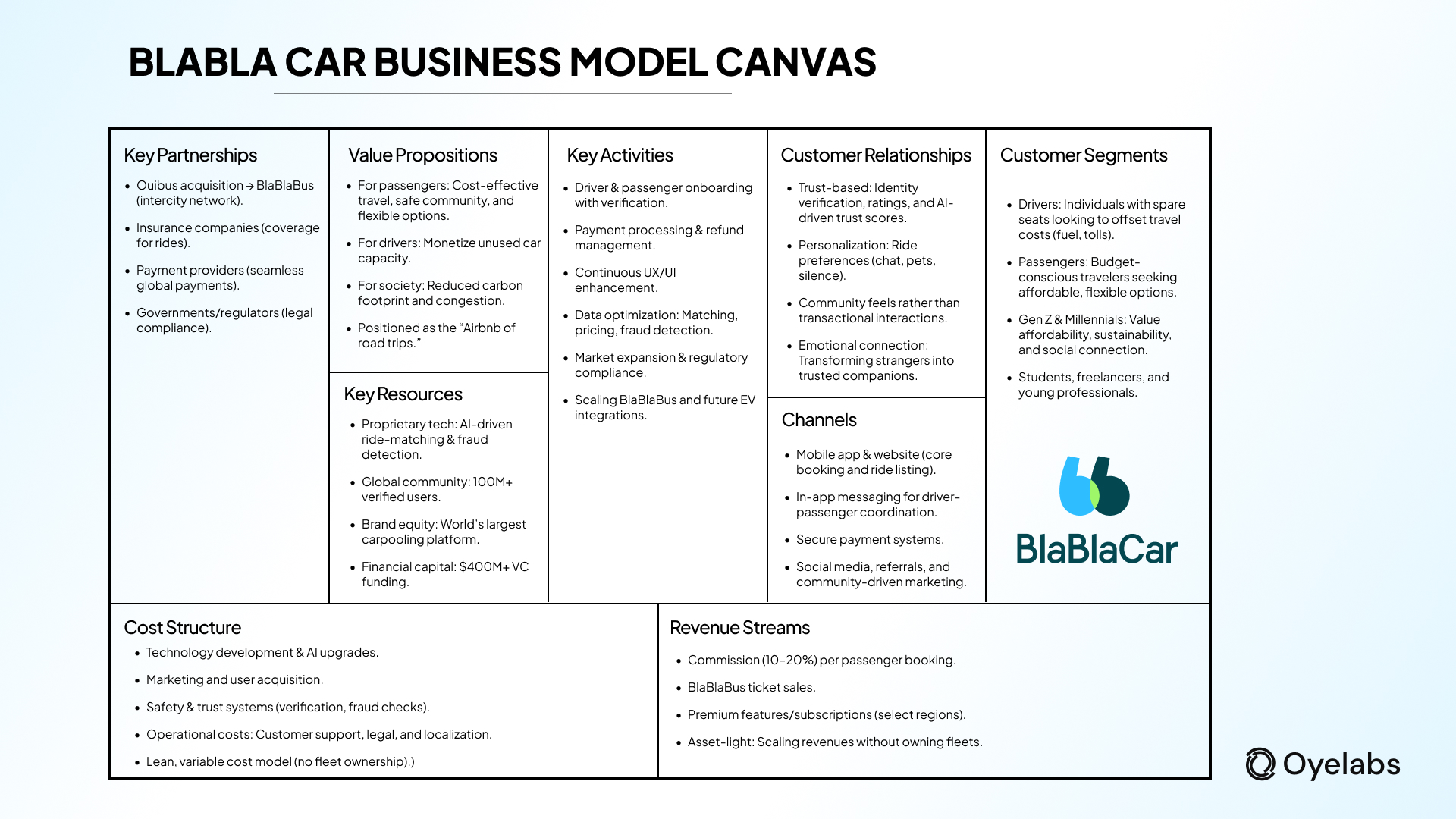
Customer Segments
BlaBlaCar targets two primary user groups that drive its marketplace engine:
- Drivers: Individuals with extra car seats looking to offset fuel or toll costs.
- Passengers: Budget-conscious travelers seeking cheaper and eco-friendly alternatives to buses and trains.
The brand primarily resonates with Gen Z and millennials, demographics who value affordability, community, and sustainability. Operating across 22+ countries and serving over 100 million members, BlaBlaCar has smartly positioned itself for students, freelancers, and young professionals.
By focusing on long-distance intercity travel, they address a pain point where traditional public transport is often costly, rigid, or unavailable. This laser-sharp segmentation helps the platform grow virally while delivering relevant value to both sides.
Also Read: Ola’s Business Model Explained
Value Propositions
BlaBlaCar’s value proposition lies in delivering affordable, sustainable, and community-centric travel. For passengers, it means:
- Access to cost-effective rides is significantly cheaper than trains or buses.
- Verified, trustworthy drivers with a reputation system.
For drivers, it provides: - A way to monetize unused car capacity and cover travel costs.
- Access to a global pool of vetted, like-minded passengers.
For society, BlaBlaCar reduces congestion and carbon emissions, promoting environmentally responsible travel. The brand markets itself as the “Airbnb of road trips”, giving it credibility and relatability.
With 100M+ registered members, it’s not just about ridesharing; it’s about building a trusted, large-scale community where financial efficiency and human connection intersect seamlessly.
Channels
BlaBlaCar leverages digital-first distribution channels that maximize reach and minimize friction.
- Mobile app & website: Core touchpoints for booking and listing rides.
- In-app communication tools: Enable seamless coordination between drivers and passengers.
- Secure payment gateways: Protect transactions and reduce disputes.
- Social media and referral programs: Boost viral growth and community engagement.
Their digital platforms are designed with AI-powered algorithms to match users with optimal rides while ensuring an intuitive user experience (UX). The app consistently scores 4.5+ stars globally, proving strong customer satisfaction.
By keeping channels simple, fast, and reliable, BlaBlaCar ensures convenience across all user journeys, from ride discovery to post-trip ratings. This omnichannel approach keeps them top-of-mind for young, digital-native travelers.
Read More: Key Trends Shaping the Future of Ride-Hailing Apps like Uber
Customer Relationships
Building trust-based relationships is BlaBlaCar’s strongest asset. They nurture user loyalty through:
- Identity verification & driver ratings: Ensuring safety and credibility.
- Preferences system: Drivers indicate if they like chatting (“Bla,” “BlaBla,” or “BlaBlaBla”), accept pets, or prefer quiet rides.
- AI-driven trust scores: Add an extra layer of transparency.
These features create a community feel rather than a transactional one. For passengers, it reduces anxiety about sharing rides with strangers. For drivers, it ensures reliable companions.
BlaBlaCar has built a sticky ecosystem; users return not just for price savings, but because the community feels safe and relatable. By turning strangers into trusted travel partners, they’ve built a brand powered by social capital and emotional connection.
Revenue Streams
BlaBlaCar’s business model monetizes through commission-based earnings on each booking.
- Booking fee (10%–20%): Charged per passenger ride, serving as the primary revenue source.
- Diversification with BlaBlaBus: Ticket sales from their intercity bus network.
- Premium features/subscriptions: Tested in some regions to provide added convenience.
The model is asset-light, meaning BlaBlaCar doesn’t own cars or infrastructure; it simply facilitates transactions. With 100M+ global members and millions of trips booked annually, revenue scales proportionally with adoption.
The platform leverages network effects: every new rider increases value for drivers and vice versa, boosting booking volumes. This capital-efficient, transaction-driven model allows consistent growth while maintaining high margins compared to traditional transport operators.
Learn More: What Uber’s Robotaxi Move Means for Ride-Hailing Startups
Key Resources
BlaBlaCar’s resources aren’t physical fleets; it’s digital IP, data, and community trust.
- Technology: Proprietary AI-driven algorithms for matching passengers and drivers.
- Brand equity: Known as the world’s largest carpooling platform.
- Community: 100M+ verified users worldwide.
- Financial resources: Over $400M+ in VC funding for expansion and R&D.
By combining technical assets with human capital, BlaBlaCar maximizes scalability. Their trust-and-safety ecosystem is as important as their app code, ensuring verified profiles, ratings, and secure payments.
Unlike traditional transport providers, their lightweight asset model reduces operational risks while unlocking exponential global growth potential. Ultimately, their brand reputation and platform algorithms serve as the true backbone of the business.
Key Activities
BlaBlaCar focuses on digital operations that ensure trust, scalability, and seamless travel experiences.
- Onboarding drivers & passengers through easy registration and verification.
- Processing transactions with secure payments and refunds.
- Enhancing UX/UI for frictionless ride booking.
- Data optimization: AI systems improve ride-matching and fraud detection.
- Expanding into new markets while adapting to local regulations.
These core activities support their mission of making long-distance ridesharing mainstream. Unlike traditional transport companies, BlaBlaCar doesn’t operate vehicles; it curates trust-based connections. Their activity roadmap also includes scaling BlaBlaBus operations and exploring future integrations like electric vehicle partnerships.
By prioritizing trust, technology, and user experience, BlaBlaCar continues to lead the global mobility marketplace.
Explore Further: Build a Cabify-Like App: Features, Costs & Tech
Key Partnerships
Partnerships fuel BlaBlaCar’s expansion. Notable alliances include:
- Ouibus acquisition (rebranded BlaBlaBus): Diversified into intercity bus networks.
- Insurance companies: Provide coverage for passengers and drivers.
- Payment providers: Ensure global, seamless, and secure transactions.
- Regulatory partnerships: Work with governments to align on legal frameworks.
These collaborations showcase ecosystem thinking; by working with external players, BlaBlaCar amplifies reliability and market presence. Strategic partnerships reduce risk, enhance safety, and open new revenue streams.
By integrating transport modes (carpool + bus), BlaBlaCar increases convenience for users while locking in dominance across Europe’s mobility sector. Their ability to leverage alliances while staying asset-light highlights strategic foresight.
Cost Structure
BlaBlaCar operates with a lean, scalable cost structure.
- Technology & platform development: Continuous updates and AI upgrades.
- Marketing & user acquisition: Significant spend to maintain viral growth.
- Trust verification systems: Identity checks, fraud prevention, and safety features.
- Operational expansion: Legal compliance, customer support, and localization in new markets.
Unlike bus or train companies, BlaBlaCar doesn’t own vehicles or depots, which slashes fixed costs. Instead, expenses are variable and scale with growth, making profitability easier.
Their biggest bet is on network effects; once critical mass is achieved in a region, marketing costs decrease as community-driven adoption takes over. This model enables BlaBlaCar to remain capital-efficient, sustainable, and margin-friendly in the long run.
Check This Out: How to Attract and Retain Riders on Your Ride-Hailing App
Revenue Model
When building a censorship-free content platform, your revenue model isn’t just about income; it’s about trust, sustainability, and scale. Below are four tested strategies entrepreneurs can adopt.
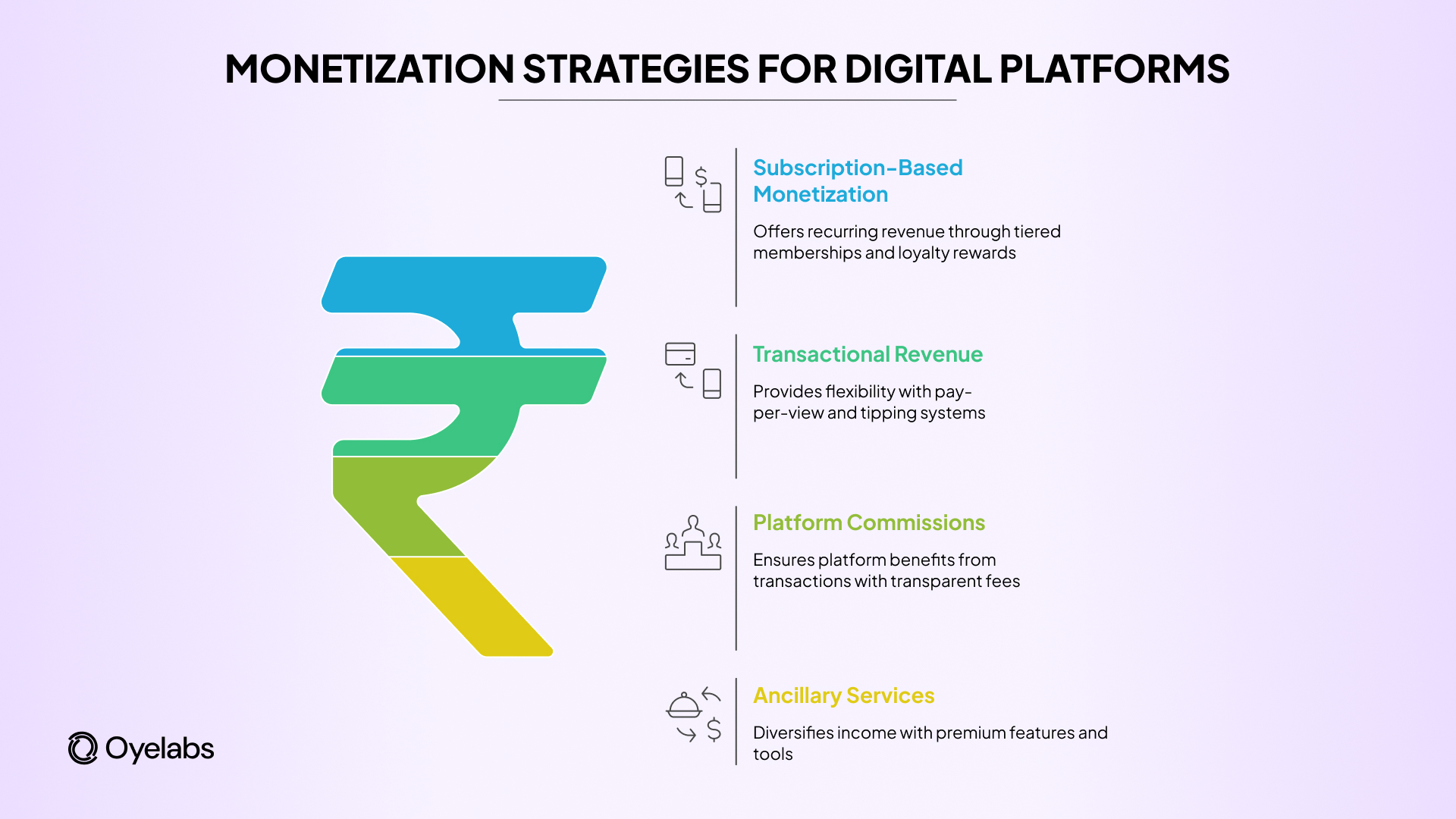
Subscription-Based Monetization
Subscription revenue is the most reliable way to generate ARR (Annual Recurring Revenue) while fostering user loyalty.
By offering recurring monthly packages, creators get a predictable income, and platforms maintain financial stability. Subscriptions work best when users feel they’re receiving consistent value and exclusivity. Globally, subscription platforms see average retention rates of 60–70% among paid members.
To maximize effectiveness, platforms should:
- Offer tiered memberships (basic, premium, VIP access)
- Provide loyalty rewards to reduce churn
- Use analytics dashboards to help creators optimize pricing
This model gives entrepreneurs strong cash-flow visibility, which investors love. It also builds a long-term relationship between creator and subscriber, strengthening retention.
Transactional Revenue (Pay-Per-View and Tips)
Transactional models like pay-per-view (PPV) and tipping systems bring flexibility for both creators and fans. PPV monetizes high-value content (exclusive videos, behind-the-scenes, custom requests), while tipping allows fans to show support instantly.
From a financial perspective, this boosts ARPU (Average Revenue Per User) without forcing users into recurring commitments. Entrepreneurs should:
- Enable frictionless, one-click payments
- Provide dynamic pricing tools based on demand trends
- Use push notifications to increase engagement at key moments
This model is especially powerful during live events, limited-time releases, or exclusive drops. It complements subscription income by capturing impulse spending, a critical growth driver.
Platform Commissions and Fees
Commission-based revenue ensures the platform benefits from every transaction while incentivizing creators to grow. Industry benchmarks show 15–20% commission rates strike the right balance between profitability and fairness.
To strengthen credibility, transparency is key; creators must see exactly what they’re paying for. Entrepreneurs can implement:
- Tiered commissions (lower rates for top earners, higher for newcomers)
- Priority listings and marketing boosts as value-adds
- Clear dashboards showing earnings and fee breakdowns
This model aligns platform success with creator success. By offering fraud protection, escrow systems, and promotional tools, commissions become more than a fee; they become an investment in growth for creators.
Ancillary Services and Upsells
Beyond subscriptions and commissions, the most innovative platforms thrive on ancillary revenue streams. These upsells not only diversify income but also deepen platform stickiness. Examples include:
- Premium analytics dashboards with performance insights
- Paid verification badges to enhance creator credibility
- Sponsorships and ad placements integrated into profiles
- Exclusive creator tools like AI-powered content editors
Ancillary services often carry high margins, boosting profitability without alienating users. They also establish the platform as a full-service ecosystem, not just a transaction hub.
For entrepreneurs, this creates multiple revenue touchpoints and builds stronger network effects, ensuring creators stay loyal to the platform while scaling their income.
Don’t miss: How Grab works – Business model explained
Challenges & Opportunities
Sometimes the best journeys aren’t just about the destination; they’re about the model driving them. BlaBlaCar’s business strategy offers both roadblocks and fast lanes worth analyzing.
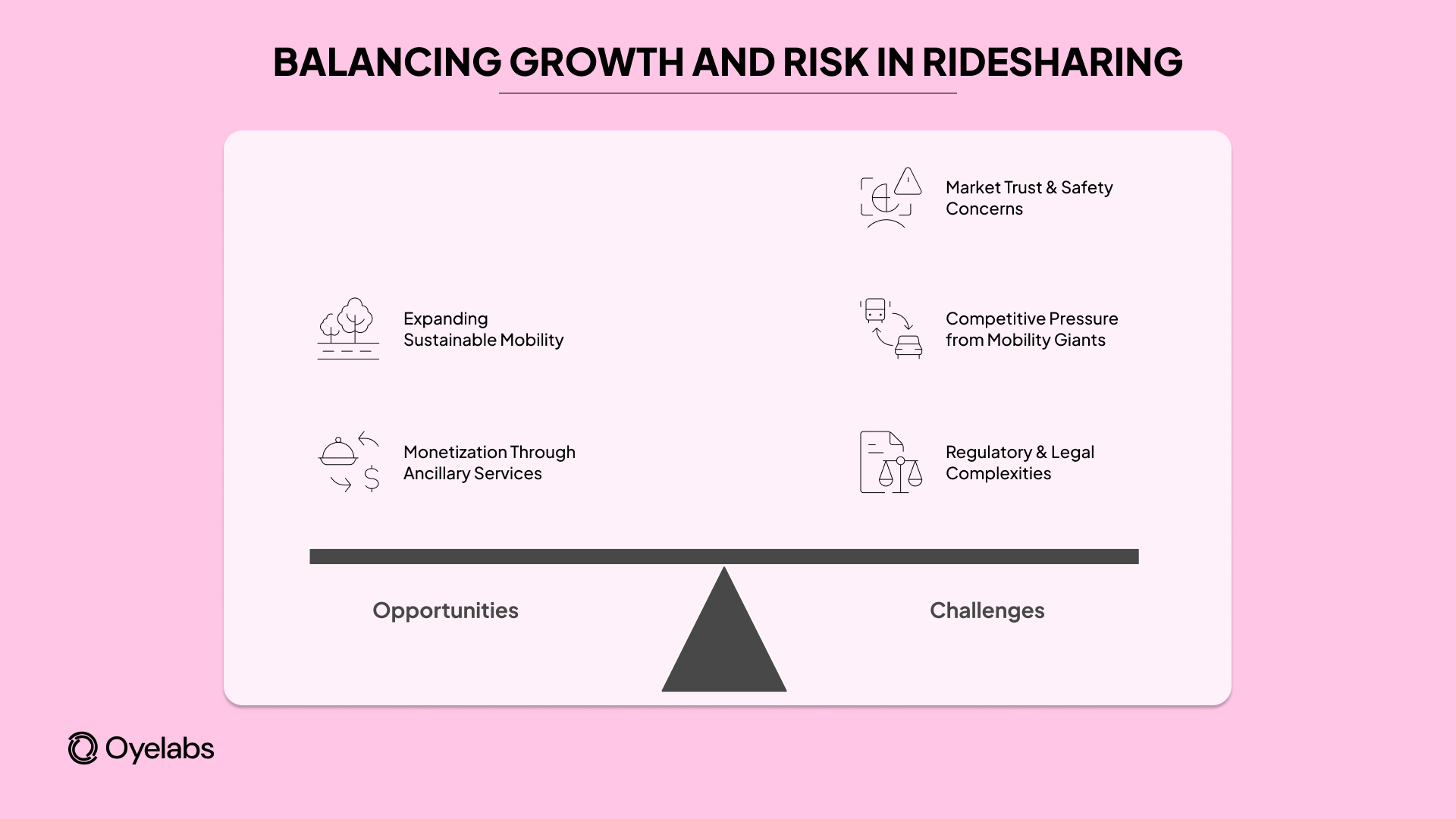
Opportunity 1: Expanding Sustainable Mobility
With governments pushing carbon neutrality and users craving eco-friendly solutions, BlaBlaCar’s shared rides directly reduce per-capita emissions. Unlike traditional transport, its platform optimizes existing vehicle capacity instead of adding cars to the road. This positions the company as a sustainability leader.
By highlighting metrics like CO₂ saved per trip and partnering with environmental NGOs, BlaBlaCar can strengthen its green credentials. The opportunity lies in aligning its core service with broader ESG goals and marketing sustainability as both a cost-saver and a status symbol for conscious travelers.
Opportunity 2: Monetization Through Ancillary Services
BlaBlaCar’s community isn’t just a ridesharing base; it’s a high-intent, location-driven audience. Beyond ticket commissions, the platform can monetize by offering travel insurance, in-app entertainment, or targeted local deals.
Think curated pit-stops, food partnerships, or cross-selling hotel stays. Such ancillary revenue streams boost margins without increasing ride volume. More importantly, they enhance user experience, making BlaBlaCar more than a transport app; it becomes a travel ecosystem.
When executed with personalized AI recommendations, this opportunity strengthens loyalty while driving incremental revenue per user.
Recommended reading: Understanding Uber Business Model
Challenge 1: Market Trust & Safety Concerns
Building trust is non-negotiable for peer-to-peer platforms. BlaBlaCar faces the ongoing challenge of ensuring passenger safety while balancing convenience.
Despite ID verification, rating systems, and AI-powered fraud detection, skepticism remains, especially in markets less familiar with ridesharing. Any breach of trust could derail adoption.
To counter this, BlaBlaCar must continuously invest in compliance frameworks, third-party audits, and transparent communication. Winning credibility means proving security not once, but daily. For a service where strangers share cars, perception of safety is just as critical as the ride itself.
Challenge 2: Competitive Pressure from Mobility Giants
Ridesharing titans like Uber, Lyft, and even traditional bus operators aggressively compete for the same audience. BlaBlaCar’s model thrives on affordability, but scale can be threatened by apps offering instant convenience.
According to McKinsey’s 2024 Mobility Report, Uber has a global ride-hailing market share of 18.076 trillion US dollars, while BlaBlaCar’s penetration is strongest in Europe but less than 5% worldwide.
Competitors with deeper pockets push discounts, tech integrations, and loyalty perks that BlaBlaCar may struggle to match. The challenge? Carving a niche where BlaBlaCar isn’t just cheaper but smarter.
Leveraging network effects, the more users, the more value, becomes essential. The brand must invest in predictive analytics, dynamic pricing, and partnerships to sustain its distinct advantage against multi-modal rivals.
Challenge 3: Regulatory & Legal Complexities
Transport regulations are notoriously fragmented. What’s legal in France may be restricted in India. BlaBlaCar’s expansion relies on navigating licensing issues, insurance mandates, and cross-border compliance. One misstep could trigger fines or operational bans.
Regulators often view carpooling as a gray area between private and commercial transport. BlaBlaCar must proactively lobby for policy frameworks, showcase economic benefits (reduced congestion, shared fuel costs), and collaborate with authorities.
Legal friction is a challenge, but it’s also a chance to set industry standards. By championing fair regulation, BlaBlaCar not only protects itself but legitimizes the ridesharing model globally.
End-to-End Ridesharing App Solutions You Can Trust
At Oyelabs, we specialize in ride-hailing app development that’s scalable, secure, and engineered for performance.
With 150+ successful mobility projects and a client retention rate of 92%, we’ve proven expertise in building apps with real-time GPS tracking, AI-driven route optimization, dynamic pricing algorithms, and multi-payment gateway integration.
Our developers employ microservices architecture and cloud-native infrastructure to ensure high uptime and lightning-fast response rates. Whether you need a taxi booking app, ridesharing platform, or on-demand fleet solution, Oyelabs combines technical precision with user-first design. Build an app that not only competes but dominates in today’s mobility marketplace.
Conclusion
BlaBlaCar’s business model is a fascinating blend of community-driven trust, sustainable mobility, and platform economics. While it faces real challenges, regulatory hurdles, market skepticism, and competitive threats, it also holds powerful opportunities to redefine how we think about shared travel.
By capitalizing on ancillary services, eco-conscious branding, and user-centric innovation, BlaBlaCar can continue steering ahead in the global mobility race. The future of ridesharing won’t just be about saving money; it will be about building ecosystems that connect people, places, and possibilities.
Ready to create disruptive platforms like this? Partner with Oyelabs to turn your bold idea into reality today.