
Ola’s Business Model Explained: Revenues, Growth & Strategy

Ola’s Business Model Explained: Revenues, Growth & Strategy
 Anuraag Jain
Last Updated on September 25, 2025
Key Takeaways
What You Will Learn
-
How Ola leverages a two-sided aggregator model to connect riders with independent driver-partners while remaining asset-light.
-
The power of commission-based revenue, dynamic pricing, and surge algorithms in scaling ride-hailing economics.
-
Why multi-modal mobility, Ola Select subscriptions, and corporate solutions strengthen customer retention and lifetime value.
-
How Ola integrates fintech and EV ventures to diversify income beyond ride commissions.
-
Practical lessons for entrepreneurs on scaling platform-based marketplaces, building sticky ecosystems, and future-proofing mobility ventures.
Important Stats
-
1.5+ billion rides served across India, making Ola one of the largest mobility platforms.
-
Commission per ride: 15–30%, depending on city and vehicle type.
-
Active cities served: 250+ across India, with 1.5 million+ driver-partners.
-
Ola Electric S1 scooters: Over 1 million sold, expanding EV revenue streams.
-
Subscription-based revenue: Ola Select boosts retention with perks like zero surge pricing and priority support.
“Ever wondered how that bright green Ola cab pulls up in minutes while you’re still deciding on your coffee order? That’s not luck; it’s a finely tuned business model reshaping urban mobility in India and beyond.
Hi, I’m your go-to growth strategist, breaking down how ride-hailing apps like Ola cracked the code of ride-hailing economics. If you’re a founder, investor, or Gen Z entrepreneur eyeing the next unicorn play, this is your backstage pass.
With over 1.5 billion rides served, Ola isn’t just a taxi app; it’s a platform leveraging dynamic pricing, demand-supply algorithms, fleet optimization, and scalable tech architecture. From auto-rickshaws to electric vehicles, Ola blends AI-driven route mapping with localized customer acquisition strategies to stay ahead of Uber in its home turf.
By studying Ola’s ecosystem, drivers, customers, payments, and partnerships, you’ll unlock proven strategies for building platform-based marketplaces that scale fast, stay profitable, and disrupt legacy industries. Ready to ride?”
Ola’s Market Size
Ola has emerged as one of the leading ride-hailing companies in India, expanding its presence globally while catering to diverse mobility needs. Its market spans metropolitan cities, tier-2 towns, and even rural segments where affordable transportation is a priority. With a customer-first approach, Ola positions itself as more than just a cab service; it’s a complete mobility ecosystem.
Key aspects of Ola’s market include:
-
Urban Dominance: Over 250+ cities in India are covered with diverse ride options.
-
Tier-2 & Tier-3 Reach: Nearly 45% of Ola’s rides come from smaller towns.
-
International Expansion: Active in 3+ countries, including Australia, New Zealand, and the UK.
-
User Base: More than 250 million customers globally.
-
Driver Network: Over 2.5 million driver-partners registered.
-
Ola Electric: Sold 5 lakh+ EV scooters in 2024, making it India’s EV leader.
-
Market Share: Holds about 52% of India’s ride-hailing market, competing closely with Uber.
The Core Ola Business Model Explained
Ever thought what makes Ola more than just an app that gets you from point A to B? Let’s peel back the layers of its powerful business engine.

Aggregator Marketplace Structure
Ola thrives on a two-sided aggregator model, linking millions of riders with independent driver-partners. Unlike traditional taxi companies, Ola doesn’t own cars; it owns the platform. This asset-light approach ensures fast scalability while minimizing upfront costs.
The credibility factor? Ola uses driver KYC verification, license validation, and performance ratings to maintain trust and safety.
- Drivers bring their own vehicles.
- Customers tap into an AI-powered platform for instant rides.
- Ola earns by enabling these transactions.
This setup creates a flexible supply chain that adapts quickly to demand spikes across urban and semi-urban areas. Think of it like Airbnb for mobility: Ola acts as the middleman, matching idle driver assets with real-time rider demand. This keeps cost efficiency, trust, and scalability at the core of the business model.
Also read: How to Attract and Retain Riders on Your Ride-Hailing App
Commission-Based Revenue Engine
The commission model is Ola’s bread and butter. Every ride completed results in a percentage cut going back to Ola, typically between 15% and 30%, depending on the city and vehicle type. This system is transparent, automated, and performance-driven. Drivers know what to expect, and Ola ensures predictable revenue per ride.
- Percentage-based commissions.
- Automated fare splits via the app.
- Dashboards for both drivers and Ola to track transactions
This revenue stream allows Ola to reinvest in customer acquisition campaigns, fleet support programs, and platform technology upgrades. What’s powerful here is alignment; Ola makes money only when drivers do. That means growth is mutually beneficial.
For entrepreneurs studying Ola, this proves how transaction-based monetization ensures recurring income and healthy unit economics. It’s not just scalable; it’s reliable, sustainable, and measurable, making it the backbone of Ola’s entire ecosystem.
Dynamic Pricing and Surge Algorithms
Ola’s magic lies in its dynamic pricing system. When demand shoots up, on rainy evenings, during festivals, or during peak office hours, Ola’s AI-backed surge algorithms automatically increase fares. This encourages more drivers to log in and balances supply with demand.
- Real-time geospatial data tracks rider density.
- Algorithms forecast demand spikes before they happen.
- Transparent surge notifications maintain customer trust.
The credibility here? Surge pricing is modeled after airline yield management systems, where prices adapt to demand elasticity. It ensures liquidity across the platform, drivers earn more when they’re most needed, and riders always find a cab even during crunch times.
Surge isn’t just about higher fares; it’s about supply-demand equilibrium. For Gen Z entrepreneurs, this highlights the power of elastic pricing models that maximize efficiency while still keeping customer transparency intact.
Read more: InDriver App Business Model
Multi-Modal Mobility Options
Ola doesn’t limit itself to just cabs; it’s a multi-modal mobility platform. From bikes and autos to luxury sedans and electric scooters, Ola has built options for every demographic. This diversification attracts students, corporates, families, and eco-conscious riders alike.
- Ola Auto for affordability.
- Ola Bike for fast solo commutes.
- Ola Prime for premium business travel
- Ola Electric for sustainable mobility.
This layered offering drives higher transaction frequency and ensures broader market capture. Instead of relying on a single service, Ola maximizes revenue by tailoring rides to customer needs. It’s a textbook case of product-line diversification, strengthening customer lifetime value (CLV).
By creating a stack of options, Ola has future-proofed its growth, proving that adaptability and inclusivity are key drivers in the ride-hailing economy.
Subscription-Based Monetization
Ola takes a page from SaaS models with Ola Select, its subscription plan offering exclusive perks like zero surge pricing, priority support, and in-app rewards. This adds a recurring revenue stream on top of ride commissions.
- Monthly or yearly fee from customers.
- Benefits include no peak pricing and premium ride options.
- Loyalty incentives like points and discounts for repeat use.
For customers, Ola Select delivers VIP treatment and predictability. For Ola, it reduces churn, increases retention, and ensures consistent cash flow.
Subscriptions create an emotional lock-in: riders feel rewarded, not just serviced. This model mirrors global digital businesses like Netflix or Amazon Prime, proving Ola knows how to blend psychology, exclusivity, and tech-driven loyalty.
For entrepreneurs, Ola Select is a masterclass in building sticky customer relationships through perks that customers actually value.
To know more, read InDriver vs Bolt vs DiDi vs Cabify
Corporate & Enterprise Solutions
Ola isn’t just serving individuals; it’s scaling into B2B mobility solutions with Ola Corporate. This service is tailored for companies needing centralized billing and employee travel management. Enterprises benefit from cost control and compliance, while Ola secures steady, high-volume contracts.
- Real-time ride tracking for safety.
- Automated invoicing and GST compliance.
- Dashboards for HR and finance teams.
The credibility marker? Ola Corporate is trusted by top Indian enterprises that rely on mobility as a core function. This vertical diversifies Ola’s income, reducing overdependence on B2C riders. For Ola, corporate tie-ups mean higher-value clients and predictable revenue streams.
For businesses, it solves pain points around travel expense management. This move transforms Ola from a gig-economy disruptor into a Mobility-as-a-Service (MaaS) provider, proving its ability to serve both mass-market consumers and institutional enterprises.
Driver Incentive Ecosystem
Drivers are the lifeblood of Ola’s platform, and the company keeps them motivated through a robust incentive framework. Bonuses, micro-loans, and insurance packages empower drivers to stay loyal.
- Performance-based bonuses for peak hours.
- Rewards for maintaining high ratings.
- Access to financial tools like loans and vehicle leasing.
This system doesn’t just increase supply, it creates supply-side stickiness. Drivers feel part of an ecosystem rather than just contractors. Ola’s AI-backed dashboards personalize incentives regionally, ensuring fairness and effectiveness.
By blending behavioral economics with financial empowerment, Ola keeps service levels high while reducing driver churn. This ecosystem proves Ola’s maturity as a platform: it doesn’t just connect drivers; it invests in them.
For entrepreneurs, the lesson is clear: empowering your supply base ensures sustainable growth and higher customer satisfaction.
Learn more: How to Create InDriver App in 2025
Digital Payment & Fintech Integration
With Ola Money, the company has embedded fintech into its core mobility business. Beyond ride payments, Ola Money is used for bill payments, recharges, and even shopping. This integration drives convenience and additional revenue streams.
- Proprietary wallet alongside UPI, cards, and net banking.
- Transaction fees and float revenue from stored balances.
- Cross-sell opportunities into retail and lifestyle payments
Payments aren’t just about convenience; they’re about reducing friction. Ola’s fintech play increases ride completion rates and keeps users locked into its ecosystem. This mirrors strategies from global super-apps like Grab and Gojek, where mobility and fintech reinforce one another.
For Ola, this vertical means higher margins, ecosystem expansion, and financial credibility. For entrepreneurs, it’s a blueprint on how embedding payments can transform a niche app into a platform powerhouse.
Expansion into Electric Mobility
Ola’s boldest move is Ola Electric, which positions it at the intersection of sustainability and mobility. By building e-scooters, batteries, and charging infrastructure, Ola is vertically integrating its value chain.
- Ola S1 scooters for consumers.
- EV fleets for ride-hailing.
- Charging infrastructure for ecosystem growth.
This strategy goes beyond just green branding; it’s future-proofing against climate risks and regulatory changes. Ola Electric also creates multiple new revenue streams, from hardware sales to subscription-based charging models.
Vertical integration means Ola controls the hardware, software, and infrastructure; a closed loop that boosts profitability and competitive advantage. The credibility marker? Ola Electric has attracted global investors and government support, validating its role in India’s EV revolution.
For Gen Z entrepreneurs, Ola proves how diversification plus sustainability can turn a mobility company into a tech-driven clean energy leader.
Dive Deeper into the Guide to Launch Your Own Ride-Hailing App Like inDriver in the USA to know more.
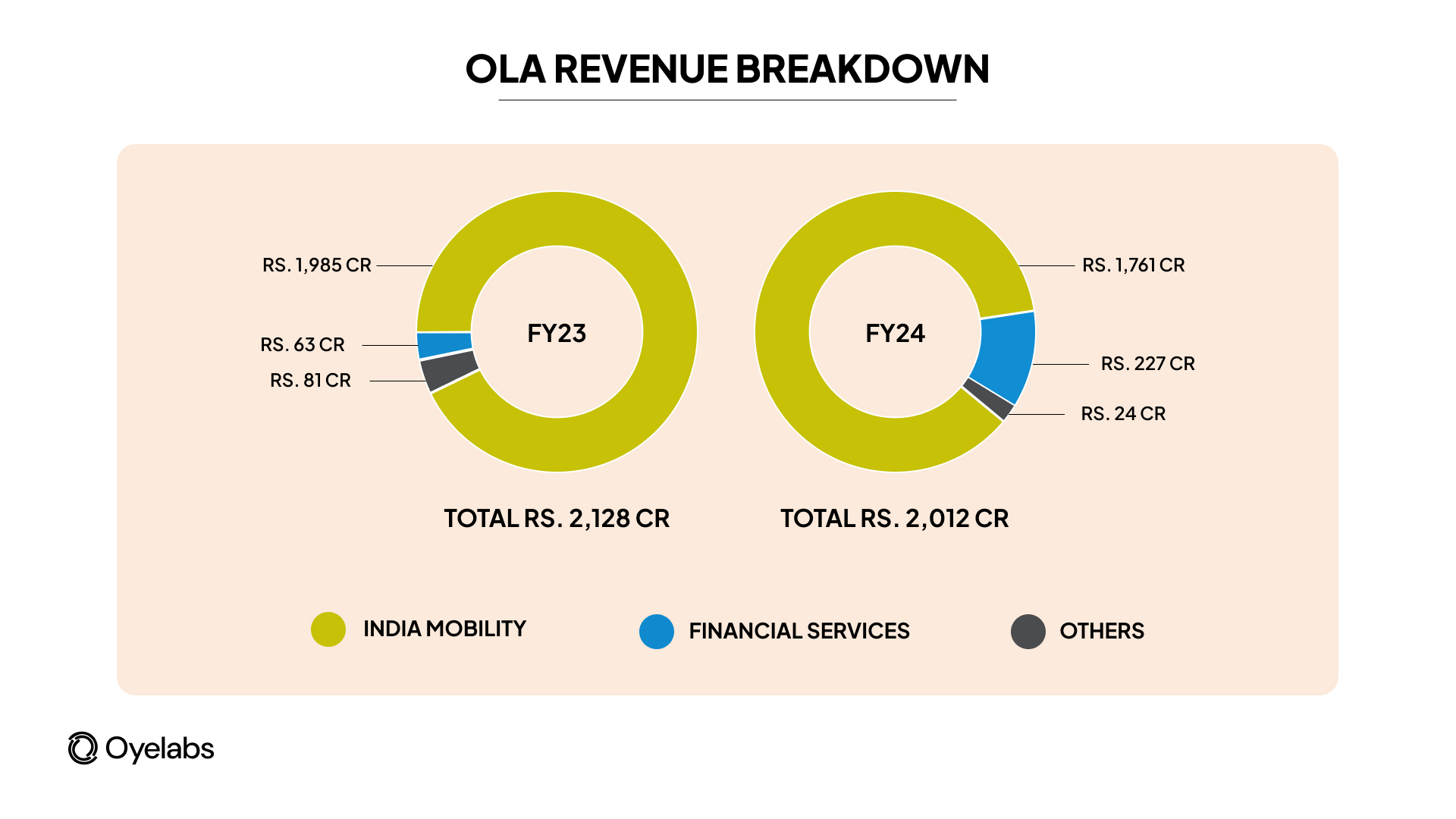
Revenue Streams in Detail
Before we dive into the details, it’s worth noting that Ola has grown far beyond just being a ride-hailing app. Its diversified business model generates revenue through multiple verticals, making it one of India’s most successful mobility platforms. Let’s break down the five key revenue streams in detail.

Ride-Hailing Services
Ola’s core revenue generator remains its ride-hailing operations. Customers book cabs through the app, and Ola charges a commission fee from drivers on every completed ride. Typically, this commission ranges between 15% to 30%, depending on the ride category and city. The platform also leverages surge pricing during peak hours, allowing it to optimize margins.
Ola’s algorithm-driven demand-supply mapping ensures maximum fleet utilization, reducing idle driver hours and boosting earnings. By offering multiple ride categories like Ola Micro, Mini, Prime, and Auto, the company taps into diverse customer budgets, ensuring a wider user base. This segment accounts for the lion’s share of Ola’s income.
Ola Electric Vehicles (EV) and Scooters
With India’s EV revolution accelerating, Ola Electric has become a significant revenue pillar. With over 1.5 million driver-partners serving 250+ cities, Ola has established itself as India’s largest ride-hailing network. Ola monetizes its electric scooters (S1 series) through direct sales and after-sales services.
Additionally, it is expanding into EV battery charging infrastructure, aiming to create a recurring revenue loop. Subscriptions for battery swaps and long-term servicing contracts further increase lifetime customer value.
Ola Electric has raised billions in funding, cementing its credibility as not just a mobility player but also a clean-tech pioneer. As government incentives and carbon credit opportunities expand, Ola stands positioned to multiply revenues from its EV ecosystem.
Ola Financial Services
Ola Money, its fintech arm, acts as a super app for payments, lending, and insurance. Revenue flows from:
- Digital wallet transactions
- Micro-lending and credit solutions
- Insurance policies for riders and drivers
- Partner merchant payments
By embedding financial products into the mobility experience, Ola builds ecosystem stickiness.
Every cab ride, recharge, or insurance purchase through Ola Money contributes to consistent transaction-based revenue. This vertical also enhances customer retention while reducing dependency on third-party payment platforms.
Ola Foods & Cloud Kitchens
Ola’s foray into food delivery goes beyond restaurants—it operates cloud kitchens under the brand Khichdi Experiment and others. Revenue comes from:
- Direct food orders via its own channels
- B2B partnerships with food aggregators
- White-label kitchen services
Unlike traditional delivery models, cloud kitchens cut overhead costs while scaling quickly. Ola leverages its logistics fleet to ensure efficient food distribution, creating synergy with its mobility network. This not only diversifies revenue streams but also strengthens brand presence in daily household consumption.
You Might Like: How to Build a Taxi App Like Uber
Subscription & Corporate Services
Ola also drives revenue through subscription models, such as a taxi-booking app like Ola Select, offering premium benefits like zero wait-time rides and free in-trip Wi-Fi.
Additionally, its corporate mobility services cater to businesses by providing employee transportation solutions, invoicing systems, and customized ride packages.
Revenue here is predictable due to recurring contracts and bulk bookings. Corporate clients, valuing efficiency and safety, contribute to long-term stability. By blending individual subscriptions with enterprise-grade mobility, Ola ensures a steady inflow of non-transactional revenue, reducing volatility in its cash flow.
Why Oyelabs Leads in Smart Ride Solutions
Building a custom mobility platform can unlock immense growth potential in today’s on-demand economy. At Oyelabs, we specialize in designing scalable, AI-powered ride-booking ecosystems that maximize fleet utilization, reduce operational overhead, and ensure seamless UX.
With expertise in geo-location APIs, dynamic pricing algorithms, and payment gateway integrations, our team delivers solutions tailored for startups and enterprises alike. Trusted by global clients, we don’t just build apps; we engineer end-to-end platforms with enterprise-grade security, cloud scalability, and 99.9% uptime assurance.
If you’re ready to disrupt the urban mobility space, Oyelabs is your innovation partner.
Conclusion
Ola’s business model thrives on diversification, seamlessly blending mobility, financial services, EV innovation, and food ventures into one scalable ecosystem.
By leveraging data-driven algorithms, subscription models, and sustainable technology, Ola has created multiple, dependable revenue streams that ensure long-term profitability. Its expansion into electric mobility and fintech positions it not just as a ride-hailing platform but as a mobility-tech powerhouse shaping the future of transportation.
For entrepreneurs inspired by Ola’s success, building a robust, future-proof platform is key. Partner with Oyelabs today to turn your bold startup vision into a thriving, scalable business model.
FAQs
What cities does Ola operate in?
Ola operates in over 250 Indian cities, including metros, tier-2, and tier-3 towns, and has expanded to countries like Australia, New Zealand, and the UK.
How many users does Ola have?
Ola has a global user base of over 250 million customers, with daily rides reaching millions across India.
How large is Ola’s driver network?
Ola has more than 2.5 million registered driver-partners, making it one of India’s largest mobility networks.
What share of the ride-hailing market does Ola hold?
Ola commands approximately 52% of India’s ride-hailing market, giving it a slight edge over competitors like Uber.
How is Ola contributing to electric mobility?
Through Ola Electric, the company has sold 500,000+ EV scooters, expanded charging infrastructure, and strengthened its eco-friendly transportation footprint.