
Patreon vs OnlyFans: Opportunities in the Creators Economy
Patreon vs OnlyFans: Opportunities in the Creators Economy
 Anuraag Jain
Last Updated on September 22, 2025
Key Takeaways
What You Will Learn
-
Why Patreon and OnlyFans, though both subscription-driven, offer very different monetization models for U.S.-based creators.
-
How audience demographics shape creator success—Patreon’s millennial-heavy base vs. OnlyFans’ Gen Z-driven growth.
-
The impact of brand reputation and discoverability on long-term creator equity and sponsorship opportunities.
-
Why content format (structured vs. spontaneous) directly affects revenue stability and fan retention.
-
Practical lessons U.S. creators can apply to diversify revenue, manage risks, and build stronger digital brands in a crowded market.
Important Stats
-
The global creator economy is valued at $250B+ in 2025, with U.S. creators driving a significant share.
-
Patreon’s average monthly creator income is $350, while OnlyFans averages $180 with higher upside potential.
-
50M+ active U.S. creators are competing for attention and revenue (SignalFire, 2024).
-
60% of Patreon users are over 30, while 70% of OnlyFans users are under 30, highlighting demographic contrasts.
Quick question: what’s cooler, collecting likes or collecting paychecks? In today’s booming creator economy, the answer is obvious.
Whether you’re an indie podcaster, fitness coach, or digital artist in the U.S., turning passion into income is no longer a pipe dream; it’s a strategy. Enter Patreon and OnlyFans, two subscription-based creator platforms reshaping creator monetization.
On the surface, they both let you trade exclusive content for monthly support. But under the hood, their business models, audience segmentation, and revenue optimization strategies differ in ways that matter for your growth.
As creators juggle brand partnerships, recurring income streams, and platform algorithms, choosing the right space is more than preference; it’s economics.
This guide breaks down the opportunities, risks, and real earning potential behind Patreon vs OnlyFans, giving U.S.-based creators like you clarity in a noisy market. Because in 2025, making content isn’t enough; you need to master the business of content
Understanding the Creator Economy
Think of the creator economy as the gig economy’s cooler cousin, except instead of delivering food, you’re delivering your ideas, your art, your expertise. In 2025, this industry is worth $250+ billion globally, and U.S. creators account for a major slice of that pie. However, whether the economy is recession-proof remains a question.
At its core, the creator economy is powered by digital platforms that let individuals monetize directly from their audience, cutting out the middleman.
Here’s what makes it tick:
- Direct-to-fan monetization: Fans pay for subscriptions, premium content, or experiences.
- Platform-as-a-service models: Patreon, OnlyFans, and Substack provide infrastructure (payment rails, content hosting, analytics).
- Community-first engagement: Algorithms are shifting from “reach” to “retention,” rewarding creators who build loyalty.
Snapshot of the Market
| Metric (2025) | Data Point |
| Global Creator Economy Value | $250B+ |
| Active U.S. Creators | 50M+ |
| Avg. Monthly Income (Patreon) | $350 |
| Avg. Monthly Income (OnlyFans) | $180 |
Bottom line? The creator economy isn’t a side hustle anymore; it’s a scalable business model. With the right platform, creators can turn attention into sustainable revenue streams while mastering brand positioning, customer lifetime value, and digital monetization strategies.
Patreon vs OnlyFans: Key Differences
Before you pick sides in the Patreon vs OnlyFans debate, let’s break down the essentials. Think of it as a head-to-head matchup where revenue models, brand perception, and creator growth strategies play starring roles.

Revenue Models
Patreon runs on a tiered membership system; fans subscribe monthly for perks like early access or bonus content. This structure gives creators predictable recurring revenue, making it a favorite for podcasters, writers, and educators. OnlyFans, however, blends subscriptions, pay-per-view (PPV), and tips, offering creators multiple income streams.
While Patreon ensures stability, OnlyFans leans on immediacy; earnings spike with viral posts or exclusive drops. According to Patreon’s 2024 Transparency Report, creators average $350/month, while OnlyFans’ Business Insider stats show $180/month, but with higher upside potential. For U.S. creators, the choice comes down to stability vs flexibility in monetization.
Audience Demographics
Patreon’s community skews toward creative niches, writers, educators, indie musicians, and podcasters. Its audience is largely millennial, seeking depth and long-term engagement. OnlyFans, by contrast, attracts lifestyle influencers, fitness trainers, and adult creators, with Gen Z fueling much of the growth.
Demographic breakdowns from SignalFire (2024) show 60% of Patreon users are over 30, while 70% of OnlyFans users are under 30. This matters: your platform should align with your brand’s positioning. If your audience craves structured learning or exclusive behind-the-scenes access, Patreon works. This is the one thing entrepreneurs should learn from China’s ban.
If they’re after instant, personality-driven content and high interactivity, OnlyFans wins. Targeting the right demographic ensures stronger customer lifetime value (CLV) and better community retention.
Brand Reputation
Patreon markets itself as a professional membership platform, often tied to art, education, and activism. Its reputation is credibility-driven, making it attractive for creators seeking partnerships, sponsorships, or grant funding.
OnlyFans, while massively popular, faces stigma because of its association with adult content, even though fitness trainers, chefs, and wellness coaches also thrive there. Media reports show Patreon is more “brand safe,” while OnlyFans struggles with mainstream acceptance despite profitability.
For creators building long-term brand equity, reputation can make or break future collaborations. Patreon signals stability and professionalism; OnlyFans, while lucrative, requires careful brand positioning strategies to manage audience perception and expand beyond niche categories.
Discoverability & Algorithms
Patreon doesn’t function like a social media feed; it’s more like a gated community. Fans must already know you to subscribe, which limits organic growth but strengthens loyalty. OnlyFans, however, leans on algorithmic discoverability and built-in fan engagement tools, making it easier for new audiences to stumble upon your content.
Think of Patreon as an anchor for retention marketing, while OnlyFans leans toward acquisition marketing. Data from Business Insider (2024) shows creators on OnlyFans gain new subscribers 40% faster due to in-app discovery features.
If you already have a big following, Patreon is ideal; if you’re starting and need reach, OnlyFans provides the algorithmic edge.
Latest blog: Can AI Improve Creator Retention in OnlyFans-Like Platforms?
Content Flexibility
Patreon is designed for structured, long-form content, podcasts, lessons, art portfolios, and serialized stories. Its interface supports scheduled drops, community polls, and discussion threads.
OnlyFans is optimized for visual-first, on-demand content, photos, short videos, and livestreams, often monetized through immediacy. According to platform guidelines, Patreon restricts explicit content, while OnlyFans embraces it (though policies shift with payment processors).
This flexibility can be a double-edged sword: Patreon’s restrictions make it safer for advertisers and educators, while OnlyFans’ looser rules allow rapid monetization across niches. For U.S. creators, the decision comes down to whether you want to build a structured knowledge business or a reactive, content-driven funnel.
Fees & Payout Structures
Both platforms take a cut, but their approaches differ. Patreon charges 5–12% platform fees, plus payment processing, depending on the creator’s plan tier. This sliding scale rewards larger creators with lower marginal costs.
OnlyFans takes a flat 20% fee, but creators benefit from fast payouts and streamlined PPV features. According to Patreon Transparency (2024), creators net about 88–95% of subscriber revenue, while OnlyFans creators net 80%.
For those balancing cash flow, OnlyFans’ rapid turnaround appeals, but Patreon’s tiered approach offers higher profit margins long-term. The fee structures reveal each platform’s DNA: Patreon rewards scale and structure; OnlyFans rewards immediacy and hustle.
| Feature | Patreon | OnlyFans |
| Revenue Model | Tiered membership subscriptions; steady monthly recurring revenue (MRR) | Hybrid: subscriptions, pay-per-view (PPV), and tips; flexible income spikes |
| Audience Demographics | Millennials & older Gen Z; 60% users over 30 | Mostly Gen Z; 70% users are under 30 |
| Brand Reputation | Professional, “brand safe,” linked to education, art, and activism | Popular but stigmatized; strongly associated with adult content |
| Discoverability | Fans must already know you; limited algorithmic discovery | Algorithm-driven feeds; faster subscriber growth (40% faster, BI 2024) |
| Content Flexibility | Structured, long-form, family-friendly (podcasts, lessons, art) | Visual-first, spontaneous, adult-friendly (photos, videos, livestreams) |
| Fees & Payouts | 5–12% platform fee + processing; slower but higher net (88–95% revenue kept) | Flat 20% fee; faster payouts; creators keep 80% |
Read about: AI vs Real Creators – Best Fit for Your OnlyFans-Like App
Opportunities for U.S. Creators
Before diving in, let’s be real: the creator economy isn’t just hype anymore; it’s infrastructure. For U.S. creators, both Patreon and OnlyFans open distinct doors. Here’s where the real opportunities lie.
Building Recurring Income Streams
Patreon empowers U.S. creators to establish predictable monthly recurring revenue (MRR) through tiered memberships. This model works like SaaS subscriptions: fans commit to long-term support, stabilizing cash flow. Key benefits include:
- Scalability: Adding higher-value tiers for superfans
- Retention-driven growth: Patrons stay for community perks and exclusive drops
- Credibility: Patreon’s Transparency Report (2024) shows average creators earn $12.4/month, with top earners crossing six figures annually
For educators, podcasters, and indie artists, Patreon transforms passion into a sustainable business model. The steady inflow allows creators to reinvest in production, marketing, and team support, making content creation a reliable career path rather than a side hustle.
Expanding Through High-Engagement Niches
OnlyFans thrives on niche-driven, high-engagement content, giving U.S. creators flexibility to monetize lifestyle brands, fitness coaching, or adult-oriented work.
Unlike Patreon’s structured ecosystem, OnlyFans rewards immediacy: tips, pay-per-view content, and viral drops drive spikes in income.
Opportunities include:
- Direct fan interactions via livestreams
- Premium access to personalized content
- Monetization flexibility through hybrid pricing models
This positions OnlyFans as a lucrative channel for creators with charisma and consistent visual-first output. For Gen Z-heavy audiences, immediacy and intimacy translate into rapid monetization, helping creators test new verticals without overhauling brand strategy.
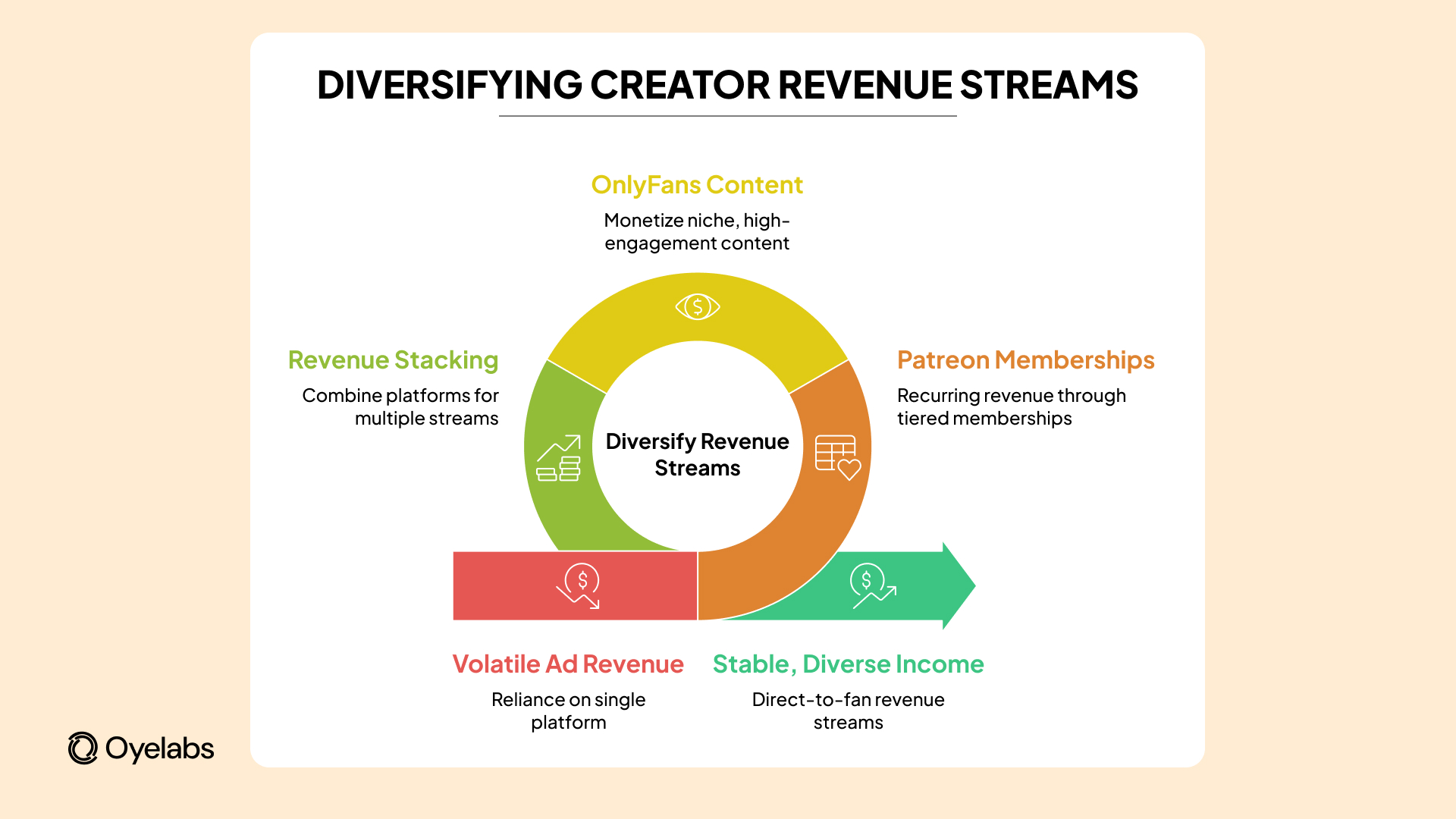
Diversifying Revenue Beyond Ads
Both Patreon and OnlyFans let creators bypass volatile ad markets. Instead of chasing CPMs on YouTube or Instagram, U.S. creators can generate direct-to-fan revenue streams. Key advantages:
- Higher customer lifetime value (CLV) compared to ad-driven models
- Independence from algorithm shifts on traditional social platforms
- Ability to bundle perks, exclusive merch, digital downloads, or premium community access
Goldman Sachs (2023) estimates the creator economy is worth $250B+ globally, and U.S. creators are uniquely positioned to claim a large share by diversifying.
Whether it’s adding Patreon memberships on top of YouTube or layering OnlyFans into an Instagram strategy, the opportunity lies in revenue stacking, not reliance on a single platform.
Strengthening Community and Brand Equity
In the U.S., creators aren’t just building audiences; they’re building micro-brands. Platforms like Patreon amplify loyalty through structured tiers, while OnlyFans enhances intimacy through direct engagement. Both approaches strengthen brand equity, which translates into:
- Better sponsorship deals
- Long-term community retention
- Increased negotiating power with platforms and advertisers
Forbes (2024) notes that creators with strong community-first strategies are 2.5x more likely to secure external partnerships. Patreon is ideal for scaling professional credibility; OnlyFans for deepening personal fan relationships.
U.S. creators who leverage both can balance professional trustworthiness with authentic connection, creating a multi-dimensional brand that outlasts trends and algorithm changes.
Read more: OnlyFans vs Subs – Is the Creator Economy Entering a New Phase?
Risks and Challenges
Every opportunity has a flip side. For U.S. creators on Patreon or OnlyFans, success isn’t automatic; it comes with risks that need serious navigation.
Platform Dependence
When your career is tied to one platform, you’re building on borrowed land. Patreon and OnlyFans hold the keys to policies, payouts, and discoverability. For creators, this dependency creates serious risks.
- Policy shifts can suddenly ban entire categories of content, leaving creators stranded.
- Payment processor freezes may delay or withhold income, as seen in Patreon disputes (2023).
- Algorithm tweaks can push some creators forward while burying others.
The smart approach is diversification. Creators who spread their presence across Patreon, OnlyFans, YouTube, or even personal websites reduce their vulnerability. It’s like financial investing; you don’t put all your money in one stock.
Building multiple income streams ensures stability, even if one platform changes its rules. Bottom line: platform dependence limits control; creators must own their audiences through email lists, personal sites, or cross-platform ecosystems.
One of my clients, a digital illustrator, relied 100% on Patreon. When Patreon froze payouts during a policy review, she couldn’t pay rent. Together, we built a Shopify merch store and email newsletter. Within 3 months, 30% of her income came from direct sales, reducing dependence.
Content Restrictions & Compliance
Content rules are a moving target, and creators often learn the hard way. Patreon restricts explicit content to maintain brand safety, while OnlyFans, though more open, is still tied to banking and compliance requirements. Risks include:
- Content takedowns for violating evolving guidelines.
- Account suspensions without clear appeal systems.
- Third-party pressure from payment processors is shaping what’s allowed.
Business Insider (2024) reported that OnlyFans nearly banned adult content in 2021 after financial institutions raised concerns. Patreon also enforces strict terms that can affect artists experimenting outside mainstream categories.
For U.S. creators, compliance literacy is non-negotiable. Knowing the rules, diversifying formats, and securing off-platform backups are essential safeguards.
Treat compliance like a tax; you may not like it, but ignoring it could end your business overnight. Staying proactive keeps your content strategy alive and your revenue safe.
Also read: Why Creator Platforms Are A Hot Startup Opportunity in 2025
Income Volatility
Unlike a salary, creator income fluctuates month to month. Even stable platforms like Patreon see subscriber churn, while OnlyFans revenue often depends on viral content or seasonal trends. Common challenges include:
- Churn rates average 10–15% monthly on Patreon (Transparency Report, 2024).
- Burnout risk arises as creators push themselves to produce sticky content nonstop.
- Revenue gaps when platforms or audiences shift behavior.
The solution? Think like a business owner. Build savings cushions, reinvest part of earnings, and diversify with sponsorships, merchandise, or affiliate marketing. Treating creative work as a structured enterprise, not just passion, helps mitigate volatility.
Many successful U.S. creators now combine multiple revenue streams, Patreon memberships, OnlyFans tips, YouTube ad revenue, and branded partnerships. This “stacked model” creates resilience.
Bottom line: volatility is part of the game, but smart planning transforms unpredictability into manageable risk.
Market Saturation
The creator economy is booming, but competition is fierce. SignalFire (2024) reports over 50M active U.S. creators, all vying for attention and wallet share. For newcomers, standing out isn’t easy. Key hurdles include:
- Oversaturation in popular niches like fitness, lifestyle, and art.
- Rising acquisition costs, as fans face subscription fatigue.
- Conversion challenges, turning casual followers into paying subscribers.
With so many creators, differentiation becomes survival. That means innovating with storytelling, blending formats, or offering unique community experiences. For example, educators on Patreon succeed by combining exclusive lessons with live Q&As, while OnlyFans fitness trainers bundle coaching with direct fan interaction.
Successful U.S. creators also invest in branding, logos, content design, and positioning to cut through noise. Market saturation isn’t the end of opportunity; it’s the filter that rewards originality. In this landscape, playing safe is the real risk.
| Risk | Mitigation |
| Platform Dependence | Encourage creators to own their audience through email lists, personal websites, and merchandise. Build multiple income streams to balance reliance on one platform. |
| Content Restrictions & Compliance | Stay updated on platform rules, back up content externally, and create a “compliance-friendly” funnel. Use tiered content strategies where high-risk material lives off-platform. |
| Income Volatility | Treat creator work like a business: save during high-earning months, reinvest profits, and diversify with sponsorships, merch, and affiliate deals. Seasonal planning helps offset churn. |
| Market Saturation | Differentiate with unique storytelling, niche targeting, and community-building. |
Uncensored, Unstoppable: Build Your Creator App with Oyelabs
At Oyelabs, we specialize in building censorship-free creator apps like OnlyFans that empower digital voices without compromising security or performance.
Our team leverages end-to-end encryption, blockchain-based content validation, and scalable microservices architecture to ensure your platform stays free from algorithmic suppression and centralized control.
With proven expertise in real-time streaming, tokenized monetization models, and compliance with global data laws, we deliver apps that balance creator freedom with robust reliability.
Partner with us to launch a platform where creators can publish, share, and monetize without fear of deplatforming, future-proofing your creator economy venture with cutting-edge technology and expert product strategy.
Conclusion
The creator economy is thriving, but it’s not without its hurdles. From platform dependence to market saturation, every opportunity comes with a set of risks. Smart creators diversify income, protect their content, and build strong personal brands to stay resilient.
If you’re ready to launch your own creator-focused platform or app, Oyelabs can help you design, build, and scale with confidence. Let’s turn your vision into a thriving digital ecosystem; partner with Oyelabs today and shape the future of the creator economy.