
Why Home Services Startups Are Gaining Investor Attention?

Why Home Services Startups Are Gaining Investor Attention?
 Anuraag Jain
Last Updated on September 18, 2025
Key Takeaways
What You Will Learn
-
How home services startups transformed fragmented, informal markets into billion-dollar, tech-driven ecosystems.
-
Why recurring revenue models and consumer-first innovations make these platforms investor magnets.
-
The role of AI, IoT, and hyperlocal targeting in building scalable, resilient business models.
-
Risks startups must navigate, including compliance hurdles, gig workforce management, and market saturation.
Important Stats
-
Global home services market projected to reach $1.8 trillion by 2030, growing at a CAGR of 18.9% (2023–2030).
-
The US market alone is expected to exceed $600 billion by 2026, expanding at a 14.4% CAGR.
-
78% of bookings in this sector are projected to be mobile-first by 2027.
-
The Asia-Pacific region will cross $480 billion by 2030, with the fastest growth rate of 20.1% CAGR.
“Remember when fixing a leaky faucet meant begging your neighbor for a wrench? Not anymore.” That’s the banter investors are buying into as home services startups turn everyday headaches into frictionless, app-driven experiences.
From on-demand plumbing to AI-powered cleaning bookings, the space is buzzing with innovation, and VCs are paying attention. Why? Because the gig economy meets digital transformation is a formula with proven ROI.
With scalable business models, API integrations, and hyperlocal targeting, these on-demand home service platforms aren’t just streamlining chores; they’re reshaping consumer behavior. Add to that a post-pandemic surge in remote lifestyles, and you’ve got an ecosystem primed for exponential growth.
Analysts project the home services market to hit multi-billion dollar valuations by 2030, making it a venture capital hotbed. For investors chasing high-yield opportunities in tech-driven sectors, home services startups are no longer a side hustle; they’re the main event.
Market Dynamics Fueling Growth
The home services industry is no longer an afterthought; it’s a multi-billion-dollar opportunity that has investors watching closely. A mix of consumer behavior shifts, technological adoption, and urban lifestyle pressures is fueling unprecedented growth.
According to Grand View Research, the global home services market is set to hit $1.8 trillion by 2030, expanding at an impressive CAGR of 18.9%. Numbers like these make it clear: the sector is no longer niche; it’s mainstream.
So, what’s driving this wave?
- Consumer Demand for Convenience: Dual-income households, remote workers, and digitally savvy Gen Z consumers prefer outsourcing chores. Time is money, and services like cleaning, plumbing, and home repairs are now app-booked essentials.
- Digital Adoption: More than 78% of bookings are mobile-first, highlighting the shift to smartphone-driven economies. This mobile-native preference is creating stronger engagement rates and repeat business.
- Economic Realignment: The gig economy has created a flexible, on-demand workforce. Platforms don’t need to build employee-heavy structures; they can scale using independent contractors.
- Urbanization: With more people living in high-density areas, fast service access is becoming a necessity. Cities like New York, San Francisco, and London are already proving that hyperlocal service delivery scales profitably.
Moreover, the pandemic accelerated the “home as a service hub” model. People became more comfortable booking services online, and startups leveraged this behavioral reset to embed themselves in daily routines.
For investors, this confluence of convenience, digitization, and scalability represents a perfect storm of opportunity. What was once fragmented and informal is now being organized into data-rich, platform-driven ecosystems ripe for long-term growth.
For founders, this surge also highlights the need to understand what a TaskRabbit-like app truly needs to win user confidence, from transparency to trust-driven features that fuel retention.
| Region/Segment | Market Size Projection | CAGR (Forecast Period) |
| Global Home Services Market | $1.8 Trillion by 2030 | 18.9% (2023–2030) |
| US Home Services Market | $600+ Billion by 2026 | 14.4% (2021–2026) |
| Asia-Pacific Market | $480+ Billion by 2030 | 20.1% (2023–2030) |
| Europe Market | $400+ Billion by 2030 | 17.5% (2023–2030) |
| Mobile-First Service Bookings | 78% of total bookings by 2027 | – |
Technology as the Differentiator
Technology is not just part of the playbook; it’s the competitive moat separating market leaders from startups that fizzle out. Consumers today expect Uber-like reliability in every interaction: transparent pricing, real-time tracking, and instant confirmations.
Without the right tech backbone, no home services startup can scale sustainably.
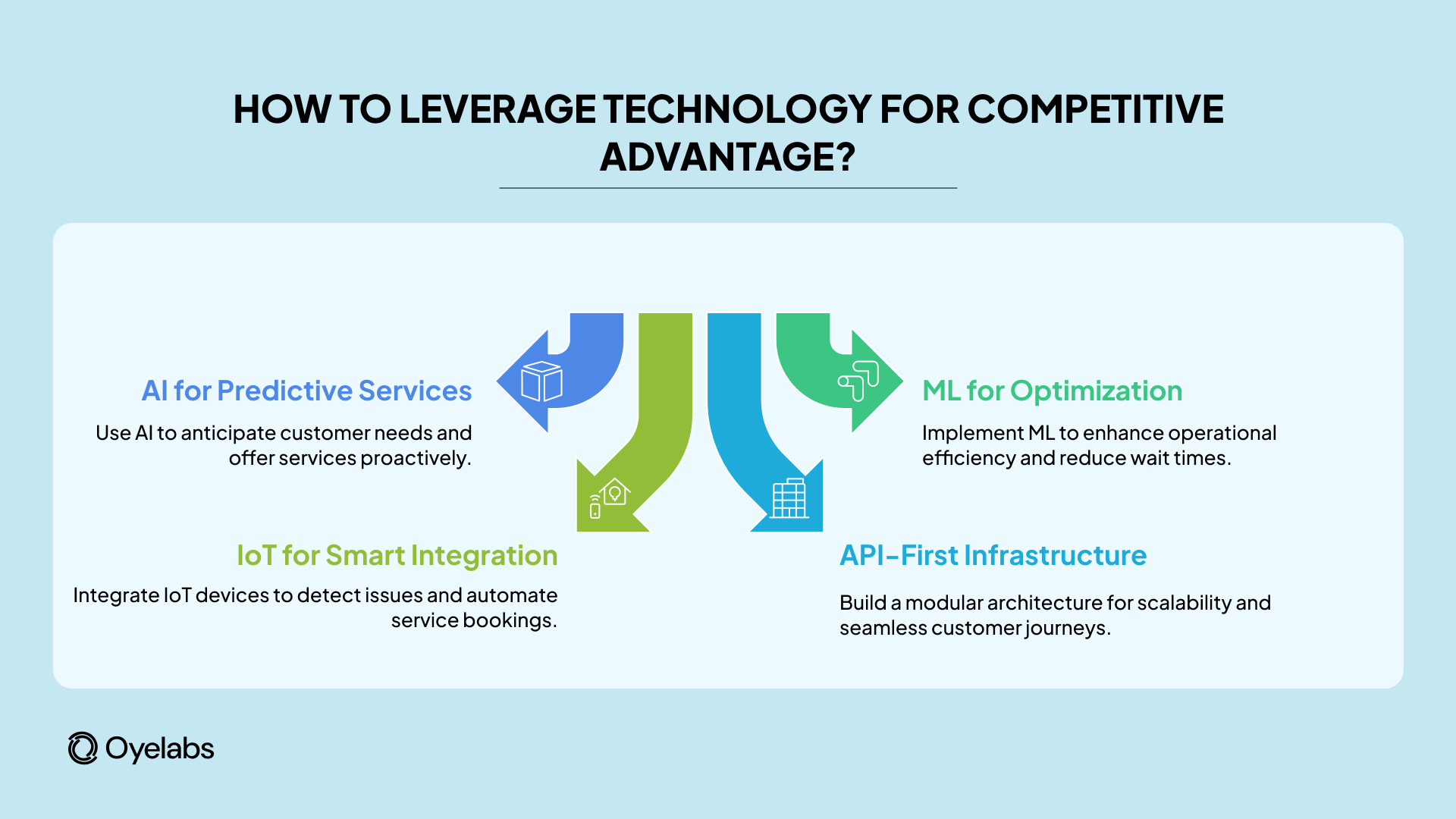
Here’s where technology creates investor confidence:
- Artificial Intelligence (AI): Predictive algorithms suggest recurring services, like HVAC maintenance, before breakdowns happen.
- Machine Learning (ML): Platforms continuously optimize provider allocation and routing, reducing wait times.
- Internet of Things (IoT): Smart home integrations detect issues (like water leaks) and automatically book services.
- API-First Infrastructure: Payment gateways, CRM systems, and digital wallets enable frictionless customer journeys.
Take Handy and Urban Company as case studies. Their modular software architecture allows them to scale into new cities without rebuilding from scratch. This scalability translates into lower CAC (Customer Acquisition Cost) and higher LTV (Lifetime Value), metrics that investors track religiously.
Equally critical is cybersecurity. With payments, personal addresses, and service histories stored online, startups with robust data encryption and compliance protocols gain a credibility edge. Investors see not just a tech product but a risk-mitigated asset.
As AI and automation shape this ecosystem further, it’s clear that the role of AI in TaskRabbit-like apps is not optiona; it’s the foundation of operational excellence and investor confidence.
Investor Appeal: Why VCs Are Betting Big
If you peek into any VC portfolio today, you’ll find at least one home services play. Why? Because this industry delivers the holy grail of investing, recurring revenue and scalable growth. Unlike one-off e-commerce purchases, home services are repeat-driven by nature.
A household that hires a cleaner or handyman once is likely to rebook regularly, creating sticky, high-LTV customers.
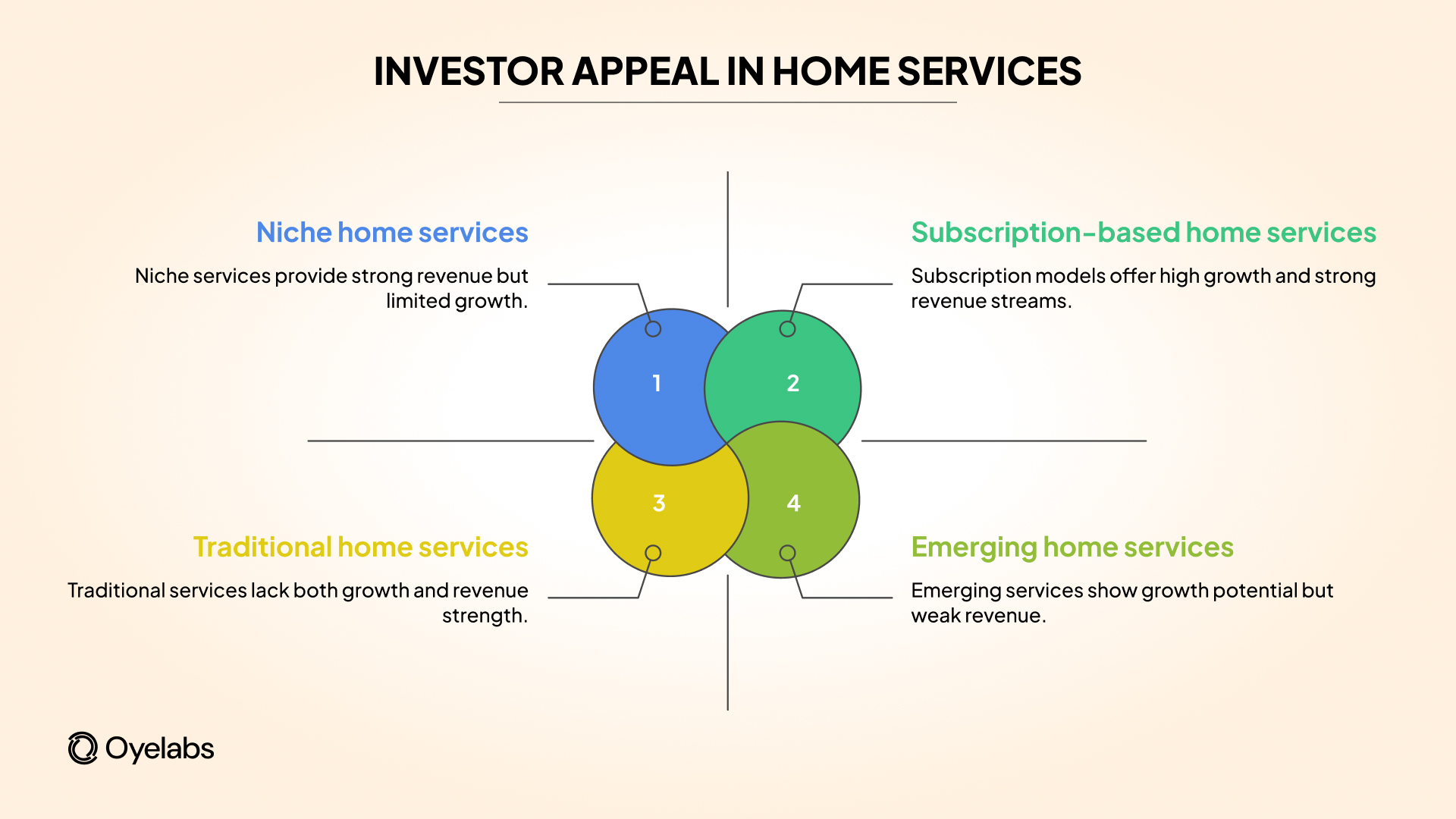
Investor Hot Buttons
- Recurring Revenue Models: Subscription bundles for weekly cleaning or seasonal maintenance lock in predictable cash flow.
- Data-Driven Growth: Customer behavior insights power cross-selling, increasing ARPU (Average Revenue Per User).
- High Exit Potential: IPOs, strategic acquisitions, and consolidation pathways make this sector M&A-friendly.
- Fragmented Market: No single player dominates globally, leaving ample room for regional leaders to emerge.
A Deloitte survey found that 72% of investors prioritize startups with tech-enabled recurring revenue models. Couple this with a projected 18.9% CAGR, and you have a sector offering both short-term traction and long-term compounding.
What seals the deal for VCs is the dual revenue structure: commission fees from providers and service charges from customers. This dual-sided model creates diversified income streams, making it resilient even during downturns.
In essence, home services startups are not just solving household problems; they’re solving portfolio problems by offering investors stability, scalability, and strong exit pathways.
Consumer-Centric Innovations
At the heart of this industry lies one truth: consumers call the shots. If platforms fail to meet evolving expectations, no funding round can save them. That’s why consumer-first design is the ultimate growth lever.
Innovations Driving Adoption
- Hyperlocal Targeting: AI-driven geo-filters match customers with the nearest, best-rated providers.
- Transparent Pricing: Instant, upfront quotes eliminate uncertainty and build trust.
- Real-Time Tracking: GPS-enabled features create Uber-like service visibility.
- Gamified Loyalty Programs: Reward points, referral bonuses, and tiered memberships drive retention.
Case study: Urban Company scaled across Asia by prioritizing transparency, cashless payments, and reliable service providers. Their consumer-first approach not only built trust but also improved retention rates, boosting their valuation.
Another rising trend is eco-conscious services. Startups offering green cleaning, sustainable repairs, and low-emission transport options are capturing the eco-minded millennial and Gen Z audience, an attractive demographic for investors. This mirrors the rising importance of hyperlocal targeting in apps like TaskRabbit, where consumer proximity and trust drive both adoption and retention.
Challenges and Risks
Every booming industry carries its shadows, and home services startups are no exception. Behind the glossy growth charts are risks that founders and investors must navigate carefully.
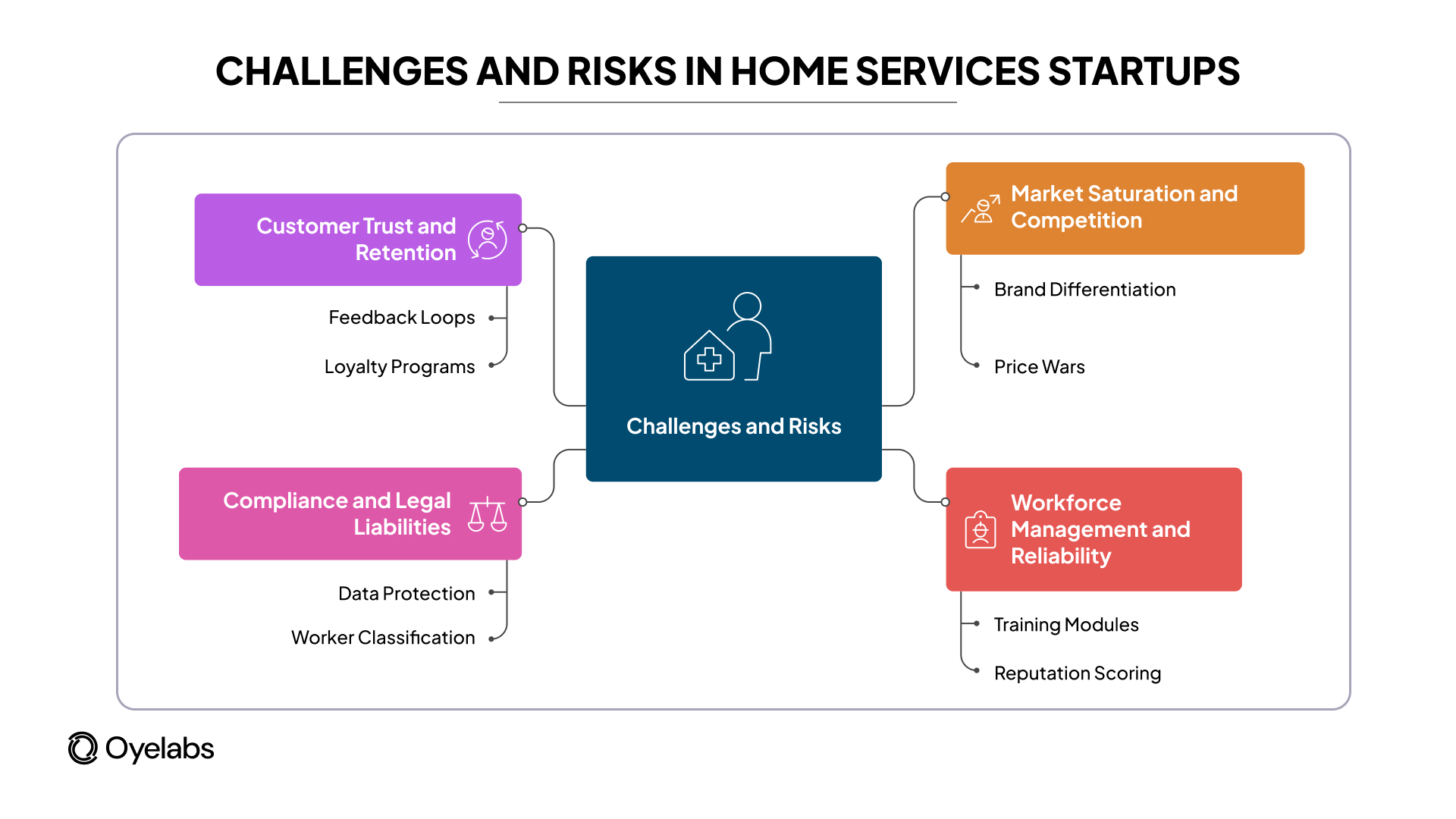
Market Saturation and Competition
The home services market is highly competitive, with numerous players vying for market share. Without strong brand differentiation and a unique value proposition, startups risk fading into the noise.
According to IBISWorld, over 35,000 registered businesses are competing in the US market alone, creating fierce price wars. Competitors with deep funding can undercut prices, forcing weaker players to burn capital unsustainably.
To stand out, startups must leverage hyperlocal targeting, innovative customer experiences, and robust technology. In saturated markets, even small shifts in user loyalty can trigger revenue swings, making competitive agility a survival skill.
Workforce Management and Reliability
Gig workers fuel this sector, but managing them is no cakewalk. Issues like inconsistent service quality, delayed arrivals, and high attrition rates damage trust. A PwC workforce report revealed that 42% of gig workers leave platforms within a year, signaling weak retention systems.
To counter this, startups must build training modules, reputation scoring systems, and AI-driven workforce scheduling. Consistency is a brand’s credibility marker, and without it, repeat business plummets.
Reliable service providers are not just operational assets; they’re the backbone of investor confidence. Workforce reliability isn’t optional; it’s the foundation of consumer trust and long-term scalability.
Also read: Top Mistakes to Avoid When Building a TaskRabbit-like App
Compliance and Legal Liabilities
Operating in multiple states or countries means navigating complex compliance frameworks, from labor laws to consumer protection statutes. Non-compliance can lead to lawsuits, fines, and even shutdowns.
According to Deloitte’s 2024 Compliance Survey, nearly 68% of startups fail initial compliance audits, highlighting this risk. Home services platforms often deal with sensitive data, making GDPR, CCPA, and PCI-DSS compliance mandatory.
Beyond data, ensuring gig workers are properly classified (contractor vs. employee) can make or break profitability. Legal missteps not only drain finances but also damage credibility with investors.
A proactive compliance strategy signals maturity and governance strength, both credibility markers VCs look for before writing checks.
Customer Trust and Retention
In this sector, trust is currency. One poor service experience can lead to bad reviews that ripple across platforms like Yelp or Google, eroding reputation overnight.
A BrightLocal study found that 87% of consumers won’t engage with a business rated below 3 stars. To mitigate this, startups must invest in real-time feedback loops, transparent pricing models, and strong dispute resolution systems.
Building loyalty through gamified rewards and personalized services also ensures higher LTV (Lifetime Value). Trust drives retention, and retention drives profitability. In a digital-first marketplace, credibility is won or lost at the point of service delivery.
Future Outlook: Billion-Dollar Potential
The future of home services startups isn’t just bright; it’s blinding. With tech adoption soaring and consumer trust deepening, the path to billion-dollar valuations looks more inevitable than aspirational.
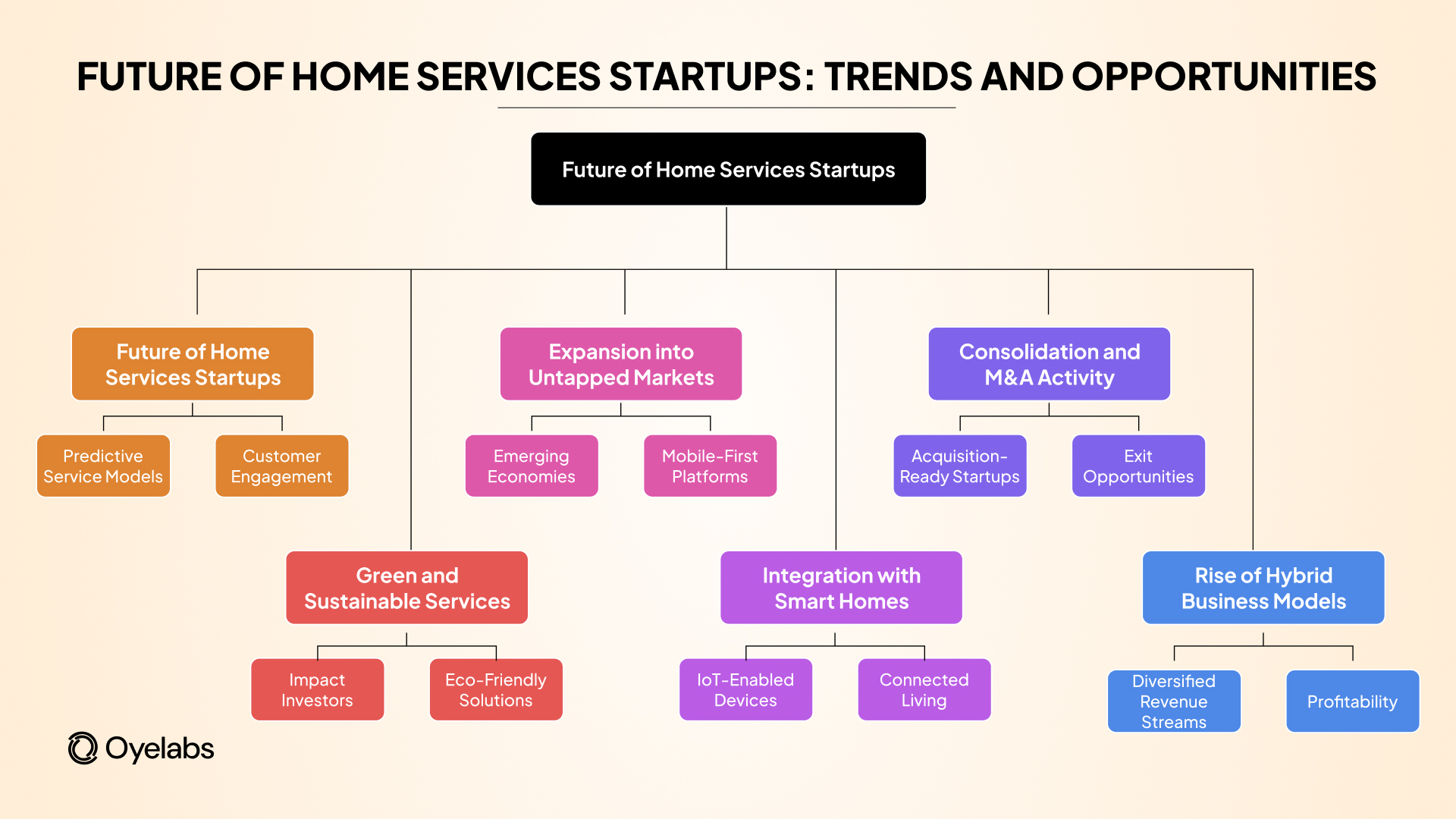
AI-Powered Personalization
Artificial Intelligence will move beyond simple recommendations into predictive service models. Imagine a system that books pest control before an infestation even begins. According to McKinsey, companies that leverage AI personalization boost revenue by up to 15% annually.
For home services startups, this translates into proactive customer engagement, reduced churn, and sticky LTV. Investors love businesses that anticipate consumer needs before they’re voiced; AI-powered personalization is the credibility marker that separates futuristic startups from outdated platforms.
Green and Sustainable Services
Eco-consciousness is no longer a niche; it’s mainstream. By 2030, Accenture predicts 63% of consumers will choose eco-friendly service providers over traditional options. Startups adopting green cleaning solutions, sustainable materials, and carbon-neutral logistics will win over millennials and Gen Z customers who prioritize values over price.
Sustainable operations also open doors to impact investors, a growing capital pool focused on ESG (Environmental, Social, Governance) standards. This isn’t a trend; it’s the future blueprint for growth and global scalability.
Expansion into Untapped Markets
Emerging economies like Southeast Asia, Latin America, and Africa are primed for disruption. With rising urbanization and smartphone penetration, demand for on-demand home services is skyrocketing. Statista projects smartphone users in Africa to surpass 700 million by 2030, creating fertile ground for mobile-first platforms.
Investors looking for high-growth frontiers will back startups that tailor offerings to local infrastructure and price sensitivity. Global expansion is more than geographic scaling; it’s revenue diversification and portfolio risk reduction.
Integration with Smart Homes
The smart home revolution is bridging convenience with automation. From IoT-enabled fridges that order repair services to AI thermostats that schedule maintenance, the convergence is real. IDC forecasts 1.3 billion connected devices globally by 2027.
Startups integrating seamlessly with these ecosystems will ride a network-effect wave. For investors, these integrations prove a startup’s technical sophistication and readiness for a connected-living future, where service platforms aren’t apps; they’re household essentials.
Read more: Services That Can Maximize Revenue in a TaskRabbit-Like Platform
Consolidation and M&A Activity
The fragmented nature of the home services market means consolidation is inevitable. Larger players will acquire regional startups for talent, technology, or market share. PwC’s 2024 M&A Outlook notes that service-sector deals will increase by 22% over the next five years.
For VCs, this creates lucrative exit opportunities. Startups positioning themselves as acquisition-ready, through strong unit economics, clean compliance records, and defensible IP, stand to benefit from billion-dollar buyouts.
Rise of Hybrid Business Models
Future winners won’t rely on one revenue stream. Instead, they’ll combine subscriptions, commissions, and value-added services like insurance or financing. This diversification reduces risk and maximizes ARPU (Average Revenue Per User).
According to Deloitte, hybrid models improve profitability margins by up to 19% over single-stream models. For investors, this signals resilience in volatile markets. Startups that design adaptable, hybrid frameworks today will become tomorrow’s unicorns.
The Smart Way to Launch Your On-Demand Home Service App
At Oyelabs, we specialize in developing cutting-edge home service apps that combine seamless UX, robust back-end architecture, and enterprise-grade scalability. Our team leverages AI-powered scheduling, secure payment gateways, and real-time service tracking to deliver world-class platforms.
With a proven track record of 50+ successful app launches and recognition from Clutch as a Top B2B Developer, we ensure your product is investor-ready from day one. Whether you’re building a hyperlocal marketplace or a nationwide platform, Oyelabs’ agile development process ensures rapid go-to-market and unmatched ROI. Let’s turn your home service startup vision into a high-performing digital product today.
Conclusion
Home services startups are attracting investor attention because they solve real, recurring problems with scalable, tech-driven solutions. Rising urbanization, busy lifestyles, and the demand for convenience are fueling growth, while digital platforms improve trust, transparency, and service quality.
Investors see strong potential in recurring revenue models and large addressable markets. As technology continues to streamline scheduling, payments, and quality assurance, this sector is poised for rapid expansion.
For entrepreneurs eager to seize this opportunity and build a high-impact, investor-ready home services platform, partner with Oyelabs, we’ll help you turn your idea into a scalable, successful business.