
Ride Hailing vs Ride Sharing vs Carpooling: Startup Guide

Ride Hailing vs Ride Sharing vs Carpooling: Startup Guide
 Anuraag Jain
Last Updated on October 6, 2025
Key Takeaways
What You’ll Learn
- Ride hailing is when a user books a private ride instantly using a mobile app.
- Ride sharing combines multiple passengers going in similar directions into one vehicle.
- Carpooling is when people share a ride to a common location, usually without profit.
- Ride hailing vs ride sharing depends on exclusivity, pricing logic, and matching algorithms.
- Apps like inDriver allow riders and drivers to negotiate trip prices directly.
- BlaBlaCar is a carpooling app for long-distance, pre-scheduled, non-commercial travel.
- A ride hailing MVP needs live location tracking, fare logic, and user-driver chat.
- Launching in one city first helps reduce operational risks and test product-market fit.
Stats That Matter
- Global ride-hailing market could hit $248B by 2030.
- Uber holds 76% of the U.S. rideshare market; Lyft has 24%.
- Transport makes up 25% of energy-related CO₂ emissions worldwide.
- World Bank supports urban transport in over 18 countries.
Real Insights
- Ride hailing earns faster but needs strong local driver supply.
- Shared rides need dense cities to stay profitable.
- Carpooling is community-driven and has lower legal risk.
- Safety tools increase retention and daily active usage.
- Lean MVPs launch faster and attract investor interest early.
- Hybrid platforms mix hailing and sharing for better flexibility.
- Driver incentives improve supply, especially in peak hours.
- Local partnerships help with user trust and adoption.
Ride Hailing vs Ride Sharing vs Carpooling: Startup Guide
Ever paid $18 for a 4-mile ride and thought, “There’s gotta be a better way?” You’re not alone.
As cities get denser and wallets tighter, the demand for smarter, more affordable mobility is exploding. But for founders building the next inDriver or BlaBlaCar, understanding the fine line between ride hailing, ride sharing, and carpooling isn’t just a naming game – it shapes your entire product, tech stack, and business model.
These models differ in control logic, user intent, scheduling patterns, and monetization flows. Misreading them can cost you time, market-fit, and investor confidence.
At Oyelabs, we’ve worked with fast-scaling mobility startups from LATAM to Africa, helping them architect lean MVPs and optimize rider-matching algorithms that actually convert. In this guide, we’ll decode each model, break down real startup risks, and help you choose the right play for your market.
Because in mobility, what you build is only as smart as what you understand.
What’s the Real Difference Between Ride Hailing, Ride Sharing, and Carpooling?
For startups entering the mobility space, misinterpreting these terms can lead to flawed business models and poor go-to-market strategies. While “ride hailing,” “ride sharing,” and “carpooling” are often used interchangeably in casual conversation, they each represent distinct operational frameworks, user behaviors, and platform requirements.
Let’s break them down:
Ride Hailing
Ride hailing refers to the process where a user books a private ride in real-time through an app. Popular examples include Uber, Bolt, and inDriver. In this model:
- The passenger has exclusive access to the vehicle.
- The driver is paid to provide a transportation service.
- The ride is typically on-demand, not pre-scheduled.
- Pricing is dynamic, often adjusted based on demand (surge pricing).
Ride Sharing
Ride sharing is structured to combine multiple passengers headed in the same direction into a single vehicle. It’s a platform-coordinated model, using algorithms to match riders based on routes. Examples include UberPool and Lyft Shared.
- Riders share the vehicle and split the fare.
- The platform handles route optimization and stops.
- Ideal for urban, high-density zones where passenger overlap is frequent.
Carpooling
Carpooling is a pre-arranged agreement between individuals traveling similar routes, usually for non-commercial reasons. Think BlaBlaCar or company-run employee carpool apps.
- The driver is typically not a professional – they’re just offsetting their own travel costs.
- No dynamic pricing or dispatch system.
- Used for long-distance or regular commutes.
How Do These Models Compare at a Glance?
Understanding their operational, legal, and technical differences is crucial before committing to one model. Here’s a concise comparison:
| Feature | Ride Hailing | Ride Sharing | Carpooling |
| Driver Type | Professional | Professional | Non-commercial |
| Booking Method | On-demand via app | On-demand or scheduled | Pre-arranged / Scheduled |
| Fare Structure | Full fare paid by one user | Fare split among users | Often free or cost-shared |
| Ownership of Vehicle | Typically individual/leased | Same | Same |
| Platform Matching | 1:1 driver-rider | 1:many rider match | Manual or low-tech matching |
| Revenue Potential | High | Medium | Low (limited commercial potential) |
| Regulatory Complexity | High | High | Low |
This table offers a clear lens through which founders can assess technical, financial, and regulatory trade-offs.
What Are the Current Trends in Mobility and Shared Transportation?
The global mobility market is undergoing rapid transformation – driven by urban congestion, sustainability goals, and evolving consumer expectations. As of 2025:
- The global ride-hailing market is expected to cross $250 billion, with major growth in Asia, Latin America, and Africa.
- Ride sharing and carpooling models are gaining traction in emerging markets, driven by cost sensitivity and rising fuel prices.
- Decentralized platforms like inDriver are disrupting traditional models by allowing passenger-driver fare negotiations, reducing platform monopolies.
Key Trends Driving Innovation
- Environmental Sustainability: Shared mobility contributes to fewer vehicles on the road and lower emissions, aligning with city-wide net-zero goals.
- Tier 2 and Tier 3 City Expansion: Large metro markets are saturated. Startups are increasingly targeting underserved mid-sized cities with hybrid models.
- Flexible Fare Logic: Platforms like inDriver have validated the demand for negotiation-based pricing, shifting power back to the user.
- AI-Powered Matching & Route Optimization: Startups are investing in real-time ride matching, dynamic rerouting, and behavioral analytics to improve user retention.
- Corporate & Government Partnerships: Enterprise carpool programs and public-private ride systems are gaining traction as urban commuting solutions.
For founders, the message is clear: mobility is no longer one-size-fits-all. Success depends on how precisely your platform addresses a market segment’s real needs – at the right price, with the right tech.
How Do Ride Hailing and Ride Sharing Make Money?
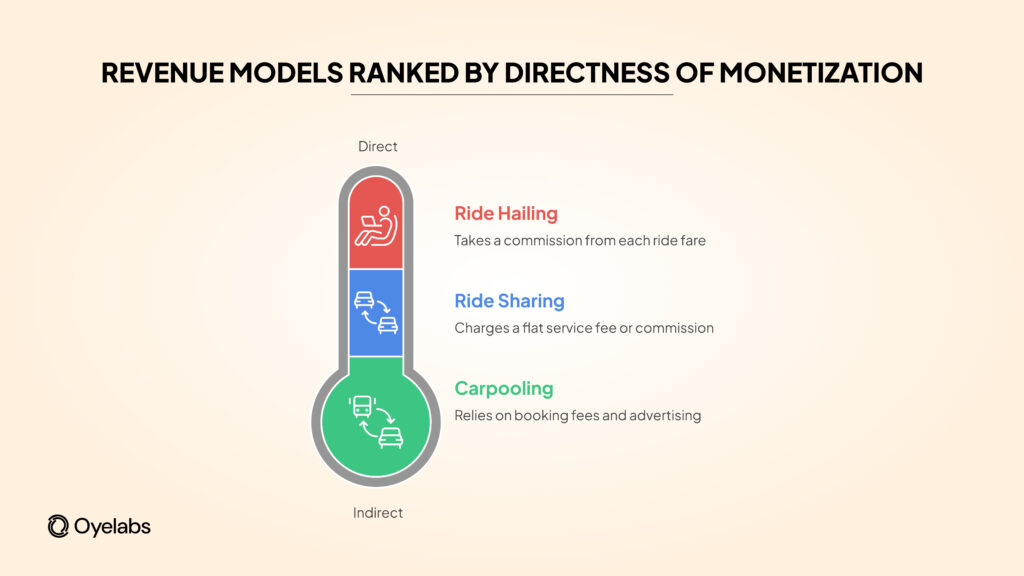
Understanding monetization is central to building a scalable platform. While ride hailing, ride sharing, and carpooling may all fall under the mobility umbrella, their revenue logic is quite different – and each comes with its own implications for pricing power, scalability, and platform sustainability.
Ride Hailing Revenue Model
This is the most straightforward. Users pay a fare, and the platform takes a commission (typically 15–30%) from each ride. Dynamic pricing and surge multipliers help optimize revenue during peak hours. Some platforms also charge drivers subscription fees or provide premium features as upsells.
Ride Sharing Revenue Model
Here, the fare is distributed among multiple passengers, and the platform typically charges a flat service fee or a commission on the total pooled fare. Since per-user revenue is lower, high ride density is critical to profitability. The technical challenge lies in routing optimization – getting multiple riders to their destinations with minimal detour.
Carpooling Monetization
Pure carpooling is usually non-commercial. The driver is not profit-seeking and only shares fuel costs. However, platforms like BlaBlaCar monetize through booking fees, freemium models, or advertising. This model is more community-driven and less aggressive in revenue generation.
From a startup’s perspective, ride hailing offers quicker monetization, while ride sharing requires algorithmic maturity and market density. Carpooling, while socially impactful, may not be ideal if monetization is a near-term priority.
Once your platform is live, the next challenge is loyalty. Our guide on How to Attract and Retain Riders on Your Ride‑Hailing App explains how top apps keep users coming back.
What Tech Stack Powers Ride-Based Startups Today?
Building a ride platform isn’t just about launching an app – it’s about architecting a real-time system that can handle demand surges, route changes, fraud prevention, and payment processing, all without friction.
At the core, any ride-based app will include:
- Passenger App: For booking, tracking, payments, and feedback.
- Driver App: For accepting jobs, route navigation, earnings dashboard.
- Admin Dashboard: For monitoring live operations, adjusting pricing, resolving issues.
- Dispatch & Matching Engine: For intelligent rider-driver pairing based on location, pricing, ETA, and vehicle type.
- Payment & Wallet Modules: Supporting instant payouts, commissions, refunds, and multi-currency logic.
Beyond these, advanced platforms integrate:
- AI for Dynamic Pricing: Adjusting fare suggestions based on demand-supply patterns.
- Geo-fencing: Enabling area-specific service rules, availability zones, or curfews.
- Safety Stack: Emergency buttons, driver background checks, in-app SOS alerts, trip tracking.
Modern ride apps often rely on cloud-native architecture, containerized deployments (e.g., Docker, Kubernetes), and real-time databases (Firebase, Redis). Mobile tech stacks generally include React Native or Flutter, with backends on Node.js, Laravel, or Go.
Choosing the right stack depends on your scaling plan, initial market, and whether you aim for rapid MVP deployment or enterprise-grade stability from day one.
What’s the Best Way to Launch and Scale a Mobility Platform?
Even the best tech can fail without a clear go-to-market (GTM) strategy. In mobility, acquiring both riders and drivers simultaneously is a classic chicken-and-egg challenge. Your early traction depends on hyper-local execution and strong operational playbooks.
Entry Strategy
- Start Small, Go Deep: Focus on a single city or corridor with a high density of unmet demand. Validate the platform experience before expanding.
- Leverage Underserved Segments: For example, in many mid-tier cities, existing players offer poor wait times or charge high fares – leaving room for new entrants with localized value.
- Driver Acquisition Is Everything: Without a dependable supply of vehicles and drivers, even the best rider app fails. Initial incentives, flexible commissions, and responsive support matter deeply.
Growth Levers
- Referral Programs that reward both riders and drivers for inviting others.
- Promotional Pricing during peak onboarding weeks.
- Partnerships with local businesses, coworking spaces, or real estate players to embed your app into daily routines.
- Employer Tie-ups for daily commute carpooling or first-mile/last-mile coverage.
And crucially, plan for regulatory readiness. Even if your MVP flies under the radar initially, expansion will draw scrutiny. Ensure legal vetting on transport regulations, fare controls, data privacy, and driver background checks.
If you’re ready to move from concept to launch, our step‑by‑step guide on How to Launch Your Ride‑Hailing App Like inDriver walks you through everything from MVP features to regulatory approvals.
How Did OyeLabs Help One Founder Disrupt the Market with a Ride Platform?
At OyeLabs, we’ve worked closely with founders across the globe to turn early-stage mobility concepts into functional, revenue-generating platforms. One standout case was a startup founder in East Africa who approached us with a vision to build an inDriver-style ride negotiation platform for underserved urban zones.
The goal was simple: create a system where riders and drivers could negotiate fares directly, bypassing traditional surge pricing and offering transparency and flexibility to both sides.
We led the product through three critical stages:
- MVP design and development with custom fare logic and real-time map integrations.
- Driver onboarding tools with KYC, earnings dashboard, and payout automation.
- User engagement modules like in-app ratings, saved locations, and one-tap rebooking.
Within 60 days of launch, the platform had gained impressive traction – 25,000+ active users, 11% week-over-week ride growth, and a 4.8-star app rating. The founder reported a sharp increase in user engagement, brand impressions, and local market recognition. Today, the platform is expanding into neighboring countries with support from local transport unions and micro-financing partners.
This is what we mean at OyeLabs when we say: we don’t just build apps – we build products that win in real markets.
Which Model Is Right for Your Startup Vision?
Choosing between ride hailing, ride sharing, and carpooling isn’t about personal preference – it’s about fit with your market, team capabilities, regulatory environment, and financial runway.
Here are a few guiding questions:
- How dense is your target geography?
Ride sharing works best in areas with high population density and trip overlaps. If your region has scattered demand, ride hailing may be more viable. - Are you targeting affordability or convenience?
Ride hailing offers exclusivity and faster trips; ride sharing and carpooling offer cost efficiency but may compromise speed and privacy. - Is your user base cost-conscious?
In emerging markets, fare negotiation or pooled rides often lead to faster adoption. - What’s your monetization timeline?
Ride hailing can be monetized faster; ride sharing needs scale first. Carpooling may require a longer view if built around community and employer integrations. - Are you subject to tight regulatory oversight?
Ride hailing usually faces stricter compliance needs, including permits and insurance. Carpooling may offer more flexibility at the early stage.
In some cases, founders opt for a hybrid model – starting with hailing, then introducing pooling once ride density improves. The best model is often a result of iterative market testing, not fixed assumptions.
What Does a Winning Ride-Based MVP Look Like?
Startups often waste time trying to launch a perfect product on day one. In mobility, speed to market and learning loops matter more than full feature sets. A strong MVP should do one thing extremely well: match supply and demand efficiently.
Here’s what your MVP must include:
- User App Features
- Real-time ride requests
- Fare estimation or negotiation
- Driver tracking
- In-app payments
- Basic ride history
- Driver App Features
- Trip requests and earnings view
- Navigation integration
- Ratings and feedback
- Payout tracking
- Admin Panel
- User and driver management
- Ride monitoring
- Pricing configuration
- Dispute resolution tools
Behind the scenes, your MVP should be architected for scalability, data logging, and compliance readiness. Avoid bloated UX or overly complex AI in the first version. Instead, focus on live performance, trip conversion rates, and rider retention.
Once your MVP gains traction, you can layer in advanced features like:
- Scheduled rides
- Subscription passes
- Driver loyalty rewards
- Pooled ride algorithms
- AI-powered fare prediction
What Risks Should Founders Watch Out For?
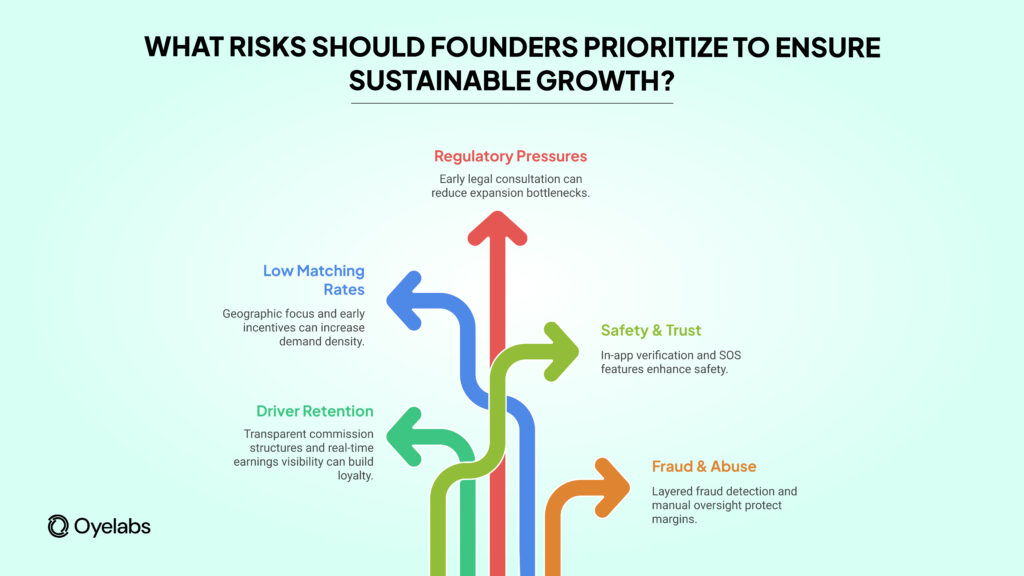
Mobility platforms operate in a fast-moving, high-stakes environment. While the upside is significant, the risks are just as real. Founders must plan for:
- Driver Retention Challenges: Low margins or delayed payouts can lead to high driver churn. Transparent commission structures and real-time earnings visibility help build loyalty.
- Low Matching Rates: Without demand density, you risk idle drivers and unsatisfied users. Geographic focus and early incentives can mitigate this.
- Regulatory Pressures: Licensing, insurance, and compliance can differ city to city. Work with legal advisors early to reduce expansion bottlenecks.
- Safety & Trust: Rider and driver safety should be a top priority. In-app verification, SOS features, and two-way ratings are essential.
- Fraud & Abuse: Fake bookings, chargebacks, and platform manipulation can eat into margins. A layered fraud detection framework and manual oversight are critical in early phases.
Proactively building for these risks sets your platform up for sustainable growth, not just early buzz.
Why the Mobility Space Still Has Massive Untapped Potential
Despite the dominance of major players, mobility remains one of the most under-optimized verticals, especially outside tier-one cities and high-income zones. World Bank‑backed urban transport initiatives have already improved mobility for over 20 million people – underscoring both the demand and the institutional support for transit and mobility innovation.
- Rising urban congestion and limited public transport make ride-based services a daily need in mid-tier regions.
- Green transport policies are pushing cities to support shared mobility startups.
- Decentralized fare systems, like those pioneered by inDriver, have unlocked new user expectations and widened adoption.
With the right mix of technology, execution, and localized strategy, new players still have room to differentiate – and scale.
Founders who move quickly, test thoughtfully, and execute lean can still build breakout platforms in 2025 and beyond.
Conclusion
The future of mobility isn’t one model – it’s a mix of solutions tailored to user needs, infrastructure gaps, and behavioral patterns. Whether you’re building a fast-growth hailing app or a community-first carpool network, your success depends on how clearly you define your model and how quickly you get to market.
At OyeLabs, we help founders turn ideas into scalable ride platforms – faster, smarter, and with full-stack support. From MVP to market traction, our team builds with precision and speed.
Let’s build your inDriver or BlaBlaCar – designed for your market, delivered with purpose.
Start your journey with Oyelabs
FAQs –
Q: What’s the main difference between ride hailing, sharing, and carpooling for startups?
A: Ride hailing is on-demand, ride sharing pools strangers, carpooling is pre-arranged and non-commercial.
Q: Which model offers the fastest monetization for a new mobility startup?
A: Ride hailing typically monetizes faster due to direct fares and flexible pricing control.
Q: Can I combine ride sharing and hailing in one platform?
A: Yes, hybrid models work well once rider density and route overlap improve significantly.
Q: Is carpooling regulated the same as commercial ride hailing services?
A: No, carpooling often avoids commercial licensing since drivers aren’t earning profit.