
Top 10 Restaurant Software Food Business Owners Can Opt For

 Anuraag Jain
Last Updated on November 4, 2025
Key Takeaways –
What You’ll Learn:
-
Running a restaurant in 2025 is about mastering tech as much as taste; cloud-based POS, AI analytics, and mobile systems are redefining operations.
-
From food trucks to multi-chain franchises, digital tools now manage inventory, staffing, and customer experiences in real time.
-
Key features to prioritize include cloud integration, CRM, AI-driven data analytics, mobile access, and cybersecurity compliance.
-
Smart software solutions like Toast POS, Lightspeed, Square, and POSist help automate workflows and improve ROI across outlets.
-
Choosing the right platform means evaluating scalability, integration capabilities, ease of use, and long-term cost efficiency.
-
Digital transformation empowers owners to focus on what truly matters—exceptional dining experiences and customer loyalty.
Stats That Matter:
-
Restaurants using integrated systems report 30% higher operational efficiency.
-
Cloud platforms deliver 35% faster updates and 25% fewer system errors.
-
Smart inventory tools can cut food waste by up to 20%.
-
Personalized CRM engagement increases customer retention by 25%.
-
Data-driven decision-making can raise profitability by 60%.
Real Insights:
-
Cloud-based and mobile systems ensure real-time control, and your restaurant runs smoothly even when you’re off-site.
-
AI-powered analytics identify peak hours, top-selling dishes, and customer behavior trends.
-
Secure, PCI DSS–compliant systems build customer trust and protect brand reputation.
-
Automation saves hours in manual reporting and reduces costly errors.
Implementing restaurant software today isn’t just about great food; it’s about great tech. From cloud-based POS systems to AI-powered analytics, the food industry has gone full digital, and if you’re still stuck juggling paper receipts, it’s time for a serious upgrade.
The right restaurant software can streamline inventory, speed up orders, reduce waste, and even predict peak hours using real-time data. According to Forbes Tech Council, restaurants using integrated management software report up to 30% higher operational efficiency. That’s the kind of ROI that turns chaos into calm.
Whether you’re managing a food truck, café, or multi-chain franchise, the right platform helps you automate the grind and focus on what truly matters, creating exceptional dining experiences.
In this guide, we break down the top restaurant management system solutions that every forward-thinking food business owner should consider in 2025. Let’s find the tech that keeps your tables turning and your profits sizzling.
Key Features to Look For in Restaurant Software
Choosing the right restaurant software is like finding the secret sauce for your business; get it right, and everything just flows. Here’s what to look for when you’re serious about scaling smart, not sweating over spreadsheets.
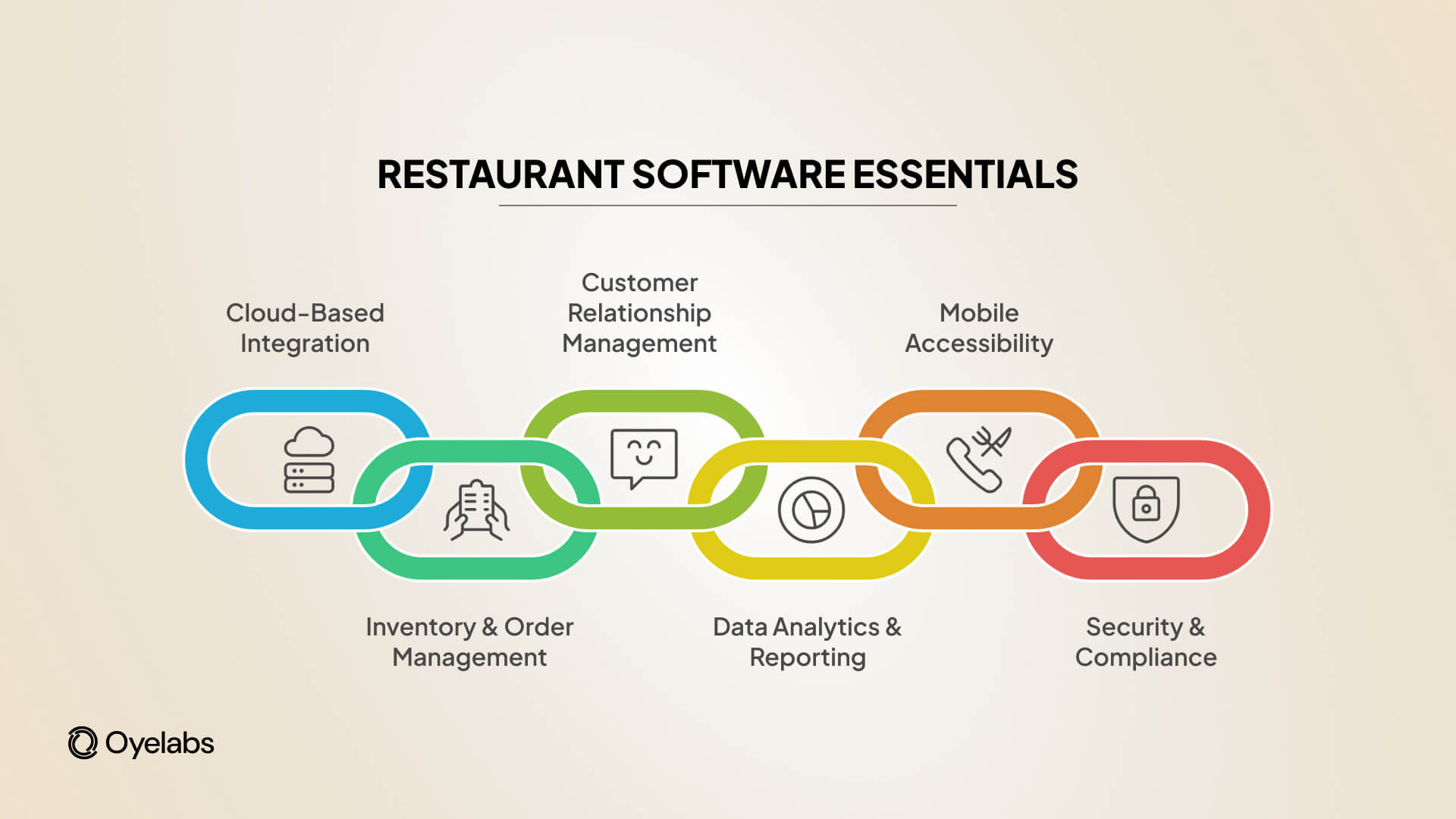
Cloud-Based Integration
A cloud-based restaurant management system keeps your business running smoothly, no matter where you are. It stores all your operational data, sales, inventory, menus, and staff schedules securely online, eliminating the need for on-site servers.
You can access insights in real time from any device, ensuring seamless coordination across multiple outlets. According to Restaurant Technology News (2024), restaurants using cloud platforms experience 35% faster updates and 25% fewer system errors. This means fewer headaches and more control.
With automatic data syncing, daily reports, and remote accessibility, cloud integration ensures your restaurant never misses a beat. Think of it as your virtual headquarters, organized, efficient, and always open.
Inventory & Order Management
Inventory and order management software acts as your digital sous-chef, tracking every ingredient, every time. It automatically updates stock levels as orders are processed, preventing costly shortages or overstocking.
The system can even forecast demand based on sales history, helping you order smart and cut waste. National Restaurant Association data shows that smart inventory tools can reduce food waste by up to 20%. Key functions include:
- Real-time stock tracking across multiple locations
- Automatic purchase orders for low inventory alerts
- Integration with POS and supplier systems
These tools streamline operations, ensuring that your kitchen runs like a well-oiled machine. Less guesswork, more profit.
Customer Relationship Management (CRM)
A robust CRM system helps you understand, engage, and retain your guests. By tracking customer preferences, visit frequency, and purchase history, it personalizes experiences at scale.
The system can send automated loyalty rewards, birthday offers, and feedback requests, building meaningful relationships. Harvard Business Review notes that personalized engagement can boost customer retention by 25%. With built-in segmentation and analytics, you can:
- Identify high-value repeat customers
- Run targeted marketing campaigns
- Analyze guest satisfaction trends
CRMs turn diners into loyal fans by making them feel seen and valued. In short, it’s not just software, it’s your brand’s relationship manager in digital form.
Also read: How to Attract Restaurant Partners to Your Food Delivery App
Data Analytics & Reporting
Numbers don’t lie, and they can help you grow faster. Advanced restaurant software uses AI-powered analytics to turn raw data into real insights. It tracks KPIs such as revenue per table, top-selling items, and peak dining hours.
You can generate daily or weekly reports that reveal performance trends and predict future demand. According to McKinsey & Company, data-driven decision-making can increase restaurant profitability by up to 60%. Expect features like:
- Custom dashboards for at-a-glance insights
- Predictive analytics for smarter staffing and inventory
- Detailed reports for management reviews
This data intelligence helps you identify what’s working—and what’s wasting your time and money.
Mobile Accessibility
Modern restaurants demand flexibility. Mobile-accessible software allows owners and managers to oversee operations from anywhere, whether it’s approving shifts, tracking sales, or viewing inventory updates.
Through an app or mobile dashboard, you can monitor your restaurant in real time. Statista (2024) reports that 67% of restaurant owners prefer mobile-compatible software for better agility. Key benefits include:
- Instant alerts for order issues or low inventory
- Remote approvals for scheduling and payments
- Cloud syncing for consistent data across devices
With mobile accessibility, your business is literally in your pocket. You’re no longer tied to the back office; you’re managing smarter, faster, and freer.
Read More: Build Your Food Delivery Platform Without 20–30% Commissions
Security & Compliance
In the digital dining world, data protection is non-negotiable. Restaurant software must comply with PCI DSS and GDPR to ensure secure payment processing and customer privacy. Look for systems that use end-to-end encryption, role-based access, and multi-factor authentication. These safeguards protect against data theft and unauthorized access.
Cybersecurity Ventures (2025) estimates that businesses prioritizing digital security reduce breach risks by over 40%. Robust software also includes automatic backups and real-time fraud detection. This isn’t just about compliance, it’s about customer trust.
When guests know their payment and data are safe, your brand credibility rises. Secure systems protect your revenue, reputation, and relationships, all in one go.
Top 10 Restaurant Management Software Solutions
| Software Name | Core Features | Best For | Pros | Cons | Pricing Insight |
| Toast POS | All-in-one POS, online ordering, payroll, analytics dashboard. | Full-service restaurants and busy cafés. | Seamless mobile POS, offline mode, built-in delivery integration | Add-ons can raise costs for small outlets | Custom pricing; free demo available. |
| Lightspeed Restaurant | POS, inventory tracking, analytics, and multi-location support. | Multi-chain restaurants and bars. | Excellent data visualization, strong cloud performance. | Limited offline features. | Starts at $69/month; free trial available. |
| Square for Restaurants | POS, online ordering, CRM, and real-time reporting. | Small cafés and food trucks. | Easy setup, transparent pricing. | Limited advanced analytics. | Free basic plan; paid plans from $60/month. |
| TouchBistro | iPad POS, tableside ordering, inventory, and staff management. | Dine-in restaurants and casual eateries. | Easy training, fast transactions | Occasional sync delays. | From $69/month; free trial on request. |
| Revel Systems | POS, CRM, employee scheduling, analytics, and delivery integration. | Franchises and fast-casual chains. | Powerful analytics, scalable features. | Higher upfront setup cost. | Custom quotes only; demo available. |
| Clover POS | POS, payments, reporting, staff, and menu management. | Cafés, bakeries, and small restaurants. | Intuitive hardware options, app integrations. | Dependent on Clover devices. | From $14.95/month; hardware sold separately. |
| Upserve by Lightspeed | POS, menu optimization, analytics,and staff performance tracking. | Fine dining and full-service restaurants. | Deep insights, excellent customer analytics. | Slight learning curve. | From $59/month; free trial available. |
| HungerRush | POS, delivery management, CRM, loyalty programs. | Quick-service and delivery focused brands. | Excellent delivery tracking, marketing tools. | Complex setup for small teams. | Custom quote only; trial available. |
| Oracle MICROS Simphony | POS, inventory, enterprise analytics, security compliance. | Large restaurant chains and hotels. | Enterprise-level scalability, global support. | Complex setup process. | Enterprise pricing; demo required. |
| POSist | Cloud POS, inventory, CRM, kitchen display system (KDS). | Cloud kitchens, quick-service, and multi-outlet brands. | Excellent automation, robust KDS. | Limited customization. | Starting from $79/month; demo available. |
Further Read: How To Create A Takeaway App For Restaurants
How to Choose the Right Restaurant Software
Choosing the right restaurant software isn’t just about what looks flashy on a demo; it’s about finding a system that actually simplifies your chaos. Here’s how to pick tech that works as hard as you do.
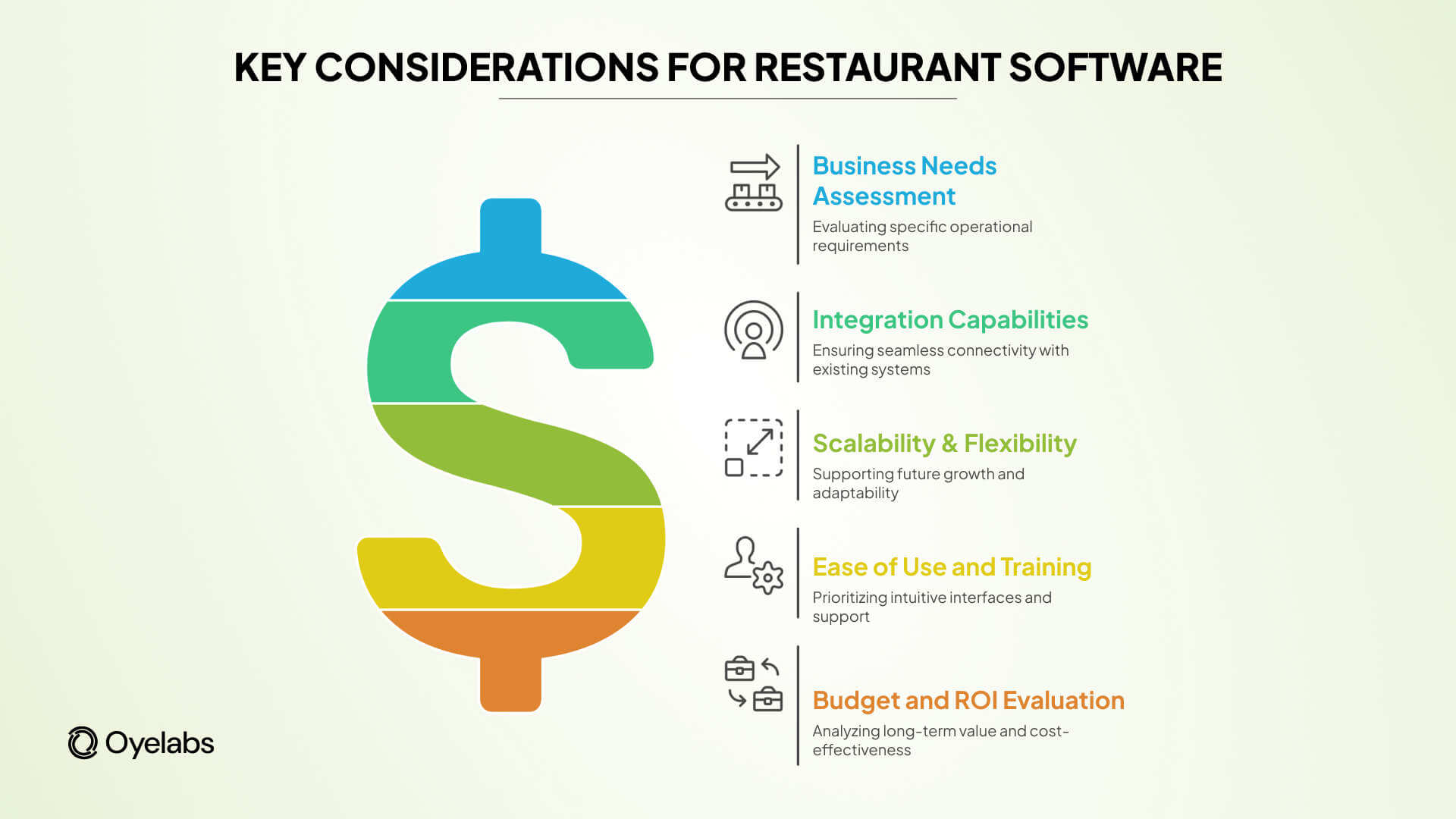
Assess Your Business Needs
Before swiping your credit card, take stock of what your restaurant truly needs. Are you focused on speeding up service, managing inventory, or scaling multiple outlets? According to Hospitality Tech (2025), 72% of restaurant owners invest in software that directly aligns with their operational pain points.
Make a list of must-haves versus nice-to-haves. The right tool should fit your workflow, not force you to fit into its system. Tailor your choice to match your size, service type, and long-term vision.
Integration Capabilities
The best restaurant software plays well with others. Check if it integrates seamlessly with your existing tools, like accounting software, payroll systems, delivery apps, or CRM platforms. Forbes Technology Council reports that businesses using integrated solutions reduce manual errors by 40%.
Look for APIs and open-system compatibility for smooth data flow. Whether it’s syncing online orders from Uber Eats or pulling daily sales into QuickBooks, integration saves time and prevents data silos. In short, your tech stack should talk fluently across platforms, no translation required.
Scalability and Flexibility
Think long-term. Your restaurant today might be one location, but what about five years from now? Scalable software grows with your business. Gartner Research highlights that scalable systems can reduce upgrade costs by 35% over time.
Choose a platform that supports multiple outlets, evolving menus, and regional pricing without forcing you to start over. Flexibility in modules, add-ons, and user access ensures you can expand without disruptions. The goal? Invest once, grow continuously, and stay agile no matter how fast your restaurant empire rises.
Ease of Use and Training
Even the most advanced software falls flat if your team can’t use it efficiently. Prioritize systems with intuitive dashboards, drag-and-drop menus, and minimal learning curves. Capterra’s 2025 User Study shows that restaurants adopting user-friendly tools improve onboarding speed by 50%.
Look for vendors offering free onboarding sessions or 24/7 customer support. Simple navigation reduces staff stress during rush hours and keeps operations smooth. Remember, technology should empower, not overwhelm, your employees. Ease of use isn’t a luxury; it’s a necessity for success.
Budget and ROI Evaluation
Software is an investment, not an expense, so analyze total value, not just monthly cost. Compare plans based on included features, scalability, and customer support. Restaurant365 Insights found that businesses tracking software ROI saw 28% higher profit margins within a year.
Consider long-term savings from automation, reduced errors, and faster reporting. Avoid “cheap” systems that cost more in hidden fees or inefficiencies. The right solution will pay for itself through smoother operations, improved sales insights, and smarter decision-making. Spend wisely, scale strategically, and let your software fuel your growth.
To know more, read Best Cloud Kitchen Business Models You Can Adopt In 2025
Scale Your Food Business with Intelligent Delivery Solutions
Transform your food business into a digital powerhouse with Oyelabs’ custom-built food ordering and delivery solutions. Our expert developers create AI-driven, cloud-native, and API-integrated mobile apps tailored to your brand’s needs.
From real-time tracking and secure payment gateways to dynamic menu management and driver analytics, every feature is built for performance and scale. According to Statista (2025), the global online food delivery market is projected to hit $1.22 trillion, and Oyelabs ensures your business claims its share.
Partner with us to build a platform that’s fast, intuitive, and future-ready, because your customers deserve technology as good as your food.
Conclusion
Choosing the right restaurant software isn’t just a tech decision; it’s a growth strategy. The perfect system streamlines operations, enhances customer experience, and unlocks data-driven insights that boost profitability.
Whether you run a cozy café or a multi-chain franchise, investing in smart, scalable software transforms how you manage, serve, and grow. As the food industry evolves, staying ahead means embracing innovation that saves time and maximizes efficiency.
Ready to upgrade your restaurant with cutting-edge tech that works seamlessly from kitchen to customer? Partner with Oyelabs today, where innovation meets execution, and your restaurant’s digital transformation begins.
FAQs
1. Why do modern restaurants need management software?
Because restaurant operations now rely on speed, data, and automation, management software streamlines everything from orders to analytics, boosting efficiency and profit.
2. What’s the biggest advantage of using cloud-based restaurant systems?
Cloud-based platforms let you access data anytime, anywhere, while reducing errors and ensuring real-time updates across all outlets.
3. How does restaurant software improve customer experience?
By using CRM tools and data analytics, restaurants can personalize offers, enhance loyalty, and deliver faster, more accurate service.
4. Is restaurant software worth the investment for small businesses?
Yes, automation cuts waste, saves time, and increases efficiency, offering measurable ROI even for small cafés or food trucks.
5. How can Oyelabs help my restaurant go digital?
Oyelabs builds AI-driven, cloud-native restaurant and delivery platforms that optimize operations, payments, and customer engagement for scalable growth.