
How to Build an App Like Duolingo – Detailed Guide

 Sachin Sharma
Last Updated on November 25, 2025
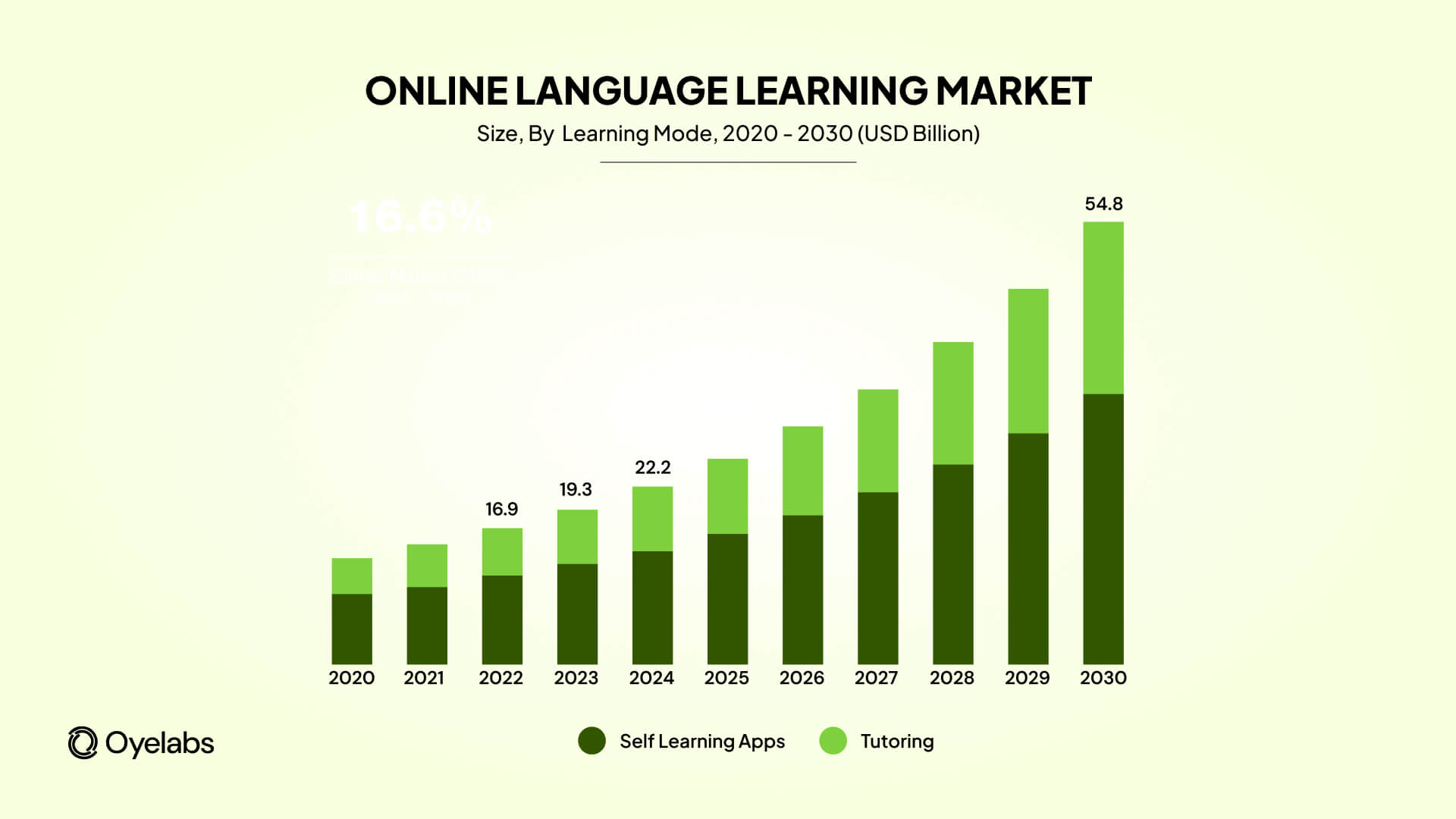
Key Takeaways What You’ll Learn A Duolingo-like app needs short lessons that help users learn faster. Gamification keeps users motivated and returning every day. Personalized lessons improve learning by adapting to each user’s level. Speech recognition helps users improve pronunciation correctly. Multiple content types create a more engaging learning experience. Monetization works through subscriptions, premium lessons, and ads. Stats That Matter The language learning market may reach $54B by 2030, showing strong global growth. Duolingo has 130M monthly users, making it one of the top learning apps. Over 50M people use Duolingo daily, proving its high engagement and stickiness.
Learning a new language has become much simpler and more enjoyable, thanks to apps such as Duolingo. With short lessons, friendly visuals, and a game-like experience, it has changed how people learn and stay consistent every day. The growth of mobile learning has encouraged many entrepreneurs to build their own language learning apps. But getting started can feel confusing. What features should you include? How do you keep users engaged? And what technology is needed to create an app similar to Duolingo? This guide explains everything in a clear and practical way. You will learn about the key features, the tech stack, and the steps required to bring a language learning app idea to life. Duolingo is one of the world’s most widely used language learning apps. It offers short and interactive lessons that make learning enjoyable and accessible for learners of all ages. The platform works like an online learning platform by covering vocabulary, pronunciation, grammar, listening, and reading skills through simple visuals and a clean interface that supports consistent daily learning. Today, Duolingo has more than 130 million monthly active users and supports over 40 languages. It is also used by more than 50 million people every day, which shows how strong its engagement levels are. The app maintains this consistency by combining streaks, XP points, levels, badges, and leaderboards that keep learners motivated to return daily. Another major strength of the platform is personalized learning. Duolingo adjusts lesson difficulty based on each user’s performance, allowing both beginners and advanced learners to progress at the right pace. Real-time speech recognition also gives immediate pronunciation feedback, which is especially useful for speaking-focused languages. Duolingo supports mixed learning methods by including reading, writing, listening, and speaking exercises in every course. This approach helps users gain practical knowledge instead of relying only on memorization. Its community features such as friend challenges, study clubs, and leaderboards create a sense of social motivation that improves retention. Building a language learning app is a strong business opportunity in the expanding digital education market. The global online language learning market size was estimated at USD 22,115.7 million in 2024 and is projected to reach USD 54,833.2 million by 2030, growing at a 16.6% CAGR from 2025 to 2030. This growth is driven by globalization, digital adoption, and the rising need for multilingual communication across industries. Remote work continues to increase the demand for language skills, as teams now collaborate across countries and time zones. Employees who know more than one language often have a strong competitive advantage. Travel, migration, and international education trends also contribute to the growing number of learners who prefer quick, convenient, and app-based learning solutions. Digital learning has become the preferred choice for students and professionals because it is flexible, accessible, and cost-efficient. Micro learning supports this shift by offering short lessons that fit easily into daily routines, improving both retention and consistency. Modern technology also enhances learning quality by analyzing mistakes, recommending suitable lessons, and offering real-time pronunciation guidance. Language learning apps offer strong monetization potential. Businesses can earn revenue through subscriptions, premium content, offline learning modules, certification programs, corporate training, and in-app ads. With demand increasing every year and the market expected to more than double by 2030, creating a language learning app presents a profitable and future-ready business opportunity. Also Read: Build a Live Shopping App Like Whatnot Creating a Duolingo-like language learning app requires a balanced mix of educational value, engagement, and user-friendly design. Below is a detailed explanation of the most essential features your app must include for long-term success. 1. Simple Onboarding The first impression matters. Users should be able to sign up effortlessly using email, phone number, or social logins. After registration, allow them to pick a language, set their skill level, and choose daily learning goals. A smooth onboarding process increases conversion and reduces drop-offs. 2. Well-Structured Course Content A strong learning experience depends on high-quality content. Organize lessons into levels such as beginner, intermediate, and advanced. Include vocabulary drills, grammar explanations, sentence-formation tasks, reading practice, and listening modules. Real-world examples and practical phrases help learners feel more confident. 3. Gamification Elements like streaks, badges, levels, XP points, and leaderboards make learning enjoyable and keep users motivated. When learning feels like a game, users stay consistent and return daily, which improves retention and lifetime value. 4. Interactive Lesson Types Interactive lessons are essential for keeping users engaged and preventing the learning experience from feeling repetitive. By including a mix of drag-and-drop tasks, fill-in-the-blank questions, matching games, pronunciation challenges, listening exercises, and short conversation prompts, you create a dynamic learning flow that keeps users actively involved. These varied formats make lessons more enjoyable while helping learners understand concepts better and retain new information for longer. 5. AI-Based Personalization Personalization increases effectiveness. AI can study user behavior, identify weak areas, and adjust lesson difficulty automatically. It can also recommend revision sessions, highlight common mistakes, and suggest the next step in the learning journey. 6. Speech Recognition Speech recognition allows learners to practice pronunciation in real time. The system listens to the user’s voice, compares it with native pronunciation, and offers instant feedback. This boosts speaking confidence and accuracy. 7. Progress Tracking A clear sense of progress motivates users. Add dashboards showing completed lessons, weekly summaries, streaks, score histories, and upcoming goals. Daily reminders and push notifications keep learners engaged. 8. Social and Community Features Users enjoy learning together. Features like challenge groups, class competitions, leaderboards, and learning clubs encourage friendly competition and build a sense of community. 9. In-App Store and Payments Monetize the app through subscription plans, premium content, offline downloads, and ad-free options. An in-app store helps create multiple stable revenue channels. 10. Admin Dashboard A strong backend dashboard helps you manage lessons, track user activity, send notifications, handle payments, and review analytics. This is essential for smooth operations and long-term scalability. Top Read: Build a Home Services App Like UrbanClap The development process requires careful planning, design, and execution. Here is a detailed step by step roadmap that guides you through the entire journey. Step 01: Decide the Features Begin by finalizing what your app will include. Features like short lessons, speech recognition, gamification, AI based recommendations, and social elements should be part of your core feature list. This helps set the direction for design, development, and content creation. Step 02: Search Qualified Teachers Work with certified language experts who can create high quality learning material. Their knowledge ensures that vocabulary, grammar rules, pronunciation, and exercises are accurate. Good educational content builds credibility and improves learning outcomes. Step 03: Development Platform Choose whether you want to build the app for Android, iOS, or both. Cross platform frameworks such as Flutter and React Native allow you to build one app that runs smoothly on multiple platforms. This reduces development time and cost. Step 04: Use the Latest Technology Stack Select reliable technologies for frontend and backend development. Include tools for AI processing, speech recognition, cloud storage, real time analytics, and database management. A modern technology stack ensures better performance, faster load times, and the ability to handle large numbers of users. Step 05: Focus on App UI and UX Design the app with a clean and simple interface. Buttons, colors, icons, and lesson screens should be easy to understand for learners of all ages. A comfortable learning environment encourages users to practice regularly and stay loyal to the platform. Step 06: Start App Development Begin building the core components of your app. This includes the frontend interface, backend system, lesson modules, gamification engine, AI recommendation system, and user profile management. Integrate speech recognition and progress tracking to complete the learning experience. Step 07: Test Your Application Test the app thoroughly before release. Check for bugs, audio issues, algorithm errors, slow screens, and inaccurate lessons. Testing ensures that users get a smooth and frustration free experience from the first day. Step 08: Launch and Market Your App Publish your app on the Google Play Store, Apple App Store, and web platform. Promote your app through social media, SEO, paid ads, influencer partnerships, and content marketing. A strong marketing strategy helps you attract users quickly and build early momentum. If you’re planning to launch your own Duolingo clone, Oyelabs is the right partner to bring your vision to life. We specialize in building smart, scalable, and engaging language learning apps designed to deliver a smooth and intuitive learning experience. From AI-powered personalization to gamification and rich lesson content, we craft platforms that feel modern, interactive, and learner-friendly. Whether you want an MVP or a fully advanced Duolingo-like app, our team ensures fast development, solid performance, and complete technical support. Connect with Oyelabs today and start building your powerful Duolingo clone app. Building an app like Duolingo is a powerful opportunity for anyone looking to enter the digital learning industry. With the right mix of structured lessons, gamification, AI-driven personalization, and seamless user experience, your app can attract learners worldwide and stand out among competitors. The key is to design a learning journey that feels rewarding, intuitive, and engaging. By following a structured development approach and focusing on user satisfaction, you can create a language learning platform that delivers value and achieves long-term success. 1. What age groups can a Duolingo-like app target? Ans – A Duolingo-like app can be used by kids, teens, adults, and working professionals. You can create separate learning paths for each age group so the content feels easy and relevant for every user. 2. Can language apps support multiple languages at launch? Ans – Yes, but launching with too many languages can make the app difficult to manage. Starting with one or two languages helps you offer high-quality lessons and gives you time to refine your system before adding more. 3. How long does it take to build a Duolingo-like app? Ans – On average, it takes three to six months to build a language learning app depending on the features, design, content creation, and level of gamification you want. 4. Do language apps need certified teachers to create content? Ans – Not always. Many successful apps use a mix of linguists, native speakers, and content creators to build structured lessons. Certified teachers are helpful but not required for every module. 5. Can a new app compete with popular apps like Duolingo? Ans – Yes, by focusing on niche languages, unique teaching methods, or advanced features like voice AI, personalized learning paths, or interactive speaking practice. New apps grow fast when they offer something big players do not. 6. How can a language learning app retain users long term? Ans – Retention grows when users feel motivated. Streak rewards, new challenges, fun activities, regular lesson updates, and notifications reminding users to practice all help keep users engaged for months.
What Is Duolingo
Why Build a Language Learning App
Features to Integrate Into a Duolingo-Like App
Step by Step Process to Build a Duolingo Like App
Technology Stack Table for a Language Learning App
Component
Technologies & Tools
Purpose
Frontend (Cross-Platform)
React Native, Flutter
Builds iOS and Android apps with one codebase for faster development
Frontend (Native – iOS)
Swift
Delivers high performance and secure iOS app experience
Frontend (Native – Android)
Kotlin
Provides reliable, fast, and secure Android app development
Backend Development
Node.js, Django
Manages app logic, APIs, user authentication, and lesson processing
Database
PostgreSQL, Firebase
Stores lessons, user progress, activity data, and app content securely
Speech Recognition & AI
Google Cloud Speech-to-Text, Amazon Polly
Enables pronunciation checks, listening exercises, and real-time learning feedback
Cloud Storage & Hosting
AWS, Google Cloud, Firebase Cloud Storage
Supports scalable hosting, secure file storage, and fast content delivery
Analytics & User Insights
Google Analytics, Mixpanel
Tracks user engagement, progress, retention, and app performance
Estimated Cost to Develop a Duolingo-Like App
Phase / Cost Factor
Details
Estimated Cost (USD)
UI/UX Design
App screens, flow design
$5,000 – $8,000
Backend Development
Server, database, APIs
$10,000 – $15,000
Frontend Development
iOS/Android interfaces
$12,000 – $18,000
AI Features & Personalization
Scoring, adaptive learning
$15,000 – $25,000
Gamification System
Rewards, levels, challenges
$10,000 – $15,000
More Languages & Content
Extra lessons, audio, translations
Increases overall cost
Complex AI Features
ML models, training data
Increases overall cost
Mobile + Web Versions
Separate builds & testing
Increases overall cost
Conversational AI Modules
NLP chatbot features
Increases overall cost
Testing & QA
Bug fixing, performance tests
$5,000 – $8,000
Deployment & Maintenance
Updates, monitoring
$3,000 – $7,000
Total Estimated Investment
—
$60,000 – $100,000+
Why Choose Oyelabs to Build Your Duolingo Clone App?
Conclusion
FAQs