
The Silent Killers of Home-Service Marketplaces

The Silent Killers of Home-Service Marketplaces
 Anuraag Jain
Last Updated on December 10, 2025
Key Takeaways
What You’ll Learn:
- Home-service marketplaces fail quickly when trust, pricing clarity, and operational workflows are not built correctly.
- Simple booking flows in home-service platforms increase completed jobs and improve overall customer satisfaction.
- Strong provider vetting in home-service marketplaces improves safety, service quality, and repeat customer engagement.
- Real-time scheduling and transparent pricing in home-service apps reduce cancellations and prevent booking confusion.
- Reliable customer support systems in home-service marketplaces help retain both users and service providers long-term.
- Oyelabs enables faster home-service marketplace launches with proven, ready-to-deploy technology frameworks.
Stats That Matter:
- 72% of users prefer digital home services because they save time.
- 42% of startup failures come from no real market need.
- Slow mobile pages can cause 53% of users to quit instantly.
- Platforms with verified providers see 35% more repeat bookings.
Real Insights:
- Trust improves when providers are verified and payments are transparent.
- Simple workflows convert better than complex booking systems.
- Strong provider onboarding increases supply and marketplace reliability.
- Real-time availability reduces cancellations and boosts satisfaction.
- Good support builds confidence and strengthens brand loyalty.
The Silent Killers of Home-Service Marketplaces
Every founder thinks their home-service marketplace will be the next TaskRabbit until reality pulls up like, “Hey, where’s your retention strategy?”
The on-demand home-services industry is booming, yet most new platforms don’t crash dramatically; they fade out silently. No headlines, no farewell post… just slow drops in bookings, rising acquisition costs, frustrated providers, and users bouncing after one bad experience.
Behind the scenes, CEOs aren’t losing to competition. They’re losing to hidden operational gaps, broken trust loops, poor liquidity, and misaligned user flows – the technical fundamentals that make or break a two-sided marketplace.
This guide exposes the silent killers that quietly erode home-service platforms from the inside. Whether you’re building a marketplace like TaskRabbit or UrbanClap, knowing these pitfalls upfront can save you months of burn and accelerate your path to real traction.
Ready to future-proof your platform? Let’s dig in.
What Should Founders Understand Before Launching a Home-Service Marketplace?
Most first-time founders underestimate the operational complexity of home-service marketplaces. Unlike traditional e-commerce, this category requires real-time coordination between customers, service providers, scheduling constraints, geolocation factors, and trust-driven decision-making. A home-service marketplace is not just a matching engine; it is a live operational ecosystem that must balance supply liquidity, service reliability, and user experience simultaneously.
A critical distinction is that home-service platforms operate on a two-sided dependency model. If supply is weak, customers churn. If customer demand falters, providers disengage. Maintaining equilibrium between both sides is often the biggest determinant of early success.
Founders should have a clear understanding of the following before launching:
- Dual marketplace dynamics: both sides require structured acquisition strategies.
- Quality governance: every provider interaction impacts brand perception and repeat usage.
- Operational readiness: scheduling, routing, payouts, and dispute management must be airtight from day one.
This foundational clarity sets the stage for avoiding the most common silent failures.
The Silent Killers of Home-Service Marketplaces
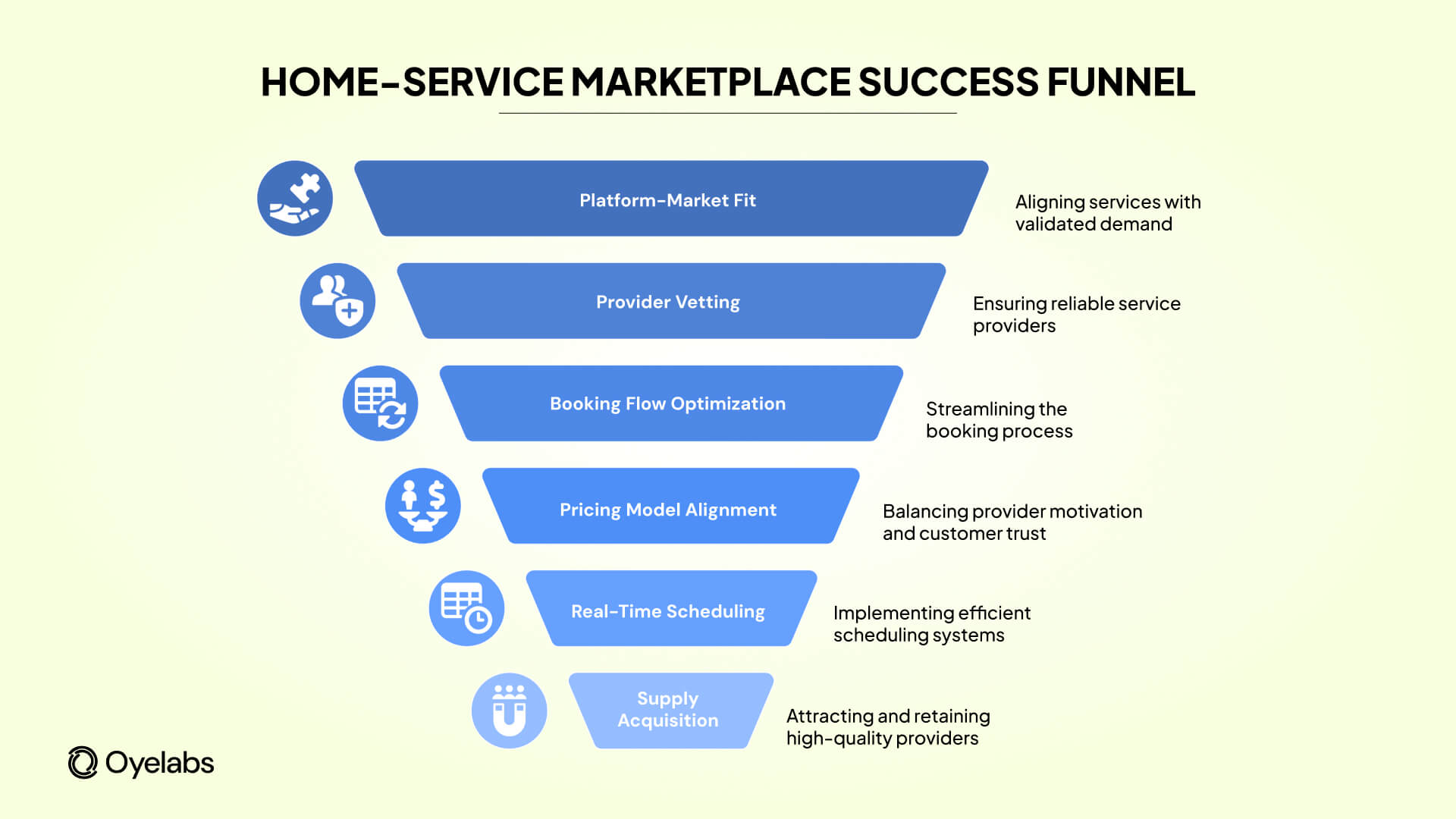
1. Launching Without Platform-Market Fit
Many home-service startups launch based on intuition rather than validated demand. A marketplace that attempts to serve “everyone” typically ends up serving no one well. Without market fit, customer acquisition becomes expensive, repeat usage declines, and supply remains disengaged.
Key issues founders encounter:
- Broad category selection: the platform becomes diluted and fails to resonate with a specific audience.
- Insufficient demand validation: the core use case is never pressure-tested in a real market environment.
- Misalignment between pricing and customer willingness to pay: revenue projections become unrealistic.
A simple pre-launch validation framework:
- Micro-niche definition: selecting a narrow starting category improves adoption and reduces CAC.
- Customer interviews: direct feedback reveals expectations, pricing sensitivity, and service gaps.
- Pilot tests: running small controlled experiments verifies whether the marketplace creates tangible value.
CB Insights identifies ‘no market need’ as the leading cause of startup failure, accounting for 42% of cases – highlighting why platform-market fit is non-negotiable for home-service marketplaces.
Launching with sharp market alignment dramatically increases adoption and lowers early burn.
2. Weak Provider Vetting & Quality Control
A home-service marketplace lives and dies by the reliability of its service providers. When vetting is inconsistent – or worse, nonexistent – trust erodes quickly. Users remember poor service far more than good service, and a single negative experience can eliminate the likelihood of repeat bookings.
Common structural failures include:
- No formal verification process: unchecked providers increase operational risk.
- Skill inconsistencies: customers encounter unpredictable service outcomes.
- Missing background checks: safety incidents undermine the entire brand ecosystem.
A strong provider governance model requires:
- Multi-layer verification: identity checks, background screening, skill validation.
- Performance tracking: ratings, completion rates, cancellations, and customer feedback are monitored continuously.
- Provider tiers: high performers receive better visibility, incentives, and priority job assignments.
A well-governed provider ecosystem strengthens trust and reduces long-term customer churn.
3. Overcomplicated Booking Flows That Kill Conversions
User friction is one of the fastest ways to destroy adoption. A booking flow that requires multiple steps, unclear inputs, or unnecessary information creates drop-offs at every stage. Home-service customers expect speed and clarity; any deviation increases abandonment rates.
Typical booking flow problems include:
- Excessive input fields: users lose patience before completing the process.
- Non-transparent pricing: customers hesitate when they cannot anticipate final costs.
- Undefined timelines: users expect clarity on service duration, arrival windows, and confirmation status.
Founders should design around the principle of minimal friction:
- Streamlined forms: capture only the essential details needed for service fulfillment.
- Pricing clarity: provide upfront estimates or transparent pricing ranges.
- Real-time confirmations: eliminate uncertainty and reinforce user confidence.
A simplified, intuitive booking experience increases conversions, reduces support queries, and strengthens the platform’s early trust momentum.
4. Choosing the Wrong Pricing Model
Pricing is one of the most underestimated variables in home-service marketplaces. Founders often adopt a flat-rate or commission-based structure without understanding how pricing influences provider motivation, customer trust, and marketplace liquidity.
Common pricing misalignments include:
- Flat pricing across diverse service types: this ignores variations in task complexity and provider skill levels.
- Provider-controlled pricing without oversight: prices fluctuate unpredictably, making customers hesitant.
- Underpriced initial services: this attracts low-quality providers and sets unrealistic user expectations.
A sound pricing approach incorporates:
- Value-based pricing: aligning prices with service complexity to ensure provider satisfaction.
- Transparent price bands: users understand expected costs before booking.
- Dynamic adjustments: pricing evolves based on demand patterns, seasonal trends, and provider reliability.
Effective pricing protects margins, reduces operational disputes, and keeps both sides of the marketplace invested.
5. No Real-Time Availability or Scheduling System
Home-service marketplaces depend heavily on timing. When customers cannot see accurate availability or providers struggle to manage schedules, the platform experiences silent breakdowns: missed appointments, last-minute cancellations, and operational bottlenecks.
Common issues include:
- Manual scheduling by providers: high error rates and lack of synchronization lead to service failures.
- Non-updated calendars: customers book time slots that providers cannot fulfill.
- Absence of routing and travel-time considerations: providers arrive late or miss appointments entirely.
A real-time scheduling system should incorporate:
- Live availability: auto-updated calendars based on provider inputs and existing jobs.
- Automated notifications: confirmations, reminders, and rescheduling prompts.
- Smart routing: optimized travel time estimates to maintain service predictability.
Building this infrastructure early prevents reliability issues that are difficult to correct once the platform scales.
6. Poor Supply Acquisition & Provider Retention
One of the most significant silent killers is the inability to attract enough high-quality providers – and keep them. A home-service marketplace without a strong supply foundation becomes unstable, no matter how polished the customer experience is.
Key challenges include:
- Overreliance on paid ads: expensive acquisition with low long-term retention.
- Weak onboarding flow: providers abandon sign-up due to lengthy or unclear processes.
- Limited earning transparency: providers cannot predict income, leading to disengagement.
A sustainable supply acquisition and retention strategy requires:
- Clear value proposition: explanation of earnings, lead flow, and platform benefits.
- Streamlined onboarding: fast, informative, and mobile-first enrollment.
- Reliable payout systems: timely payments and transparent commission structures build provider loyalty.
A marketplace with engaged, well-supported providers naturally develops stronger service reliability and customer retention.
7. Zero Brand Differentiation in a Crowded Landscape
Home-service marketplaces often enter the market with a generic identity – similar colors, similar messaging, and similar value propositions. When customers cannot distinguish one platform from the next, the marketplace becomes a commodity, competing only on price. This weakens long-term sustainability and increases acquisition costs.
Common brand issues include:
- Generic messaging: the platform does not communicate a unique value or perspective.
- Broad positioning: attempting to serve all categories without a strong narrative.
- Inconsistent user experience: mismatched design, tone, and service workflows dilute trust.
A recognizable brand requires intentional differentiation:
- Clear category ownership: becoming the go-to marketplace for a specific service or demographic.
- Strong visual identity: consistency across app, web, communication, and marketing.
- Trust-driven storytelling: showcasing real providers, real customers, and real outcomes.
A marketplace with distinct positioning stands out, earns loyalty faster, and retains users even in competitive markets.
8. Premature Scaling Before Product–Market Fit
Many founders expand aggressively – new cities, new categories, larger teams – before the core experience is stable. While this may create early excitement, premature scaling increases operational complexity and amplifies existing weaknesses. Growth becomes costly, inefficient, and unsustainable.
Typical scaling mistakes include:
- Geographic expansion without sufficient supply: new locations open with inadequate provider density.
- Introducing new services without validating demand: categories remain unused and drain resources.
- Hiring too many operational resources early: burn increases faster than revenue.
A disciplined scaling approach emphasizes:
- Single-market focus: achieving density, trust, and retention in one region first.
- Demand-led category expansion: adding services only when user requests consistently indicate need.
- Incremental rollout: testing operational processes in controlled environments before broader deployment.
Scaling should follow readiness – not ambition. When done systematically, growth becomes predictable and cost-efficient.
9. Ignoring Data Until It’s Too Late
In a two-sided marketplace, data is not optional; it is the decision-making engine. When founders rely on intuition instead of analytics, early warning signals go unnoticed. Declines in repeat usage, provider cancellations, customer dissatisfaction, or rising acquisition costs often indicate deeper structural problems that require immediate correction.
Critical data gaps include:
- No tracking of service lifecycle metrics: cancellations, delays, and completion times remain invisible.
- Limited provider performance analytics: high-risk providers continue receiving jobs.
- Poor understanding of customer behavior patterns: the platform cannot identify friction points.
Key metrics founders must monitor include:
- Customer acquisition cost (CAC): indicates marketing efficiency.
- Provider response time: directly impacts booking success.
- Repeat job frequency: a strong indicator of marketplace health.
- Net promoter score (NPS): signals brand strength and service reliability.
Proactive data monitoring helps founders identify issues early, iterate faster, and protect the long-term viability of the platform.
10. Delivering a Weak Mobile Experience
Home-service marketplaces are predominantly mobile ecosystems. Customers browse, compare, book, track, and review services through their phones. Providers accept jobs, manage schedules, navigate routes, and communicate through mobile as well. When the mobile experience is slow, unresponsive, or poorly designed, both sides of the marketplace disengage silently.
Common issues tied to weak mobile performance include:
- Slow loading times: users abandon the app before the booking flow even begins.
- Inconsistent interface elements: design variations create uncertainty and reduce trust.
- Lack of offline tolerance: providers struggle in low-network zones, affecting job reliability.
- Weak notification infrastructure: missed alerts lead to unfulfilled bookings and cancellations.
A strong mobile foundation prioritizes:
- Optimized app performance: fast load times, responsive layouts, and reliable caching.
- Structured user journeys: streamlined flows tailored separately for customers and providers.
- Robust notifications: confirmations, reminders, and alerts that ensure real-time coordination.
A marketplace with a dependable mobile experience establishes credibility quickly and reduces operational friction significantly.
How Did These Silent Killers Affect Real Founders in the Industry?
Across the home-service ecosystem, many marketplace founders encounter operational decline without realizing the root cause. Several platforms begin with strong demand but gradually lose traction due to weaknesses that were invisible at first. Early generic branding results in low recall, leading to high acquisition costs.
Platforms without structured provider vetting face rising cancellation rates, poor ratings, and declining repeat usage. Founders who scaled prematurely experienced operational inconsistencies that strained support teams and created distrust among early adopters. Others lacked a clear pricing framework, causing unpredictable customer expectations and reduced provider motivation.
These silent failures rarely appear suddenly; they accumulate over time. By the time the effects become visible – falling retention, lower job completion rates, inconsistent supply – the platform is already under strain. The strongest lesson from industry cases is straightforward: addressing structural flaws early determines whether the marketplace grows sustainably or contracts quietly.
Explore our breakdown of new TaskRabbit-style features every founder should consider – Read the full guide.
How Did Oyelabs Help a Founder Build a TaskRabbit-Style Brand Successfully?
One founder approached Oyelabs with an idea similar to TaskRabbit but lacked clarity on validation, onboarding, and conversion workflows. Their initial platform faced fragmented demand, slow service-matching, and low provider consistency. Oyelabs implemented a structured home-service framework that included optimized booking flows, multi-layer provider verification, transparent pricing bands, and real-time availability mapping. This created predictable service delivery and reduced friction on both user and provider sides.
As the platform launched, engagement began rising consistently. Impressions grew as the brand established a recognizable identity, and customer satisfaction increased due to reliable scheduling and vetted providers. Within a short period, the platform transformed into a regionally recognized service brand – strengthened by solid operational infrastructure rather than short-term marketing. This progression illustrates how the right technical foundation can shift a marketplace from inconsistent adoption to sustained market presence.
What Can Founders Do to Prevent These Silent Killers Before Launch?
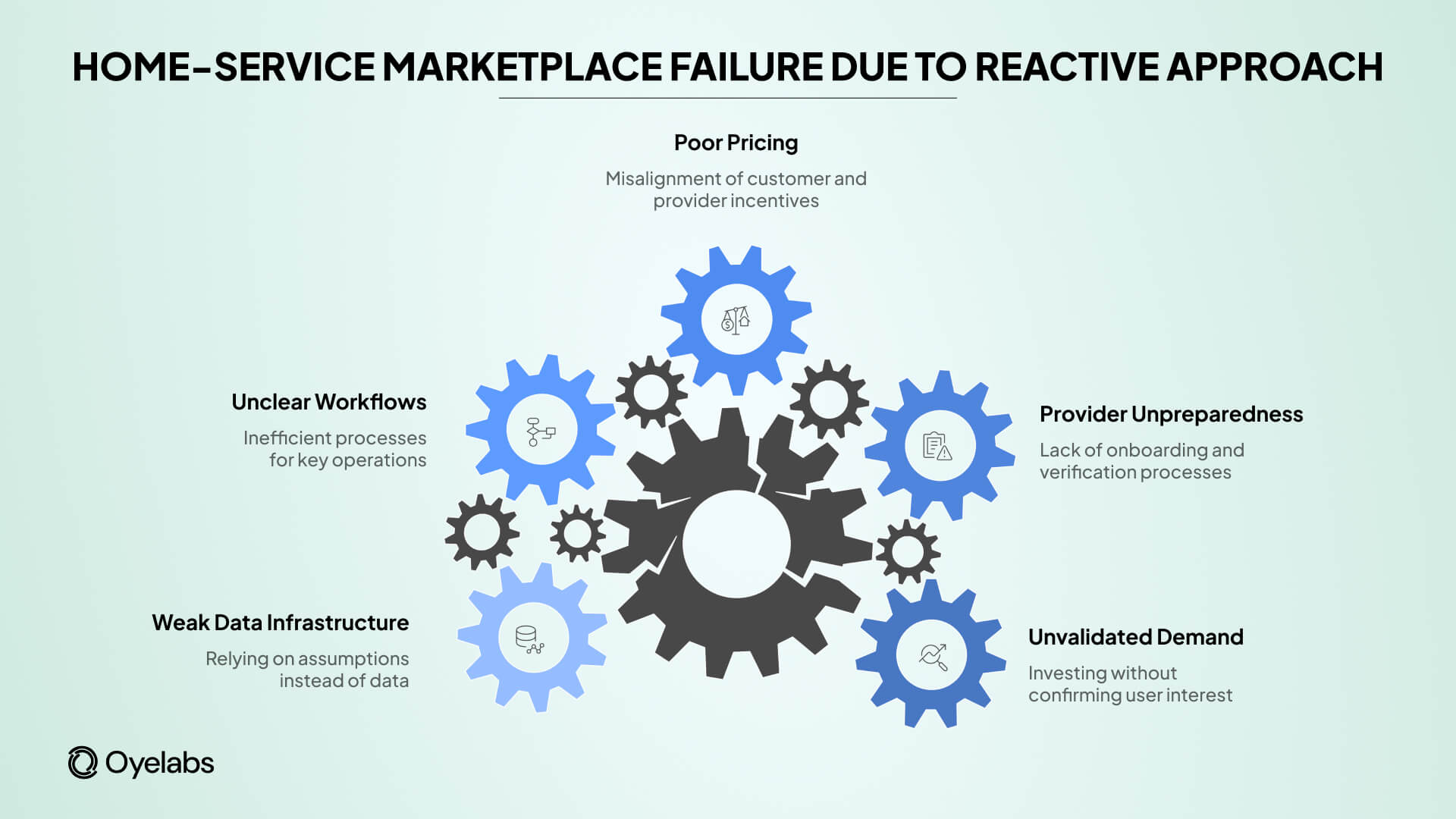
Founders who want to build durable home-service marketplaces must adopt a preventive mindset rather than a reactive one. This begins with narrowing the target market, validating real user needs, and mapping out operational workflows before development. A structured approach reduces errors and creates a stable environment for early adoption.
Key preventive measures include:
- Demand validation: confirm real interest in the selected niche before investing heavily.
- Provider readiness planning: Establish onboarding, training, and verification processes early.
- Pricing architecture: define pricing logic that aligns customer expectations with provider incentives.
- Operational workflow mapping: create clear processes for scheduling, routing, refunds, and escalations.
- Data infrastructure: build dashboards that highlight critical trends instead of relying on assumptions.
By addressing these areas upfront, founders avoid the majority of systemic failures that typically surface only after the marketplace has already invested significant time and capital.
Why Is Oyelabs the Smartest Way to Launch a Home-Service Marketplace?
Founders often spend months navigating technical uncertainty, operational planning, and iterative development before their marketplace ever reaches users. Oyelabs simplifies this entire journey by providing a structured, scalable home-service marketplace framework modelled after proven platforms like TaskRabbit and UrbanClap. Instead of building core components from scratch, founders receive a ready ecosystem optimized for discovery, booking, provider management, and trust workflows.
Oyelabs’ approach is grounded in technical rigour and market understanding. The platform is built with a modular infrastructure that supports real-time availability, automated scheduling, and transparent pricing. Providers benefit from guided onboarding, verification layers, and performance tracking systems that create consistent service quality. Customers experience streamlined booking, reliable notifications, and a cohesive interface across mobile and web.
For early-stage startups, this significantly reduces time-to-market and minimizes development risk. For growth-stage founders, it offers a stable foundation capable of expanding into new categories and regions without structural rework. In both scenarios, Oyelabs enables founders to focus on strategy, brand building, and market growth – while the technical backbone stays robust and scalable.
Conclusion
Building a home-service marketplace requires far more than assembling a feature set; it demands a reliable operational engine that can scale without losing trust or consistency. The silent killers outlined in this guide – ranging from weak provider governance to flawed pricing and poor user flows – tend to surface gradually, often after significant time and capital have already been invested. Founders who address these issues early establish stronger retention, higher service reliability, and durable market positioning.
The most strategic path forward is to validate demand, refine workflows, enforce quality, and scale intentionally. For leaders ready to launch or upgrade their platform, Oyelabs offers a proven foundation built to eliminate these challenges from day one.
Contact Oyelabs today to discuss your marketplace vision and accelerate your go-to-market journey.
FAQs
Q: What causes most home-service marketplaces to fail in their first year?
A: Most fail from weak validation, poor provider quality, unclear pricing, and inefficient operations.
Q: How can founders prevent operational failures in a home-service platform?
A: Build strong workflows, verify providers, track data early, and focus on real user needs.
Q: Which features matter most in a home-service marketplace like TaskRabbit?
A: Real-time scheduling, transparent pricing, vetted providers, reliable support, and simple booking flows matter most.
Q: How does Oyelabs help founders launch stronger home-service marketplaces?
A: Oyelabs offers ready frameworks, proven workflows, faster deployment, and scalable architecture.