
Rental Startup Opportunities Ahead of FIFA World Cup 2026

Rental Startup Opportunities Ahead of FIFA World Cup 2026
 Anuraag Jain
Last Updated on January 7, 2026
Key Takeaways
What You’ll Learn
- FIFA World Cup 2026 will create massive short-term rental demand across multiple North American cities.
- Rental marketplaces perform better than single property listings during large global events.
- Event-focused platforms attract users faster than generic booking apps.
- Owning a platform gives founders control over pricing, users, and brand value.
- Early launch increases visibility, trust, and booking readiness during peak demand.
Stats That Matter
- The FIFA World Cup 2026 includes 48 teams and 104 matches across three countries.
- Host cities already operate near peak hotel occupancy during summer seasons.
- Short-term rentals often see two to three times higher occupancy during major events.
- Over 30% of travelers prefer rentals over hotels for group and extended stays.
- Platform businesses scale faster than asset-heavy real estate models.
Real Insights
- Event demand favors platforms that are simple, fast, and trusted.
- Group travel increases demand for larger rental properties.
- Early SEO visibility drives bookings without heavy advertising spend.
- City-focused platforms build trust faster than global marketplaces.
- Platforms launched for FIFA can scale into year-round rental businesses.
Rental Startup Opportunities Ahead of FIFA World Cup 2026
Imagine summer 2026, your city is flooded with fans, creators, sponsors, and teams – and every bed within a 10-mile radius is booked solid. Prices surge. Demand spills over. And the real winners aren’t just property owners. They’re platform owners.
The FIFA World Cup 2026 isn’t a normal sports event. It’s a multi-city, multi-country demand shock across the U.S., Canada, and Mexico – at a scale the short-term rental market has never seen. Hotels will cap out fast. Airbnb listings will get crowded. Fees will climb. Rules will tighten.
That’s where smart founders lean in.
For CEOs and early-stage entrepreneurs, this moment unlocks a rare play: launching a rental marketplace platform tailored to event-driven demand – built for scale, flexible pricing, vendor onboarding, and long-term brand equity. Not a side hustle. A real tech asset.
If you’ve been looking for a timing-led opportunity where distribution meets infrastructure, FIFA 2026 might be it. And the clock is already ticking.
Why FIFA World Cup 2026 Is a Once-in-a-Generation Rental Opportunity
The FIFA World Cup 2026 is not just bigger than previous editions – it is structurally different. With 48 teams, 104 matches, and an expected audience of over five million in-stadium spectators, FIFA World Cup 2026 will be the largest global sporting event ever hosted across North America. This changes how demand behaves.
Instead of a short, localized surge, FIFA 2026 will create a sustained, distributed demand wave across multiple metro areas. Fans won’t just arrive for match days. They will come early, stay longer, move between cities, and travel in groups. Add to that players’ families, media crews, sponsors, brand teams, influencers, and event staff – and the pressure on short-term accommodation multiplies fast.
From a business perspective, this is rare. Events of this scale don’t happen often, and when they do, they expose gaps in existing infrastructure. Hotels reach capacity quickly. Traditional booking platforms become saturated. Prices spike, but supply remains fragmented.
For founders and CEOs, this creates a clear signal: when demand outpaces centralized supply, marketplace platforms outperform individual operators. FIFA 2026 is not just a tourism boom – it is a platform-building moment.
FIFA World Cup 2026 Rental Demand by Host Cities: What the Data Shows
Market data from short-term rental analysts and pricing platforms shows a consistent pattern across host cities: demand will significantly exceed normal seasonal peaks, even in cities with strong hotel inventory.
Key demand drivers include:
- Multi-match attendance across cities
- Group travel (families, fan clubs, corporate teams)
- Longer average stays compared to typical sporting events
- Spillover demand into suburban and secondary neighborhoods
Cities like New York/New Jersey, Los Angeles, Miami, and Dallas are expected to see the highest absolute volume. However, the most interesting opportunities often emerge in Tier 2 and Tier 3 host cities, where:
- Hotel capacity is more limited
- Short-term rental supply is fragmented
- Local operators lack brand visibility
Across most host cities, projections point to:
- Occupancy levels are rising far beyond normal summer averages
- Daily rental rates are increasing sharply during match windows
- Early booking behavior starts months in advance
What matters for founders is not just higher prices – it’s a behavioral shift. During large events, users prioritize availability, trust, and ease of booking over brand loyalty. That creates space for new platforms to capture attention, traffic, and repeat usage quickly.
Why Traditional Airbnb Hosts Won’t Capture the Full Opportunity
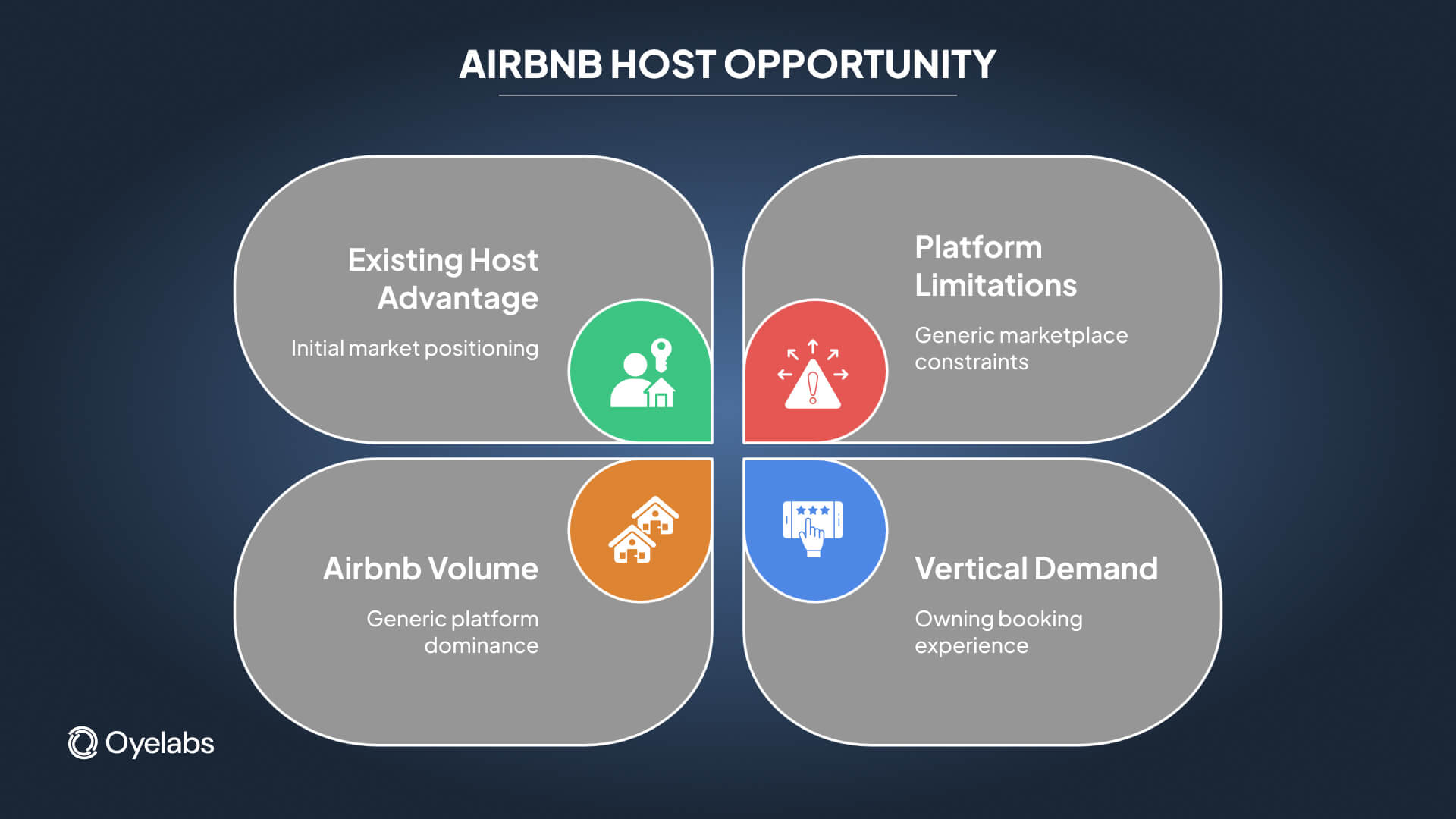
At first glance, existing Airbnb hosts are best positioned to benefit. In reality, many will face constraints that limit upside.
Several factors work against individual hosts and generic platforms:
- Rising platform fees reduce net margins
- Algorithm-driven visibility favors established listings
- Local regulations tighten during high-profile events
- Hosts compete globally, not locally, for attention
More importantly, Airbnb is built as a horizontal marketplace. It serves everyone, everywhere, all the time. During FIFA, demand becomes vertical and specific – fans from certain countries, corporate groups, media teams, and long-stay travelers all have distinct needs.
Generic platforms struggle to adapt quickly to:
- Country- or group-specific inventory
- Event-based pricing logic
- Bulk or managed bookings
- Brand-led trust for first-time visitors to a city
This is where opportunity shifts from “listing more properties” to owning the booking experience. Founders who control their own rental platforms can design supply, pricing, and messaging around FIFA-driven demand – rather than competing inside someone else’s ecosystem.
In short, Airbnb will benefit from volume. But founder-led rental marketplaces can benefit from focus, speed, and ownership.
The Rise of Event-Focused Rental Marketplaces (Beyond Airbnb)
Large global events have a habit of exposing limitations in one-size-fits-all platforms. FIFA World Cup 2026 will be no different. As demand becomes concentrated around a specific event, specialized rental marketplaces tend to outperform generic booking platforms.
Event-focused rental marketplaces are designed around a clear context:
- A defined time window
- A predictable demand spike
- A specific audience profile
Instead of trying to serve everyone, these platforms serve one audience extremely well.
What differentiates event-focused marketplaces is not technology complexity, but strategic design. They are built to:
- Highlight event-relevant inventory first
- Support group and extended stays
- Adjust pricing dynamically around match schedules
- Communicate clearly with first-time visitors unfamiliar with the city
This approach changes user behavior. Travelers book faster, hosts gain confidence, and trust is built quickly because the platform speaks directly to the moment the user is in.
For founders, this model offers a practical advantage: speed. You are not competing with Airbnb on global scale. You are competing on relevance, which is easier to win and faster to monetize. Once the event passes, the same platform can evolve into a city-first or niche rental brand.
Event-driven marketplaces are not temporary businesses. They are entry points.
Rental Startup Opportunities Ahead of FIFA World Cup 2026
FIFA World Cup 2026 opens multiple, clearly defined rental startup opportunities for founders who think beyond individual listings and focus on platform ownership. These opportunities are not theoretical – they are grounded in how people travel during global sporting events.
Fan-First Rental Marketplaces
Fans rarely travel alone for events like the World Cup. They move in groups, follow teams across cities, and often prefer shared or community-style stays.
A fan-first rental platform can focus on:
- Group accommodations and larger properties
- Country or team-based discovery filters
- Neighborhood guides aligned with match venues
- Flexible check-in and check-out windows
These platforms benefit from strong word-of-mouth and repeat usage as fans move between host cities.
Corporate, Media, and Sponsor Housing Platforms
Beyond fans, FIFA brings thousands of professionals who require reliable, longer-term housing:
- Broadcasters and production teams
- Brand and sponsorship staff
- Security, logistics, and event operations teams
This segment values consistency over price and often books in bulk. A platform tailored to corporate housing can support:
- Managed listings
- Fixed-term stays
- Centralized billing and reporting
- Dedicated support workflows
For founders, this model offers higher average booking values and predictable demand.
City-Specific Rental Brands
Not every opportunity needs to scale across all host cities. In fact, city-specific platforms often gain traction faster.
Examples include:
- Rentals focused exclusively on one host city
- Inventory curated around stadium proximity
- Local branding that builds trust with visitors
These platforms perform well in Tier 2 and Tier 3 cities, where national platforms lack localized storytelling and supply organization.
Hybrid Platforms: Event Launch, Long-Term Growth
Some of the strongest opportunities combine event focus with a long-term vision. FIFA 2026 becomes the launchpad, not the finish line.
A hybrid approach allows founders to:
- Acquire users during peak demand
- Retain hosts after the event
- Expand into conferences, tourism, and seasonal travel
The key insight is simple: FIFA creates urgency. Platforms create durability.
Real Estate vs Platform Ownership: The Smarter Play for Founders
Many founders initially look at FIFA 2026 through a real estate lens – buy a property, list it short term, benefit from higher prices. While this approach can work, it caps upside and ties growth directly to capital and location.
Platform ownership works differently.
Owning a rental marketplace allows founders to participate in the entire transaction flow, not just a single asset. Instead of earning from one property, the platform earns from many – across neighborhoods, cities, or even countries.
The distinction becomes clear when comparing outcomes:
- Real estate scales linearly. Each new property requires capital, management, and time.
- Platforms scale exponentially. Each new host increases supply without increasing fixed costs at the same rate.
During events like FIFA, the advantage compounds. Demand surges across multiple cities simultaneously, something individual property owners cannot match. A platform, however, can aggregate supply, route demand, and adapt pricing dynamically.
For CEOs and entrepreneurs, this shifts the question from “How many properties can I manage?” to “How much demand can my platform capture?” In high-velocity markets, infrastructure beats inventory.
Timeline Strategy: When Founders Should Launch to Win FIFA 2026
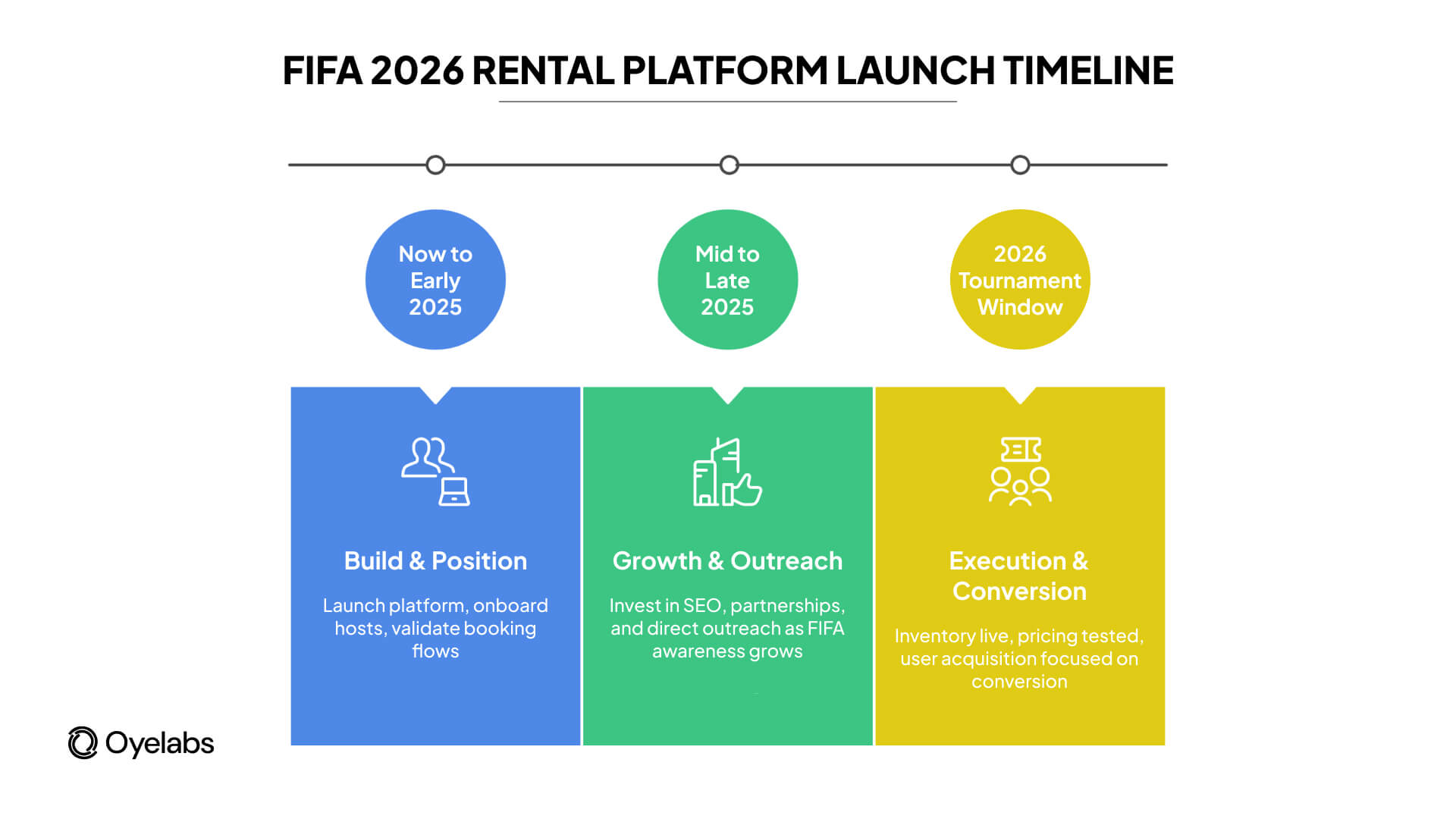
Timing will determine who benefits most from the FIFA World Cup 2026. The biggest mistake founders make with event-driven opportunities is waiting too long to enter the market.
Successful rental platforms will not launch during the tournament. They will already be established.
A practical founder timeline looks like this:
- Early Phase (Now to Early 2025): This is the build and positioning phase. Founders focus on launching the platform, onboarding initial hosts, and validating booking flows. Early traction here builds credibility.
- Growth Phase (Mid to Late 2025): As awareness of FIFA increases, search interest and early planning begin. Platforms that are live can invest in SEO, partnerships, and direct outreach to hosts and corporate renters.
- Peak Phase (2026 Tournament Window): This is execution, not experimentation. Inventory is live. Pricing rules are tested. User acquisition shifts from education to conversion.
The core insight is straightforward: FIFA demand rewards preparedness. Platforms that exist early benefit from trust, indexed visibility, and operational confidence. Late entrants compete for attention when users are already booking.
For founders, launching early is not about rushing – it’s about earning the right to scale when demand explodes.
How a Founder Used an Airbnb-Like Platform to Build Market Value
One founder approached this opportunity with a clear goal: stop depending on third-party rental platforms and start owning the relationship with both hosts and guests. Instead of competing for visibility on crowded marketplaces, they launched their own Airbnb-style rental platform tailored to their local market.
With the platform live, several things changed quickly. Host onboarding became easier because fees and policies were transparent. Guest engagement improved because the experience was designed around local stays, not generic listings. Traffic grew steadily through organic search and direct visits, rather than paid promotions alone.
Over time, the platform began to function as more than a booking tool. It became a recognizable brand in its market – trusted by hosts, indexed by search engines, and remembered by returning users. That brand value translated into higher engagement, stronger impressions, and a defensible market position.
The key takeaway is not the technology itself, but the leverage it created. By owning the platform, the founder owned the audience, the data, and the growth curve. That shift is what turned a rental idea into a scalable business asset.
If you’re considering building your own rental platform, this guide on how to build an Airbnb-like app with experiences explains the complete process, features, and launch approach.
What CEOs Should Look for in a FIFA-Ready Rental Marketplace Platform
For founders and CEOs evaluating whether to launch a rental platform ahead of FIFA 2026, the question is not whether demand will exist. The question is whether the platform is built to handle it.
A FIFA-ready rental marketplace must be designed for flexibility and scale from day one. At a minimum, decision-makers should look for:
- Multi-city readiness: The ability to manage listings, pricing, and availability across different cities without operational friction.
- Host onboarding and control: Simple onboarding flows, clear policies, and tools that make it easy for hosts to manage availability during peak demand.
- Dynamic pricing capability: Support for event-based pricing rules that adjust around match schedules and high-demand windows.
- Operational visibility: An admin layer that allows founders to monitor bookings, resolve issues quickly, and maintain platform trust during peak usage.
- Mobile-first experience: Most event travelers book on mobile. The user experience must be fast, intuitive, and reliable under traffic spikes.
From a leadership perspective, the platform should not just handle traffic – it should support decision-making. When demand accelerates, clarity beats complexity. The simpler it is to manage supply and bookings, the more effectively the business can scale during FIFA and beyond.
Why Building an Airbnb-Like Platform Is Faster Than Most Founders Think
Many founders delay action because they assume building a rental marketplace requires years of development, large engineering teams, and heavy upfront investment. That assumption used to be true. It no longer is.
Today, the advantage lies in starting from proven foundations, not building from scratch. Core marketplace flows – listing management, bookings, payments, reviews, and admin controls – are already well understood. The real work is not inventing features, but tailoring them to a specific market and moment.
For FIFA-driven opportunities, speed matters more than perfection. Founders who launch early gain:
- Time to onboard and organize supply
- Space to test pricing and policies before demand peaks
- Search visibility that compounds month over month
- Operational confidence before traffic spikes
Instead of overbuilding, successful teams focus on:
- Launching a stable core platform
- Customizing workflows for event-driven demand
- Iterating based on real usage, not assumptions
From a CEO’s perspective, this is an infrastructure decision, not a tech experiment. The goal is to deploy a platform that works reliably, scales predictably, and can evolve after the event. When approached this way, building an Airbnb-like platform becomes a measured business initiative, not a risky bet.
Rental Startup Opportunities Don’t End With FIFA World Cup 2026
One of the biggest misconceptions about event-led platforms is that their value disappears once the event ends. In practice, the opposite often happens.
FIFA 2026 acts as a market accelerator. It brings users, hosts, and attention onto a platform faster than normal growth cycles would allow. What founders do after that determines long-term value.
A rental marketplace launched for FIFA can transition naturally into:
- City-focused short-term rentals
- Corporate and extended stays
- Conference and event housing
- Seasonal tourism markets
The infrastructure remains the same. The audience expands.
Founders who plan for this from the start design platforms that are not locked into one event narrative. They retain hosts, remarket to past guests, and reposition the brand for ongoing demand. The event becomes part of the origin story – not the ceiling.
From a strategic standpoint, this is where platform ownership pays off. Instead of chasing the next spike, founders control an asset that continues to generate bookings, data, and brand equity long after the final match.
FIFA 2026 is the catalyst. The real opportunity is what comes next.
Final Thought: Build the Platform Before the Crowd Arrives
Every global event creates short-term winners. The FIFA World Cup 2026 will create long-term businesses.
Founders who move early have the advantage of clarity. They are not reacting to demand; they are ready for it. They control how bookings happen, how hosts are onboarded, and how the brand is remembered after the event ends.
When millions of travelers arrive in unfamiliar cities, they will look for something simple: a place they can trust to stay. The platforms that earn that trust will not just win bookings during FIFA – they will carry that momentum forward.
The window to build is open now. By the time the crowd arrives, the market will already be decided.
FAQs
Q: Is the FIFA World Cup 2026 a good time to launch a rental marketplace?
A: Yes, demand spikes across cities, creating fast user growth and booking volume.
Q: Can startups compete with Airbnb during major events like FIFA?
A: Yes, niche and city-focused platforms perform better during event-driven demand.
Q: How early should founders launch a rental platform before FIFA 2026?
A: Ideally, 12–18 months earlier to build trust, inventory, and search visibility.
Q: Do rental platforms remain valuable after the FIFA World Cup ends?
A: Yes, platforms convert event users into long-term travelers and repeat customers.