Agent as a Service (AaaS) – Everything You Need to Know

Agent as a Service (AaaS) – Everything You Need to Know
 Anuraag Jain
Last Updated on April 7, 2026
Key Takeaways
What You’ll Learn:
- AaaS uses AI agents to complete tasks without human involvement
- Agents focus on outcomes, not just providing tools
- Businesses can scale operations without increasing team size
- AaaS integrates with CRM, APIs, and internal systems
- Founders can launch agent platforms with defined use cases
Stats That Matter:
- AI market may reach $1.8 trillion by 2030 globally
- Over 55% of businesses already use AI in operations
- Automation can improve productivity by up to 40%
- AI can reduce operational costs by 20% to 30%
- Up to 30% of work hours may be automated by 2030
Real Insights:
- AaaS replaces repetitive work with automated execution systems
- Clear agent roles improve performance and reliability
- Integration defines how useful an AI agent becomes
- Early launch helps validate real-world agent performance
- Controlled automation reduces risk while improving efficiency
Agent as a Service (AaaS) – Everything You Need to Know
You’re not hiring software anymore. You’re hiring outcomes.
That’s the shift happening right now. Businesses are moving beyond dashboards and tools toward systems that actually do the work. This is where Agent as a Service (AaaS) comes in.
Instead of giving your team another platform to manage, AaaS deploys autonomous AI agents that can execute tasks, make decisions, and deliver results across your business operations. From handling customer support to generating leads or processing workflows, these agents act like a scalable digital workforce.
For founders and startups, this changes the economics of building and scaling a business. You no longer need large teams to operate efficiently.
In this guide, you’ll learn what AaaS is, how it works, and how you can launch your own Agent as a Service platform.
What Is Agent as a Service (AaaS)?
Agent as a Service (AaaS) is a cloud-based model where autonomous AI agents are deployed to perform tasks, make decisions, and deliver outcomes – without constant human intervention.
Unlike traditional software that requires users to operate it, AaaS systems are designed to act independently. These agents can handle workflows end-to-end, from understanding a goal to executing tasks across multiple systems such as CRMs, APIs, or internal tools.
At its core, AaaS transforms software from a passive tool into an active participant in business operations.
For example, instead of a sales team manually following up with leads using CRM software, an AI agent can identify prospects, personalize outreach, schedule meetings, and track engagement – automatically.
This shift is particularly relevant for startups and founders who need to scale operations without increasing headcount. By deploying AI agents, businesses can execute repetitive and complex tasks more efficiently while maintaining consistency.
What Makes AaaS Different from Traditional Software
Traditional software platforms are designed to assist users. They provide interfaces, dashboards, and tools, but the execution still depends on human input.
AaaS operates differently. It focuses on execution rather than enablement.
Key distinctions include:
- Software requires user interaction; agents operate autonomously
- Software provides tools; agents deliver outcomes
- Software depends on workflows; agents create and manage workflows
This difference fundamentally changes how businesses approach productivity and automation.
How Autonomous AI Agents Work in Real Business Environments
Autonomous agents are designed to function within real-world business systems. They are not isolated tools; they integrate with existing infrastructure.
A typical agent workflow includes:
- Understanding a defined goal
- Accessing relevant data sources
- Making decisions based on context
- Executing tasks across systems
- Learning from outcomes and improving performance
For example, in customer support, an AI agent can receive a query, analyze customer history, generate a response, and resolve the issue – without manual intervention.
This level of automation allows businesses to operate faster while reducing dependency on human resources for repetitive processes.
Why Agent as a Service (AaaS) Is the Next Big Shift After SaaS
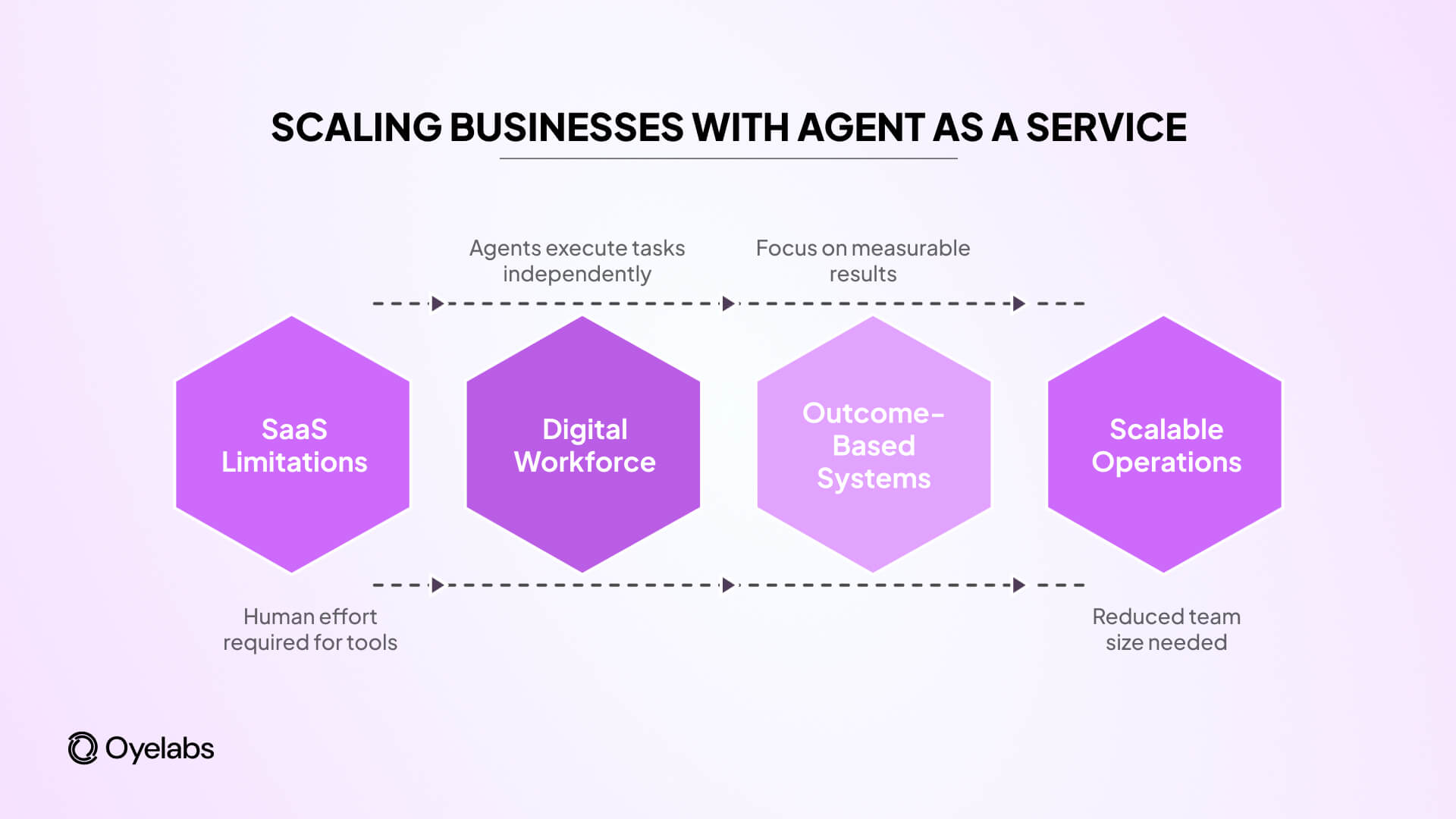
Software as a Service (SaaS) transformed how businesses access tools. However, SaaS still relies heavily on human effort to operate those tools.
AaaS represents the next stage in this evolution. It shifts the focus from providing tools to delivering outcomes.
According to Statista, the global AI market is projected to reach $1.8 trillion by 2030, driven by automation technologies like Agent as a Service.
From Tools to Digital Workers
SaaS platforms act as systems of record and engagement. They store data and provide interfaces, but they do not act independently.
AaaS introduces the concept of a digital workforce. These agents function like employees who can:
- execute predefined tasks
- analyze data and make decisions
- interact with multiple systems simultaneously
For founders, this means that scaling operations no longer requires proportional increases in team size.
Why Businesses Are Moving Toward Outcome-Based Systems
Modern businesses are increasingly focused on measurable results rather than activity.
Traditional systems track actions – emails sent, tasks completed, tickets created. AaaS systems focus on outcomes – leads converted, issues resolved, workflows completed.
This shift is important because it aligns technology investment directly with business performance.
For startups, outcome-based systems provide:
- clearer ROI from automation
- faster execution cycles
- reduced operational complexity
As competition increases, businesses that adopt outcome-driven systems gain a significant advantage.
Growth Insight: Businesses adopt AaaS when outcomes are visible. Track metrics like tasks completed, response time, and cost savings. Clear performance indicators make it easier to justify adoption and scale usage across teams.
Agent as a Service (AaaS) vs SaaS: Key Differences
Understanding the difference between AaaS and SaaS is essential for founders evaluating their technology strategy.
| Aspect | SaaS | AaaS |
| Function | Provides tools | Executes tasks |
| User Role | Active operator | Supervisor or reviewer |
| Output | Data and workflows | Completed outcomes |
| Scalability | Requires more users | Scales with agents |
| Cost Model | Subscription per user | Outcome or usage-based |
This comparison highlights a fundamental shift. SaaS platforms require human input to generate value, while AaaS systems generate value through execution.
Control vs Automation
SaaS offers greater control because humans operate every function. However, this also increases dependency on manual effort.
AaaS reduces manual involvement by automating decision-making and execution. While this increases efficiency, it requires well-defined boundaries and oversight mechanisms.
For founders, the balance lies in deploying automation where it adds value while maintaining control over critical decisions.
Cost vs Outcome Alignment
SaaS pricing is typically based on the number of users or licenses. This means costs increase as teams grow.
AaaS aligns cost with output. Businesses pay based on tasks completed or results achieved.
This model is particularly beneficial for startups because it allows them to scale operations without proportional increases in fixed costs.
Core Components of an Agent as a Service (AaaS) Platform
An AaaS platform is not a single system but a combination of components that enable autonomous operation.
These components work together to ensure that agents can understand goals, make decisions, and execute tasks effectively.
Goal Engine and Task Definition
The goal engine defines what the agent needs to achieve.
This includes:
- specific objectives
- task boundaries
- success criteria
Clear goal definition is critical. Without it, agents may produce inconsistent or irrelevant results.
Reasoning Layer and Decision-Making
The reasoning layer enables agents to process information and make decisions.
This component uses AI models to analyze data, evaluate options, and determine the best course of action.
For example, a sales agent may decide which leads to prioritize based on engagement data.
Memory and Context Awareness
Memory allows agents to retain information over time.
This includes:
- customer interactions
- past decisions
- workflow history
Context awareness ensures that agents operate intelligently rather than repeating generic actions.
Feedback Loop and Continuous Learning
A feedback loop enables agents to improve performance.
By analyzing outcomes, agents can refine their decision-making processes and optimize future actions.
This continuous improvement is essential for maintaining efficiency and accuracy.
Key Benefits of Agent as a Service (AaaS) for Startups and Enterprises
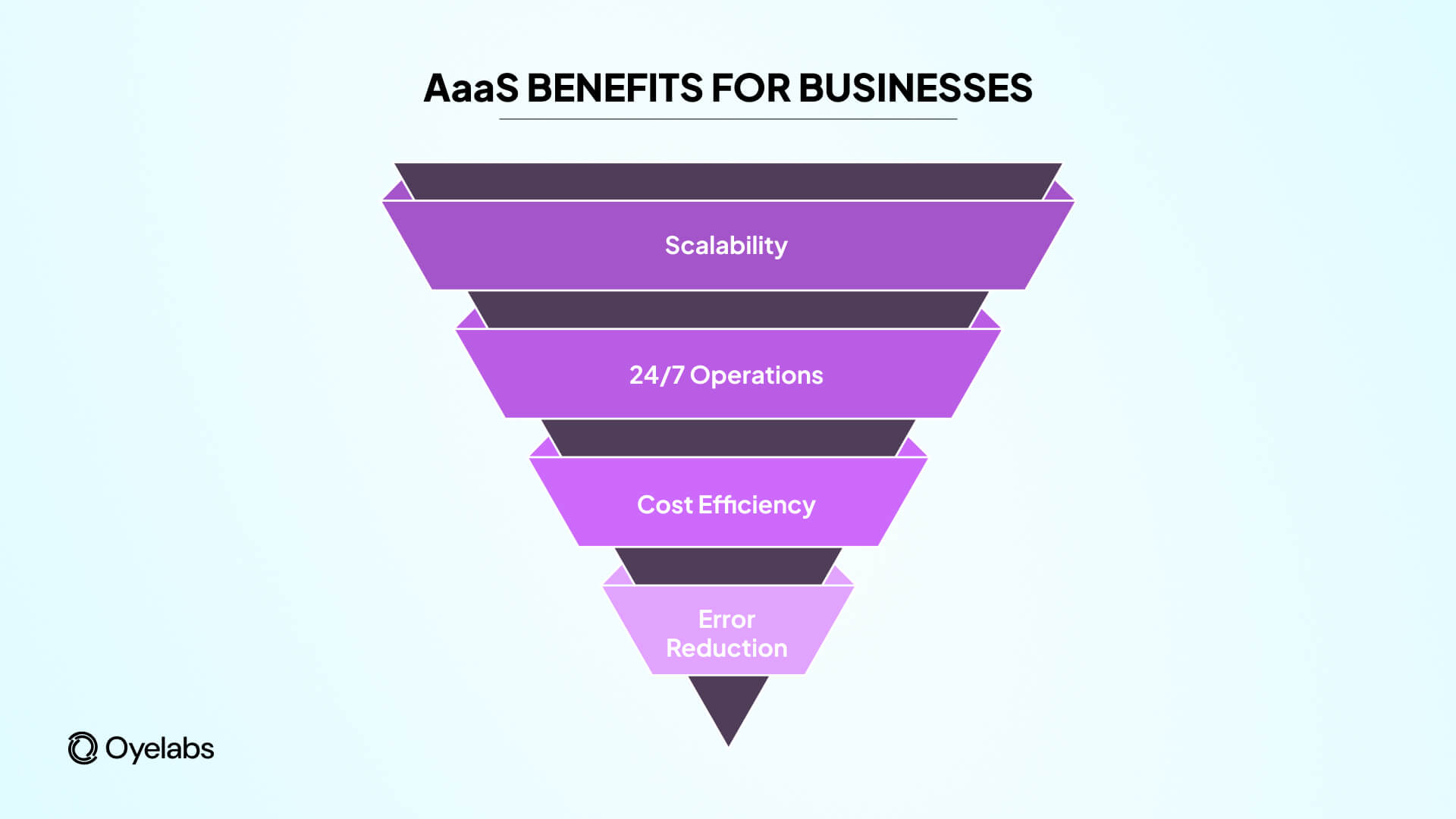
AaaS offers several strategic advantages for businesses looking to scale efficiently.
These benefits are particularly relevant for startups that need to operate with limited resources while maintaining high performance.
Scalability Without Hiring
AaaS allows businesses to scale operations without increasing team size.
Instead of hiring additional staff, companies can deploy more agents to handle increased workloads.
This approach reduces hiring costs and simplifies operational management.
24/7 Operations
AI agents can operate continuously without breaks.
This ensures that tasks such as customer support, lead generation, and data processing are handled at all times.
For global businesses, this provides consistent service across time zones.
Cost Efficiency Through Outcome-Based Models
Because AaaS often uses outcome-based pricing, businesses pay for results rather than access.
This improves cost efficiency and aligns spending with business performance.
Reduction in Human Error
Manual processes are prone to inconsistencies and errors.
AaaS systems reduce these risks by standardizing workflows and automating execution.
This is particularly valuable in areas such as compliance, finance, and operations.
Builder Tip: Avoid building a general-purpose agent platform. Start with one clear use case where automation delivers measurable outcomes quickly. Focused execution helps validate product-market fit faster and reduces unnecessary complexity in early stages.
Real-World Use Cases of Agent as a Service (AaaS)
AaaS is not limited to a single function. It can be applied across multiple business domains.
Understanding these use cases helps founders identify where agents can deliver the most value.
Customer Support Automation
AI agents can manage customer support workflows from start to finish.
They can:
- respond to inquiries
- resolve common issues
- escalate complex cases when needed
This reduces response times and improves customer satisfaction.
Sales and Lead Generation Agents
Sales agents can automate prospecting and outreach.
They can identify potential leads, personalize communication, and track engagement.
This allows businesses to maintain consistent sales activity without increasing team size.
Finance and Operations Automation
In finance, agents can handle tasks such as:
- invoice processing
- data reconciliation
- expense tracking
In operations, they can manage workflows, monitor performance, and generate reports.
Procurement and Compliance Workflows
Agents can streamline procurement processes by:
- onboarding vendors
- verifying compliance
- generating contracts
This reduces administrative overhead and ensures consistency in decision-making.
If you’re planning to move from theory to execution, follow our step-by-step guide to build AI agents and understand how to turn ideas into working systems.
How Oyelabs Helped a Founder Build an AaaS Platform and Become a Brand
A founder approached Oyelabs with a clear vision: build a platform where AI agents could handle customer engagement and lead qualification for service-based businesses. The idea was strong, but the execution required complex infrastructure, integrations, and scalable architecture.
By leveraging Oyelabs’ development expertise, the founder was able to launch an Agent as a Service platform with defined workflows, API integrations, and agent logic tailored to their niche. Instead of spending months on backend complexity, the focus shifted toward product positioning and market entry.
Within a few months of launch, the platform began attracting users. Engagement increased as businesses adopted the agents for daily operations. Impressions grew through targeted campaigns, and the platform gradually positioned itself as a reliable solution in its category – ultimately evolving into a recognized brand within its niche.
Common Mistakes Founders Make When Building AaaS Platforms
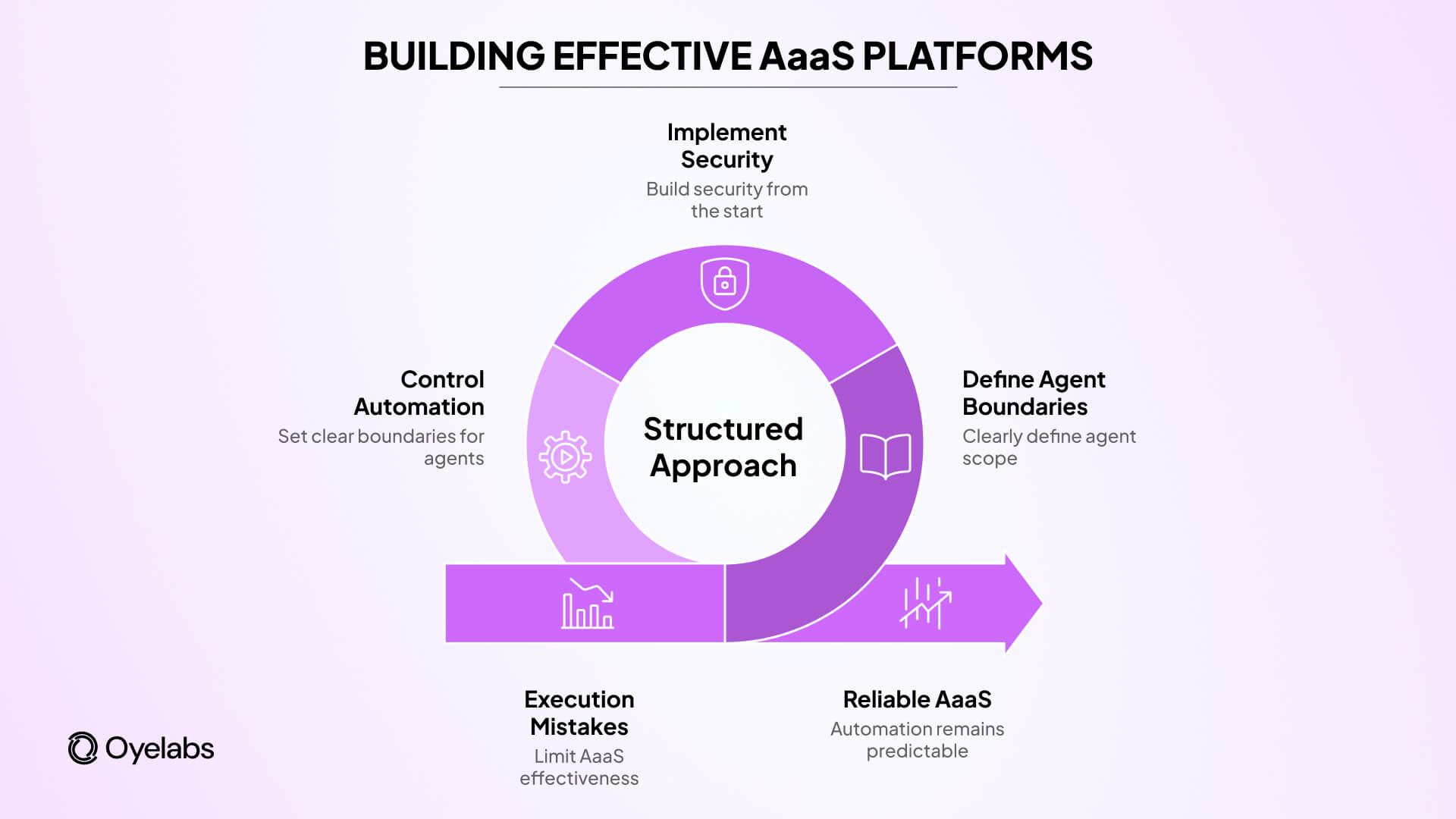
While AaaS presents significant opportunities, execution mistakes can limit its effectiveness.
Over-Automating Without Control
One of the most common mistakes is giving agents too much autonomy without clear boundaries.
Without defined constraints, agents may:
- perform unintended actions
- generate inconsistent outputs
- create operational risks
A structured approach ensures that automation remains reliable and predictable.
Lack of Clear Agent Boundaries
Agents perform best when they operate within well-defined scopes.
Ambiguous task definitions can lead to:
- inefficient execution
- incorrect decision-making
- reduced trust in the system
Founders must clearly define what the agent should and should not do.
Ignoring Security and Permissions
AaaS platforms often interact with sensitive data and critical systems.
Without proper access controls, agents may expose businesses to security risks.
Best practices include:
- role-based permissions
- limited system access
- audit logs for agent activity
Security must be built into the platform from the beginning.
Future of Agent as a Service (AaaS)
AaaS is still in its early stages, but its impact on business operations is already visible.
As AI models improve and integrations become more seamless, agents will become more capable of handling complex workflows.
Rise of Autonomous Digital Workforce
Businesses are gradually moving toward hybrid teams where human employees work alongside AI agents.
These agents will:
- handle repetitive and data-driven tasks
- support decision-making processes
- improve operational efficiency
This shift allows companies to operate with smaller teams while maintaining high productivity.
AI Agents in Every Business Function
In the future, AI agents will be embedded across all business functions.
This includes:
- marketing automation
- sales execution
- customer support
- finance operations
Instead of isolated tools, businesses will operate through interconnected systems powered by agents.
Why Startups Choose Oyelabs to Build AaaS Platforms
Building an AaaS platform requires more than just AI capability. It requires a combination of product thinking, system architecture, and execution strategy.
Oyelabs works with founders to translate ideas into scalable digital products.
Expertise in Marketplace and AI-Driven Platforms
Oyelabs has experience building platforms that combine automation, user interaction, and business workflows.
This includes:
- service marketplaces
- AI-powered applications
- automation platforms
This experience helps founders avoid common development challenges.
Faster Time to Market
Speed is critical in emerging markets like AaaS.
Oyelabs enables founders to launch platforms faster by:
- using structured development approaches
- leveraging existing frameworks
- focusing on core functionality first
This allows businesses to enter the market early and refine their product based on real usage.
Scalable and Customizable Solutions
AaaS platforms must evolve as business needs grow.
Oyelabs builds systems that allow:
- feature expansion
- integration with new tools
- scaling across industries
This flexibility ensures long-term sustainability.
Launch Your Agent as a Service Platform Today
Deploy a scalable AaaS platform designed to automate workflows and deliver real business outcomes.
✓ Launch AI agents with defined workflows and outcomes
✓ Integrate seamlessly with CRM, APIs, and business tools
✓ Automate operations, support, and sales processes efficiently
✓ Scale agent capabilities without increasing operational complexity
Conclusion
The transition from software tools to autonomous systems is already underway. Businesses are increasingly looking for solutions that can execute tasks rather than simply assist users.
For founders, this presents a strategic opportunity to build platforms that deliver measurable outcomes through AI agents.
Launching an AaaS platform does not require starting from zero. With the right development partner, it is possible to build, test, and deploy a scalable system without navigating the full complexity of AI infrastructure alone.
Oyelabs provides the technical expertise and product development support required to turn an idea into a functional AaaS platform. By combining structured development with a clear focus on business outcomes, founders can launch faster and position themselves effectively in a growing market.
If you are planning to build your own Agent as a Service platform, the next step is to move from concept to execution with a system designed for scale and real-world impact.
FAQs
What are the biggest risks when deploying AI agents in real business workflows?
The biggest risks include uncontrolled automation, incorrect decision-making, and security vulnerabilities. Without defined boundaries and human oversight, agents may execute unintended actions. Startups should implement role-based access, approval layers, and monitoring systems to ensure safe and predictable agent behavior.
How do businesses measure ROI from an Agent as a Service platform?
ROI is typically measured through outcomes such as reduced operational costs, faster task completion, improved conversion rates, and lower dependency on human resources. Tracking metrics like task automation rate, response time, and cost per outcome helps evaluate real performance.
What industries are best suited for adopting Agent as a Service models early?
Industries with repetitive workflows and high operational volume benefit the most. This includes customer support, sales, finance operations, procurement, and logistics. These sectors see faster adoption because agents can immediately replace manual processes with measurable efficiency gains.
What level of human oversight is required when using autonomous AI agents?
Most AaaS platforms operate with a hybrid model. Agents handle routine tasks independently, while high-risk or sensitive decisions require human approval. This “human-in-the-loop” approach ensures accuracy, accountability, and controlled automation without compromising efficiency.