
Biggest Mistakes The I See in Creator Economy Platforms
Biggest Mistakes The I See in Creator Economy Platforms
 Anuraag Jain
Last Updated on April 6, 2026
Key Takeaways What You’ll Learn: Stats That Matter:
Over the past 6 years, working directly with founders building creator monetization platforms has given me a clear view of what it actually takes to launch and scale in this category. The creator economy is no longer a niche experiment. It is a serious industry attracting significant capital, and creator economy platforms like OnlyFans, Fansly, and JustForFans have proven that the model works at scale.
But for every platform that gains traction, many others fail to make it past the first year. In most cases, the reasons are not dramatic. It is rarely a bad idea or a weak team. More often, it comes down to avoidable mistakes made at the wrong stage of the build.
This article breaks down eight of the biggest mistakes that consistently show up across early-stage creator platforms. If you are building in this space right now, these are the areas where getting the fundamentals right will make the biggest difference.
Biggest Mistakes in Creator Economy Platforms
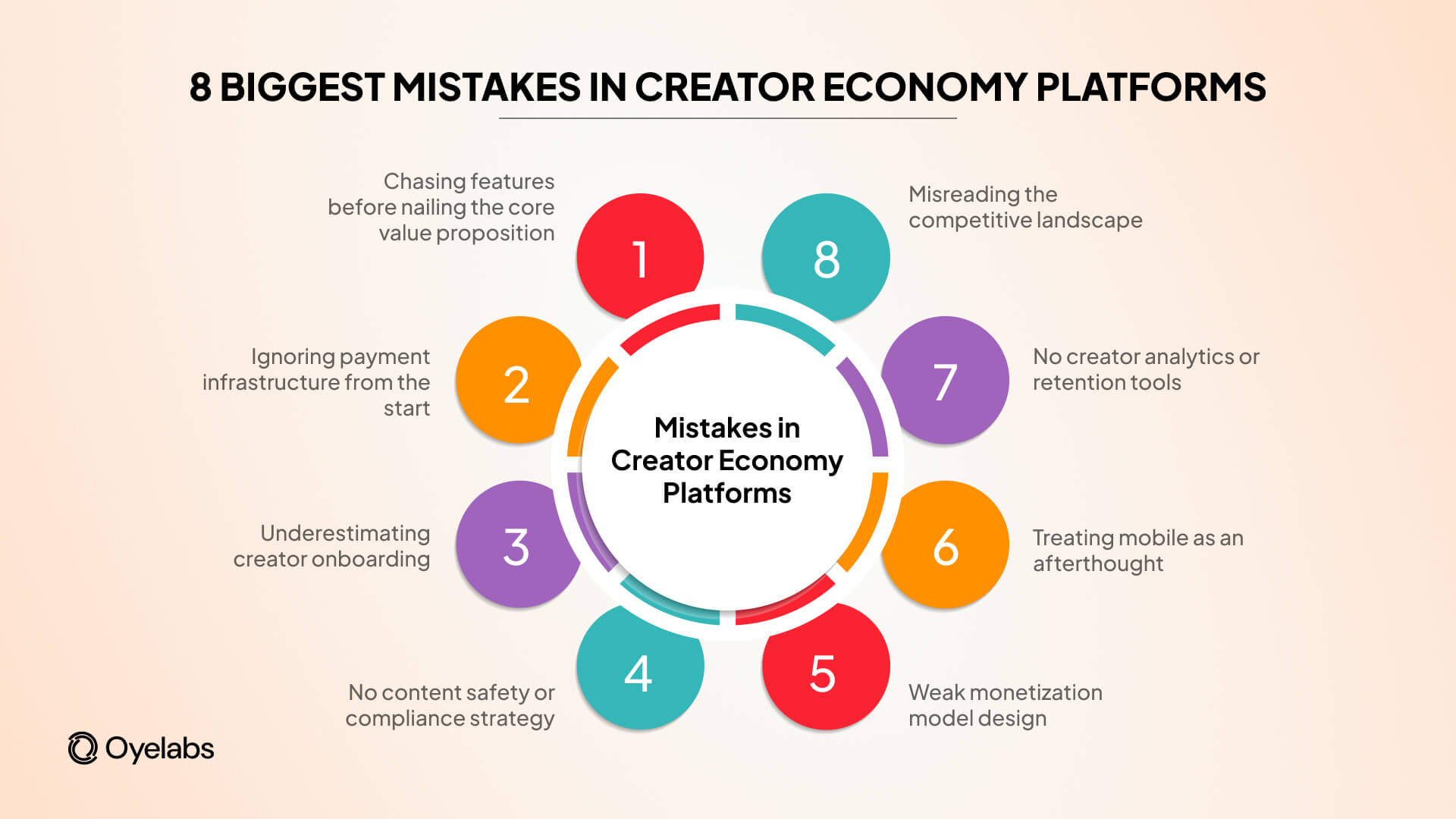
1. Chasing features before nailing the core value proposition
This is the single most common and the biggest mistake I see. Founders often come in with an ambitious roadmap: live streaming, AI-powered recommendations, gamified tipping, referral programs, all planned for launch. The intent is strong, and the energy is real. But trying to build everything at once usually leads to a product where nothing works well enough to keep people around.
Take OnlyFans as an example. It started with a simple model: subscriptions and direct tips. It did not become dominant because it offered more features than everyone else. It grew because it solved one problem exceptionally well by helping creators get paid directly by their fans, without intermediaries.
Where most platforms go wrong
- Trying to launch with too many features at once
- Prioritizing feature count over product reliability
- Ignoring core user flows like subscriptions and payouts
- Shipping partially built features just to “go live” faster
The real issue is not lack of features, but lack of reliability. Many platforms end up shipping too much at once, but at partial quality. In practice, this means creators encounter slow uploads, broken payout flows, or confusing subscription steps. These are the kinds of issues that directly impact trust, and once that trust is lost, users rarely come back.
What this looks like in reality
We saw this play out with one client who approached us six months into their build. They had already developed live streaming, a creator shop, a DM tipping system, and a referral module. On paper, it looked complete. In reality, none of these features were stable.
After two rounds of creator testing, the feedback was consistent:
- The core subscription flow felt unfinished
- Creators could not reliably access their earnings
- Early users started dropping off quickly
The solution was not to add more features. It was to pause, step back, and fix the fundamentals. We helped them focus on stabilizing the core experience first, ensuring subscriptions worked smoothly and payouts were dependable. Only after rebuilding that foundation did it make sense to expand further. That reset cost them four months they could have avoided.
What you should do instead
- Define your core creator-to-fan transaction first
- Make subscriptions and payouts completely frictionless
- Focus on stability before adding new features
- Launch with fewer features, but at full quality
Before writing a single line of code or choosing a creator marketplace script, define the core loop your platform enables. Identify the primary interaction between creator and fan, and make sure that experience is seamless. Everything else can come later.
2. Ignoring payment infrastructure from the start
Payment processing for creator subscription platforms is one of the hardest infrastructure problems you will face. It has quietly ended more promising platforms than any technical issue ever has.
Most mainstream processors come with strict policies, especially around adult content. Platforms that overlook this early often build their entire product on a payment stack that cannot support them once they begin to scale.
Where most platforms go wrong
- Choosing a payment provider without reviewing content restrictions
- Building the checkout flow before validating compliance requirements
- Assuming mainstream processors will work in the short term
- Ignoring chargebacks and dispute handling early on.
Payment provider comparison
| Payment Provider | Adult Content Support | Notes | Risk Level |
|---|---|---|---|
| Stripe | Restricted | Prohibited for explicit content; account closures are common | High |
| Segpay | Supported | Specialized in subscription billing for adult platforms | Low |
| Epoch | Supported | Established provider with global reach | Low |
| CCBill | Supported | Widely used across major platforms | Low |
| PayPal | Restricted | Explicit prohibition in terms of service | Very High |
A common scenario
A team builds their entire checkout flow on Stripe, launches successfully, and starts onboarding creators. Early traction looks promising, and everything appears to be working as expected. Then, within a few weeks, the account gets flagged and suspended due to policy violations.
The impact is immediate and difficult to recover from:
- Payments stop without warning
- Creators lose confidence in the platform
- Rebuilding the payment system becomes urgent and costly
- Growth momentum slows at a critical stage
This is not just a technical issue. It directly affects trust, which is much harder to rebuild once lost.
How to approach this correctly
- Validate payment provider policies before building your backend
- Choose processors that clearly support your content category
- Design your system with flexibility to switch providers if needed
- Set up chargeback and dispute handling systems from day one
Integrating compliant payment infrastructure early is essential. Creator subscription platforms typically face higher dispute rates than standard e-commerce, which makes proactive systems critical from the beginning.
Getting this right ensures stability, protects creator trust, and allows your platform to scale without unnecessary disruptions.
3. Underestimating creator onboarding
Platforms live and die by the supply side. If your creators cannot set up a profile, configure pricing, upload content, and start earning within 30 minutes of signing up, you are losing them before they ever bring a single fan onto your platform.
Many founders focus heavily on the consumer-facing experience and then ship a creator dashboard that feels complex and unintuitive. That approach is backwards. Creators are the product. Fans only show up because creators are active and earning. If onboarding is slow or confusing, your supply disappears before demand even has a chance to build.
Where most platforms go wrong
- Treating creator onboarding as a secondary flow
- Adding too many steps before creators can start earning
- Relying on manual verification processes that create delays
- Providing no guidance on pricing or first content
A real onboarding breakdown
A client building a fitness-focused creator platform ran an onboarding session with 12 invited creators. Out of those, eight dropped off before completing profile setup.
The biggest issue was the KYC step. It was handled manually and took over 20 minutes, creating immediate friction. By the time the problem was identified and fixed using an automated verification solution, three of the original creators had already moved to another platform.
This highlights a critical point. Onboarding is not just a UX issue. It is an early retention problem that shows up before your platform even has active users.
How to approach this correctly
- Reduce time to first earning as much as possible
- Automate identity verification instead of relying on manual review
- Guide creators with clear steps instead of leaving them to figure things out
- Prioritize payout setup early to build trust
Creator onboarding checklist
- Identity verification (KYC): Avoid manual delays, use automated tools like Veriff or Onfido
- Profile setup: Limit required fields, use progressive disclosure
- Pricing configuration: Provide suggested pricing tiers based on content type
- First content upload: Add a simple onboarding wizard with prompts
- Payout setup: Introduce early and make it a priority step
Getting onboarding right creates immediate momentum. When creators can set up quickly and start earning without friction, they are far more likely to stay, invite their audience, and grow on your platform.
Also Read: Why OnlyFans Alternatives Keep Getting Shut Down
4. No content safety or compliance strategy
This is where even well-funded platforms get caught off guard. Building a creator platform that supports adult content requires a strong compliance and moderation system, yet many founders delay thinking about this until issues start appearing.
Regulatory requirements are not static. They vary by region and continue to evolve. Age verification laws, platform liability rules, and data privacy standards all apply here. Ignoring these is not a minor risk. It can lead to platform shutdowns, not just penalties.
Where most platforms fall short
- Treating compliance as something to handle after launch
- Relying on basic or unchecked age verification methods
- Not defining clear content boundaries early
- Ignoring legal differences across regions
What your platform must include
- Verified age checks for both creators and subscribers
- Automated systems to detect and flag content violations
- A human moderation layer for edge cases and appeals
- Clear Terms of Service outlining prohibited content
- A DMCA-compliant takedown and response process
- Strong data privacy practices for handling user information
Platforms like OnlyFans and Fansly invest heavily in trust and safety operations. This is not a feature that sets you apart. It is a basic requirement to operate in this category.
Getting this right early protects your platform, builds trust with creators, and ensures you can scale without regulatory setbacks.
5. Weak monetization model design
Most founders default to the OnlyFans blueprint: a monthly subscription plus tips. That model works, but it also creates a ceiling. Platforms gaining traction are building layered monetization systems that support different creator styles and fan spending behaviors.
Relying on a single revenue stream limits both creator earnings and platform growth. In fact, over 70% of creators now use multiple income streams to maximize earnings and diversify risk, highlighting the importance of flexibility in monetization.
Where most platforms go wrong
- Relying only on subscriptions and tips
- Not supporting different creator monetization styles
- Limiting earning flexibility for creators
- Treating platform commission as the only revenue stream
Revenue model comparison
| Revenue Model | Best For | Typical Platform Cut | Creator Control |
|---|---|---|---|
| Monthly Subscriptions | Consistent content creators | 15–20% | Medium |
| Pay-per-view Content | Premium drops | 15–20% | High |
| Tips & Gifting | Live and DM engagement | 10–15% | High |
| Custom Content | Niche/high earners | ~15% | Very High |
| Referral Commissions | Network-driven growth | Varies | Medium |
A better approach
- Offer multiple monetization options from the beginning
- Allow creators to combine different revenue streams
- Support both recurring and one-time payments
- Introduce platform-side revenue like featured listings or premium tools
The platform cut should not be your only source of revenue. Additional layers such as premium analytics, promotional placements, and featured discovery can generate income without affecting the core creator relationship.
A strong monetization system does not just increase revenue. It gives creators more control, which directly improves retention and long-term platform growth.
6. Treating mobile as an afterthought
The majority of content consumption and creator activity on these platforms happens on mobile. Yet many platforms still approach product design from a desktop-first perspective and adapt later.
Over 70% of global internet traffic now comes from mobile devices, which makes mobile performance and usability a critical factor in how users experience any platform. This creates a disconnect between how the product is built and how it is actually used.
Where most platforms go wrong
- Designing the full experience for desktop first
- Trying to compress complex workflows into smaller screens later
- Ignoring real-world mobile usage conditions
- Offering limited functionality on mobile compared to desktop
Common mistake
Designing for desktop first, then trying to fit everything into a mobile experience
Creators manage their communities on the go. Uploading content, replying to messages, and tracking earnings all happen in short, frequent sessions. If any of these actions feel slow or broken on a phone, creators will switch to a platform that works better. Fans behave the same way.
How to approach this correctly
- Design the entire product with a mobile-first mindset
- Ensure core actions work smoothly on smaller screens
- Keep workflows simple and intuitive for quick interactions
- Test the full creator journey on mobile, not just individual features
Mobile-first is not a preference. It is a core product requirement. Whether you build native apps or progressive web apps, the experience must feel seamless on a phone from day one.
Note: Apple’s App Store has strict policies around adult content. Explicit content must be gated outside the app. This should be planned early in your distribution strategy to avoid delays or rejections later.
7. No creator analytics or retention tools
What separates platforms that creators stay on from those they eventually leave is simple: feedback loops. Most early-stage platforms provide very limited insights, leaving creators unsure of what is working and what is not.
As more creators enter the space, the ability to understand performance becomes even more important. Creators are not just looking for a place to post content. They want to know what drives engagement, what converts into earnings, and how their audience is growing over time.
Where most platforms fall short
- Offering only basic metrics like total earnings or subscriber count
- Not showing which content drives engagement or revenue
- Providing no visibility into audience behavior
- Ignoring tools that help creators improve performance
A real example
We worked with a client facing high creator churn within the first three months. The issue was not earnings. It was a lack of visibility. Creators could not tell what was working, which content was performing well, or whether their audience was growing.
After introducing a simple analytics dashboard with subscriber trends, top-performing content, and revenue breakdown, retention improved significantly within two months. Creators started posting more consistently once they had clear feedback.
What to Prioritize in Analytics
- Subscriber growth tracking – Know how audiences change over time
- Revenue breakdown by content type – Understand what drives income
- Content performance metrics – Identify which posts engage and convert
- Churn and retention rates – Spot creators at risk of leaving
- Fan engagement scoring – Measure meaningful interactions
Providing clear, actionable data is essential for retention and long-term growth. Creators stay when they understand what works and can improve their performance.
8. Misreading the competitive landscape
Many founders assume they need to compete directly with OnlyFans. That is rarely the right move, especially in the early stages.
The creator economy is large and still expanding, with projections crossing $500 billion by 2027. This means you do not need to beat the biggest platform. You need to own a specific niche and serve it better than anyone else.
Where most founders go wrong
- Trying to build a generic platform for all creators
- Competing on price instead of differentiation
- Copying features without a clear positioning
- Overlooking niche-specific needs
The creator economy is not one uniform market. It is made up of focused segments. Platforms like Fansly, JustForFans, and Fanvue gained traction by targeting specific audiences and building around their needs instead of trying to serve everyone.
Underserved niches to consider
- Fitness and wellness creators
- Independent musicians
- Educators and skill-based creators
- Regional markets with limited localization
- Collaborative creator accounts
The right question to ask
Which creator segment is underserved right now, and what would a platform built specifically for them look like? Focusing on a niche gives you clearer positioning, faster traction, and a more defined product roadmap from the start.
Also Read: Top Successful Niche Subscription Content Platforms
Ready to Build a Creator Platform That Works?
Avoid common pitfalls like weak monetization, poor onboarding, or unstable payments. At Oyelabs, we help founders launch fully functional OnlyFans clones in just 30 days, with free OST and post-launch support. Our white-label and custom-built solutions focus on the fundamentals, smooth subscriptions, reliable payouts, mobile-first design, and layered monetization so creators stay engaged and your platform grows. Don’t risk feature bloat or compliance missteps. Let’s talk about building a platform that avoids the mistakes outlined in this article and sets you up for long-term success.
Conclusion
Building a creator economy platform in 2025 is complex. The competition is stronger, and the margin for error is smaller. But most failures are predictable. Feature bloat. Weak payments. Poor onboarding. Ignored compliance. The client stories in this article are patterns, not exceptions. The founders who get the fundamentals right early are the ones who scale successfully. If you are building right now, treat this as a product audit.
FAQs
1. Why do creators leave new platforms quickly?
Creators leave when payouts fail, onboarding is confusing, or earnings are delayed, making trust break early and pushing them to more stable platforms.
2. What causes payment failures in creator platforms?
Payment failures happen due to wrong provider choice, compliance issues, high chargebacks, or lack of proper subscription billing infrastructure from the start.
3. Why do onboarding flows fail for creators?
Onboarding fails when it takes too long, requires manual steps, or lacks guidance, preventing creators from earning quickly and reducing early platform retention.
4. What makes a creator platform fail in the first year?
Most platforms fail due to weak core features, poor payments, lack of niche focus, and ignoring creator experience during early product development stages.
5. Why is choosing the right niche important for creator platforms?
Without a clear niche, platforms struggle to attract users, compete with established players, and build strong communities that drive long-term engagement and growth.