
How I Choose the Right Tech Stack for Fiverr-Like Platforms
How I Choose the Right Tech Stack for Fiverr-Like Platforms
 Anuraag Jain
Last Updated on April 14, 2026
Key Takeaways
What You’ll Learn:
- Fiverr-like platforms are transaction-based marketplaces, not simple websites
- Tech stack decisions should follow business model, not trends
- MVP helps launch faster and test real user demand
- White-label platforms reduce time and development cost
- Custom development is needed only after validation
Stats That Matter:
- 42% startups fail due to lack of market demand
- Freelance economy continues growing globally year over year
- Marketplace platforms rely heavily on repeat transactions
- Payment and escrow systems are core to platform trust
- Faster launch increases chances of early traction
Real Insights:
- Build workflows first, then choose technology stack
- Launch early to learn from real user behavior
- Avoid overengineering in initial product version
- Focus on transactions, not just features
- Marketplace success depends on trust and execution
How I Choose the Right Tech Stack for Fiverr-Like Platforms
Everyone wants to build the next Fiverr. Few understand what actually powers it.
A Fiverr-like platform is not just a website with listings-it is a structured marketplace driven by workflows, transactions, and trust systems. Over the years, working with 300+ founders across global markets has revealed a consistent pattern: most tech stack decisions are made too early, and often for the wrong reasons.
Founders tend to focus on tools-React, Node, Flutter-without first defining how gigs, proposals, payments, and user interactions will function together. That gap leads to delays, rework, and unnecessary cost.
Choosing the right tech stack for a freelance marketplace is less about technology and more about alignment between business model, execution speed, and scalability. When approached correctly, even non-technical founders can build and launch strong marketplace platforms without overengineering.
Most Founders Choose the Wrong Tech Stack for Fiverr-Like Platforms
The first decision most founders make is also the one that creates the most long-term friction: choosing a tech stack too early.
Instead of asking how the platform should function, founders ask:
- Should it be built in React or Angular?
- Should backend be Node or Laravel?
- Should mobile apps be native or cross-platform?
These are implementation questions, not business decisions.
A Fiverr-like platform operates as a transaction engine, not just a content platform. If the underlying workflows are unclear, even the best tech stack will fail to deliver value.
The wrong stack rarely breaks the product immediately. It slows down iteration, complicates changes, and increases dependency on developers over time.
What a Fiverr-Like Platform Actually Needs (Before Talking About Tech Stack)
Before choosing any technology, it is important to understand what the platform must do.
Online gig work already accounts for up to 12% of the global labor force, which shows how large the opportunity is for well-structured freelance marketplaces.
A Fiverr-like marketplace consists of three critical layers:
| Layer | Purpose |
| Marketplace Layer | Connects clients and freelancers |
| Transaction Layer | Handles payments, escrow, commissions |
| Communication Layer | Enables messaging, updates, collaboration |
Each layer must function seamlessly for the platform to work.
At a minimum, the system must support:
- Gig creation and browsing
- Job posting and proposal submission
- Secure escrow-based payments
- Real-time messaging between users
- Ratings and reviews
Without these systems working together, the platform cannot operate as a marketplace.
The Pattern Seen Across Founders Building Freelance Marketplaces
Across multiple founder journeys, similar mistakes appear repeatedly.
Most founders approach marketplace development with a product mindset instead of a systems mindset.
Common patterns include:
- Replicating Fiverr’s UI instead of understanding workflows
- Prioritizing design over backend logic
- Ignoring payment and escrow complexity
- Attempting full custom builds from day one
This creates a disconnect between what the platform looks like and how it functions.
The result is predictable-delays, budget overruns, and platforms that struggle to handle real transactions.
Growth Insight: Copying Fiverr’s design is easy. Replicating its transaction flow is not.
The Framework Used to Choose the Right Tech Stack for Fiverr-Like Platforms
Choosing the right tech stack is not about selecting technologies. It is about structuring decisions.
1. Start With Business Model, Not Technology
Every marketplace operates differently.
Before selecting a stack, define:
- Fixed gig model vs bidding system
- Service packages vs custom projects
- Commission structure
These decisions influence backend logic far more than frontend tools.
2. Define Core Marketplace Workflows First
The system must clearly support:
- Gig purchase flow
- Job posting and proposal process
- Milestone-based payments
- Dispute handling
Without defining these workflows, tech decisions become guesswork.
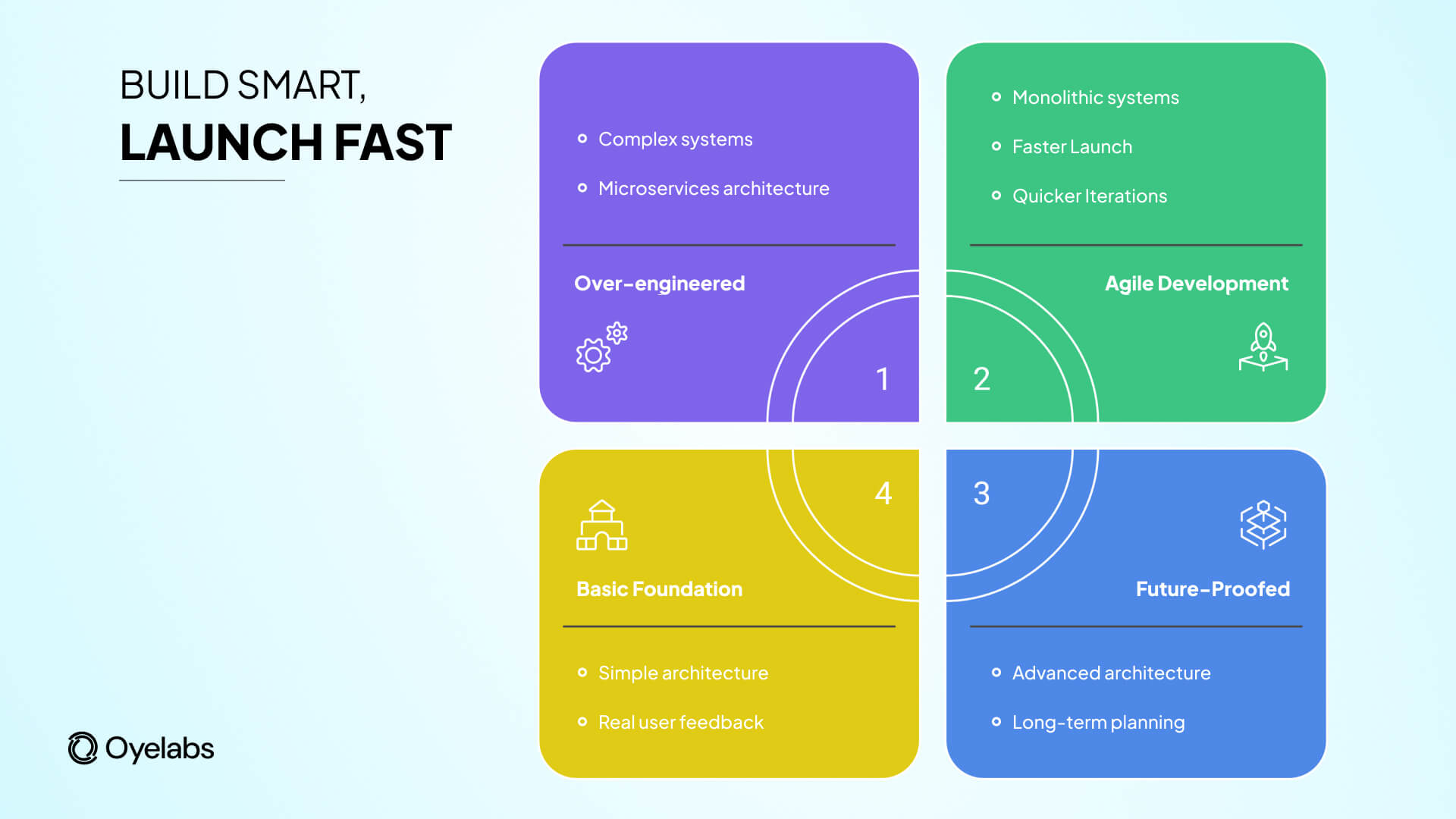
3. Choose Based on Speed, Not Just Scalability
Early-stage platforms need:
- faster launch
- quicker iterations
- real user feedback
Scalability becomes relevant only after validation.
4. Avoid Overengineering Early
Many founders assume complex architecture is required from day one.
In reality:
- monolithic systems work well initially
- microservices add unnecessary complexity early
- simple architecture reduces development time
5. Ensure Tech Stack Supports Monetization
Revenue systems are often overlooked.
A Fiverr-like platform must support:
- commission calculations
- escrow-based payments
- wallet systems
Without these, the platform cannot generate or manage revenue effectively.
What a Real Tech Stack for a Fiverr-Like Platform Looks Like
Once the structure is clear, the tech stack becomes easier to define.
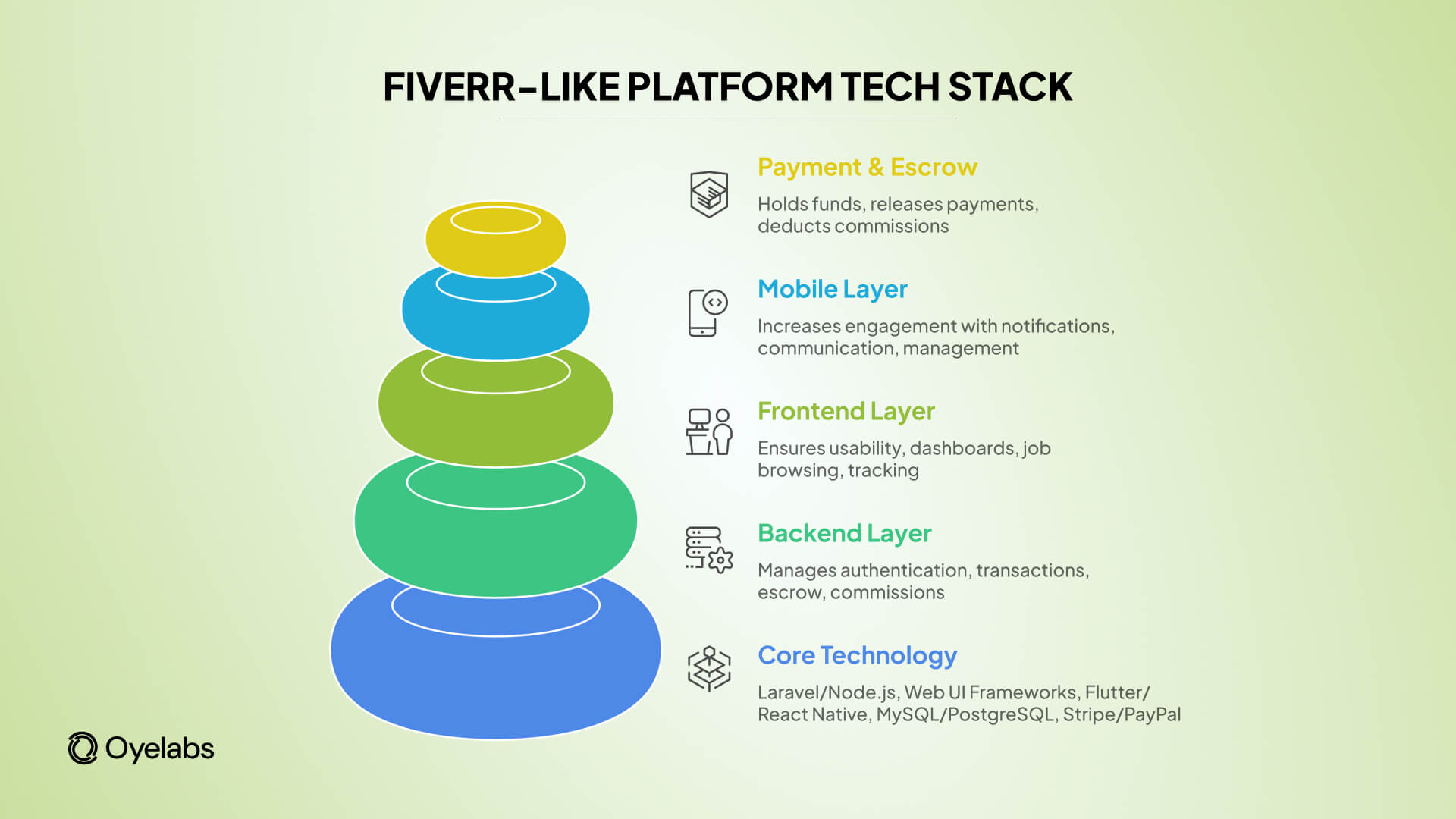
Core Technology Stack Overview
| Component | Typical Technology |
| Backend | Laravel / Node.js |
| Frontend | Web UI Frameworks |
| Mobile Apps | Flutter / React Native |
| Database | MySQL / PostgreSQL |
| Payments | Stripe / PayPal |
Backend Layer
The backend manages:
- user authentication
- transaction logic
- escrow workflows
- commission calculations
This is the most critical layer of the platform.
Frontend Layer
The frontend ensures usability:
- dashboards for clients and freelancers
- job and gig browsing
- transaction tracking
It must be intuitive but does not define the core functionality.
Mobile Layer
Mobile apps increase engagement:
- real-time notifications
- easier communication
- on-the-go project management
Cross-platform frameworks like Flutter reduce development time while maintaining performance.
Payment and Escrow Systems
A Fiverr-like platform requires structured payment handling:
- funds are held in escrow
- payments are released upon completion
- commissions are automatically deducted
This builds trust and ensures platform reliability.
Why Most Founders Should NOT Start With Custom Development
Custom development appears attractive because it offers full control.
However, it introduces several challenges:
- long development timelines (4–6 months or more)
- high upfront costs
- continuous dependency on development teams
- unclear outcomes in early stages
For early-stage founders, this often leads to delays without validation.
A working platform that enables transactions is more valuable than a custom system that is still under development.
For founders who understand the stack decision but need the actual build sequence, this step-to-step guide to building a platform like Fiverr is the logical next read.
Founder Insight: If real users are not transacting yet, custom development will only delay validation and increase costs.
The Smarter Approach: Start With a Structured Platform
A structured platform eliminates the need to build core systems from scratch.
Instead of focusing on development, founders can focus on execution.
A ready-built marketplace system typically includes:
- gig and job workflows
- escrow and wallet systems
- user dashboards
- admin controls for monetization
These systems are essential for running a freelance marketplace and are often the most complex to build independently.
This approach allows founders to:
- launch faster
- reduce technical risk
- focus on acquiring users and generating revenue
When Custom Tech Stack Actually Makes Sense
Custom development becomes relevant at a later stage.
It is justified when:
- the platform has validated demand
- user base is growing consistently
- unique features are required
Examples include:
- advanced recommendation engines
- large-scale traffic optimization
- complex integrations with third-party systems
At this stage, the business has enough clarity to justify deeper technical investment.
What Every Founder Gets Wrong About Tech Stack Decisions
Tech stack decisions are often driven by perception, not logic.
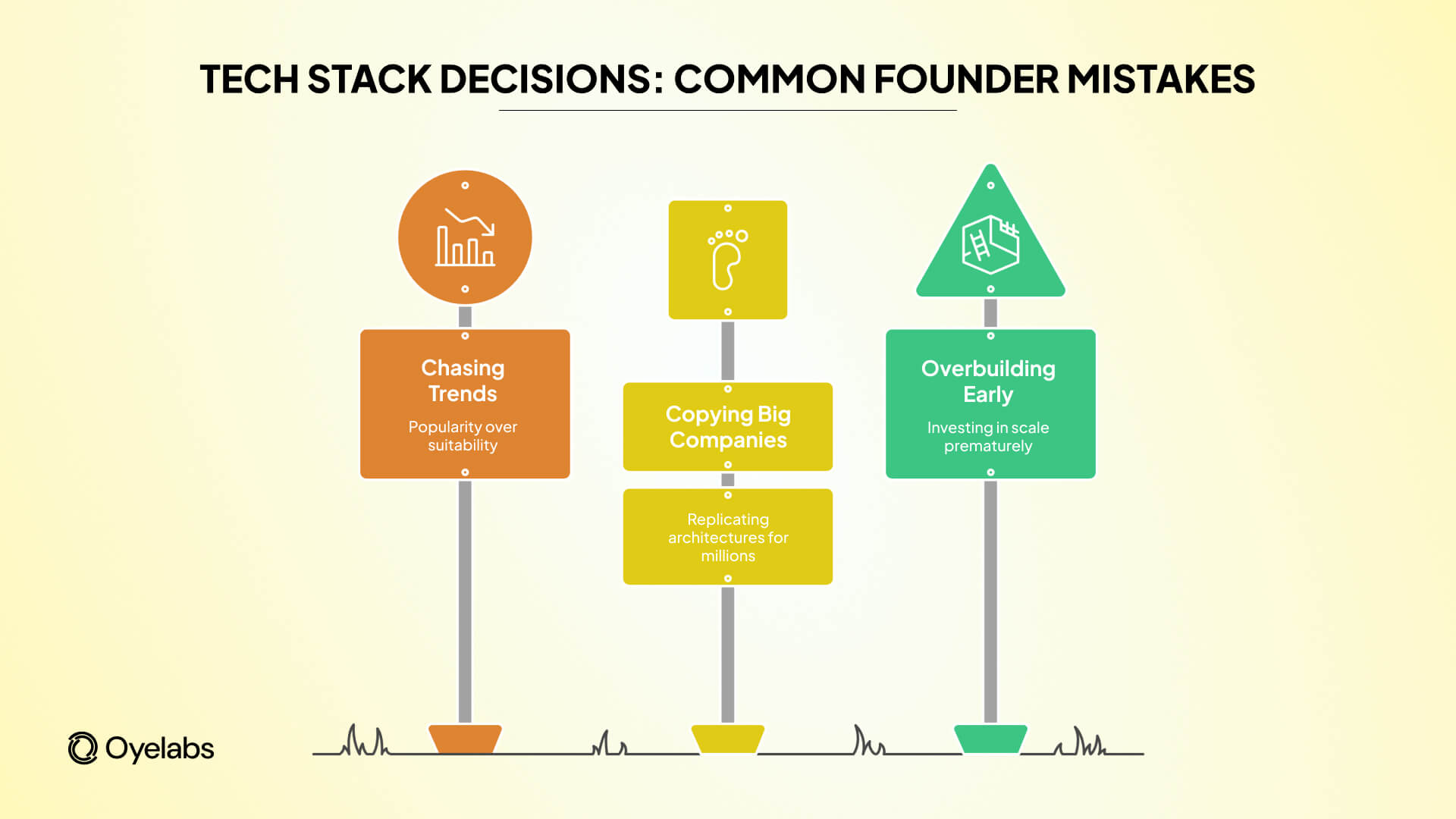
Three patterns show up repeatedly:
- Chasing trends – selecting technologies because they are popular, not because they fit the use case
- Copying big companies – trying to replicate architectures designed for millions of users
- Overbuilding early – investing in scale before the platform has users
This creates unnecessary complexity.
A freelance marketplace does not fail because of a basic stack. It fails when the system cannot support transactions smoothly.
The underlying truth is simple:
Fiverr did not start with the stack it has today.
It evolved with usage, demand, and scale. Early decisions were likely driven by speed and practicality, not perfection. The same principle applies to every founder building a marketplace today.
How Oyelabs Helps Founders Make the Right Tech Decisions
Making the right tech decision is less about tools and more about structure.
Most founders do not need a custom-built system from day one. They need a platform that allows real transactions to happen-gigs to be purchased, projects to be assigned, and payments to be processed securely.
At Oyelabs, the focus remains on:
- enabling a working marketplace quickly
- reducing unnecessary development time
- ensuring the platform can scale when needed
Over time, working with founders across multiple geographies has shown a clear pattern: those who launch faster, with a structured system, reach clarity sooner.
With experience across 300+ founders globally, the emphasis has always remained the same: build what is necessary to operate, then evolve based on real usage.
A Founder Journey: From Idea to Live Freelance Marketplace
A typical journey begins with a familiar idea: building a platform similar to Fiverr.
At the start, the focus is almost always on features-what the platform should include, how it should look, and which technologies should be used.
This phase is often marked by confusion:
- uncertainty around tech stack choices
- difficulty in prioritizing features
- hesitation in committing to development
Progress begins when the focus shifts from “what to build” to “how it will work.”
A structured approach changes the trajectory:
- defining how gigs will be created and purchased
- enabling proposal-based hiring workflows
- setting up a simple but reliable payment flow
Once launched, the real learning begins.
Users interact with the system. Transactions take place. Gaps become visible.
With each iteration:
- workflows improve
- trust increases
- usage becomes consistent
The platform moves from concept to a functioning marketplace, not because of complex technology, but because it supports real interactions.
The One Insight Most Founders Realize Too Late
There is a point where every founder reaches the same realization:
Technology does not build marketplaces.
Workflows do.
A freelance platform succeeds when:
- users can find value quickly
- transactions happen without friction
- trust is built through consistent outcomes
Without these, even the most advanced tech stack fails to create impact.
Understanding these early changes how decisions are made, from focusing on tools to focusing on execution.
Launch Your Freelance Marketplace Without Guesswork
Start with a proven system designed to run real transactions from day one.
✓ Pre-built marketplace system with gigs, proposals, and payments
✓ Secure escrow, wallet, and commission logic already integrated
✓ Faster launch timeline compared to custom development approacht
✓ Scalable system designed for long-term marketplace growth
Final Thought
The right tech stack for a Fiverr-like platform is not the most advanced one – it is the one that gets you live, enables real transactions, and supports continuous learning. Founders building with Oyelabs’ Fiverr clone approach benefit from starting with a revenue-ready system where core workflows – gigs, proposals, escrow, and payments – are already structured.
This eliminates months of unnecessary development, allowing immediate focus on user acquisition and marketplace growth. Every successful freelance platform evolves with usage, not assumptions. The early advantage comes from speed, clarity, and the ability to iterate based on real demand.
Technology should act as an enabler, not a bottleneck. When the foundation is right, founders can scale confidently without rebuilding the core system from scratch.
FAQs
What is the best tech stack for building a Fiverr-like platform in 2025?
The best tech stack depends on the stage of the platform. Early-stage founders benefit from structured or white-label solutions that support core workflows like gigs, payments, and messaging. Custom stacks using Laravel, Node, or React are more suitable once the platform has validated demand and requires scalability.
Should non-technical founders build a freelance marketplace from scratch?
Building from scratch is not recommended at the early stage. It increases cost, delays launch, and adds complexity. Non-technical founders should focus on launching a functional platform quickly using pre-built systems, then move to custom development only after achieving traction and validating the marketplace model.
What are the most important features in a Fiverr-like marketplace platform?
Core features include gig listings, job posting, proposal submission, escrow payments, messaging, and review systems. These features enable transactions and build trust between users. Advanced features like analytics or AI recommendations can be added later once the platform has consistent user activity and revenue generation.
How long does it take to build a Fiverr-like platform with the right tech stack?
Using structured platforms, founders can launch within a few weeks. Custom development typically takes 4 to 6 months depending on complexity. The timeline depends on how much of the system is built from scratch versus using pre-built marketplace components that already support transactions and workflows.