
How to Build an App Like Porch for Home Services
How to Build an App Like Porch for Home Services
 Anuraag Jain
Last Updated on May 4, 2026
Key Takeaways
What You’ll Learn:
- Porch-like apps connect homeowners with verified local service professionals.
- A strong platform needs customer, provider, and admin systems.
- Trust, reviews, and provider quality drive repeat bookings.
- White-label platforms reduce development cost and launch time.
- Founders should launch one niche before expanding categories.
Stats That Matter:
- Online home services may reach $14.7 billion by 2030.
- The market is expected to grow at 16.7% CAGR.
- India’s online home services market may cross $1 billion by 2030.
- Mobile-first booking is a major growth driver.
- Reviews strongly influence local service buying decisions.
Real Insights:
- Home service apps grow when users trust providers enough to rebook.
- Provider supply is as important as customer demand.
- Too many categories at launch create operational confusion.
- Fast MVP launch helps founders learn from real bookings.
- Simple workflows beat complex features in early marketplaces.
How to Build an App Like Porch for Home Services
Need a plumber at 8 PM?
Most people are not opening a phone book – they are opening an app. That shift is exactly why platforms like Porch gained traction. A Porch-like home services app turns fragmented local services into a trusted digital marketplace where homeowners can book professionals in minutes.
Over years of helping founders launch marketplace products across multiple countries, one pattern is clear: speed, trust, and clean workflows matter more than flashy features. The right platform combines customer booking flows, provider dashboards, admin controls, payments, notifications, and location-based matching into one scalable system.
For founders, this creates a major opportunity. Home services demand is constant, recurring, and local by nature. When built correctly, an app like Porch can become a high-retention marketplace with strong repeat usage and measurable revenue growth.
Why Apps Like Porch Are Winning in the Home Services Market
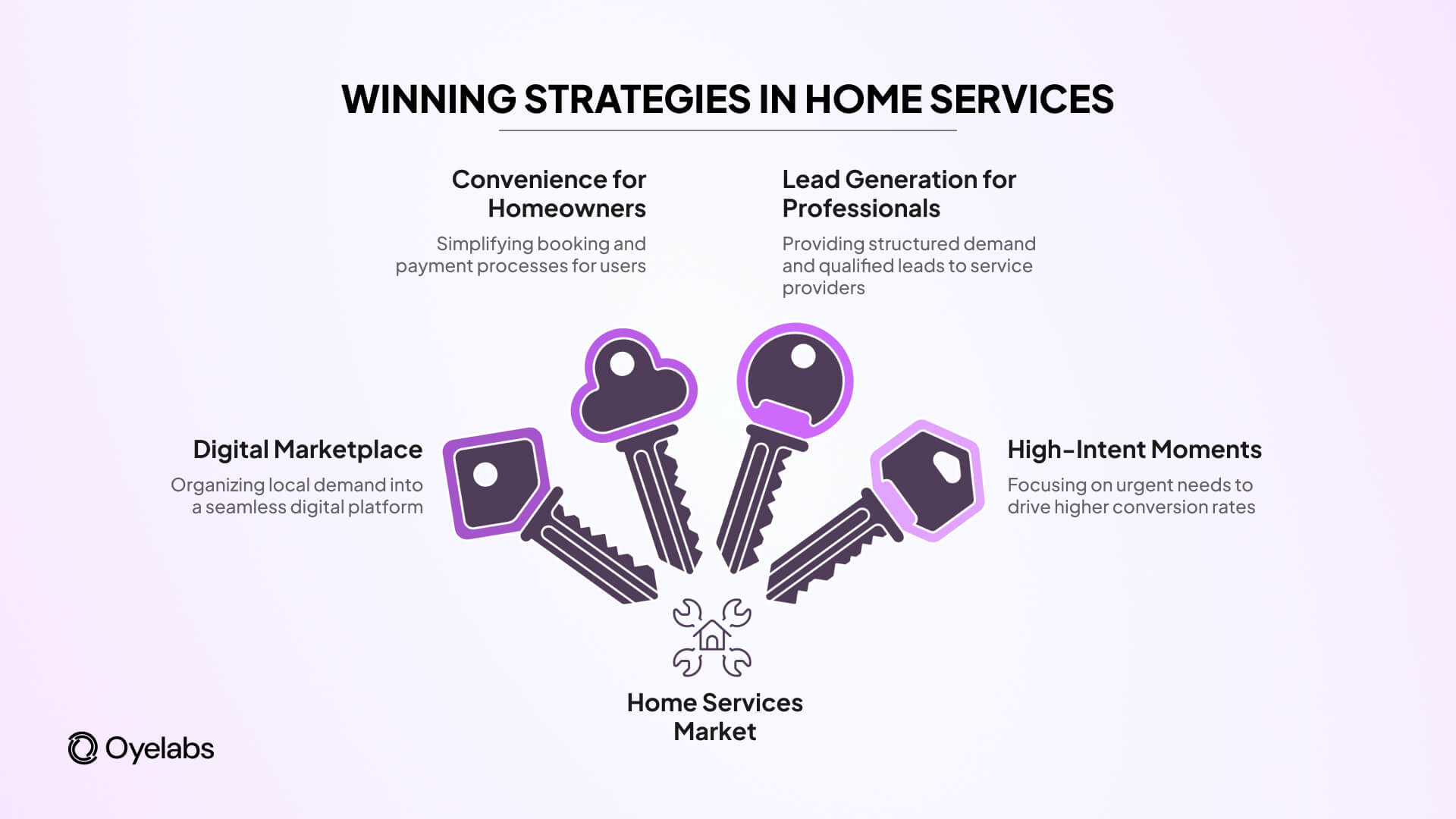
The home services industry has always had demand. What it lacked was structure. For years, customers relied on referrals, classified listings, or trial-and-error hiring when they needed cleaners, movers, electricians, plumbers, or repair professionals. That process was slow, uncertain, and inconsistent.
Apps like Porch changed the experience by organizing local demand into a digital marketplace. Instead of searching blindly, users can compare professionals, schedule services, and pay securely through one platform. That shift is why home services apps continue to grow.
The online on-demand home services market is projected to reach $14.7 billion by 2030, showing strong demand for digital home service platforms.
For founders, this creates a strong opportunity. Unlike trend-based industries, home services are tied to recurring real-life needs. Homes constantly require maintenance, upgrades, repairs, cleaning, and installation support. Demand renews itself.
What makes this category especially attractive is the combination of:
- repeat customer usage
- local market scalability
- trust-based transactions
- multiple revenue streams
A founder does not need to invent a new need. The need already exists. The opportunity is to make booking easier than the alternatives.
Homeowners Want Faster, Easier Booking
Modern users expect convenience. If someone needs a handyman or a deep cleaner today, they expect to solve that need quickly.
They no longer want to:
- call multiple providers
- wait for callbacks
- negotiate unclear pricing
- hope the provider shows up
A Porch-like app solves this by simplifying discovery and fulfillment. Users can search by category, view ratings, choose time slots, and complete payments in minutes.
That convenience often becomes the reason users return.
Local Service Professionals Need Better Lead Sources
The supply side of the marketplace matters just as much as customers.
Many local professionals still depend on word-of-mouth, expensive advertising, or inconsistent referrals. A strong marketplace gives them structured demand.
Instead of spending time chasing customers, professionals receive qualified leads from users already searching for services. This creates a healthier ecosystem where:
- customers get faster responses
- providers get more bookings
- platforms generate revenue consistently
The best marketplaces solve problems for both sides, not just one.
Why Porch Built a Strong Position Around Homeownership Moments
Porch gained traction by focusing on moments when homeowners urgently need help – especially moving, setup, inspections, repairs, and post-purchase maintenance.
This offers an important lesson for founders: high-intent moments convert better than passive browsing.
Someone casually thinking about cleaning may delay booking. Someone moving into a new home often needs immediate services and is ready to spend now.
That kind of demand timing can lower acquisition costs and improve conversion rates.
What Is an App Like Porch for Home Services?
A Porch-like platform is not a simple mobile app. It is a connected marketplace ecosystem where customers request services, professionals fulfill them, and administrators control operations.
To function properly, the business usually requires three coordinated systems.
| System | Core Role |
| Customer App | Search, book, pay, review |
| Professional App | Accept jobs, manage calendar, track earnings |
| Admin Panel | Monitor bookings, commissions, support, analytics |
When these systems are designed properly, the platform can scale without operational chaos.
Customer App Experience
The customer experience must feel fast and trustworthy from the first screen.
Users should be able to sign up quickly, browse relevant services, compare providers, and complete bookings without confusion. If too many steps exist, conversion drops.
Strong customer-side experiences usually include service filters, live availability, secure payments, and visible reviews.
When users trust the process, repeat usage increases.
Service Professional App Experience
Service providers need efficiency. If the platform creates extra friction, they stop using it.
The professional app should help them manage real work, not just receive notifications. That includes:
- incoming lead alerts
- scheduling tools
- customer messaging
- earnings history
- route planning if needed
Provider retention often determines whether the marketplace can grow consistently.
Admin Control Panel
Many founders focus on user-facing design and ignore the admin layer. That is a mistake.
The admin system is where growth is managed. It should allow the business to monitor performance, approve providers, handle disputes, manage commissions, and track city-level operations.
Without strong backend controls, scaling becomes messy and expensive.
Builder Tip: A Porch-like app needs three connected systems: customers, providers, and admin controls working together reliably.
Core Features Needed to Build an App Like Porch
Great home service apps do not win because they have the most features. They win because they remove friction.
The right feature set should improve trust, booking speed, and operational consistency.
Simple Onboarding and Profiles
Every extra step during signup reduces completion rates.
Both customers and providers should be able to join quickly using email, phone number, or social login. For providers, profile setup should also support credentials, certifications, experience, and service categories.
Shorter onboarding flows usually mean faster marketplace growth.
Service Search and Smart Filters
Search quality strongly impacts booking conversion.
Users should be able to filter by:
- service type
- rating
- distance
- price range
- next available slot
- verified providers
If users cannot quickly find the right provider, they leave the platform.
Real-Time Booking and Scheduling
The booking system is the revenue engine.
Users should be able to choose dates, request urgent jobs, reschedule easily, and receive instant confirmations. On the provider side, calendars must update properly to prevent double bookings.
Reliable scheduling reduces cancellations and support issues.
Ratings, Reviews, and Trust Signals
Trust decides whether users book.
Most customers allow strangers into their homes only when enough credibility exists. That is why visible trust indicators matter:
- customer reviews
- completed jobs count
- verification badges
- response speed
- repeat booking history
These signals often convert hesitant users into paying users.
Payments and Commission Logic
A marketplace must move money accurately.
That means handling:
- customer payments
- provider payouts
- commissions
- refunds
- invoices
If payments feel unreliable, both sides lose confidence quickly.
Building the app is only the first step; avoiding marketplace failure is the harder part. Read The Silent Killers of Home-Service Marketplaces before scaling.
What Makes Porch Different (And What Founders Should Learn)
Many founders study features. Fewer study positioning.
Porch built a stronger identity by focusing on specific homeowner moments instead of trying to become a generic services app.
That strategic clarity matters more than copying UI screens.
Capturing High-Intent Users During Moves
Moving homes creates immediate service demand. Users often need cleaners, TV mounting, furniture assembly, locksmiths, repairs, and setup services within days.
These are urgent, budget-approved decisions.
For founders, this means targeting life-event demand can outperform generic broad targeting.
Selling Tools to Pros, Not Just Leads
A marketplace that only sells leads limits itself.
Smarter platforms also monetize professionals through software and business tools such as:
- scheduling systems
- CRM tools
- premium placements
- analytics dashboards
- subscription plans
This can create more stable recurring revenue.
Owning a Niche Before Expanding
Trying to launch in every category and city often fails.
A better path is to dominate one segment first. For example:
- cleaning in one city
- handyman services in one metro
- moving support in one region
Once operations become predictable, expansion becomes far safer.
How to Build an App Like Porch Step by Step
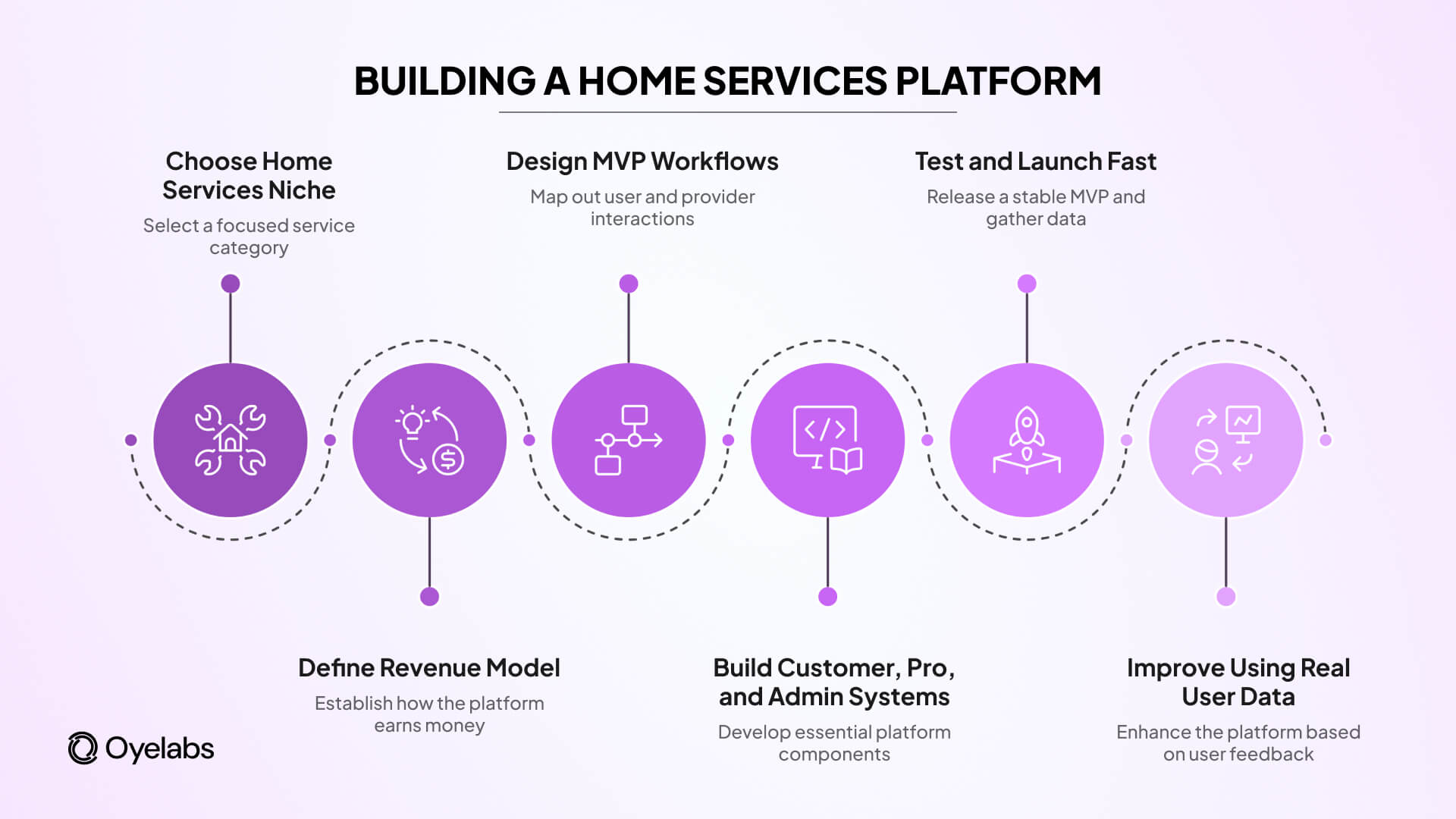
Building a Porch-like home services platform becomes easier when approached in stages.
Many founders fail because they attempt to launch everything at once. A phased rollout creates faster learning and lower risk.
Step 1: Choose Your Home Services Niche
Start focused.
Instead of launching ten categories, choose one high-demand niche such as cleaning, handyman, appliance repair, or movers.
Focused categories help with:
- sharper marketing
- easier provider onboarding
- simpler operations
- stronger early reviews
Step 2: Define Revenue Model
Your platform should know how it earns before it launches.
Common monetization models include commissions on bookings, monthly subscriptions for providers, lead fees, and featured listings.
The strongest marketplaces often combine multiple revenue streams over time.
Step 3: Design MVP Workflows
Before building screens, map workflows.
A strong MVP should answer:
- how users request services
- how providers accept jobs
- how payments are processed
- how cancellations are handled
- how reviews are collected
Workflows matter more than visual polish in the early stage.
Step 4: Build Customer, Pro, and Admin Systems
Once workflows are clear, development should begin with the three systems that power the marketplace.
The customer app must make booking simple. The professional app must make work manageable. The admin panel must keep operations under control.
Each system serves a different purpose:
| Platform Layer | Primary Goal |
| Customer App | Fast search, booking, and payments |
| Professional App | Accept jobs, manage schedule, track income |
| Admin Panel | Manage users, payouts, disputes, analytics |
Many founders make the mistake of prioritizing only the customer-facing experience. That creates imbalance. If providers cannot manage work smoothly or admins cannot control quality, growth stalls.
The smartest builds treat all three systems as essential from day one.
Step 5: Test and Launch Fast
Perfect launches rarely exist. Delayed launches happen often.
A better strategy is to launch a stable MVP, gather real usage data, and improve quickly. Early testing should focus on practical issues that directly affect transactions.
That includes:
- failed bookings
- payment errors
- provider no-shows
- scheduling conflicts
- slow onboarding flows
Real users reveal friction faster than internal planning sessions ever will.
Speed matters because every week in the market teaches more than weeks spent debating features in development.
Step 6: Improve Using Real User Data
Once live, the market starts giving answers.
Founders should track:
- booking conversion rate
- repeat customer rate
- provider acceptance rate
- cancellation percentage
- customer support tickets
- top-performing service categories
This data helps prioritize what to improve next.
For example, if many users search but do not book, pricing clarity or trust signals may be weak. If providers reject jobs often, supply incentives may need adjustment.
Strong platforms are shaped by behavior, not assumptions.
Founder Reality: Most home-service marketplaces fail from weak provider supply, not from lack of app features.
How Oyelabs Helps Founders Build Apps Like Porch
Many founders understand the opportunity in home services but struggle with execution. They know demand exists, yet turning that demand into a functioning marketplace requires more than a design concept or a developer quote.
Oyelabs helps founders move from idea to launch through structured marketplace systems built for real transactions. Instead of starting from zero, founders can begin with a proven framework that includes the three layers most home service platforms need: customer booking systems, provider management systems, and admin controls.
This approach shortens time to market and reduces early-stage technical risk.
More importantly, it allows founders to focus on the work that actually drives traction: building provider supply, acquiring customers, refining categories, and building trust in the local market.
Over time, supporting founders across multiple countries and industries has shown a consistent truth: speed with structure often outperforms slow custom perfection.
The goal is not simply to build software. The goal is to launch a business that can operate and grow.
A Founder Journey: From Idea to Live Home Services Marketplace
A typical founder journey often begins with a familiar frustration.
Someone needs a cleaner, handyman, mover, or electrician and realizes the experience is still broken. Discovery is messy, trust is low, pricing is unclear, and scheduling is inefficient. That frustration becomes the seed of a business idea.
The next phase is usually ambition. The founder wants to launch a broad platform immediately across many categories and cities.
That is where many journeys stall.
Real progress starts when the model becomes focused. One city. One niche. One repeatable workflow.
Instead of trying to serve everyone, the founder launches with a specific category such as cleaning or handyman services. Providers are onboarded manually. Bookings begin. Customers leave reviews. Real usage starts replacing assumptions.
Then momentum builds.
The first 25 bookings create insights. The first 100 bookings create patterns. The first repeat customers create confidence.
What began as an idea becomes an operating marketplace.
That is how real platforms are built – not through oversized plans, but through structured progress.
The One Insight Most Founders Learn Too Late
Most founders believe growth comes from adding more features.
In reality, home service platforms grow when users trust them enough to book again.
That single insight changes priorities.
Instead of asking what new feature to build next, stronger founders ask:
- Are providers showing up on time?
- Are bookings smooth and reliable?
- Are customers returning without incentives?
- Is support solving issues quickly?
Repeat bookings are often a stronger growth signal than downloads.
A platform with fewer features and stronger trust can outperform a platform with more features and weak execution.
Technology can attract first-time curiosity. Trust creates recurring revenue.
Launch Your Home Services Marketplace Without Guesswork
Start with a proven marketplace system designed for bookings, providers, payments, and growth.
✓ Customer app built for fast service booking
✓Provider app for jobs, schedules, earnings
✓ Admin panel for operations, payments, analytics
✓ Scalable foundation for multi-category service growth
Final Thought
The best Porch-like home services app is not the one with the most features. It is the one that launches quickly, earns trust early, and improves through real market feedback. Founders who win in this space focus less on flashy technology and more on reliable booking systems, strong provider supply, transparent payments, and repeat customer experience.
That is where Oyelabs creates value – helping founders launch structured marketplace platforms without wasting months rebuilding common systems from scratch. A home services business grows when customers book again, providers stay active, and operations become predictable. Technology should accelerate that process, not slow it down.
In the long run, the strongest platforms are built through steady execution, clear priorities, and trust earned transaction by transaction.
FAQs
How do you build an app like Porch?
To build an app like Porch, create a customer app, a service professional app, and an admin panel. The platform should support service search, booking, payments, reviews, provider management, and admin controls. Start with one niche, launch an MVP, and improve using real user data.
What features are needed in a Porch-like app?
A Porch-like app needs user onboarding, service search, booking, scheduling, provider profiles, payments, reviews, chat, notifications, and admin management. These features help customers book trusted professionals while allowing providers to manage jobs and platform owners to control operations.
How much does it cost to build an app like Porch?
The cost depends on features, platform type, and development method. A custom build costs more because it requires customer apps, provider apps, backend systems, payment flows, and admin dashboards. White-label platforms reduce cost by using pre-built marketplace infrastructure.
Can a white-label solution launch a Porch-like app faster?
Yes, a white-label solution can launch faster because common marketplace features are already built. Founders can configure branding, services, payments, and provider workflows instead of building everything from scratch. This helps reduce development time, cost, and early-stage technical risk.