
How to Go Beyond a Basic Language Learning App

 Anuraag Jain
Last Updated on May 12, 2026
Key Takeaways
What You’ll Learn:
- Basic language apps improve vocabulary but rarely create real speaking confidence.
- AI conversation practice improves fluency faster than repetitive translation exercises.
- Gamification alone cannot sustain long-term language learning retention.
- Adaptive learning systems personalize lessons based on learner weaknesses and progress.
- Speech recognition improves pronunciation correction and conversational learning accuracy.
- Most language learning startups underestimate multilingual content production costs.
- Real-world immersion improves fluency more effectively than isolated grammar drills.
Stats That Matter:
- Duolingo reported 116M+ monthly active users during Q1 2025.
- The language learning market may exceed $200B before 2030 globally.
- AI in education could surpass $88B market value by 2032.
- Duolingo generated over $748M revenue during 2024 operations.
- Mobile app consumer spending crossed $171B globally during 2023.
- Spaced repetition significantly improves long-term memory retention and vocabulary recall.
- AI-powered tutoring systems are rapidly reshaping digital language learning platforms.
- Enterprise language learning demand continues increasing across global workforce training programs.
Real Insights:
- Users stay longer when apps improve real-life communication confidence.
- Too many features usually reduce language learning completion rates.
- Speaking practice increases retention more effectively than passive vocabulary drills.
- Short lesson formats improve consistency for mobile-first language learners.
- Native speaker interaction improves fluency faster than isolated app exercises.
- Poor pronunciation feedback systems reduce advanced learner engagement significantly.
How to Go Beyond a Basic Language Learning App
Most language learning apps feel productive until reality hits. A 300-day streak looks impressive, but ordering coffee in Spanish still feels like a boss fight. That is the gap most basic language learning apps never solve.
Today’s users want more than flashcards, badges, and repetitive translation drills. They expect AI conversation practice, speech recognition, adaptive learning paths, and real-world immersion that actually improves fluency. That shift is changing how founders approach language learning app development.
The problem? Many startups still copy the Duolingo playbook without understanding user retention, NLP infrastructure, pronunciation engines, or scalable content systems.
This guide breaks down what separates a basic language app from a serious language learning platform, including the features, technology stack, monetization models, development costs, and scaling realities founders need to understand before building in the modern edtech market.
Why Most Language Learning Apps Fail to Create Fluent Users
Millions of users download language learning apps every year. Very few become fluent. The reason is not motivation alone. It is product design.
Despite crossing 116 million monthly active users globally, the larger challenge for language learning apps still remains long-term fluency and retention.
Most beginner-focused apps are built around recognition-based learning. Users match words, tap answers, complete streaks, and move forward quickly. The experience feels rewarding, but the brain is often memorizing patterns instead of building communication ability.
Real fluency depends on active recall, contextual understanding, pronunciation control, listening comprehension, and spontaneous sentence formation. Most apps barely touch these areas.
Another issue is artificial progression. Users can complete hundreds of lessons without facing real-world complexity. Ordering food, handling accents, understanding fast speech, or responding naturally in conversation remains difficult because the learning environment is too controlled.
The strongest language learning platforms solve this by combining multiple learning systems together:
- Contextual conversation practice
- AI-assisted speech correction
- Scenario-based immersion
- Adaptive repetition models
- Real-world listening exposure
- Live communication opportunities
This is why founders building modern language learning apps must stop thinking like game designers alone. Retention matters, but learning outcomes matter more.
What Features Separate a Serious Language Learning Platform From a Basic App?
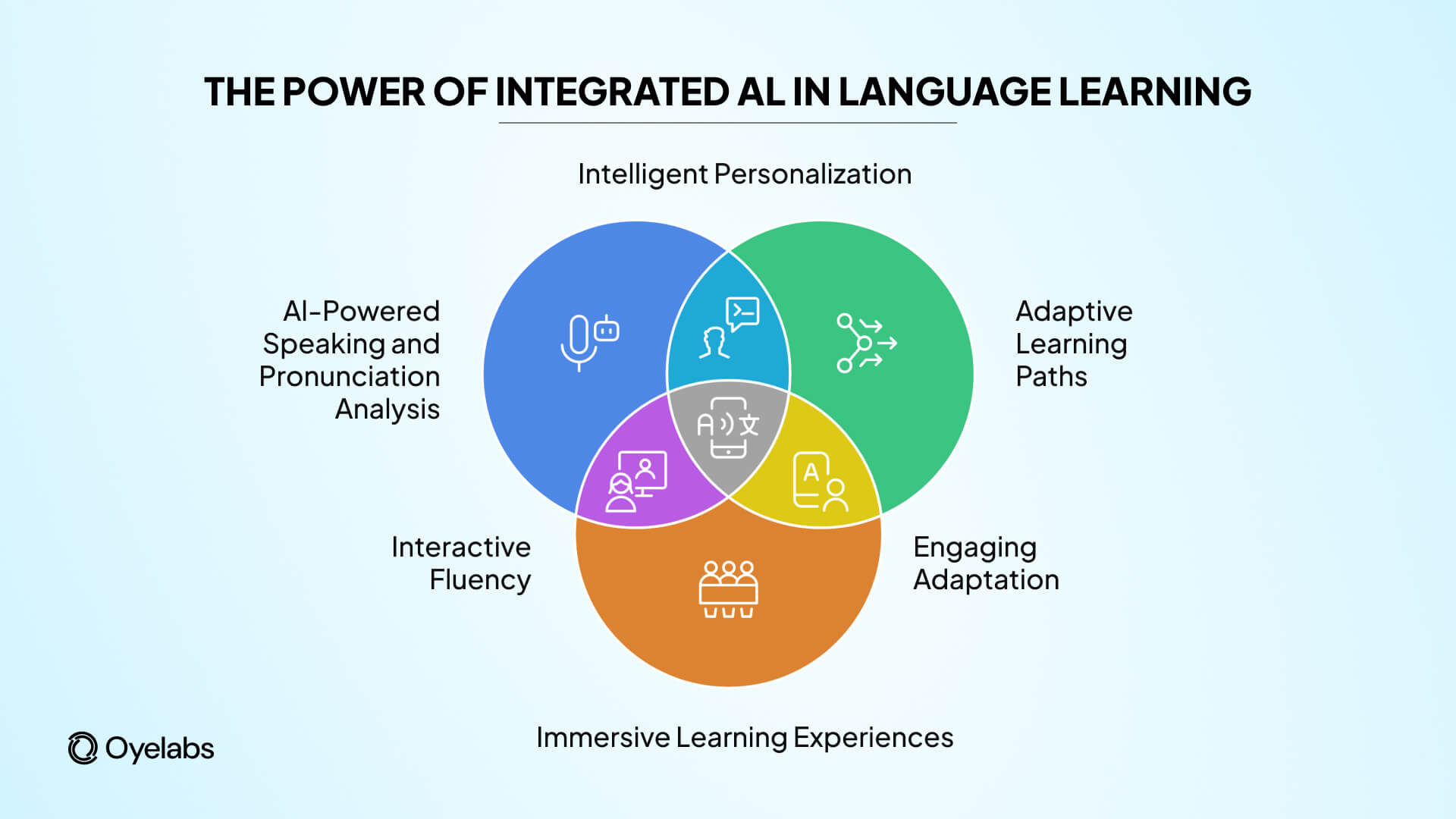
The market has moved far beyond simple vocabulary drills. Serious learners now expect intelligent systems that simulate natural language use.
A modern language learning platform is no longer just a mobile app. It behaves more like an AI-assisted communication ecosystem.
AI-Powered Speaking and Pronunciation Analysis
Speech recognition has become a major differentiator in edtech products. Users expect instant pronunciation feedback, fluency scoring, and accent analysis.
This requires:
- NLP engines
- Phoneme detection systems
- Real-time audio processing
- AI speech comparison models
Many founders underestimate how technically demanding this layer becomes at scale.
Adaptive Learning Paths
Most apps still push every learner through the same structure. That approach creates drop-offs because learning speed varies dramatically.
Advanced platforms track:
| Learning Metric | Purpose |
| Error frequency | Detect weak areas |
| Response timing | Measure confidence |
| Vocabulary retention | Improve repetition cycles |
| Speaking accuracy | Personalize pronunciation training |
Adaptive systems improve engagement because users feel the product understands their progress.
Immersive Learning Experiences
Users now prefer scenario-based learning instead of isolated exercises.
For example:
- Simulated travel conversations
- Business meeting roleplays
- Restaurant ordering flows
- Customer support interactions
This creates emotional memory, which improves retention far more effectively than repetitive quizzes.
Execution Insight: Content operations become harder to scale than app development across multilingual learning ecosystems and regional educational adaptations.
Are Apps Like Duolingo Enough for Long-Term Language Mastery?
Apps like Duolingo succeeded because they removed friction from language learning. They made learning accessible, entertaining, and habit-driven.
But accessibility and fluency are not the same thing.
Most gamified platforms work well for:
- Vocabulary exposure
- Beginner motivation
- Daily consistency
- Basic sentence familiarity
The problems begin at intermediate levels.
Learners often plateau because the app environment becomes predictable. Real language is messy. Native speakers interrupt, change pace, use slang, shorten words, and speak with cultural context. Gamified apps rarely prepare users for that transition.
This explains why many advanced learners eventually move toward:
- Live tutoring platforms
- Native conversation communities
- Immersion-based learning systems
- Long-form listening and reading content
Founders entering this market should recognize a critical truth:
Users no longer want “learning apps.”
They want fluency systems.
That shift changes product architecture entirely.
What Most Founders Get Wrong About Building a Language Learning App
The biggest mistake founders make is assuming language learning is mainly a UI problem.
It is not.
Many startups spend heavily on animations, gamification, and onboarding flows while ignoring the deeper educational infrastructure required for long-term retention.
Mistake #1: Copying Existing Apps Without Solving Their Weaknesses
Many products imitate Duolingo visually but repeat the same limitations:
- Weak speaking systems
- Poor contextual learning
- Minimal personalization
- Low real-world application
A polished interface cannot compensate for shallow learning architecture.
Mistake #2: Underestimating Content Complexity
Language platforms require enormous structured content systems.
That includes:
- Grammar sequencing
- CEFR-level mapping
- Voice datasets
- Localization workflows
- Cultural adaptation
Content becomes one of the largest operational costs over time.
Mistake #3: Ignoring Retention Psychology
Many founders focus on downloads instead of completion behavior.
The real challenge is keeping users engaged after the novelty phase disappears.
High-retention products usually include:
- Personalized milestones
- Social accountability
- Conversation-based progression
- Real-world outcomes tracking
Without these systems, user churn rises quickly.
Builder Tip: Most founders overbuild gamification systems while ignoring speaking confidence, retention psychology, and contextual communication experiences users actually need.
Which Features Increase Retention in Advanced Language Learning Platforms?
Retention in edtech products is heavily connected to emotional progress. Users continue when they feel improvement in real-life communication.
That means modern language learning apps must create experiences that feel practical, measurable, and socially rewarding.
AI Conversation Simulations
AI tutors now allow users to practice conversations without social pressure.
Popular use cases include:
- Travel preparation
- Job interviews
- Casual conversations
- Business communication training
This creates a safer environment for beginners while increasing speaking confidence.
Community-Based Learning
Language learning becomes easier when users feel part of a learning ecosystem.
Platforms increasingly add:
- Peer correction systems
- Speaking clubs
- Group challenges
- Native speaker interaction
These features improve both retention and user-generated content growth.
Spaced Repetition Systems (SRS)
Vocabulary retention declines rapidly without reinforcement.
Modern SRS engines analyze:
- Forgotten words
- Repeated mistakes
- Usage frequency
- Memory decay patterns
This makes learning more efficient while reducing frustration.
How AI Is Changing the Future of Language Learning Apps
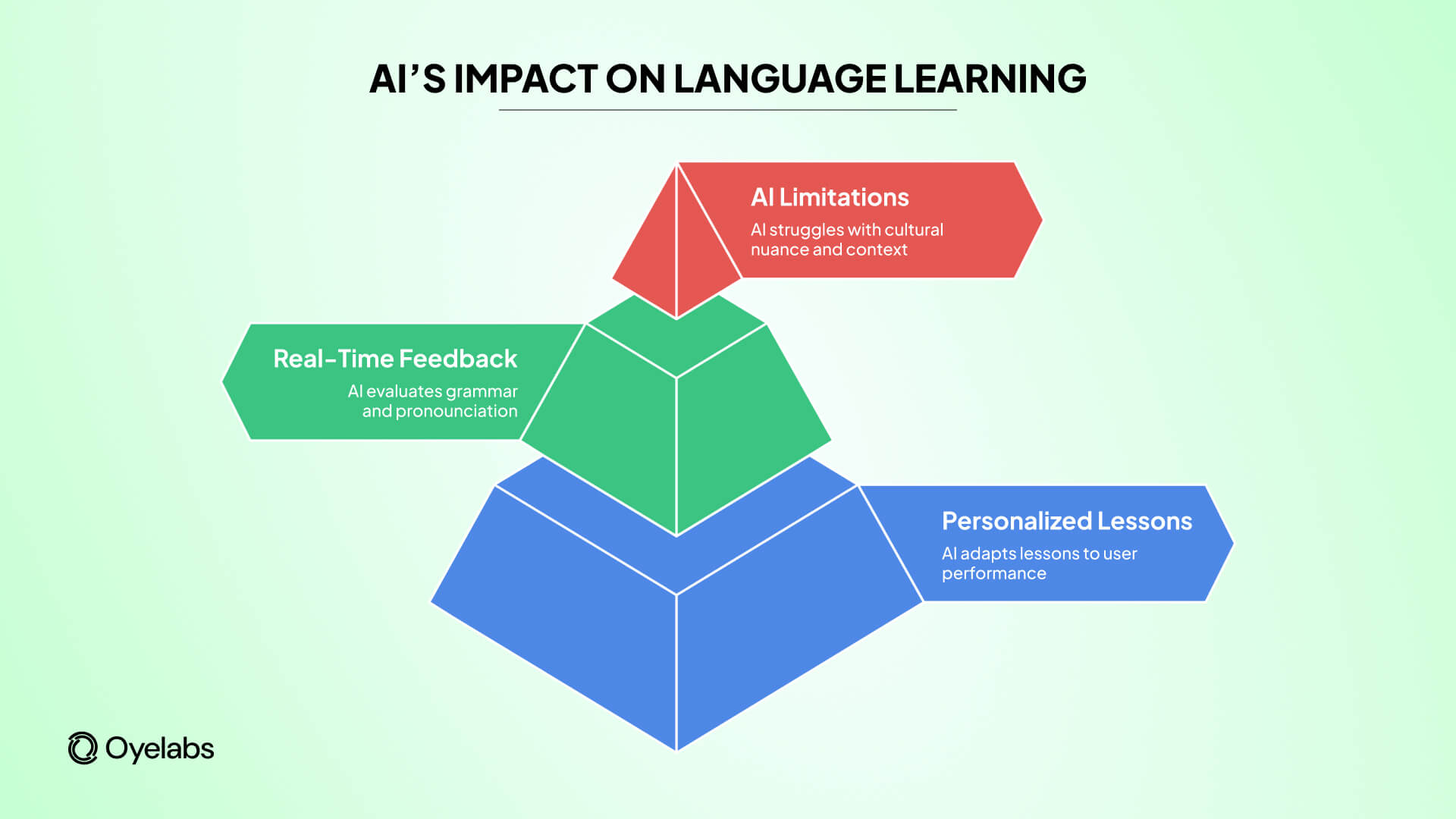
Artificial intelligence is reshaping the entire edtech market.
Traditional language apps relied on static lessons. AI-powered systems now generate dynamic learning experiences in real time.
Personalized Lesson Generation
AI can modify lessons based on:
- User performance
- Native language background
- Pronunciation weaknesses
- Conversation confidence
This creates highly personalized learning journeys.
Real-Time Grammar and Pronunciation Feedback
Modern AI models can now evaluate:
- Sentence structure
- Accent clarity
- Word stress
- Speaking pace
This moves language learning closer to human tutoring experiences.
AI Still Has Major Limitations
Despite rapid growth, AI is not a complete replacement for structured pedagogy.
Many AI systems still struggle with:
- Cultural nuance
- Emotional encouragement
- Long-term curriculum planning
- Contextual correction accuracy
Founders building AI-first products must avoid overpromising capabilities that the technology cannot consistently deliver.
Why Most Language Learning Startups Struggle to Scale
The language learning industry looks attractive from the outside. Recurring subscriptions, global demand, and mobile-first behavior make it appealing to founders.
The operational reality is much harder.
Content Production Becomes Expensive Fast
Every additional language multiplies complexity.
A scalable platform often requires:
| Scaling Requirement | Operational Impact |
| Voice recordings | Higher localization cost |
| Grammar structuring | Subject matter experts |
| Native reviews | Quality assurance overhead |
| Cultural adaptation | Regional customization |
This is why many startups fail while trying to expand too quickly.
Speech Infrastructure Costs Are Often Ignored
AI voice systems, pronunciation engines, and audio streaming require ongoing infrastructure investment.
Costs usually increase through:
- GPU processing
- Audio storage
- Real-time API requests
- Speech-to-text services
Many early-stage founders budget for app development but ignore long-term processing costs.
Retention Is More Important Than User Acquisition
Language learning apps often experience strong download numbers but weak retention curves.
If users leave after 30 days, scaling marketing spend becomes unsustainable.
The strongest platforms optimize for:
- Learning outcomes
- Long-term engagement
- Community participation
- Habit formation beyond streaks
Growth Insight: Subscription revenue becomes sustainable only when users consistently experience measurable communication improvement and long-term learning confidence gains.
How Much Does It Cost to Build an Advanced Language Learning App?
There is no universal cost because platform complexity varies significantly.
A lightweight MVP focused on recorded lessons and quizzes is very different from an AI-driven conversational platform.
Typical Cost Drivers
The biggest development factors usually include:
- AI integration
- Speech recognition
- Video infrastructure
- Real-time messaging
- Tutor marketplace systems
- Multi-language content management
A simple MVP may work for validation, but scaling requires stronger backend architecture.
Infrastructure Matters More Than Most Founders Expect
Many startups focus only on launch costs. Ongoing operational expenses often become the bigger challenge.
These include:
- Cloud hosting
- AI API usage
- Media delivery systems
- User analytics
- Data security compliance
Poor infrastructure planning leads to performance issues as user activity grows.
Build Strategy Directly Impacts Budget
Founders generally choose between:
| Approach | Best For |
| White-label foundation | Faster market entry |
| Hybrid customization | Mid-scale growth |
| Full custom development | Complex long-term ecosystems |
The smartest founders usually validate traction first before investing heavily into enterprise-level custom architecture.
Duolingo did not become a billion-dollar edtech company through gamification alone. Its monetization strategy is built around retention psychology, subscription optimization, and scalable AI-driven engagement systems. Explore the complete breakdown in our detailed guide on “Duolingo Business Model – How it Earns Money?”
Should You Build From Scratch or Use a Ready-Made Solution?
This is one of the most expensive decisions founders make in the edtech space. Many teams immediately choose full custom development without understanding the tradeoffs involved.
In reality, most early-stage language learning startups do not fail because of limited features. They fail because they burn too much time and capital before reaching product-market validation.
When a Ready-Made Solution Makes More Sense
A white-label or pre-built foundation is often the smarter route when the goal is:
- Faster market entry
- MVP validation
- Investor demonstrations
- Early user acquisition
- Testing monetization models
This approach allows founders to focus on growth, partnerships, and learning outcomes instead of rebuilding standard infrastructure from zero.
Core modules that usually do not need reinvention initially include:
- Authentication systems
- Lesson management
- Subscription billing
- User dashboards
- Progress tracking
- Basic gamification systems
When Full Custom Development Becomes Necessary
Custom architecture becomes valuable when the product includes:
- Proprietary AI learning engines
- Complex adaptive learning systems
- Unique conversational models
- Large-scale live tutoring ecosystems
- Enterprise or institutional integrations
At this stage, scalability and differentiation justify deeper technical investment.
Why Founders Waste Months Rebuilding Common Features
Many startups spend six to twelve months recreating standard features users already expect.
The result is usually:
| Common Problem | Business Impact |
| Delayed launch | Lost market momentum |
| Overbuilt MVPs | Higher burn rate |
| Feature overload | Poor user adoption |
| Weak validation | Investor hesitation |
The strongest execution strategy is usually phased growth.
Why “More Features” Usually Makes Language Apps Worse
One of the biggest misconceptions in edtech is that more features automatically create a better product.
They usually do the opposite.
Language learning is already cognitively demanding. Overloading users with excessive mechanics increases confusion and fatigue.
Cognitive Overload Kills Retention
Many apps fail because users feel overwhelmed after the first few sessions.
Common problems include:
- Too many learning modes
- Complex navigation systems
- Excessive notifications
- Complicated progress tracking
- Feature-heavy dashboards
Users want clarity, not complexity.
Simplicity Creates Better Learning Behavior
The highest-retention apps typically focus on a few core outcomes:
- Daily consistency
- Speaking confidence
- Vocabulary retention
- Real-world communication
This is why many successful platforms intentionally avoid feature bloat.
Copying Every Trend Weakens Product Identity
Founders often chase trends without asking whether the feature actually improves learning.
Examples include:
- Random social feeds
- Excessive gamification
- NFT rewards
- Unnecessary AI gimmicks
- Overcomplicated leveling systems
Strong products stay focused on learning efficiency.
Strategic Insight: Fast validation matters more than perfect architecture during early-stage language learning product launches and market testing phases.
When Should Founders Invest in a Custom Language Learning Platform?
Not every language learning idea requires custom development immediately.
The smartest founders identify whether their advantage comes from technology, distribution, niche positioning, or operational execution.
Signs You Need a Custom Platform
Custom development becomes more valuable when:
- The platform depends heavily on proprietary AI
- You target underserved language markets
- Enterprise integrations are required
- The business model differs significantly from standard apps
- You plan to scale into a multi-product ecosystem
At this stage, technical flexibility becomes a competitive advantage.
Major Opportunities Still Exist in the Market
Despite competition, several areas remain underserved:
- Regional language ecosystems
- Industry-specific communication training
- Corporate language onboarding
- Child-focused conversational AI
- Immigration and relocation learning systems
Most platforms still target broad audiences instead of specialized outcomes.
Why Execution Speed Still Matters More Than Perfect Features
Many founders delay launch while trying to perfect every component.
The market usually rewards speed, iteration, and user feedback more than theoretical perfection.
This is where experienced execution partners become valuable.
Oyelabs helps founders accelerate product launches using scalable white-label foundations, AI-ready architectures, and customizable edtech ecosystems designed for faster validation and long-term scalability.
The strongest products are rarely the ones that launch perfectly.
They are the ones that learn, adapt, and improve faster than the market around them.
Launch Your AI-Powered Language Learning Platform Faster
Accelerate your edtech product launch using scalable infrastructure, AI-ready systems, and customizable language learning architecture.
✓ AI-ready architecture supporting scalable conversational learning experiences
✓Faster launch timelines with customizable white-label learning systems
✓ Multi-language support with scalable backend infrastructure foundations
✓ Enterprise-ready monetization and subscription management system integrations
Final Thoughts
The language learning market is shifting rapidly from simple gamified apps toward intelligent, immersive learning ecosystems. Users no longer want endless translation exercises and streak counters. They want measurable fluency, real-world communication confidence, and adaptive experiences that feel personal.
That shift creates both opportunity and pressure for founders.
The winners in this space will not be the companies that copy existing apps with better animations or more notifications. They will be the platforms that combine AI, behavioral science, scalable infrastructure, and meaningful educational outcomes into one cohesive experience.
For founders entering this market, the real challenge is not building another language app.
It is building a system users trust to help them communicate in the real world.
FAQs
How does Duolingo make money while offering free language learning access to millions worldwide?
Duolingo primarily earns revenue through premium subscriptions, advertisements, English proficiency testing, and in-app purchases. Its freemium business model allows users to access core learning features for free while encouraging upgrades through advanced tools, ad-free experiences, and additional learning benefits that improve convenience and engagement.
Why is Duolingo considered one of the most successful subscription-based language learning platforms globally today?
Duolingo combines gamification, behavioral psychology, AI-driven personalization, and mobile-first accessibility to maximize user retention. Its recurring subscription model, combined with massive global reach and strong daily engagement metrics, allows the company to generate scalable recurring revenue while continuously expanding its product ecosystem and learning infrastructure.
What monetization strategies can founders learn from Duolingo’s business model success in modern edtech platforms?
Founders can learn the importance of retention-driven product design, freemium conversion strategies, subscription optimization, scalable AI integration, and habit-forming engagement systems. Duolingo demonstrates that long-term revenue growth in edtech depends more on user consistency and retention than simply increasing application downloads or paid acquisition campaigns.
Does Duolingo rely only on subscriptions, or are multiple revenue streams supporting its overall business growth?
No, Duolingo operates through multiple revenue streams. Beyond premium subscriptions, the company also earns through advertising, in-app purchases, enterprise partnerships, and its Duolingo English Test product. Diversified monetization helps strengthen profitability while reducing dependence on a single customer acquisition or subscription channel.