
How AI Can Improve Matching in Airtasker-Like Platforms

How AI Can Improve Matching in Airtasker-Like Platforms
 Anuraag Jain
Last Updated on May 12, 2026
Key Takeaways
What You’ll Learn
- Offline leakage happens when users bypass platform payments.
- Service platforms lose commission when deals move offline.
- In-app payments reduce private payment risks.
- Masked chat helps block phone number sharing.
- Booking locks keep users inside platform workflows.
- Strong policies reduce platform bypass attempts.
- Provider incentives can reduce direct deal poaching.
- Trust features make users less likely to leave.
- Refund protection keeps payments inside the platform.
- AI can flag suspicious off-platform behavior.
Stats That Matter
- FTC reported $12.5B fraud losses in 2024.
- FBI reported $16.6B internet crime losses in 2024.
- Stripe processed $1.4T payments in 2024.
- Upwork earned $787.8M revenue in 2025.
- Upwork supports $4B+ annual marketplace transactions.
- Taskrabbit bans cash and off-platform payments.
- Payment control protects revenue and user safety.
- Transaction visibility improves dispute handling.
- Platform-side payments create cleaner business data.
- Leakage prevention improves marketplace valuation.
Real Insights
- Users leak deals when platform value feels weak.
- High fees without benefits increase bypass behavior.
- Bad booking flows push users to private chats.
- Trust protection must feel better than direct deals.
- Providers need reasons to stay loyal.
- Customers need refunds, support, and accountability.
- Messaging controls should feel helpful, not hostile.
- Punishment alone rarely stops leakage.
- Better UX prevents more leakage than warnings.
- Revenue protection starts with product design.
How AI Can Improve Matching in Airtasker-Like Platforms
People are done scrolling through endless task listings that feel like dating apps with power tools. One wrong hire on an Airtasker-like platform can mean missed deadlines, refund disputes, bad reviews, and users who never come back.
That is exactly where AI-powered matching is changing the game. Instead of relying on basic keyword searches, modern marketplace platforms now use machine learning, behavioral analysis, natural language processing (NLP), and predictive matching models to connect the right customer with the right service provider faster.
Platforms using AI-assisted task categorization and intelligent recommendation engines are already seeing stronger engagement and better conversion rates.
For founders building service marketplaces, the real opportunity is no longer just launching an app. It is building a marketplace system smart enough to improve matching quality, trust, and retention at scale.
Why Traditional Matching Fails in Most Airtasker-Like Apps
Most Airtasker-like platforms are not losing users because of poor UI. They are losing users because their matching systems are too basic for real-world service behavior.
A customer posts a task. The platform shows dozens of providers. The customer scrolls through profiles, compares reviews, checks pricing, sends messages, waits for replies, and still remains unsure who is actually the right fit. That friction quietly damages marketplace retention.
Traditional marketplace matching usually depends on:
- Keywords
- Manual filters
- Categories
- Distance radius
- Basic ratings
The issue is that service marketplaces are highly contextual. A person searching for “home office setup” may actually need:
- Minor electrical work
- Furniture assembly
- Cable management
- Internet optimization
A keyword-based engine struggles to understand overlap between those needs. AI-driven systems do not just read words. They analyze intent, behavioral patterns, task complexity, and historical outcomes.
This gap becomes expensive very quickly.
Poor matching often leads to:
- Low-quality bids
- Customer refunds
- Longer hiring cycles
- Higher support tickets
- Provider dissatisfaction
- Lower repeat usage
Most founders underestimate how dangerous this becomes at scale. A marketplace can spend aggressively on paid acquisition and still fail because first-time users do not trust the quality of matches they receive.
That is one of the reasons many early marketplaces plateau after initial traction. Growth problems often look like marketing problems on the surface. In reality, they are matching-quality problems underneath.
How AI Matching Works in Modern Service Marketplace Platforms
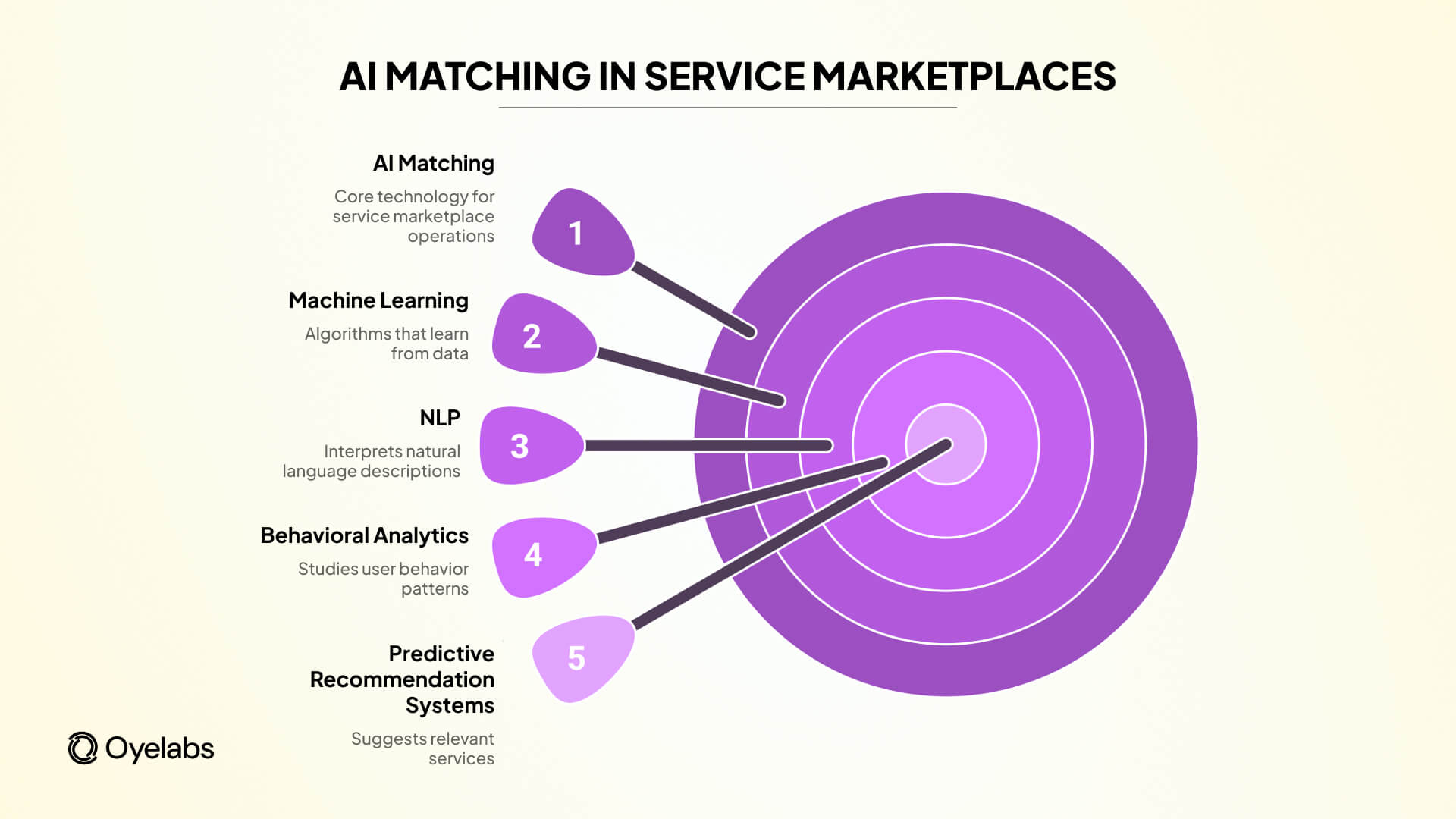
AI-powered matching systems are changing how service marketplaces operate. Instead of simply asking, “Does this provider contain the keyword?” modern platforms now ask:
“Which provider is most likely to complete this task successfully?”
That shift changes everything.
Modern AI matching engines combine multiple technologies together:
- Machine learning models
- Natural language processing (NLP)
- Behavioral analytics
- Predictive recommendation systems
- Dynamic ranking algorithms
These systems continuously study marketplace activity. Over time, they begin identifying patterns that manual filtering can never detect.
For example, a provider who charges slightly more but consistently:
- Finishes tasks faster
- Receives stronger reviews
- Maintains higher response rates
- Gets repeat customers
may become a better recommendation than a cheaper provider with weaker reliability.
This is where predictive intelligence starts outperforming manual marketplace browsing.
The Role of NLP in Marketplace Matching
Most customers do not write structured task descriptions.
They write things like:
“Need help fixing water leakage near kitchen sink before weekend.”
An NLP-powered engine can interpret:
- Urgency
- Service category
- Required expertise
- Contextual intent
- Similar historical jobs
That allows the platform to recommend providers based on actual relevance instead of surface-level keywords.
The result is a marketplace that feels faster, smarter, and easier to trust.
Builder Tip: Leakage is not only lost commission; it also destroys transaction data needed for pricing, trust, and retention decisions.
What Makes AI-Powered Matching Better Than Manual Filtering?
Most users do not enjoy comparing 40 service providers manually. They simply tolerate it because many platforms still force them to.
AI reduces that decision fatigue.
Instead of making users perform the evaluation process themselves, intelligent matching systems narrow down choices using probability models, behavioral scoring, and contextual relevance.
This creates a significantly smoother customer journey.
| Traditional Matching | AI-Powered Matching |
| Keyword dependent | Context-aware |
| Static filtering | Dynamic recommendations |
| Manual comparison | Predictive ranking |
| Generic results | Personalized matching |
| High user effort | Faster hiring decisions |
The psychological impact is larger than most founders realize.
When users feel confident in recommendations:
- Conversion rates improve
- Hiring speed increases
- Repeat usage grows
- Customer trust strengthens
AI also improves marketplace quality from the provider side.
One of the biggest operational problems in service marketplaces is proposal spam. Without intelligent filtering, customers often receive:
- Irrelevant bids
- Underqualified providers
- Automated low-quality proposals
- Price dumping offers
Strong AI ranking systems can evaluate:
- Similar completed tasks
- Completion history
- Communication quality
- Customer satisfaction
- Reliability patterns
This improves the overall quality of marketplace interactions instead of simply increasing marketplace volume.
That distinction matters. Volume alone does not create marketplace trust. Relevance does.
What Most Founders Get Wrong About AI Matching Systems
One of the biggest misconceptions in the marketplace industry is the belief that adding AI automatically creates a “smart platform.”
It does not.
AI quality depends entirely on marketplace structure, data quality, and behavioral consistency.
Many founders rush into:
- GPT integrations
- AI recommendation engines
- Automated bidding systems
- Smart matching dashboards
before solving more important problems:
- Marketplace liquidity
- Provider quality
- Trust systems
- Customer retention
This usually backfires.
AI systems learn from marketplace behavior. If the platform lacks enough high-quality transactional activity, the AI has weak data to learn from.
The result is often:
- Poor recommendations
- Irrelevant matching
- Customer frustration
- Increased churn
The Industry Truth Few People Discuss
The strongest AI marketplaces are not winning because they have “better AI.”
They are winning because they have:
- Better marketplace data
- Higher-quality transactions
- Stronger behavioral insights
- More reliable provider ecosystems
That is the real moat.
A marketplace with structured transactional history and strong operational discipline will usually outperform a marketplace using flashy AI tools with weak underlying data.
This is why many founders overspend on AI too early and underinvest in marketplace operations.
Why Generic AI APIs Fail in Real Marketplace Operations
There is a major difference between AI-assisted features and true AI marketplace infrastructure.
Many founders connect a generic AI API and assume they now have an intelligent platform. In reality, most generic AI integrations only improve surface-level workflows.
They may help:
- Generate task descriptions
- Suggest replies
- Categorize content
- Automate FAQs
But marketplace intelligence requires much deeper operational systems.
True AI matching involves:
- Recommendation engines
- Behavioral prediction models
- Ranking algorithms
- Dynamic trust scoring
- Continuous data optimization
That infrastructure is significantly more complex than most startup founders initially expect.
The Moderation Problem Most Platforms Ignore
AI can improve efficiency. It can also increase abuse if moderation systems are weak.
According to the FTC, consumers reported losing $12.5 billion to fraud in 2025, showing how dangerous unprotected off-platform transactions can become.
As marketplaces scale, platforms often experience:
- AI-generated spam proposals
- Fake provider profiles
- Automated low-quality bidding
- Fraudulent review activity
This is why successful marketplaces invest heavily in:
- Identity verification
- Fraud detection systems
- Trust scoring mechanisms
- Behavioral monitoring
AI without moderation creates operational instability at scale.
That is one of the realities rarely discussed in generic “AI marketplace” articles.A marketplace does not just need more bookings. It needs better control over where those bookings happen. Read Now – Features to Stop Offline Deal Leakage in Service Platforms
How AI Improves Customer Experience in Service Marketplace Apps
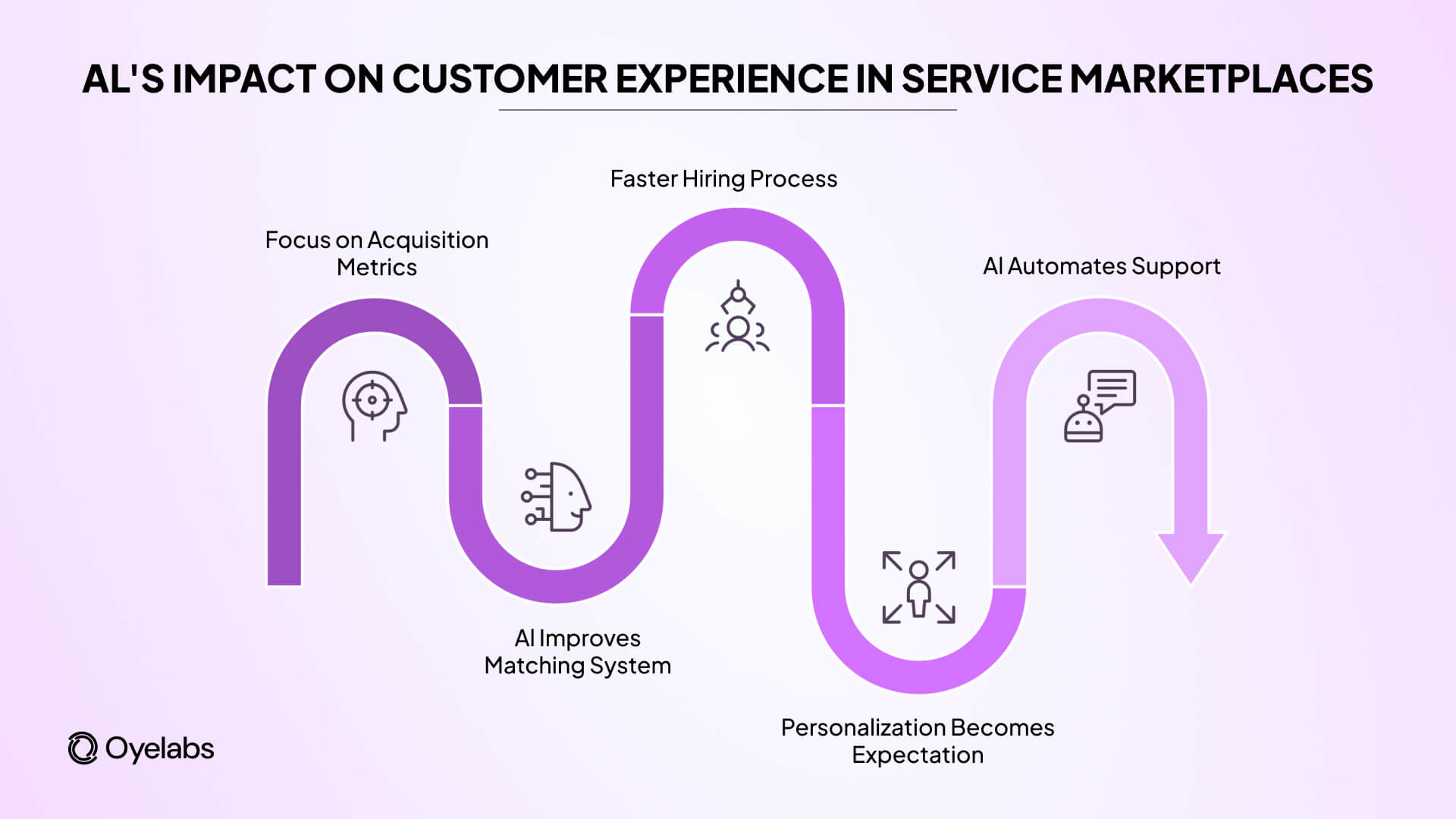
Most founders focus heavily on acquisition metrics because those numbers are visible. Downloads, signups, CAC, and ad performance are easy to track. Retention problems are harder to notice early, especially in service marketplaces.
This is where AI changes the customer experience significantly.
A good matching system reduces uncertainty. Customers feel like the platform understands what they actually need instead of forcing them to search endlessly through unrelated providers.
That reduction in friction improves the entire booking journey.
Faster Hiring Creates Higher Marketplace Trust
Speed matters in service marketplaces because many tasks are urgent by nature.
Users often post tasks when they need:
- Immediate repairs
- Last-minute movers
- Emergency cleaning
- Technical support
- Time-sensitive deliveries
Traditional marketplaces slow this process down with:
- Manual comparisons
- Irrelevant bids
- Delayed responses
- Poor provider targeting
AI-powered recommendation engines help narrow decisions faster by ranking providers based on:
- Historical success rates
- Similar completed tasks
- Response consistency
- Availability patterns
- Customer satisfaction history
This creates a smoother experience without overwhelming users with unnecessary choices.
Personalization Is Becoming a Marketplace Expectation
Modern users increasingly expect platforms to adapt to their behavior.
AI allows marketplaces to personalize:
- Service recommendations
- Preferred provider suggestions
- Budget-aligned options
- Location-aware discovery
- Recurring service reminders
This is one reason platforms like Uber, Amazon, and Netflix have changed customer expectations across industries. Users now expect platforms to predict relevance instead of making them search manually every time.
Service marketplaces are moving in the same direction.
Lower Support Costs Through AI Automation
As marketplaces scale, support operations become expensive very quickly.
AI systems can reduce operational pressure through:
- Intelligent task routing
- Automated onboarding assistance
- Dispute categorization
- FAQ automation
- Spam detection
However, strong marketplaces use AI carefully. Over-automation can damage trust if customers feel trapped inside robotic workflows.
The goal is not to remove human interaction entirely. The goal is to reduce operational inefficiencies while improving user confidence.
Growth Insight: Users bypass platforms when fees feel higher than the value, protection, convenience, or trust they receive.
Can AI Reduce Bias in Airtasker-Like Platforms?
Bias is one of the least discussed problems in service marketplaces, yet it affects both customer experience and provider opportunities significantly.
Traditional marketplaces often rely heavily on:
- Profile appearance
- Name familiarity
- Manual review interpretation
- Subjective decision-making
AI-powered matching systems can improve fairness when designed correctly because they prioritize:
- Skill relevance
- Historical performance
- Completion quality
- Reliability metrics
Instead of simply promoting the most visible providers, intelligent systems can surface providers based on actual capability alignment.
For example, a newer provider with:
- Strong task completion quality
- Faster response rates
- Relevant experience
may receive better ranking opportunities despite having fewer reviews.
That creates a healthier marketplace ecosystem over time.
The Problem Most AI Discussions Ignore
AI is not automatically unbiased.
AI systems learn from existing marketplace behavior. If historical marketplace data contains bias, the AI may unintentionally reinforce it.
This creates risks such as:
- Geographic discrimination
- Price-based bias
- Reputation loops favoring older providers
- Visibility imbalance
This is why strong AI marketplaces require:
- Transparent ranking logic
- Fair exposure systems
- Continuous moderation
- Human oversight
The marketplaces that handle this correctly build stronger provider loyalty because opportunities feel more merit-based rather than visibility-based.
What It Actually Takes to Build an AI-Powered Marketplace Platform
This is where many founder expectations collide with operational reality.
Building an AI-powered marketplace is not simply about adding APIs or integrating ChatGPT into the platform. Intelligent matching systems require structured infrastructure, behavioral data, and continuous optimization.
Most successful AI marketplaces are built in phases.
Core Infrastructure Required Before AI Scaling
Before advanced AI becomes useful, marketplaces usually need:
- Stable transactional activity
- Reliable review systems
- Structured task categorization
- Provider verification systems
- Behavioral analytics tracking
Without these foundations, AI systems operate on weak or inconsistent data.
That often leads to inaccurate recommendations and unstable marketplace experiences.
Data Is the Real Marketplace Asset
Many founders think the AI model itself is the competitive advantage. In reality, the strongest long-term asset is marketplace data.
High-quality marketplace data includes:
- Task completion patterns
- Customer behavior
- Provider performance
- Pricing trends
- Retention signals
- Support history
Over time, this data becomes increasingly valuable because it allows recommendation engines to improve continuously.
That is one reason mature marketplaces become difficult to compete against. Their advantage is not just technology. It is years of behavioral intelligence collected through marketplace activity.
Scaling AI Infrastructure Is Expensive
Most startup budgets underestimate the long-term operational cost of AI systems.
AI marketplaces require ongoing investment in:
- Data processing
- Infrastructure optimization
- Model training
- Recommendation tuning
- Fraud detection
- Moderation systems
This is why many early-stage founders burn capital too aggressively on AI before validating marketplace demand properly.
The smarter approach is usually phased implementation.
How Oyelabs Helps Founders Build AI-Ready Marketplace Platforms
Most marketplace founders do not fail because of bad ideas. They fail because marketplace execution becomes far more complex once real users, providers, disputes, and scaling challenges enter the system. Building an Airtasker-like platform today requires more than task posting and bidding features. Platforms must support intelligent matching, retention systems, operational automation, trust infrastructure, and long-term AI readiness.
At Oyelabs, the approach focuses on helping founders launch scalable marketplace infrastructure first, then gradually introduce AI based on actual marketplace behavior. Many startups rush into expensive AI development before validating liquidity, provider quality, and operational workflows. That often leads to delayed launches, rising costs, and unstable user experiences.
A stronger strategy is phased marketplace growth. Founders can launch faster, validate demand earlier, collect transactional data, and optimize the platform using real behavioral insights. Over time, AI can then improve smart task categorization, provider recommendations, fraud detection, search ranking, and personalization.
For many startups, this creates a far stronger growth path than attempting to build fully custom AI systems before marketplace fundamentals are proven.
Launch Your Service Marketplace Platform Without Revenue Leaks
Build a service platform designed to protect transactions, users, and long-term marketplace growth.
✓ Secure in-app payments from day one
✓Reduce off-platform deal bypass risks
✓ Improve provider and customer trust
✓ Launch faster with scalable marketplace infrastructure
Conclusion
AI is reshaping how Airtasker-like platforms handle matching, trust, and marketplace efficiency. But the biggest lesson most founders eventually learn is that AI alone does not fix weak marketplace operations. Strong matching systems depend on strong marketplace foundations first.
The most successful service marketplaces are not simply using more AI. They are using better operational data, stronger trust systems, cleaner provider ecosystems, and smarter execution strategies. AI becomes powerful when it strengthens those systems instead of trying to replace them.
For founders building service marketplace platforms, the real opportunity is not just launching another task app. It is building a marketplace ecosystem capable of improving continuously through behavioral intelligence, operational learning, and scalable infrastructure.
That is where long-term marketplace growth actually happens.
FAQs
Can AI fully automate task-provider matching?
Not entirely. AI can significantly improve matching accuracy by analyzing skills, behavior, reviews, and historical performance, but human trust factors still matter. Most successful marketplaces use AI to assist decision-making rather than completely replacing human judgment.
Is AI necessary for early-stage marketplace startups?
No. Early-stage marketplaces usually benefit more from strong operational systems, provider quality, and marketplace liquidity first. AI becomes more valuable after the platform starts generating reliable behavioral data and transactional history.
How does AI improve retention in service marketplaces?
AI improves retention by reducing friction across the user journey. Better recommendations, faster hiring, personalized discovery, and higher-quality matches increase customer satisfaction and encourage repeat platform usage over time.
What is the biggest mistake founders make when adding AI?
The biggest mistake is adding AI before validating marketplace fundamentals. Many startups invest heavily in recommendation engines and automation systems without first solving trust, liquidity, provider quality, and operational consistency.
How expensive is it to build AI-powered marketplace features?
Costs vary depending on complexity. Basic AI-assisted workflows are relatively affordable, while predictive recommendation systems, behavioral analytics, and real-time matching infrastructure require significantly larger long-term investment and optimization.