
Cost to Build a Reverse Fare Ride Booking App Like inDrive
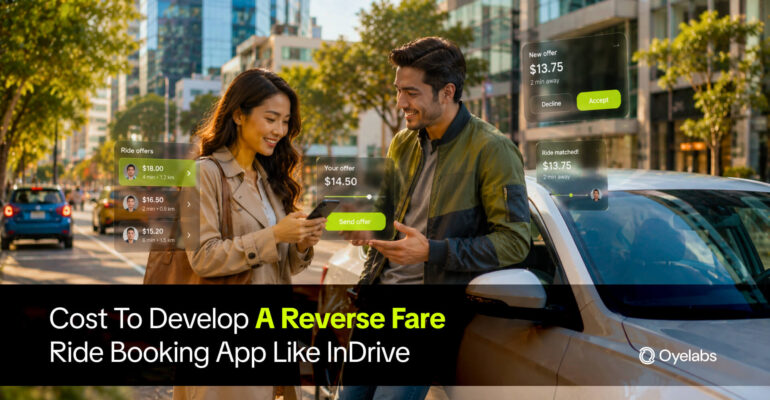
Cost to Build a Reverse Fare Ride Booking App Like inDrive
 Sachin Sharma
Last Updated on July 5, 2026
Key Takeaways –
What You’ll Learn:
- Reverse fare apps allow riders to suggest their own ride prices.
- Drivers can accept, reject, or counter-offer ride requests instantly.
- Reverse bidding apps perform well in price-sensitive markets like India.
- Rider, driver, and admin apps are required for launch.
- Real-time bidding systems need advanced backend infrastructure.
- White-label inDrive clones launch faster than custom-built platforms.
Stats That Matter:
- inDrive operates in 1,000+ cities across 48 countries.
- inDrive has crossed 400 million app downloads globally.
- Asia-Pacific handles over 57% of global ride-hailing trips.
If you’ve ever opened inDrive and thought, “this bidding model is actually genius,” you’re not alone. The idea that passengers name their price and drivers accept, counter, or ignore it completely flips the traditional ride-hailing script. No surge pricing. No algorithm making the call. Just two people negotiating a fair ride.
That model has resonated hard in emerging markets. inDrive, the reverse fare ride booking app now operates in 700+ cities across 47 countries, with a user base that has crossed 150 million downloads. Founders watching that growth are right to ask: how much does it actually cost to build something like this?
That’s exactly what this post breaks down.
What Makes a Reverse Fare Ride Booking App Different
Before getting into development costs, it helps to understand what you’re actually building. A standard ride-hailing app like Uber or Lyft uses algorithm-based pricing. The platform automatically calculates the fare, and the rider either accepts it or leaves the app.
A reverse fare app like inDrive works very differently. Instead of the app deciding the price, the rider suggests how much they’re willing to pay for the trip. Nearby drivers can then:
- Accept the offered fare
- Ignore the request
- Send a counter-offer
The passenger reviews the incoming offers and chooses the driver they prefer. Only after both sides agree does the ride begin. This negotiation-first approach has become one of the main reasons behind inDrive’s rapid global growth. The platform now operates in more than 1,000 cities across 48 countries and has crossed 400 million app downloads globally, showing strong demand for flexible pricing models in ride-hailing.
The model performs especially well in emerging markets where affordability matters more than premium convenience. Recent industry reports show Asia-Pacific now accounts for more than 57% of global ride-hailing trips, with countries like India becoming major growth markets for alternative ride-booking platforms.
That negotiation-based flow is also the biggest technical difference between a traditional taxi app and a reverse fare platform. A normal ride-hailing app mainly focuses on dispatch logic by matching the nearest available driver with a rider. A reverse fare app requires an entirely different real-time infrastructure. You need a live bidding engine capable of handling:
- Instant ride broadcasts
- Real-time offer and counter-offer updates
- Simultaneous responses from multiple drivers
- Dynamic rider-side driver selection
- WebSocket-based communication
- Low-latency notifications and syncing
This changes the backend architecture significantly. Instead of building a simple taxi-booking app, you’re building a real-time negotiation platform. That added complexity affects everything from server infrastructure and scalability to development timelines and overall project cost.
Also Read: InDriver’s Reverse Bidding Model
Core Features to Build
To launch a competitive reverse fare app, you need three apps plus an admin panel: a rider app, a driver app, and a dispatcher/admin dashboard.
Rider App Features
- Registration and profile management
- Live location-based ride request posting
- Fare input and negotiation interface
- Real-time driver offers and counter-offer viewing
- Driver selection and ride confirmation
- In-app chat and call
- Live ride tracking with ETA
- Multiple payment options (cash, card, wallet)
- Ride history and ratings
Driver App Features
- Driver onboarding with document verification
- Live offer feed showing nearby ride requests
- Accept, counter-offer, or skip functionality
- Navigation and route optimization
- Earnings dashboard
- Availability toggle and status management
- Ratings and review history
Admin Panel Features
- User and driver management
- Real-time ride monitoring
- Dispute resolution tools
- Revenue and commission tracking
- Promo and surge override controls
- Analytics dashboard
The Real Cost Breakdown
This is where most articles get vague. Let us be specific. The total cost depends on three main variables: where your team is based, whether you build from scratch or use a white-label solution, and how feature-complete your MVP needs to be.
Option 1: Custom Development from Scratch
| Development Component | Estimated Hours | US Agency Cost | Indian Agency Cost |
|---|---|---|---|
| UI/UX Design | 200–300 hrs | $20,000–$30,000 | $5,000–$8,000 |
| Rider App | 400–500 hrs | $40,000–$50,000 | $10,000–$15,000 |
| Driver App | 350–450 hrs | $35,000–$45,000 | $9,000–$13,000 |
| Real-Time Bidding Engine | 150–200 hrs | $15,000–$20,000 | $4,000–$6,000 |
| Admin Dashboard | 200–250 hrs | $20,000–$25,000 | $5,000–$7,000 |
| Backend APIs & Database | 300–400 hrs | $30,000–$40,000 | $8,000–$12,000 |
| QA & Testing | 150–200 hrs | $15,000–$20,000 | $4,000–$6,000 |
Building from scratch gives you total control. But it also means 12 to 18 months of development time before you can go live, and a high burn rate during that window.
Option 2: White-Label inDrive Clone
This is where the math shifts significantly. A white-label reverse fare solution like OyeLabs’ inDrive clone comes pre-built with the core bidding engine, both apps, and an admin panel. You’re paying for configuration, customization, and deployment, not for rebuilding what already works.
| White-Label Cost Component | Estimated Cost |
|---|---|
| Base white-label platform | $5,000 – $15,000 |
| Custom branding/UI changes | $1,000 – $3,000 |
| Payment gateway integrations | $1,000 – $2,500 |
| Server setup | $500 – $1,500 |
| Third-party APIs | $500 – $1,500 |
Delivery timelines drop to 4 to 8 weeks. The business logic is already tested in production-like conditions. You’re launching, not building.
Ongoing Monthly Operating Costs
Building the app is one cost. Running it is another. Many founders underestimate this part.
| Monthly Expense | Estimated Cost |
|---|---|
| AWS / Google Cloud hosting | $300 – $1,500 |
| Maps and navigation APIs | $200 – $800 |
| SMS OTP services | $100 – $400 |
| Push notifications | $50 – $150 |
| KYC verification | $0.50 – $2 per driver |
| Payment gateway fees | 1.5% – 3% |
| App store accounts | $25/year (Google), $99/year (Apple) |
At launch scale, expect total monthly ops to run $800 to $3,000 depending on your active user count and geography.
Related Read: Cost of Developing an Uber-Like App
Factors That Affect Your Total Budget
1. Geography and Market Complexity
A single-city MVP in one country costs less than a multi-country platform with different currencies, language packs, and local payment gateways. If you’re targeting Southeast Asia, Africa, or Latin America, factor in local payment rails like M-Pesa, GCash, or Pix.
2. Vehicle Category Scope
InDrive started with cars. If you want to launch with multiple categories (bikes, autos, cargo, intercity), each requires separate pricing logic and driver verification flows. Start narrow.
3. Safety Features
Government regulations in several markets now mandate features like SOS buttons, trip sharing, and verified driver profiles. Some markets also require local server hosting (data residency laws). Always check your launch country’s compliance requirements before budgeting.
4. Real-Time Infrastructure
The bidding engine is the most performance-sensitive component of the app. Real-time WebSocket connections need to be reliable and fast, especially in markets with lower internet speeds. This affects your hosting tier and CDN decisions.
Revenue Model: How You Make Money
This is a question every founder should be able to answer before they build. inDrive famously charges a lower commission than Uber, one of its key differentiators in price-sensitive markets.
| Revenue Stream | Description |
|---|---|
| Ride commission | 5%–15% per completed ride |
| Driver subscriptions | Paid visibility or premium access |
| Cancellation fees | Flat penalties |
| In-app advertising | Local business promotions |
| Premium ride categories | Higher commission margins |
| Intercity or cargo rides | Higher-value transactions |
The reverse fare model actually gives you a profitability edge in emerging markets because you are not subsidizing rides. Both parties set the price. Your platform just takes a cut of what they agree on.
Should You Build From Scratch or Go White-Label?
Honestly, the answer depends on what stage you’re at.
If you are at the idea stage, have a limited budget, or want to validate the model in a specific city before raising, a white-label clone gets you to market in weeks, not months. You can test real driver and rider behavior, refine your commission structure, and prove traction before committing to a full custom build.
If you have already validated demand, raised a Series A, and need differentiated features that no off-the-shelf product supports, then custom development makes sense. But even then, most founding teams use a white-label base and customize from there rather than rebuilding core logic from zero.
At OyeLabs, we have built white-label ride-hailing platforms for founders across South Asia, the Middle East, and Africa. The inDrive clone we offer includes the reverse fare bidding engine as a native feature, not a patch-on addition. That distinction matters for performance at scale.
What a Realistic Launch Timeline Looks Like
| Phase | White-Label Route | Custom Build Route |
| Discovery and scoping | 1-2 weeks | 3-4 weeks |
| Design | 1-2 weeks | 6-10 weeks |
| Development | 3-5 weeks | 20-30 weeks |
| QA and testing | 1 week | 4-6 weeks |
| Deployment and go-live | 1 week | 2-3 weeks |
| Total | 7-11 weeks | 35-53 weeks |
Time to market is a competitive moat in local ride-hailing. The first branded app to saturate driver-side supply in a city tends to win that city. Speed matters.
Conclusion
Building a reverse fare ride-hailing app like inDrive is not as out of reach as it sounds. The model is proven, the demand is real in price-sensitive markets, and the technology is accessible.
The biggest cost variable is not the app itself. It is the decision between building and launching. Custom builds give you flexibility but cost 3x to 10x more and take far longer. White-label solutions give you a head start that is worth more than most founders realize.
If you’re serious about launching in the next 90 days, the inDrive clone from OyeLabs is built for exactly this use case. Reach out to the team at OyeLabs.com to get a scoped quote for your market.
FAQs
1. Can reverse fare ride-booking apps work in small cities?
Yes, reverse fare apps perform well in smaller cities where users prefer affordable pricing and direct fare negotiation options.
2. How do reverse fare apps attract more drivers?
Lower commissions and flexible pricing help drivers earn better profits compared to traditional ride-hailing platforms like Uber.
3. Is a white-label inDrive clone better than custom development initially?
White-label solutions help founders launch faster, validate markets early, and reduce overall development costs significantly.
4. Which payment methods should reverse fare apps support?
Apps should support wallets, cards, cash payments, and local payment gateways based on regional customer preferences and habits.
5. Why is real-time infrastructure important for reverse fare apps?
Real-time bidding systems require instant notifications, fast syncing, and stable communication between riders and multiple drivers.
Reviewed By: Ayan Khan
Senior Digital Content Strategist, Oyelabs