
How to Achieve Sub-2-Second Latency in Bigo Live-Style Apps

How to Achieve Sub-2-Second Latency in Bigo Live-Style Apps
 Surya Pratap Singh
Last Updated on September 11, 2026
Key Takeaways
What You Will Learn
* Sub-2-second latency requires optimizing four separate stages: ingestion, processing, distribution, and playback.
* WebRTC-based ingestion (WHIP) became a ratified IETF standard, RFC 9725, in March 2025.
* WHEP, WebRTC’s egress counterpart, remains an unratified Internet-Draft even though major platforms already run it in production.
* LL-HLS shrinks video segments into partial chunks small enough to reach 2 to 6 seconds of delay on standard CDN infrastructure.
* GOP size and B-frame settings at the encoder directly control how much decode delay gets added before a frame ever reaches the network.
* Jitter buffer size on the client is a direct trade-off between smoothness and how close playback stays to the true live edge.
Real Insights
* Treating WHIP and WHEP as equally standardized is a common but factually incorrect assumption in latency planning.
* Hardware-accelerated encoding on the broadcaster’s device matters as much as server-side infrastructure for total latency.
* A protocol choice that works for one-on-one video chat often fails to scale economically to mass broadcast.
* Catch-up playback with pitch correction solves network jitter without the viewer noticing any audio distortion.
How to Achieve Sub-2-Second Latency in Bigo Live-Style Apps
Achieving sub-2-second latency in Bigo Live-style apps means optimizing every stage of the video pipeline together, ingestion, processing, distribution, and playback, rather than fixing one bottleneck and assuming the rest of the system will follow. A live app can have a perfectly tuned CDN and still feel laggy if the encoder settings or the client-side buffer are working against it.
From a mobile architecture standpoint, this is one of the areas where teams most often optimize the wrong layer first. I’ve seen builds spend weeks tuning server infrastructure while a bloated jitter buffer on the client was quietly adding a full second of delay that no CDN upgrade could ever fix.
This breakdown covers the real protocol choices, encoding settings, and client-side adjustments behind sub-2-second latency, including a few standards-level details, like the actual ratification status of WHIP and WHEP, that most technical content on this topic gets wrong or oversimplifies entirely.
Quick Answer
- WebRTC over UDP delivers 200ms to 500ms latency and is the standard for co-hosting and one-on-one video chat.
- WHIP, the WebRTC ingestion standard, is now a ratified IETF RFC as of March 2025; WHEP, its egress counterpart, is still only a draft.
- LL-HLS shrinks segments into partial chunks, reaching roughly 2 to 6 seconds of latency while keeping standard, cost-efficient CDN distribution.
- Reducing GOP size to 1 to 2 seconds and disabling B-frames removes meaningful decode delay at the encoding stage.
- Hardware-accelerated encoding on the broadcaster’s own device, not just the server, materially affects total pipeline latency.
- A jitter buffer of 0.5 to 1 second on the player trades some resilience for staying much closer to the true live edge.
The Four-Stage Latency Budget
Total latency in a live streaming app is the sum of delay added at four distinct stages, and treating it as a single number to optimize misses where the actual time is being spent in most real-world implementations.
Ingestion covers the time from the broadcaster’s camera capturing a frame to that frame reaching a media server. Processing covers encoding and any server-side transcoding. Distribution covers how that processed video travels from the media server to potentially millions of concurrent viewers. Playback covers how the viewer’s device buffers and renders what it receives.
A sub-2-second target usually means the ingestion and processing stages combined need to stay under a few hundred milliseconds, leaving the remaining budget for distribution and a small, deliberately minimized playback buffer on the client.
Ingestion: Choosing the Right Protocol Stack
Traditional RTMP, still common in many streaming setups, introduces 3 to 5 seconds of latency largely due to TCP’s overhead and its reliance on full segment buffering before data becomes usable downstream. For a sub-2-second target, this protocol needs to be replaced entirely, not tuned.
WebRTC is the standard for genuinely sub-second ingestion, typically landing between 200ms and 500ms. It runs over UDP rather than TCP, includes built-in echo cancellation, and dynamically adjusts to changing network conditions without requiring the application layer to manage that complexity manually.
WHIP, the WebRTC-HTTP Ingestion Protocol, standardizes how a broadcaster’s stream gets into a media server without custom WebRTC signaling logic on both ends. This is worth stating precisely, since most content on this topic gets it wrong: WHIP was formally ratified as IETF RFC 9725 in March 2025, meaning it’s no longer a draft proposal but an actual Internet Standards Track protocol with the stability guarantees that status implies for production infrastructure planning.
Builder Tip: Standardizing ingestion on a ratified protocol like WHIP reduces long-term maintenance risk compared to building on custom, unstandardized WebRTC signaling.
Distribution: Where WHIP’s Standardization Story Gets Complicated
Here’s the nuance most technical guides skip entirely, and it matters for any team making a long-term infrastructure bet. WHEP, the WebRTC-HTTP Egress Protocol that pairs with WHIP for delivering streams to viewers, is still only an IETF Internet-Draft, not a ratified RFC, as of this writing.
That doesn’t mean WHEP is unusable in production. Multiple major streaming infrastructure providers already ship WHEP support today, and it works reliably at real scale. But its formal standardization status is genuinely behind WHIP’s, and any team betting heavily on WHEP’s exact specification remaining unchanged should build with that draft status in mind rather than assuming it carries the same stability guarantees WHIP now has as a ratified standard.
For platforms where pure WebRTC distribution becomes too expensive to scale to large passive audiences, Low-Latency HLS offers a more CDN-friendly alternative. Apple’s LL-HLS specification, later incorporated into updates of the underlying IETF HLS standard, breaks video into partial segments as small as 200 to 500 milliseconds and uses preload hints so a player knows what content is coming before it’s even fully generated. Independent IEEE research evaluating this approach found it can bring HLS’s typical 8-to-30-second delay down to roughly 2 to 6 seconds, while preserving the CDN cost efficiency that pure WebRTC distribution struggles to match at large scale.
Encoding: Where Milliseconds Get Lost Before the Network Even Sees Them
How a broadcaster’s device compresses video before sending it has a direct, measurable effect on total pipeline latency, and it’s a stage that’s easy to overlook when most attention goes toward server and CDN infrastructure instead.
GOP size, the interval between full keyframes, matters significantly here. Standard streaming setups often use a 6-to-10-second GOP, but a sub-2-second target requires shrinking that to 1 or 2 seconds, since a smaller GOP lets a player start decoding and displaying video almost immediately rather than waiting for the next full keyframe to arrive.
B-frames, which require the decoder to wait for future frames before it can render a current one, add processing delay that’s straightforward to remove. Disabling B-frames at the encoder, using a zero-latency tuning profile in an encoder like x264, is a small configuration change with an outsized latency benefit for real-time use cases specifically.
Hardware-accelerated encoding on the broadcaster’s own device, using the device’s dedicated video encoding hardware rather than general-purpose CPU cycles, further reduces the time between a frame being captured and it being ready to transmit. This matters as much on the broadcaster’s phone as it does anywhere in the server infrastructure, since a slow encode on a weak mobile device can quietly become the largest single source of delay in the entire pipeline.
Growth Insight: Encoder-level latency optimizations cost nothing to implement but often deliver a larger improvement than expensive infrastructure upgrades alone.
Player-Side Adjustments: Tuning the Last Mile
Everything upstream can be perfectly optimized and still feel slow if the viewer’s own app is holding onto a large buffer before it starts rendering anything, which is a mistake that’s surprisingly common even in otherwise well-built live streaming clients.
Minimizing the jitter buffer, the small holding area a player uses to smooth out network irregularities, to somewhere between 0.5 and 1 second directly reduces perceived latency. This does trade away some resilience against unstable connections, which means it requires a genuinely stable network path to work well without introducing visible playback stutter.
Catch-up playback handles the network drops that inevitably still happen despite good tuning elsewhere. When a viewer falls behind the live edge after a brief connectivity issue, the player can temporarily speed up playback slightly, commonly to around 1.1x or 1.2x normal speed, using time-stretching algorithms that keep audio pitch sounding normal rather than the noticeably distorted, high-pitched effect a naive speed-up would otherwise introduce for the listener.
Protocol Stack Comparison for Bigo-Style Apps
| Protocol Stack | Typical Latency | Scalability | Best Use Case |
|---|---|---|---|
| Pure WebRTC (WHIP/WHEP) | 200ms – 500ms | Moderate, costly at large scale | Co-hosting, PK battles, 1-on-1 chat |
| Low-Latency HLS | ~2s – 6s | Very high, standard CDN | Mass broadcasting to large passive audiences |
| SRT Ingest + WebRTC Egress | ~500ms – 1s | High | Premium broadcasters with professional setups |
Common Mistakes Teams Make Chasing Sub-2-Second Latency
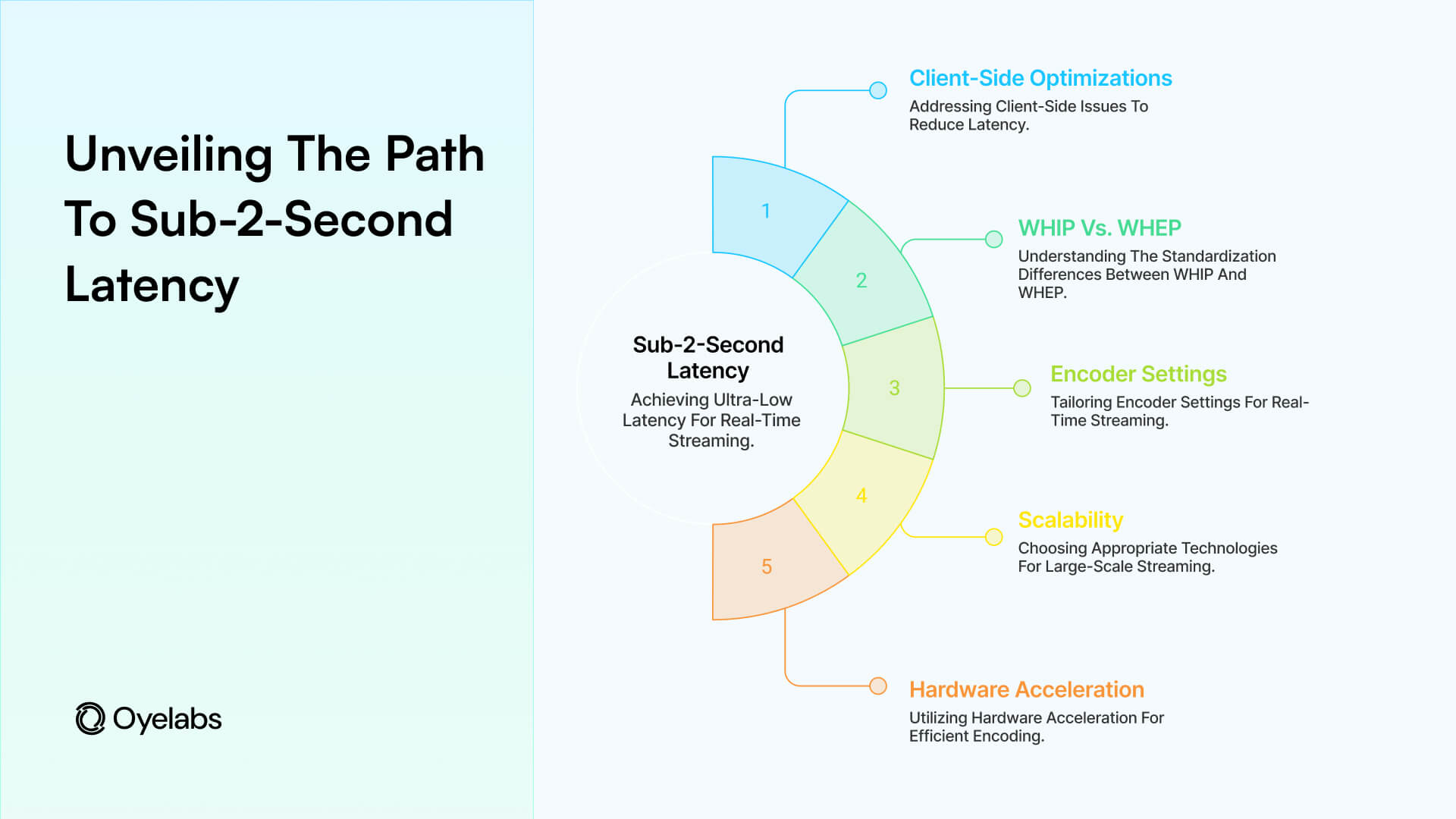
- Optimizing server infrastructure while ignoring the client player: A large jitter buffer on the viewer’s device can undo every upstream optimization by itself.
- Treating WHIP and WHEP as equally standardized: WHIP is a ratified RFC; WHEP remains a draft, which matters for long-term infrastructure planning.
- Using default encoder settings tuned for VOD: Standard GOP sizes and enabled B-frames are built for on-demand video, not real-time interactive streaming.
- Betting entirely on pure WebRTC at scale: It’s excellent for small interactive sessions but becomes expensive fast for mass broadcast to large passive audiences.
- Skipping hardware-accelerated encoding on the broadcaster’s device: A slow software encode on a weak mobile device can be the largest single latency source in the whole pipeline.
Scoping This for a Bigo Live Clone Build
When teams come to us wanting to build a Bigo Live-style app, the latency architecture decision needs to be scoped before a single line of client code gets written, since retrofitting a low-latency pipeline onto an app already built around standard HLS is a significantly harder rebuild than planning for it upfront.
The core decision is usually a hybrid one rather than a single protocol choice: WebRTC-based delivery for interactive formats like co-hosting and PK battles, paired with LL-HLS for mass broadcast to larger passive audiences where WebRTC’s per-viewer scaling cost becomes economically impractical at real user volumes.
Getting this sequencing right from the start avoids a pattern we see often: a demo that looks flawless with a handful of test viewers, followed by real cost and latency problems the moment genuine concurrent viewer counts hit production infrastructure.
Also Read: Why Bigo Live Keeps Growing While Streaming Apps Decline
How OyeLabs Approaches Latency Architecture for Live Apps
A custom build means designing the ingestion protocol stack, encoder configuration, and client-side buffer logic entirely from scratch, which is precisely the kind of deep infrastructure work that quietly extends a launch timeline by months before a single broadcaster ever goes live on the platform. For live app like Poppo Live, where real-time interaction is central to the experience, keeping this latency under control is especially important.
A white-label Bigo Live clone script starts with this latency architecture already built and production-tested, hybrid WebRTC and LL-HLS delivery, tuned encoder profiles, and properly sized client buffers included from day one. That means the team’s early effort goes into creator monetization and community features instead of solving protocol-level latency problems that established live platforms have already spent years refining through hard production experience.
Conclusion
Sub-2-second latency in a Bigo Live-style app isn’t the result of one clever fix. It comes from getting four separate stages right at once: a modern ingestion protocol, minimal encoding overhead, distribution infrastructure matched to actual audience size, and a client player tuned to stay close to the live edge without sacrificing stability.
Getting the standards details right matters more than it might seem at first. Knowing that WHIP is a ratified standard while WHEP remains a draft, or that LL-HLS trades a small amount of latency for dramatically better scalability than pure WebRTC, is the difference between an infrastructure decision that holds up at scale and one that quietly breaks the moment real concurrent viewers show up.
Frequently Asked Questions
What’s the fastest protocol for live streaming latency?
WebRTC, typically landing between 200ms and 500ms, is the fastest widely deployed option, but it becomes expensive to scale to large passive audiences compared to segment-based alternatives.
Is WHIP the same standardization level as WHEP?
No. WHIP was ratified as IETF RFC 9725 in March 2025, while WHEP remains an Internet-Draft that hasn’t yet progressed to full RFC status, despite being used in production by several platforms.
Can a live app use LL-HLS instead of WebRTC entirely?
Yes, particularly for mass broadcast scenarios with large passive viewer counts, since LL-HLS achieves roughly 2 to 6 seconds of latency while keeping standard, cost-efficient CDN distribution.
Why does GOP size matter for live streaming latency?
A smaller GOP, meaning more frequent keyframes, lets a player start decoding and displaying video almost immediately rather than waiting for the next full keyframe in a longer interval.
How small should a live video player’s jitter buffer be?
Between 0.5 and 1 second is a common target for sub-2-second latency, though this requires a genuinely stable network connection to avoid visible playback stutter.
Sources and Editorial Notes
Sources
- IETF – RFC 9725: WebRTC-HTTP Ingestion Protocol (WHIP)
- IETF Datatracker – WebRTC-HTTP Egress Protocol (WHEP), Internet-Draft Status
- Apple Developer Documentation – Protocol Extension for Low-Latency HLS
- IEEE – Evaluating the Performance of Apple’s Low-Latency HLS
Editorial Notes
- WHIP’s ratification as RFC 9725 and WHEP’s current Internet-Draft status are sourced directly from the IETF’s own official datatracker and RFC Editor records, not from secondary summaries of standards progress.
- LL-HLS’s technical mechanics (partial segments, preload hints, blocking playlist reload) are sourced from Apple’s official developer documentation for the specification.
- The 2-to-6-second latency figure for LL-HLS is corroborated by independent IEEE peer-reviewed research evaluating the specification’s real-world performance, not a vendor’s self-reported benchmark.
- Encoder-level details (GOP size, B-frame elimination, hardware acceleration) reflect established, widely documented video encoding practice rather than a single proprietary source, and are presented as general technical knowledge accordingly.