13 Best E-Learning Apps In 2026

 Sushmeet Setia
Last Updated on November 24, 2026
Key Takeaways:
-
Duolingo, Udemy, Coursera and Khan Academy show different ways to build e-learning platforms.
-
E-learning apps serve different audiences, including students, professionals and creative learners.
-
Course marketplaces, language apps and exam preparation platforms offer different business models.
-
AI tutors, interactive quizzes and progress tracking improve the learning experience.
-
Successful apps focus on specific subjects and learner needs.
-
Reliable technology, useful content and manageable costs support long-term growth.
Stats That Matter:
-
The global education app market may reach US$22.28 billion in 2026.
-
Education app downloads are expected to reach 7.27 billion in 2026.
-
The market may grow to US$34.37 billion by 2031.
Education is as important as oxygen, water, and food for a human being. So, apps for education are developed and launched in the market at a massive speed. According to Statista, the global education app market is projected to generate US$22.28 billion in revenue in 2026, with downloads expected to reach 7.27 billion.
E-Learning apps are making it quite easy for an individual to gain knowledge on particular topics. Therefore, they are also generating high revenue. According to Statista, the education app market is expected to grow at a CAGR of 9.06% between 2026 and 2031, reaching a projected market volume of US$34.37 billion by 2031.
Are Education Apps Still Popular in 2026?
Are education apps still popular in 2026? Absolutely! More students are using their phones and computers to learn new skills, prepare for exams and understand difficult subjects. From AI-powered tutors and interactive quizzes to language lessons and professional courses, education apps make learning more flexible and accessible.
With so many platforms available, there is plenty for aspiring e-learning businesses to learn from. Looking at successful apps can help you understand what features attract users, which audiences they serve and how different platforms approach online education. Below, we look at 13 popular e-learning apps in 2026 that are worth studying before launching your own e-learning business.
13 Top Quality E-Learning Apps
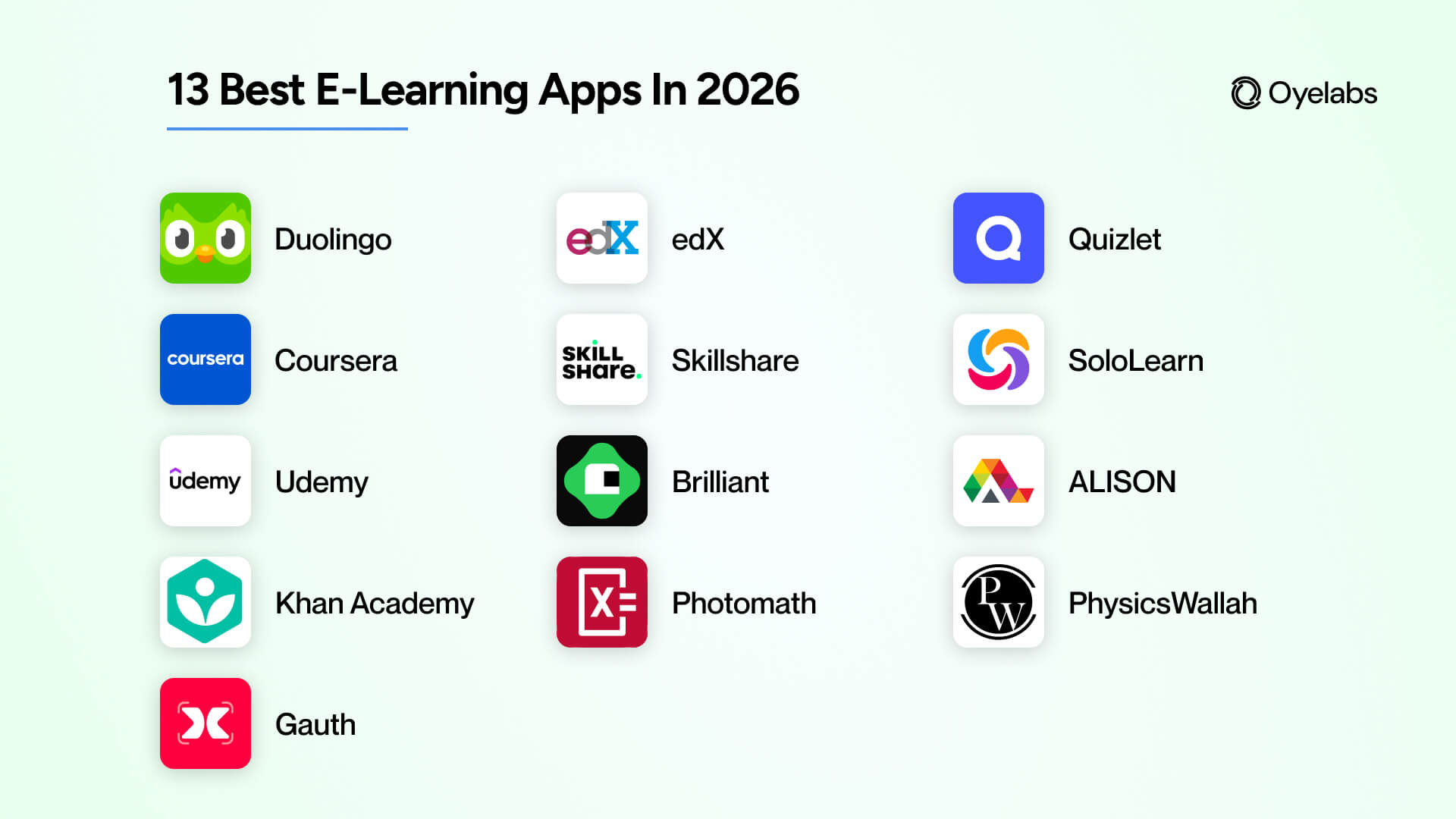
The 13 Apps at a Glance
| App | Best For | Where It Stands in 2026 |
|---|---|---|
| Duolingo | Learning languages | 64.9 million daily users and continued growth |
| Coursera | Career and university-style courses | Joined with Udemy in May 2026 |
| Udemy | Practical skills from independent instructors | Part of Coursera since May 2026 |
| Khan Academy | Free school subjects | Non-profit with 189.6 million registered users |
| edX | University programs | Operates under 2U, which went through bankruptcy in 2024 |
| Skillshare | Creative skills | Still operating with new creator tools |
| Brilliant | Math, coding, and science | Reports 10 million learners |
| Photomath | Math help with step-by-step solutions | Owned by Google and still updated |
| Quizlet | Flashcards and test preparation | Adding AI-powered study tools |
| SoloLearn | Learning to code | Reports 30 million sign-ups |
| Alison | Free online courses | Expanding its courses and recruitment services |
| Physics Wallah | Indian entrance exam preparation | Listed on the stock market in 2025 |
| Gauth | AI-powered homework help | Among the top US education app downloads in late 2025 |
1. Duolingo
Duolingo is a US-based language app, founded in 2011 by Luis von Ahn and Severin Hacker. It teaches through short, game-style lessons, and it continues to grow. If you are planning something similar, our Duolingo clone shows how the idea can be built.
Key points (Q3 2026, from Duolingo’s shareholder letter)
-
64.9 million daily active users, up 29% from a year earlier.
-
153.1 million monthly active users, up 13%.
-
It offers language lessons through interactive exercises, daily goals and gamified activities.
-
Learners can access free lessons or choose paid subscriptions for additional features.
Availability: Android, iOS
2. Coursera
Coursera is a US-based platform founded in 2012 by Andrew Ng and Daphne Koller. It offers courses from universities and companies. In May 2026, it completed a combination with Udemy.
Key points
-
Coursera and Udemy joined to expand their reach across online learning.
-
The combined platform offers courses from universities, companies and independent instructors.
-
Courses cover career topics such as data, programming and AI, alongside academic subjects.
Availability: Android, iOS
3. Udemy
Udemy is a marketplace where independent instructors sell courses on everything from programming to cooking. Eren Bali, Oktay Caglar and Gagan Biyani founded it in 2010. If you want to build a course marketplace of your own, see our Udemy clone.
Key points
-
Since May 11, 2026, Udemy has been part of Coursera.
-
The two companies said that learners’ access, subscriptions and pricing would remain unchanged on day one. The platforms would continue to operate separately for the time being.
-
Over time, they expect to offer a combined course catalog.
-
For anyone planning a new course app, this is a reminder to focus on a specific audience rather than competing on catalog size.
Availability: Android, iOS
4. Khan Academy
Khan Academy is a non-profit that offers free lessons and practice. Sal Khan founded it in 2008. Its newest bet is Khanmigo, an AI tutor and teaching assistant.
Key points (school year 2024–25, from Khan Academy’s annual report)
-
189.6 million registered users, including 20.9 million new sign-ups during the year.
-
104.9 million yearly active learners who used Khan Academy at least once during the school year.
-
Khanmigo had 2 million users, including students, teachers and parents. Nearly half were teachers using it for free.
-
Khan Academy offers lessons in math, science, humanities, economics and arts.
-
Khan Academy is available in more than 190 countries and 55 languages.
Availability: Android, iOS
5. edX
Harvard and MIT started edX in 2012. Today it belongs to 2U, which bought it in 2021. The story since then is a useful one for anyone building a learning business.
Key points
-
2U filed for Chapter 11 bankruptcy protection in July 2024. edX continued operating during the restructuring.
-
In May 2026, 2U appointed a dedicated executive director for edX.
-
In September 2026, edX added hands-on courses from CodeSignal and new Google Cloud courses.
-
It suits learners who want courses from universities and employers, with no single age group in mind.
Availability: Android, iOS
6. Skillshare
Skillshare is a US-based subscription app for creative classes such as illustration, design, writing and entrepreneurship. Michael Karnjanaprakorn and Malcolm Ong founded it in 2010.
Key points
-
Classes include projects that help learners practice what they learn.
-
Skillshare acquired Superpeer in 2024 to expand the tools available to teachers.
-
Superpeer stopped operating as a separate site in December 2024.
-
Skillshare introduced changes to its teacher earnings programme in 2026.
Availability: Android, iOS
7. Brilliant
Brilliant teaches math, computer science, data and science through short, hands-on problems instead of video lectures. It focuses on interactive learning, allowing users to understand concepts by solving problems rather than simply watching someone explain them.
Key points
-
Brilliant says it has more than 10 million learners worldwide, according to its official website.
-
It gives hints and step-by-step guidance instead of simply showing answers, with feedback as learners solve problems.
-
Its deepest subject areas are math and coding, with additional courses in data science and science.
-
Lessons require an internet connection and are not available offline.
Availability: Android, iOS
8. Photomath
Photomath reads a math problem through your phone camera and shows the steps to solve it. Damir Sabol created it, and Google acquired it in 2023. Google has kept it as its own app, and it continued receiving updates in 2026.
Key points
-
It supports students, parents and teachers who need help understanding math problems.
-
It can show multiple ways to solve a problem.
-
A scientific calculator is built in.
-
It is free to download, with a paid subscription offering additional features.
Availability: Android, iOS
9. Quizlet
Quizlet is a study app built around flashcards and practice tests. Students can make their own sets or use sets made by other students and teachers. It helps learners revise topics, memorize important information and prepare for exams through different study activities.
Key points
-
Quizlet introduced its AI tutor, Q-Chat, in March 2023. However, Q-Chat was discontinued in June 2025, so it should not be presented as a current feature.
-
In February 2026, Quizlet acquired Coconote, an AI note-taking app, and announced new AI-powered study features.
-
It is a good example of a simple idea, flashcards, that continues to evolve with new study tools.
Availability: Android, iOS
10. SoloLearn
SoloLearn teaches coding through short, interactive lessons that learners can complete on their phones. Yeva Hyusyan founded the platform in Armenia in 2014. It helps beginners learn programming concepts step by step without needing prior coding experience.
Key points
-
More than 30 million people had registered on the platform, according to a 2023 interview with its co-founder and CEO.
-
Courses cover programming languages such as Python, JavaScript, SQL and HTML.
-
Learners can practice through coding exercises and repeat lessons to revise what they have learned.
Availability: Android, iOS
11. ALISON
ALISON is an Irish platform that offers free online courses, with paid extras such as a Premium plan. Mike Feerick founded it in 2007. It provides courses in different subjects, helping learners gain new skills, improve their knowledge and prepare for career opportunities without paying tuition fees.
Key points
-
Learners can study a range of subjects, including business, technology, health and personal development.
-
Many courses are free to study, while learners can pay for certificates and additional features.
-
Its model makes online learning accessible to people who want to build skills without paying for every course.
Availability: Android, iOS
12. PhysicsWallah
PhysicsWallah is an Indian learning app known for exam preparation, such as the entrance tests for engineering and medical colleges. It is a useful counterpoint to BYJU’S, covered below.
Key points
-
PhysicsWallah became a publicly listed company on the Indian stock exchanges on November 18, 2025.
-
In FY26, it reported revenue from operations of approximately ₹3,899.5 crore, up 35.1% from the previous financial year.
-
It reported 5.34 million paid users, including 4.87 million online users and 0.47 million offline enrolments. Its business combines online learning with physical coaching centres.
Availability: Android, iOS
13. Gauth
Gauth is an AI homework helper owned by ByteDance, the company behind TikTok. You photograph or type a question, and it explains the answer. The app helps students work through academic problems and understand how to reach a solution instead of relying only on textbook explanations.
Key points
-
It uses AI to help students solve homework questions and understand the steps involved.
-
Homework solvers raise a fair question: do students learn, or just copy? Brilliant takes the opposite approach and gives hints instead of simply providing answers.
Availability: Android, iOS
Why Some Education Apps Fail
Education is a hard business. These three cases from recent years show the challenges even established platforms can face.
| Company | What happened | Key lesson |
|---|---|---|
| BYJU’S | Its main Learning app was removed from Google Play in May 2025 after unpaid cloud service bills. | Maintain reliable infrastructure and pay for essential services on time. |
| Chegg | It cut 22% of its staff in May 2025 and about 45% in October 2025, citing AI competition and declining Google traffic. | Diversify traffic sources and adapt to changing learner habits. |
| 2U and edX | 2U filed for bankruptcy in July 2024, while edX continued operating. | Build a sustainable business model and keep operating costs under control. |
What App Builders Can Learn
-
Diversify traffic sources: Use search, social media, partnerships and direct visits instead of relying only on Google.
-
Maintain reliable infrastructure: Keep hosting, payment systems and essential services running without interruption.
-
Offer real learning value: Include live teaching, graded practice and student communities instead of relying only on AI-generated answers.
-
Control operating costs: Make sure spending grows at a manageable pace alongside revenue.
Contact Us to Build Your E-Learning App
Planning to launch an education app? Oyelabs can build an e-learning platform based on your business idea. We develop apps with features such as interactive lessons, student dashboards, quizzes, progress tracking and online payments. Whether you want to build a language-learning app, an online course marketplace or an exam preparation platform, our team can help you develop it from start to finish.
Talk to Our Team to discuss your requirements and get started with your e-learning app.
Conclusion
The 13 e-learning apps on this list show how people use technology to learn languages, prepare for exams, develop professional skills and explore new subjects. From Duolingo’s gamified lessons to Coursera’s professional courses and Gauth’s AI-powered homework support, each platform offers a different learning experience.
As online education continues to grow, there is room for new platforms that solve specific learning needs. A successful e-learning app needs more than good content. It should offer an easy-to-use interface, engaging features, reliable performance and a learning experience that keeps users coming back.
FAQs
1. How do I start an e-learning app business?
Start by identifying your target learners and subject area. Research competitors, define core features, choose a business model and prepare a development budget before building.
2. How can I choose the right niche for an e-learning app?
Choose a niche by assessing learner demand, competition, your expertise and content availability. Focus on an audience whose learning needs existing apps do not meet.
3. Should I build an e-learning app from scratch or use a ready-made solution?
A ready-made solution can reduce development time and costs, while custom development offers more control over features and design. Choose based on budget and plans.
4. What technologies are used to develop e-learning apps?
Common choices include cloud hosting, video streaming, databases, payment gateways, learning management tools, analytics and security systems. Technology choices depend on features, scale and budget.
Reviewed By: Sachin Sharma
Senior Digital Transformation Consultant at Oyelabs