Peerspace Business Model: How It Works and Earns Money

 Anuraag Jain
Last Updated on November 3, 2026
Key Takeaways
What You’ll Learn
-
Peerspace is an online marketplace connecting people who rent spaces with those needing temporary venues.
-
Peerspace follows an asset-light business model without owning the properties listed on its platform.
-
Hosts earn money by renting photography studios, meeting rooms, event venues and other spaces.
-
Guests can find and book spaces for hourly rentals through Peerspace.
-
Peerspace makes money through host service fees, guest processing fees, vendor fees and concierge services.
-
Hosts can list spaces for free without paying an upfront membership fee.
-
Peerspace supports bookings, payments, host communication and reservation management.
-
Vendors can offer additional services such as catering, photography and entertainment.
Stats That Matter
-
Peerspace launched in 2014 as an online space-booking marketplace.
-
The platform has 50,000+ hosts across more than 1,000 cities worldwide.
-
Peerspace has facilitated more than $800 million in total booking value.
Peerspace has built a business around a simple idea: making it easier for people to rent spaces for a few hours instead of committing to long-term leases. From photography studios and film locations to meeting rooms and private event venues, the platform connects property owners with people who need a place for a specific purpose.
As a space-booking marketplace like Peerspace, it offers a convenient way for hosts to earn from their available properties while giving guests access to venues for different activities. What makes its business model interesting is that Peerspace doesn’t need to own these properties. Hosts list their spaces, guests book through the platform, and Peerspace earns through booking-related fees and additional services.
So, how does Peerspace work, where does its revenue come from, and what can entrepreneurs learn from its marketplace model? Let’s take a closer look.
What Is the Peerspace Business Model?
Peerspace operates an online marketplace that connects people who have spaces to rent with those looking for a venue. Instead of owning properties, the company provides a platform where hosts can list their spaces and guests can find and book them.
The marketplace has grown to include 50,000+ hosts across more than 1,000 cities worldwide, according to Peerspace. Since launching in 2014, the company has also facilitated more than $800 million in total booking value, showing the scale of activity taking place through its platform.
The process is simple. Hosts list their available spaces, set their prices, and manage their availability. Guests browse the listings and book a venue that suits their needs. For example, a photographer can rent out an unused studio on weekdays, while a business can book that same type of space for a meeting or photoshoot.
The platform brings together three main groups:
- Hosts: Property owners, studio operators, and venue managers who earn money by renting out their spaces.
- Guests: Photographers, filmmakers, businesses, event organizers, and individuals who need a venue for a specific activity.
- Vendors: Service providers offering additional options such as catering, photography, and entertainment.
Peerspace handles the marketplace infrastructure and facilitates bookings and payments, while hosts remain responsible for their properties, pricing, and availability. This makes it an asset-light business because the company can expand its marketplace without purchasing or maintaining the venues itself.
The same platform can serve customers with very different needs, from someone looking for a small meeting room to a production team searching for a filming location. This variety allows Peerspace to reach multiple customer groups through one marketplace.
Also Read: Rental Marketplace Trends
How Does Peerspace Work?
The platform brings hosts and guests together through a listing and booking process. Each participant has a different role, but both use the same marketplace to complete a rental.
Here’s how a typical transaction takes place.
Step 1. Hosts Create Space Listings
Hosts begin by creating a listing on Peerspace. They add photographs, describe the property, mention available amenities, set hourly rates, and specify when the space can be rented.
They can also establish booking rules, minimum rental durations, and additional charges for optional services.
For instance, a studio owner might list a photography space with lighting equipment, furniture, and different pricing options depending on the day or booking requirements.
Creating a listing is free, and Peerspace does not charge an upfront membership fee.
Step 2. Guests Find a Suitable Space
Guests browse the marketplace according to their location, activity, budget, and other requirements.
They can compare available spaces, check photographs, review amenities, and read listing details before making a decision.
Someone organizing a business workshop may need a conference room with presentation equipment. A filmmaker might prefer a residential property with a particular interior or outdoor setting.
The platform makes these options easier to compare without requiring guests to contact individual property owners.
Step 3. Guests Request a Booking
After choosing a space, guests select their preferred date, start time, and booking duration.
They can review the listing’s pricing and requirements before submitting a booking request.
Depending on the host’s settings, a reservation may require approval or be confirmed through instant booking.
Step 4. Peerspace Handles the Transaction
Once a host accepts a booking or an instant booking is confirmed, the guest pays through Peerspace.
The platform displays the applicable charges before the reservation is completed. This includes the rental price and relevant service fees.
Step 5. Hosts Receive Their Payout
After the booking takes place, Peerspace processes the host’s payout after deducting the applicable host service fee.
According to its published host guidance, payouts are generally processed within seven days of the booking date. The host provides the physical space, while Peerspace facilitates the transaction and provides the tools needed to manage the reservation.
How Does Peerspace Make Money?
Peerspace doesn’t charge hosts simply for creating an account or listing a property. Instead, its monetization strategy focuses on bookings and additional services available through the marketplace. The company earns through host service fees, guest processing fees, vendor fees, and concierge services.
Host Service Fees
Hosts pay Peerspace a service fee when they receive bookings through the platform. The fee is deducted from the host’s payout, and the applicable amount depends on the booking and the current fee schedule.
For example, if a host receives a booking worth $500, the amount they take home will be lower after the applicable Peerspace fee is deducted. Peerspace displays the service fee and expected payout to hosts when they receive a booking request, allowing them to review the figures before accepting. This arrangement connects the platform’s revenue to the bookings it facilitates rather than charging hosts a recurring listing subscription.
Guest Processing Fees
Peerspace also charges guests a processing fee when they book a space. The fee is calculated as a percentage of the booking subtotal, including applicable cleaning fees. It varies according to factors such as the booking amount and other transaction characteristics.
Generally, higher booking subtotals have a lower processing fee percentage.
Guests can see the exact amount during checkout before confirming their reservation. This fee contributes to the costs of processing payments, maintaining the platform, and providing booking support.
Vendor Fees
A venue booking sometimes requires more than the space itself. Guests may also need catering, photography, entertainment, or other event-related services.
Peerspace supports these requirements by connecting guests with vendors offering complementary services.
When a guest books an eligible vendor service through the platform, Peerspace may charge the vendor a service fee. The applicable amount is determined by the agreement between Peerspace and the vendor. This allows the company to earn from services connected to venue bookings rather than limiting its business to space rentals alone.
Concierge Service Fees
Some customers need help finding a venue or arranging the additional services required for an event.
Peerspace offers concierge services that can include venue scouting, finding vendors, arranging furniture rentals, and event-planning assistance.
When customers use these services, they may pay an additional concierge fee. The amount depends on the service requested and is presented before confirmation. These services provide another way for Peerspace to generate revenue from customers who need assistance beyond a standard booking.
Overall, Peerspace earns money by facilitating transactions between hosts, guests, and vendors. Its fee-based approach allows it to monetize different parts of the booking experience without charging users a mandatory monthly membership to list a space.
Peerspace Business Model Canvas
The Business Model Canvas helps explain how Peerspace organizes its business. It brings together nine components covering its customers, resources, activities, partnerships, expenses, and revenue sources.
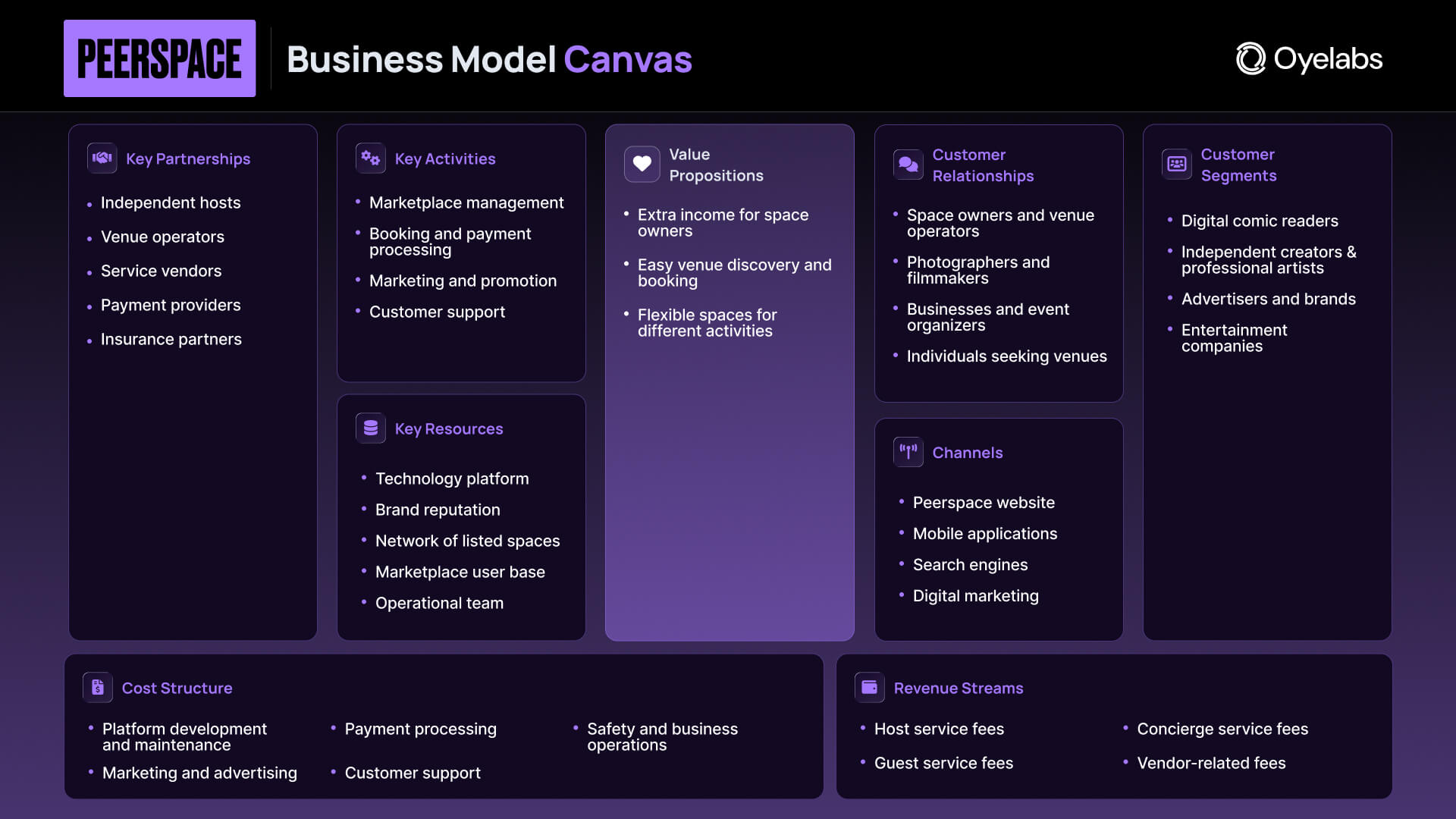
Here’s how each component applies to the company.
| Business Model Component | Peerspace |
|---|---|
| Customer Segments | Space owners, venue operators, photographers, filmmakers, businesses, event organizers, and individuals |
| Value Propositions | Hosts earn from available properties, while guests find and book spaces for different activities |
| Channels | Website, mobile applications, search engines, and digital marketing |
| Customer Relationships | Booking tools, messaging, customer support, reviews, and trust and safety services |
| Revenue Streams | Host service fees, guest processing fees, vendor fees, and concierge service fees |
| Key Activities | Marketplace management, booking infrastructure, payment processing, marketing, and customer support |
| Key Resources | Technology platform, brand, space listings, marketplace network, and operational teams |
| Key Partnerships | Independent hosts, venue operators, vendors, payment providers, and insurance partners |
| Cost Structure | Technology development, marketing, payment processing, customer support, safety services, and business operations |
What the Business Model Canvas Reveals
The canvas highlights how the different parts of Peerspace’s business support one another.
Its customer segments include both the people supplying spaces and those looking to rent them. The platform needs both groups to remain active because an increase in available venues is only valuable when customers are booking them.
Its value proposition is based on making spaces easier to find and rent. Hosts gain access to potential customers, while guests get a convenient way to explore venues without contacting property owners individually.
The company’s key activities and resources support this exchange. Its website, booking tools, payment infrastructure, and marketplace listings allow users to complete transactions through one platform.
Its partnerships also play an important role. Hosts provide the properties, vendors offer additional services, and external providers support payment processing and protection services.
Finally, its revenue streams and cost structure show how the company earns from marketplace activity while paying for the technology and operations needed to facilitate bookings.
Peerspace’s Cost Structure
Although Peerspace doesn’t have to purchase the properties listed on its marketplace, operating a booking platform still involves several expenses.
The company needs to maintain the technology, attract customers, process payments, and provide support to hosts and guests.
Its main cost categories include the following.
Technology Development and Maintenance: The website and mobile applications are central to the business. Peerspace needs to maintain its listing system, search tools, booking features, payment infrastructure, and host management tools. It also needs to keep the platform reliable as the number of users and bookings increases.
Marketing and Customer Acquisition: Peerspace needs to attract both hosts and guests. Marketing activities help the company reach property owners who may want to list their spaces and customers searching for venues. This can involve search engine optimization, digital advertising, content marketing, partnerships, and brand promotion.
Payment Processing: Every booking involves payments from guests and payouts to hosts or vendors. The company incurs expenses for third-party payment processing and the systems needed to handle transactions, refunds, and payment disputes.
Customer Support: Hosts and guests may need assistance with booking requests, cancellations, payments, or problems involving a reservation. Customer support is therefore an important operating expense, particularly for a marketplace where transactions involve independent users.
Trust and Safety: Renting a private property to an unfamiliar guest comes with potential risks. Peerspace needs processes and services that address fraud, suspicious bookings, property damage, and other concerns. Its protection programs and customer support contribute to these efforts.
General Business Operations: The company also has expenses related to employee salaries, administration, legal services, compliance, and other day-to-day operations. These are the main cost categories associated with Peerspace’s marketplace model. They are not a published breakdown of the company’s internal spending.
Peerspace’s Competitive Advantage
Peerspace operates in a market where customers can also find venues through traditional event spaces, hotels, local rental businesses, and direct property owners. Its approach stands out through the range of spaces available, its hourly booking model, and the tools it provides to manage reservations.
Different Types of Spaces in One Marketplace: Peerspace isn’t restricted to conference rooms or conventional event venues. Its listings include photography studios, film locations, private homes, restaurants, gardens, meeting rooms, and other spaces. This gives customers with different requirements a place to search without limiting the platform to one type of rental.
Hourly Booking Options: Not every customer needs a venue for an entire day. A photographer may need a studio for three hours, while a business might require a meeting room for an afternoon. Peerspace’s hourly rental approach accommodates these shorter bookings. Hosts can also set their own hourly prices and minimum booking durations, subject to the platform’s listing requirements.
No Need to Own the Listed Properties: Peerspace can expand its marketplace by bringing more independent hosts onto the platform rather than purchasing venues itself. This keeps property ownership and physical venue management with the hosts. For the company, its main focus remains the technology and services that support the marketplace.
Tools for Managing Bookings: Peerspace provides hosts with tools to manage their listings, communicate with guests, and keep their availability organized. Features such as calendar synchronization, a unified inbox, and mobile listing management help hosts handle reservations without relying entirely on separate systems.
Protection and Support Services: Trust matters when a booking involves access to someone else’s property. Peerspace provides customer support and protection programs for eligible bookings. Its published host information describes supplemental general liability coverage and a property damage guarantee for eligible US-based venues, subject to the applicable terms. These services address some of the concerns that hosts and guests may have when arranging rentals through an online marketplace.
Lessons From Peerspace’s Business Model
Peerspace offers a useful example for entrepreneurs interested in building a rental marketplace or a platform that connects service providers with customers. Its business model shows how a company can create value without owning the physical resources being offered. Here are some lessons worth considering.
1. Look for Assets That Are Not Being Fully Used: A property doesn’t have to be occupied throughout the day to generate income. Peerspace gives hosts a way to earn from spaces that might otherwise remain unused.
Entrepreneurs can apply the same idea to other assets, such as equipment, vehicles, commercial kitchens, sports facilities, and storage spaces. The opportunity lies in finding people who have something available and connecting them with customers who need temporary access.
2. Give Both Sides a Reason to Use the Platform: A marketplace needs participation from both suppliers and customers.
Peerspace gives hosts access to potential bookings while helping guests find venues that suit their requirements. Entrepreneurs should understand what each group wants before developing their platform. A rental marketplace, for example, needs to make listing and managing assets worthwhile for suppliers while keeping the booking experience convenient for customers.
3. Make Transactions Easy to Complete: Finding a suitable property is only one part of the rental process.
Customers also need clear pricing, availability information, communication tools, and a reliable way to pay. Peerspace brings these activities together rather than leaving hosts and guests to manage every step independently. This is an important consideration when developing any marketplace where customers and service providers need to coordinate a transaction.
4. Choose a Revenue Model That Fits the Business: Peerspace connects its earnings to marketplace activity through service fees.
This is one possible approach for entrepreneurs who want to build a platform around bookings or completed transactions. Other businesses may benefit from subscriptions, premium listings, commissions, or additional services. The right approach depends on the customers, industry, and frequency of platform usage.
5. Make Trust Part of the Customer Experience: People may hesitate to book a property or accept a guest if they don’t feel confident about the transaction.
Reviews, transparent listing information, payment processing, support, and protection services can help address these concerns. Entrepreneurs should consider trust and safety when planning the platform, not wait until problems arise.
6. Expand Only When Additional Services Make Sense: Peerspace’s vendor and concierge offerings show how a marketplace can serve related customer needs beyond its main service.
A venue-booking platform could explore catering, equipment rentals, event planning, or other services that customers already need when arranging an event. The important thing is to add services that complement the main offering rather than introducing unrelated features.
Build Your Own Space Rental Marketplace With Oyelabs
Have an idea for a space rental marketplace like Peerspace? Turning it into a successful platform requires the right technology to connect hosts and guests, manage listings, handle bookings, and process payments.
Oyelabs helps entrepreneurs build feature-rich digital marketplaces with ready-made software and custom development solutions. Whether you want to launch a platform for studio rentals, event venues, meeting rooms, or other bookable spaces, our team can help bring your idea to life. Get in touch with Oyelabs to discuss your project and find the right solution for your business.
Conclusion
Peerspace has built its business around a straightforward idea: connect people who have spaces available with those who need somewhere to work, create, or host an event.
Its two-sided marketplace allows independent hosts to earn from their properties while giving guests access to a range of venues. The company generates revenue through booking-related fees and additional services, without having to own the properties listed on its platform.
For entrepreneurs, the business offers an example of how an asset-light marketplace can create opportunities for both suppliers and customers. The key is to identify an existing need, bring the right participants together, make transactions convenient, and build a revenue model that supports the services the platform provides.
FAQs
1. How long does it take to develop a platform like Peerspace?
Development time depends on platform complexity, features, and technology. A basic marketplace takes less time than a custom solution with advanced booking tools.
2. What features are essential for a Peerspace-like platform?
Essential features include space listings, search filters, availability calendars, booking management, secure payments, user profiles, reviews, messaging, and admin dashboards.
3. How can I attract hosts and guests to a new space-booking marketplace?
Start by partnering with local venue owners, offering attractive listing terms, and promoting available spaces through SEO, social media, and targeted advertising.
4. Can I launch a space-booking marketplace without owning properties?
Yes. You can partner with independent property owners and venue operators who list their spaces, while your platform manages discovery, bookings, and payments.
Reviewed By: Anuraag Jain
CEO, Oyelabs & AI Transformation Expert