
Why Most Social Apps Never Reach Habit Formation

 Sachin Sharma
Last Updated on July 27, 2026
Key Takeaways
What You’ll Learn
- Why most founders fail when they try to build social app like TikTok by copying features instead of user psychology.
- How habit formation differs from user acquisition.
- The behavioral loops that keep users returning multiple times every day.
- Why recommendation quality matters more than social graphs.
- What founders should validate before investing in social platform development.
Stats That Matter
- According to DataReportal’s 2026 Global Digital Report, the average internet user spends more than 2 hours daily on social media, making user attention one of the world’s most competitive digital resources.
- TikTok remains one of the world’s most downloaded mobile applications and continues to lead short-form video engagement across major app stores.
- Research from Google has consistently shown that reducing interaction friction significantly improves engagement and task completion across digital products.
Most Founders Think They’re Building a Social App. They’re Actually Building a Habit.
When founders decide to build social app like TikTok, the conversation almost always begins with features.
They ask whether the app should support short videos, stories, live streaming, comments, direct messaging, hashtags, filters, creator profiles, or AI recommendations. Those discussions are important, but they usually miss the bigger question.
Why would someone voluntarily open the app five, ten, or even twenty times a day?
That question has very little to do with features.
Every year, thousands of social applications launch with polished interfaces, modern technology stacks, and nearly identical functionality. Most attract an initial wave of downloads through advertising, influencer campaigns, or curiosity. Then growth slows. Users stop opening the app. Content creators leave because audiences disappear. Eventually the platform becomes another abandoned social network that technically worked but never became part of anyone’s daily routine.
The difference between successful platforms and forgotten ones isn’t usually engineering quality.
It’s habit formation.
Downloads Don’t Build Businesses. Daily Habits Do.
Many startups celebrate download numbers during launch.
Investors celebrate them.
Marketing teams celebrate them.
Users rarely do.
A download simply means someone was curious enough to install the application. It says nothing about whether they will return tomorrow.
TikTok understood this early. Instead of optimizing for installation, the platform optimized for repeated engagement. Every product decision was designed to reduce the effort required to discover something entertaining.
This subtle difference changed everything.
Traditional social platforms ask users to perform work before receiving value. They ask people to search for creators, build friend lists, follow accounts, join communities, and gradually train the algorithm.
TikTok reversed that relationship.
The platform begins working immediately.
Within seconds, users are consuming content, and every swipe teaches the recommendation engine something new. The platform continuously becomes better without asking the user to do anything consciously.
That frictionless experience is one of the biggest reasons users return.
The Biggest Mistake Founders Make When They Build Social App Like TikTok
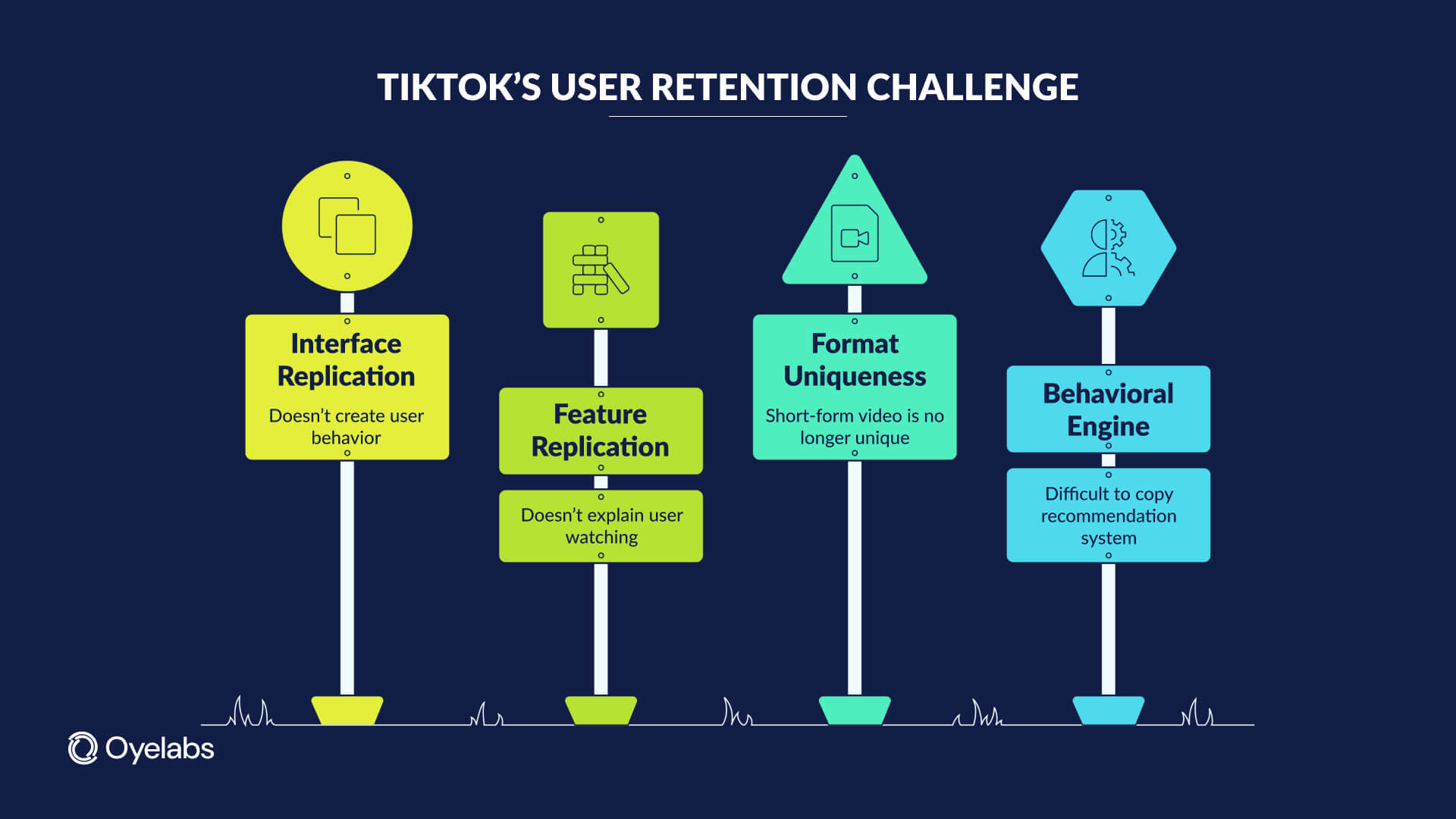
One of the most common product planning mistakes is believing that interface replication creates user behavior.
It doesn’t.
A founder might successfully recreate TikTok’s scrolling interface, add likes, comments, creators, video editing, hashtags, and notifications, yet still struggle to retain users.
Why?
Because none of those features explains why people continue watching.
The interface is simply the delivery mechanism.
The real product lives underneath it.
TikTok’s competitive advantage is not short-form video. Vine introduced six-second videos years earlier. Instagram Reels and YouTube Shorts now offer almost identical publishing experiences. The format itself is no longer unique.
What remains difficult to copy is the behavioral engine powering every recommendation.
Every pause, replay, skip, comment, share, follow, and completion rate becomes another signal. The platform continuously predicts what users will enjoy next, reducing the number of poor recommendations over time.
Users don’t consciously notice this process.
They simply feel that “TikTok always has something interesting.”
That feeling creates habit.
Habit Formation Is Built on Friction Reduction
Product designers often assume engagement comes from adding features.
Behavioral psychology suggests the opposite.
People naturally avoid unnecessary effort.
Every extra decision gives users another opportunity to leave.
Think about how different social platforms ask users to discover content.
On many platforms, users must search, follow creators, join groups, or actively explore before the experience becomes rewarding.
TikTok eliminates almost every one of those decisions.
Instead of asking users what they want, it begins showing content immediately and continuously improves through observation.
This creates a feedback loop that feels almost effortless.
Some of the biggest friction-reduction mechanisms include:
- Immediate video playback without requiring a search.
- Infinite scrolling with no natural stopping point.
- Personalized recommendations based on behavior rather than explicit preferences.
- Fast-loading content with minimal waiting.
- Continuous learning from every interaction.
None of these features is individually revolutionary.
Together, they dramatically reduce cognitive effort.
That reduction in effort is what creates repeated engagement.
The Four Behavioral Loops Behind TikTok’s Success
| Behavioral Loop | Why It Creates Habit |
| Instant content delivery | Users receive value within seconds of opening the app. |
| AI-driven personalization | Every interaction improves future recommendations. |
| Variable rewards | Users never know which video will be exceptionally entertaining, encouraging “just one more” swipe. |
| Infinite consumption | Removing stopping points naturally extends session duration. |
The important lesson for founders is that these loops reinforce each other.
Removing one weakens the entire experience.
Many clone applications successfully recreate infinite scrolling but fail to improve recommendation quality. Others build recommendation systems but neglect creator incentives or content quality.
Habit formation depends on the complete system rather than any individual feature.
The Algorithm Gets Users In. Community Keeps Them There.
Recommendation systems are incredibly effective at attracting attention.
They are much less effective at creating belonging.
As social platforms mature, users begin returning for different reasons.
Initially, people stay because the algorithm consistently entertains them.
Eventually, they stay because they recognize creators, participate in conversations, discover communities, and develop identities around shared interests.
This explains why niche social platforms often outperform much larger competitors within specific communities.
Fitness enthusiasts return because they recognize coaches.
Musicians return because they follow artists.
Gamers return because they belong to a community.
The recommendation engine starts the relationship.
The community extends it.
Founders trying to build social app like TikTok often invest heavily in artificial intelligence while overlooking community design. That imbalance usually becomes visible six to twelve months after launch when user acquisition becomes increasingly expensive and retention begins falling.
Why Content Supply Matters More Than Most Founders Realize
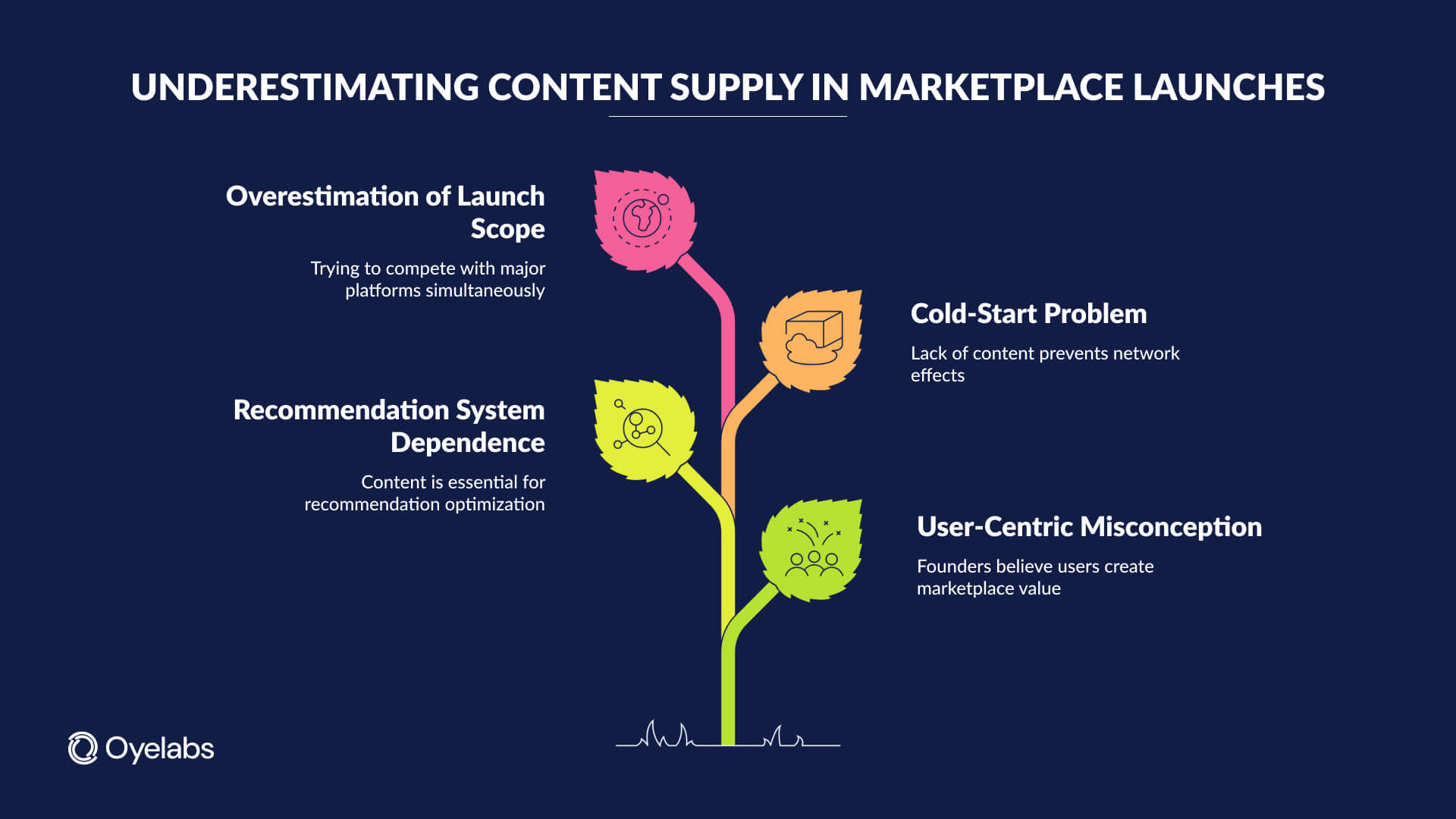
Another misconception is that users create marketplace value.
Initially, they don’t.
Content does.
A social platform without engaging content has nothing for recommendation systems to optimize.
This creates the classic cold-start problem.
During early product planning, teams commonly underestimate how difficult it is to maintain consistent content supply before network effects begin.
This is why successful launches often begin with a narrow audience instead of trying to compete with every major social platform simultaneously.
Launching a platform for every possible creator category sounds attractive.
Launching for one passionate community usually works better.
Niche platforms generate denser engagement, more relevant recommendations, and stronger creator relationships.
Once those behavioral patterns stabilize, expansion becomes significantly easier.
If You Want to Build Social App Like TikTok, Don’t Copy TikTok
This sounds contradictory.
It isn’t.
Trying to compete directly with TikTok for general entertainment is one of the hardest product challenges in modern technology.
Instead, founders should study why TikTok succeeds rather than what TikTok looks like.
That means asking questions like:
- What motivates users to return every day?
- Which behaviors improve recommendations?
- What reduces decision fatigue?
- How will creators consistently publish?
- What creates long-term community value?
Those answers usually lead to a very different product roadmap than simply recreating another short-video application.
The strongest social platforms rarely win because they copied the largest competitor.
They win because they solved habit formation for a specific audience better than anyone else.
Also Read: The TikTok Business Model – How TikTok Makes Money
How OyeLabs Helps Founders Build Social App Like TikTok
At OyeLabs, we help founders build social app like TikTok with a product-first approach rather than a feature-first approach.
Beyond video feeds, we focus on recommendation workflows, creator onboarding, engagement loops, moderation systems, monetization, analytics, and scalable platform architecture that supports long-term user retention.
Whether you’re launching a niche creator community or a next-generation short-video platform, the objective isn’t simply launching faster. It’s building a product that users naturally return to every day.
Launch a Social App That Users Actually Return To
Building a TikTok-style platform is not about replicating the interface. It’s about designing the behavioral systems that drive discovery, retention, creator engagement, and long-term habit formation.
✓ AI-powered content recommendation architecture
✓Short-video feeds, creator profiles, and community engagement features
✓ Creator monetization, moderation, and analytics dashboards
✓ White-label and custom development with complete source code ownership
Conclusion
Most social platforms never fail because of poor engineering.
They fail because they never become habits.
Users don’t develop daily routines around interfaces, animations, or video editors. They return because the platform consistently delivers rewarding experiences with almost no effort.
For founders planning to build social app like TikTok, the most valuable lesson isn’t copying TikTok’s feature list. It’s understanding the behavioral systems that transformed occasional curiosity into one of the strongest engagement engines in consumer technology.
Build those systems well, and features become amplifiers.
Ignore them, and even the most polished application struggles to survive.
FAQs
Why do most social apps fail after launch?
Most social apps struggle because they focus on acquiring users instead of retaining them. Without strong recommendation systems, low-friction experiences, and consistent behavioral rewards, users rarely develop daily engagement habits.
Why is TikTok more addictive than many social platforms?
TikTok reduces decision-making by combining AI-driven recommendations, infinite scrolling, rapid content delivery, and variable rewards. These mechanisms continuously adapt to user behavior and make content discovery feel effortless.
Can startups build social app like TikTok?
Yes. However, startups should focus on solving habit formation within a specific niche rather than competing directly with TikTok’s global audience. Building strong recommendation systems and creator communities is often more important than replicating every feature.
Are AI recommendations necessary for social apps?
Not always, but personalized recommendations significantly improve retention by helping users discover relevant content faster. As content libraries grow, recommendation quality becomes increasingly important for long-term engagement.
What’s more important: creators or algorithms?
Both matter, but at different stages. Algorithms help users discover engaging content, while creators and communities give them lasting reasons to return. The strongest social platforms balance both rather than relying entirely on one.
Sources & Editorial Notes
Primary Sources
- DataReportal – Digital 2026 Global Overview Report (Digital adoption, social media usage, user behavior, and platform trends.)
- DataReportal – Digital 2026 Mid-Year Global Update (Latest global social media growth, engagement trends, and platform comparisons.)
- TikTok Newsroom (Official product announcements, platform updates, and creator ecosystem information.)
- Google People + AI Research (PAIR) (Human-centered product design and user interaction research.)
- Nir Eyal – Hooked: How to Build Habit-Forming Products (Behavioral design framework referenced conceptually throughout the article.)
Editorial Notes
This article combines publicly available research on social media behavior, recommendation systems, behavioral product design, and creator economy platforms with OyeLabs’ experience planning and developing social, creator, and marketplace applications.
The discussion of habit formation is intended to explain product strategy rather than encourage addictive design practices. User engagement should always be balanced with user well-being, privacy, transparency, and responsible product development.
Platform metrics, user behavior, and product capabilities continue to evolve. Recommendations in this article should be adapted to your target audience, market, business model, and regulatory environment.
Disclosure
OyeLabs develops custom and white-label social media, creator economy, marketplace, and community platforms. References to TikTok and other third-party platforms are used solely for educational and comparative purposes. OyeLabs is not affiliated with, endorsed by, or associated with TikTok or its parent company. This article does not constitute legal, financial, or investment advice.
Reviewed By: Sachin Sharma
Sr. Digital Transformation Consultant, Oyelabs