
Which Service Marketplace Should You Clone?

Which Service Marketplace Should You Clone?
 Tanushree Jain
Last Updated on July 27, 2026
Key Takeaways
What You’ll Learn
- Not every service marketplace follows the same business model, even if the customer experience appears similar.
- Choosing the right service marketplace like TaskRabbit depends more on market dynamics than software features.
- A TaskRabbit clone works best for founders targeting fragmented, hyperlocal service industries with repeat demand.
- Marketplace success depends on liquidity, provider density, transaction frequency, and standardized service delivery.
- The strongest marketplace businesses solve operational friction before adding new service categories.
Facts That Matter
- According to Grand View Research, the global online on-demand home services market continues to grow as consumers increasingly book local professionals digitally.
- Local service marketplaces generally monetize through commissions, booking fees, subscriptions, premium listings, or combinations of these revenue streams.
- Hyperlocal marketplaces perform best when providers can reach customers quickly, reducing travel costs while increasing completed jobs.
- Platforms serving multiple service categories are generally more resilient to seasonal demand fluctuations than single-service marketplaces.
Real Insights
- The marketplace you clone determines your future operating model far more than your technology stack.
- Category expansion becomes significantly easier when workflows remain standardized across services.
- A marketplace with fewer service categories but stronger local density often outperforms larger platforms with fragmented supply.
- Sustainable marketplace growth depends on repeat transactions rather than one-time customer acquisition.
Most Founders Choose the Wrong Marketplace to Clone
When founders begin researching marketplace businesses, they usually compare brands.
They ask whether they should build something like TaskRabbit, Thumbtack, Urban Company, Handy, or Angi.
That sounds logical, but it is actually the wrong place to start.
The better question is whether the underlying marketplace model fits the business you want to build.
Two companies can both connect customers with local professionals while operating very different businesses behind the scenes. Some focus on recurring household services. Others specialize in project-based work, lead generation, or long-term customer relationships. Each model has different customer acquisition costs, operational complexity, monetization opportunities, and scaling challenges.
Choosing the wrong marketplace model often creates problems that no amount of software customization can fix later.
If you’re planning to build a service marketplace, your first decision should not be the technology. It should be understanding which marketplace economics best match your capital, market, and long-term growth strategy.
What Makes a Good Service Marketplace Business?
A successful service marketplace creates value by connecting fragmented demand with fragmented supply while making transactions easier, faster, and more trustworthy for both sides.
That sounds simple, but not every industry benefits equally from marketplace aggregation.
Some industries already have dominant providers.
Others rely heavily on personal relationships.
Others have highly customized pricing that makes digital transactions difficult.
The strongest marketplace opportunities usually share several characteristics.
1. Fragmented Service Providers
Markets with thousands of independent professionals create the strongest opportunity for marketplaces.
Cleaning professionals, movers, handymen, furniture assemblers, electricians, tutors, and pet sitters often operate independently, making discovery difficult for customers.
A marketplace solves that fragmentation by bringing both sides together.
Industries already dominated by a handful of national providers generally create less marketplace value because customers already know where to buy.
2. The Right Balance Between Frequency and Transaction Value
Not every service generates repeat business.
Some are booked weekly.
Others happen once every five years.
Founders need to understand which model they’re optimizing for.
| Marketplace Type | Example | Business Advantage |
| High-frequency, lower-value | Cleaning, handyman, furniture assembly | Higher customer lifetime value through repeat bookings |
| Lower-frequency, higher-value | Renovations, roofing, remodeling | Larger commissions but slower revenue cycles |
Neither model is universally better.
High-frequency services generally create stronger retention.
High-ticket services produce larger commissions but require longer sales cycles and more trust.
3. Local Density Determines Marketplace Success
Marketplace businesses don’t scale city by city because software changes.
They scale because supply and demand become dense enough to support fast matching.
A service marketplace like TaskRabbit succeeds because providers and customers typically operate within relatively small geographic areas.
That creates several operational advantages:
- Shorter travel distances
- Faster job completion
- Higher provider utilization
- Better customer satisfaction
- Lower cancellation rates
One recurring implementation lesson we’ve observed is that founders often expand into multiple cities too early. They celebrate geographic coverage while overlooking local liquidity. Five cities with weak supply usually perform worse than one city with excellent provider density.
4. Can Customers Easily Bypass Your Platform?
Every marketplace faces some level of disintermediation.
After a customer hires a provider once, both parties may decide to work together privately, avoiding future platform commissions.
Some industries have much higher leakage risk than others.
Long-term babysitting, private tutoring, consulting, and recurring household employment often move offline after the first introduction.
Short, transactional services usually don’t.
That is one reason a TaskRabbit clone has remained attractive for founders.
Many jobs are one-off tasks where customers value convenience more than building permanent provider relationships.
The marketplace continues creating value on every booking.
5. Can Services Be Standardized?
Standardization reduces operational complexity.
Customers understand what they’re buying.
Providers understand what they’re delivering.
The platform processes fewer disputes.
Services such as furniture assembly, moving assistance, appliance installation, TV mounting, and home cleaning generally fit standardized pricing models based on hourly rates or predefined packages.
Highly customized consulting projects rarely do.
The easier it is to define scope, pricing, and expected outcomes, the easier it becomes to scale the marketplace.
Comparing Popular Service Marketplace Models
Before deciding which marketplace to build, compare the operating models rather than the brand names.
| Platform Model | Best For | Revenue Velocity | Operational Complexity | Expansion Potential |
| TaskRabbit | Hyperlocal, on-demand household services | High | Moderate | Excellent |
| Thumbtack | Lead generation for professionals | Medium | Moderate | High |
| Urban Company | Managed home services with provider quality controls | High | High | High |
| Handy | Home maintenance and installations | Medium | Moderate | Medium |
| Angi | Home improvement lead marketplace | Medium | Lower | High |
Each model serves a different purpose.
The best marketplace isn’t necessarily the biggest one.
It’s the one whose economics match your business goals.
Why Many Founders Choose a TaskRabbit Clone
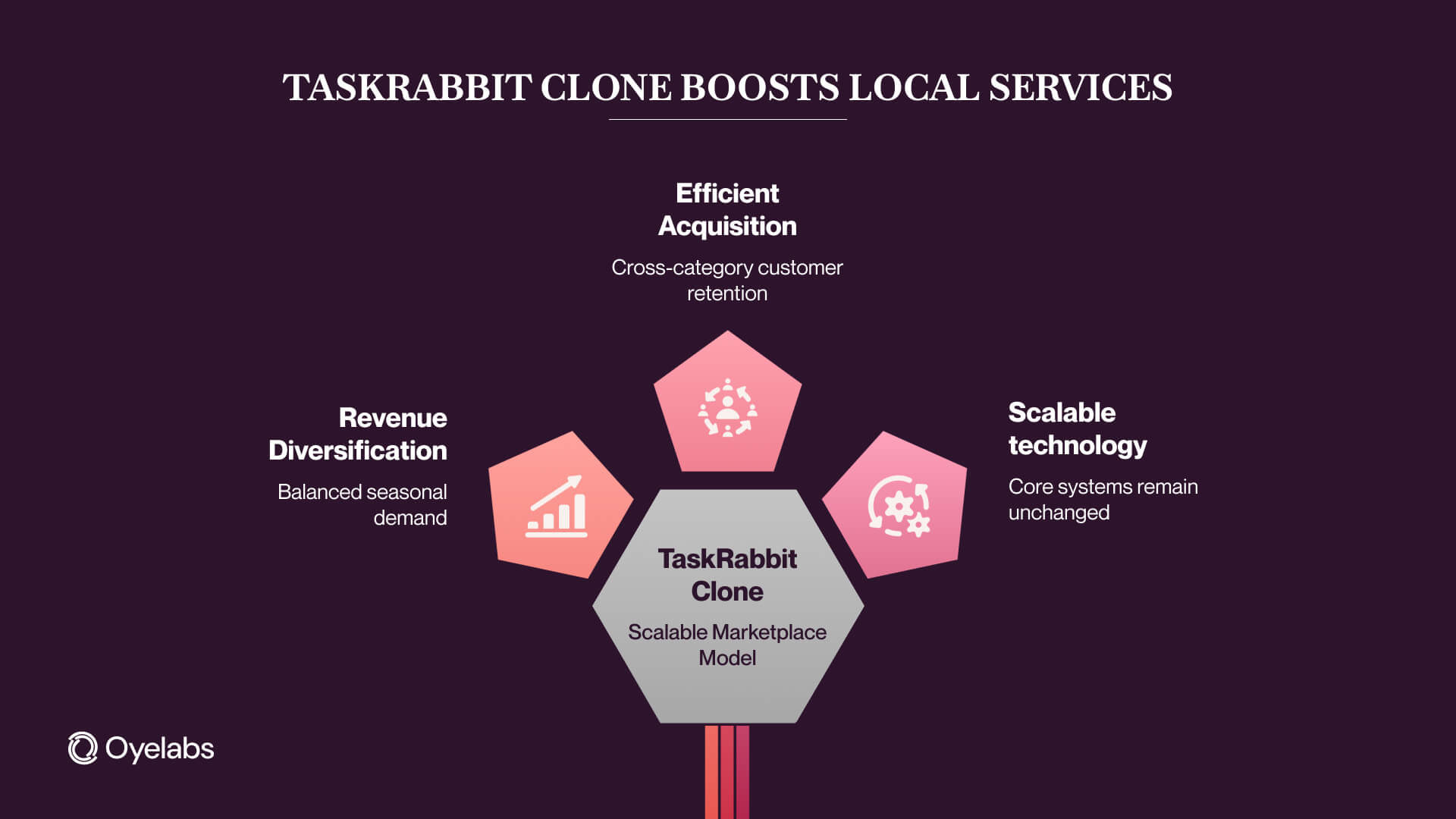
Among today’s marketplace models, a TaskRabbit clone offers one of the most balanced combinations of scalability, monetization, and operational simplicity.
Unlike niche marketplaces focused on a single category, TaskRabbit supports dozens of local services using almost identical marketplace infrastructure.
The booking workflow remains consistent whether someone books furniture assembly, moving assistance, electrical repairs, or yard work.
That creates several strategic advantages.
First, revenue becomes naturally diversified.
If one category experiences seasonal decline, others often increase in demand. Snow removal slows during summer, but moving services, landscaping, and home improvement projects typically rise.
Second, customer acquisition becomes more efficient.
Someone who first books a furniture assembler can later become a customer for plumbing, cleaning, painting, or handyman services without additional acquisition costs.
Cross-category retention significantly improves customer lifetime value.
Finally, technology investments become easier to scale.
Core systems such as geolocation, booking management, provider discovery, payments, messaging, reviews, scheduling, and admin operations remain largely unchanged regardless of how many new categories the marketplace introduces.
That operational consistency is one of the biggest reasons founders continue evaluating service marketplace like TaskRabbit when entering the local services industry.
When a TaskRabbit Clone May Not Be the Right Choice
Despite its advantages, a TaskRabbit clone is not suitable for every business.
You may want to consider a different marketplace model if your business depends on:
- Long-term recurring client-provider relationships
- Enterprise procurement workflows
- Highly customized consulting engagements
- Medical, legal, or regulated professional services
- Projects requiring lengthy proposals and negotiations
In these situations, lead-generation or project-based marketplaces may create stronger long-term economics than an on-demand service marketplace.
Choosing the right model is often more important than choosing the right technology.
What We’ve Learned Planning Service Marketplaces
One lesson appears consistently across marketplace planning projects.
Founders spend months discussing features.
Customers rarely choose platforms because of features.
They choose platforms because they solve immediate problems faster than alternatives.
The strongest marketplaces reduce uncertainty.
Customers know who will arrive, when they’ll arrive, how much they’ll pay, and what quality to expect.
Providers know how they’ll receive work, how they’ll get paid, and how disputes are handled.
Technology supports that trust.
It doesn’t replace it.
That’s why marketplace success depends less on copying an interface and more on designing reliable operational systems.
Also Read: Top Mistakes to Avoid When Building a TaskRabbit Like App
How OyeLabs Helps Build a Service Marketplace Like TaskRabbit
OyeLabs helps founders build service marketplace like TaskRabbit using both white-label solutions and fully custom marketplace development.
Our platforms include provider onboarding, service discovery, booking management, real-time messaging, payment processing, reviews, analytics, commission management, and scalable administrative controls.
Whether you’re launching a local handyman marketplace, a multi-category home services platform, or a specialized vertical marketplace, we help founders build technology that supports long-term marketplace operations – not just the initial launch.
Launch Your Service Marketplace with Confidence
Choosing the right marketplace model is only the first step. Building one that attracts providers, retains customers, and scales across cities requires the right operational foundation.
✓ Ready-made or custom TaskRabbit clone solutions
✓Complete source code ownership and scalable architecture
✓ Provider management, booking, payments, and review systems
✓ Multi-category expansion designed for long-term growth
Conclusion
Choosing which service marketplace to clone isn’t about copying the most recognizable brand. It’s about selecting the business model that aligns with your target customers, provider network, operational capabilities, and long-term growth strategy.
For many founders, a service marketplace like TaskRabbit offers the right balance of recurring demand, diversified revenue, standardized operations, and scalable technology. But even the best software cannot compensate for weak marketplace economics.
Build the right marketplace model first.
Then build the platform that supports it.
FAQs
Which service marketplace is best to clone?
For most startups, a TaskRabbit clone offers one of the strongest marketplace models because it supports multiple service categories, recurring customer demand, and standardized booking workflows. However, the right choice depends on your target market, operational strategy, and business goals.
Why is a TaskRabbit clone popular with founders?
A TaskRabbit clone combines hyperlocal services, diversified revenue streams, and scalable technology. Founders can launch with a few service categories and gradually expand without rebuilding the underlying marketplace infrastructure.
What makes a successful service marketplace?
A successful service marketplace requires strong local provider density, standardized service delivery, transparent pricing, secure payments, trust systems, and efficient customer-provider matching. Marketplace liquidity is often more important than feature count.
Can I launch a niche service marketplace instead of multiple categories?
Yes. Many founders begin with a single service category to establish local supply and demand before expanding into additional services. This approach often improves marketplace liquidity and reduces operational complexity during the early growth stage.
How does a service marketplace make money?
Most service marketplaces generate revenue through provider commissions, customer service fees, subscriptions, featured listings, advertising, or premium business accounts. The ideal monetization strategy depends on transaction frequency and marketplace positioning.
Sources & Editorial Notes
Primary Sources
Editorial Notes
This article combines publicly available marketplace research with OyeLabs’ experience planning and developing local service marketplace platforms. Strategic observations around liquidity, provider density, disintermediation risk, and operational scalability are based on marketplace design principles rather than any single platform.
Different industries require different marketplace models. Before selecting a clone architecture, founders should evaluate local demand, provider availability, regulatory requirements, pricing structures, and long-term monetization opportunities.
Disclosure
OyeLabs develops custom and white-label marketplace platforms, including service marketplaces, home services platforms, and on-demand applications. References to TaskRabbit, Thumbtack, Urban Company, Handy, and Angi are used solely for educational and comparative purposes. OyeLabs is not affiliated with or endorsed by these companies. This article is intended for informational purposes and should not be considered legal, financial, or investment advice.
Reviewed By: Tanushree Jain
Sr. Marketplace Growth Consultant, Oyelabs