
UrbanClap (Now Urban Company) Business/Revenue Model Explained
UrbanClap (Now Urban Company) Business/Revenue Model Explained
 Sushmeet Setia
Last Updated on July 9, 2026
Key Takeaways
- UrbanClap is now known as Urban Company.
- The platform operates as a managed home-services marketplace.
- Its core users are customers and trained service professionals.
- The business model of UrbanClap depends on service quality control, not only lead generation.
- The UrbanClap revenue model includes commissions, service fees, product sales, and category-led monetization.
- Provider training and verification are central to customer trust.
- Local service density matters more than app downloads.
- Founders should study Urban Company as an operations-led marketplace, not a simple listing platform.
What You’ll Learn
You will learn:
- how UrbanClap works as a home-services marketplace
- how Urban Company creates value for customers and professionals
- how the UrbanClap revenue model generates income
- why quality control is central to the model
- what founders can learn before building a similar platform
What Is The UrbanClap Business Model?
The UrbanClap business model is a managed home-services marketplace model where customers book local services and verified professionals deliver those services at home. Urban Company earns revenue through commissions, service charges, product sales, platform fees, and category-specific monetization while controlling quality, pricing, training, scheduling, and customer experience.
What Is UrbanClap?
UrbanClap, now called Urban Company, is an on-demand home-services marketplace that connects customers with trained local professionals for services such as beauty, cleaning, appliance repair, plumbing, electrical work, painting, pest control, and other household tasks.
Unlike simple directory platforms, Urban Company does not only list professionals. It manages the service experience through professional onboarding, training, pricing, quality checks, scheduling, payments, reviews, and customer support.
Urban Company reported ₹827 crore revenue in FY24, with 30% annual growth, according to its official annual business summary. The company credited its growth partly to service quality, service professional development, and new product innovation.
That distinction matters because the UrbanClap business model is not a pure classified model. It is closer to a managed marketplace where the platform takes responsibility for trust, consistency, and repeat usage.
How Does UrbanClap Work?
UrbanClap works by connecting customer demand with verified service professionals, then managing the transaction from booking to completion. The platform controls discovery, scheduling, pricing, professional assignment, payment, service tracking, reviews, and customer support.
The operating flow usually works like this:
- Customer selects a service category.
- Customer chooses a package, time slot, and address.
- Platform assigns or matches an available professional.
- Professional completes the service at the customer’s location.
- Customer pays through the platform or approved payment method.
- Platform collects its fee or commission.
- Customer reviews the professional and service experience.
The important point is this:
Urban Company is not only selling convenience.
It is selling confidence.
A customer booking a salon service, cleaner, electrician, or repair technician is inviting someone into a private space. That makes trust much more important than in many other marketplace categories.
Who Are The Main Users In The UrbanClap Business Model?
The UrbanClap business model has three main participants: customers, service professionals, and the platform operator. Each group needs a different value proposition for the marketplace to work.
| Participant | What They Need | Why It Matters |
| Customers | Reliable home services, transparent pricing, verified professionals | Drives bookings and repeat usage |
| Service Professionals | Regular demand, income opportunities, training, tools, payments | Builds supply-side retention |
| Platform Operator | Quality control, monetization, support, scheduling, marketplace balance | Protects trust and margins |
Urban Company’s partner platform describes its professional network as 30,000+ trained service professionals, positioning the platform as a way for professionals to grow their business through technology.
This shows why the business model of UrbanClap depends heavily on professional enablement. The platform must help professionals earn while also ensuring customers receive consistent service quality.
How Does UrbanClap Make Money?
UrbanClap makes money by taking a share from service transactions, charging service-related fees, supporting paid professional visibility in some categories, and monetizing category-led products or service extensions where applicable. The exact mix can differ by service category and market.
The UrbanClap revenue model has evolved from simple lead generation toward a more controlled service marketplace model.
| Revenue Stream | How It Works | Who Pays | Why It Matters |
| Commission | Platform takes a percentage from completed service bookings | Service professional or transaction flow | Core marketplace revenue |
| Service Fee | Additional fee may apply for platform support, convenience, or booking management | Customer or transaction flow | Supports operations and customer experience |
| Lead Fee | Professional may pay for qualified leads in some non-standard service categories | Service professional | Useful where pricing is not fixed |
| Product Sales | Platform may sell or support related home-care, beauty, or appliance products | Customer | Expands revenue beyond services |
| Featured Visibility | Professionals or categories may receive higher visibility where applicable | Service professional or business partner | Helps monetize demand discovery |
| Cancellation or Penalty Fee | Fees may apply when cancellation rules are violated | Customer or professional | Helps protect booking reliability |
The key is not the number of revenue streams.
The key is whether the platform can control service quality while monetizing transactions fairly.
If commission is too high, professionals may leave. If commission is too low, the platform may struggle to fund training, support, marketing, and operations.
Why The UrbanClap Revenue Model Works
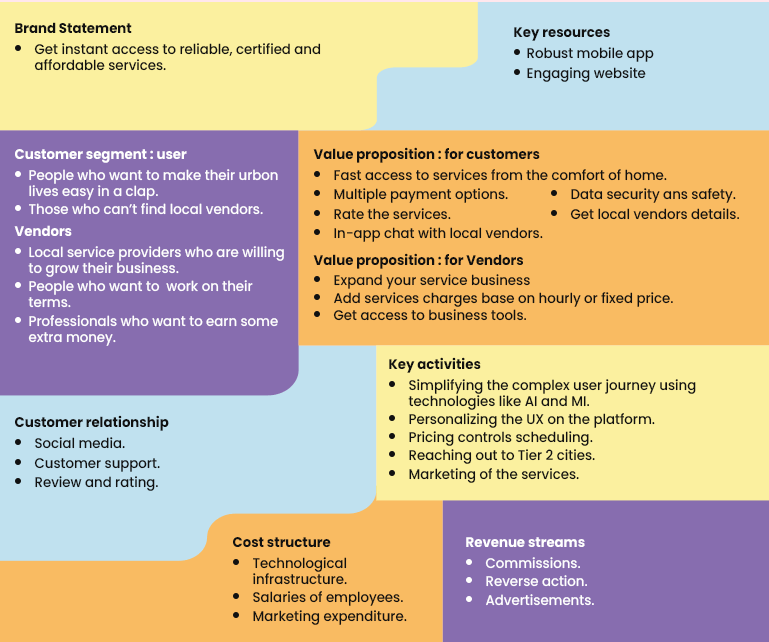
The UrbanClap revenue model works because home services are repeatable, local, fragmented, and trust-sensitive. Customers need recurring help with cleaning, repairs, beauty, grooming, appliance maintenance, and home improvement. Professionals need demand, tools, training, and payment access.
Urban Company sits between both sides and standardizes the experience.
This is where the model becomes powerful.
Traditional home services often depend on word-of-mouth, informal networks, local brokers, and inconsistent pricing. Urban Company adds structure through:
- professional verification
- defined service packages
- transparent pricing
- customer reviews
- standardized workflows
- platform-managed support
- repeat booking options
The platform earns money because it reduces uncertainty.
A customer may not know which technician or beautician to trust. The platform converts that uncertainty into a bookable service experience.
The Real Operating Model: Quality Control At Scale
The most important part of the UrbanClap business model is service quality control. A home-services platform can recruit thousands of professionals and still fail if customers receive inconsistent service.
This is the strategic truth many founders miss.
Urban Company is not valuable because it has an app.
It is valuable because it attempts to make offline services predictable.
In home services, one bad provider experience can damage platform trust more than a temporary app bug. The customer usually blames the platform, not only the individual professional.
That is why the model depends on:
- training systems
- provider ratings
- service standards
- job completion monitoring
- customer complaint handling
- refunds or resolution workflows
- professional incentives and penalties
At OyeLabs, we often see founders underestimate this part when planning local-services platforms. They budget for customer apps and provider apps, but not for the operating systems needed to maintain service consistency after launch.
Marketplace Economics Behind UrbanClap
The marketplace economics of UrbanClap depend on local density, repeat usage, provider productivity, commission rates, and service quality. The platform becomes stronger when customers repeatedly book services and professionals receive enough jobs to remain active.
The model has four important economic loops.
Demand Loop
Customers return when services are reliable, pricing is clear, and support is responsive.
Supply Loop
Professionals stay active when the platform provides steady bookings, fair earnings, and predictable rules.
Trust Loop
Ratings, verification, training, and refunds reduce customer risk.
Revenue Loop
More completed services generate more commissions, service fees, and category-level monetization opportunities.
This is why local density matters.
A city with many app downloads but weak professional availability will perform poorly. A smaller service area with trained professionals and repeat customers can produce healthier marketplace economics.
What Makes UrbanClap Different From Listing Platforms?
UrbanClap differs from listing platforms because it manages the service experience instead of only showing contact details. A listing platform helps users find professionals. A managed marketplace helps users book, pay, review, and receive support around the service.
This difference changes the business model.
| Factor | Listing Platform | UrbanClap-Style Marketplace |
| Main Function | Shows provider information | Manages service transaction |
| Trust Layer | Limited reviews or contact details | Verification, reviews, support, service standards |
| Monetization | Ads, leads, listings | Commissions, service fees, product revenue |
| Customer Experience | User manages the risk | Platform reduces the risk |
| Provider Role | Independent listing | Platform-enabled professional |
This is why the business model of UrbanClap is stronger than a pure directory model but also more difficult to operate.
The platform captures more value because it takes more responsibility.
Main Challenges In The UrbanClap Business Model
The UrbanClap business model faces challenges around professional retention, service consistency, commissions, customer trust, and operational costs. These challenges become harder as the marketplace expands into more cities and service categories.
The biggest challenges include:
Provider Retention: Professionals must earn enough to remain active on the platform.
Quality Consistency: Every service category has different standards, tools, timelines, and customer expectations.
Customer Support: Refunds, complaints, cancellations, and no-shows require operational teams.
Commission Balance: Higher platform fees can support operations but may reduce professional satisfaction.
Category Complexity: Beauty services, appliance repair, cleaning, plumbing, and painting cannot be managed with identical workflows.
This is the trade-off at the heart of the model:
Strict verification improves trust but slows provider onboarding.
Faster onboarding improves marketplace supply but increases quality-control risk.
A founder building a similar model must decide where the platform should sit between speed and control.
What Founders Can Learn From UrbanClap
Founders should learn that the UrbanClap business model is not just about connecting customers and professionals. The hard part is creating repeatable service quality in a local market.
Three lessons matter most.
First, service quality must be designed into the marketplace. Reviews alone are not enough. Training, standards, pricing clarity, support, and provider rules all matter.
Second, local density matters more than broad expansion. Launching one service category strongly in one city can be better than launching ten categories weakly across many cities.
Third, professional economics cannot be ignored. If professionals do not earn enough, service quality and availability fall.
This is where many home-services platforms fail. They acquire customers before creating a reliable professional network.
Can You Build A Similar UrbanClap-Style Platform?
Yes, founders can build a similar UrbanClap-style platform, but the model is suitable only when they can manage both marketplace technology and offline service operations. The platform should not be treated as a simple booking app.
A similar platform may work for:
- home cleaning marketplaces
- beauty services at home
- appliance repair networks
- handyman marketplaces
- pest control platforms
- home maintenance subscriptions
- professional appointment marketplaces
It may not be suitable for founders who do not have a plan for provider onboarding, quality checks, dispute handling, customer support, and local service density.
Technology can help organize the marketplace.
It cannot replace operational discipline.
Can OyeLabs Help Build A Platform Like UrbanClap?
OyeLabs helps founders and businesses build local-services marketplace platforms with customer apps, provider apps, admin panels, booking workflows, payment flows, provider management, reviews, and service-category controls.
This approach is suitable for founders who want to launch a home-services marketplace, beauty-service platform, repair-service network, or on-demand professional booking business.
OyeLabs can support both ready-made and custom marketplace development depending on launch goals, service categories, budget, and operational complexity.
A ready-made approach is useful for market validation.
A custom approach is better when the business needs advanced workflows, integrations, or unusual service operations.
Launch Your Home Services Marketplace Today
Build around service reliability, not just bookings.
✓ Launch customer, provider, and admin systems
✓Add payments, reviews, and service tracking
✓ Improve operations after real marketplace usage
✓ Improve operations after real marketplace usage
Conclusion
The UrbanClap business model works because it turns fragmented home services into a managed marketplace experience. Customers get convenience and trust, professionals get demand and tools, and the platform earns through commissions, service fees, and category-led monetization.
For founders, the deeper lesson is clear. The platform is not only an app. It is an operating system for service quality, provider productivity, and customer trust. The strongest home-services marketplaces are built around repeatable service delivery first and software second.
FAQs
What is the UrbanClap business model?
The UrbanClap business model is a managed marketplace model that connects customers with trained service professionals for home services. The platform creates value by managing booking, pricing, service delivery, payments, reviews, quality control, and customer support.
What is the UrbanClap revenue model?
The UrbanClap revenue model includes commissions from service bookings, service fees, lead-generation fees in selected categories, product-related revenue, featured visibility, and cancellation or penalty charges where applicable. The exact mix can vary by category and geography.
How does UrbanClap make money?
UrbanClap makes money by monetizing completed service transactions and related marketplace activity. The main source is usually commission from service bookings, supported by fees, product sales, visibility options, and other category-specific revenue streams.
Why did UrbanClap become Urban Company?
UrbanClap became Urban Company to support a broader and more global brand identity. The new name better fits a platform offering multiple home-service categories across different markets rather than sounding limited to one local marketplace identity.
Is UrbanClap a marketplace or service company?
UrbanClap is best understood as a managed services marketplace. It connects customers with professionals, but it also influences service quality, pricing, provider standards, customer support, and the overall transaction experience.
Can I launch a business like UrbanClap?
Yes, you can launch a business like UrbanClap if you can manage both the technology platform and offline service operations. The key challenge is not only app development. It is provider quality, local density, customer trust, and repeat service delivery.
Sources
- Urban Company Annual Business Summary FY2024: Used for FY24 revenue growth, revenue figure, and official company positioning.
- Urban Company Partner Platform: Used for service-professional network and partner positioning.
- Urban Company DRHP coverage: Used for FY25 revenue and IPO-related context where public filing details were reported.
- Reuters coverage of Urban Company instant home services: Used for current operational direction and service-density context.
Editorial Note
This article analyzes the UrbanClap business model and the UrbanClap revenue model using publicly available company information, investor-facing updates, press coverage, and marketplace strategy analysis. Revenue streams, commissions, fees, service categories, and provider policies may vary by market, category, and time.
Disclosure
OyeLabs develops local-services marketplace software, including UrbanClap-style platforms. Commercial sections are included to help founders evaluate platform-development options and do not change the editorial analysis.
Fact-Checked By: Anuraag Jain
CEO, Oyelabs and AI Transformation Expert







Comments (10)
Saniya
Any plans to expand in west? I like your business model and having used your app I think it can work in US/Canada. Would you be willing to collaborate for expansion in north americas?
Vasudevan
Hi, We are a manufacture of cleaning speciality chemicals for house keeping industry.
STAS is recognized as one of the leading companies in supplier of cleaning and maintaining aids to various industries be it a hospitality sector or automotive industries or heath care sector or auto care sector or education sector or industrial sector or commercial setups etc.
We want to associate our brand of speciality house keeping chemicals with your Urban clap group.
Please let us know how to proceed and have a fruitful business relationships.
Thanks
Vasu- BDM
STAS Chem Technologies pvt Ltd
Javed Chaudhary
I am intrested to start urban clap in canada and USA ,
Dipti Vaidya
I need help in building app. Can you help
aman jain
I am looking for an expert advice for my business plan , can you be my expert .
Anurag Jain
Sure Aman, I would be glad to help!
Aakash Goud
Excellent Research Anurag.
Anurag Jain
Thanks Aakash!
D R Harish Chandran
Hello all, My warm GREETINGS to everyone. Wish to introduce known association of MULTI-STORIED COMPLEXES Owners/Lessees in and around BENGALURU City for your on going business development. May be can discuss lots of issues have gathered to be number ONE in this business. Good luck.
Anurag Jain
Sure!
Comments are closed.