
Challenges That Vacation Rental Apps Are Facing in Florida

Challenges That Vacation Rental Apps Are Facing in Florida
 Anuraag Jain
Last Updated on November 3, 2025
Key Takeaways
What You Will Learn
-
Florida’s once “bulletproof” vacation rental market is under pressure from skyrocketing insurance, HOA fees, and stricter regulations.
-
Falling second-home mortgages and declining occupancy rates are reshaping host profitability and traveler demand.
-
The biggest operational challenges for vacation rental apps are algorithmic pricing glitches, fraud prevention, and data compliance.
-
Why AI, automation, and blockchain are emerging as survival tools for building trust, efficiency, and transparency.
-
Practical lessons for startups and operators on how to adapt, innovate, and thrive in a volatile, high-cost rental ecosystem.
Important Stats
-
Vacation home mortgages issued: Dropped from 91,000+ in 2023 to an estimated 78,000 in 2025.
-
Occupancy rates: Down from 76% (2023) to 71% (2025), signaling declining demand.
-
Insurance costs: Jumped from $2,800 in 2023 to $4,200+ per year in 2025.
-
HOA fees: Increased from $320/month in 2023 to $420+/month in 2025.
-
PwC report: 87% of users rank trust as their top decision factor when choosing rental apps.
Picture this: you finally score that dreamy beach house in Miami on your favorite vacation rental app, only to find out it’s double-booked. Ouch. That’s the harsh reality many Floridians, and the millions of travelers pouring into the Sunshine State, are dealing with in 2025.
As a seasoned content strategist writing for U.S. startups and scale-ups, I’m here to unpack the very real challenges vacation rental apps are facing in Florida. From regulatory roadblocks and rising compliance costs to fluctuating demand curves driven by Gen Z travelers, the market is anything but smooth sailing.
Add in issues like algorithmic pricing glitches, data privacy compliance under CCPA, and trust-building friction with local hosts, and you’ve got a digital ecosystem that’s under serious pressure.
With Florida ranked among the top three U.S. vacation rental markets, credibility, scalability, and tech resilience are no longer optional; they are essential for survival. Let’s break it down.
Market Condition in Florida
Florida’s vacation rental market, once considered bulletproof, is now facing a sharp downturn. According to Redfin’s latest data, second-home purchases have fallen to their lowest levels since records began in 2018.
The Sunshine State is taking the hardest hit, largely due to skyrocketing insurance premiums, rising homeowners association (HOA) fees, and elevated property taxes. Adding in the backdrop of extreme weather risks, including hurricanes and flooding, investor appetite for Florida vacation rentals has cooled dramatically.
Even cash-rich buyers are cautious, often submitting low-ball offers or demanding concessions. Occupancy rates on platforms like Airbnb have also slipped, meaning hosts are struggling to generate a reliable income.
For many would-be buyers, high interest rates and inflated home prices have made vacation rentals less appealing as both lifestyle assets and investment vehicles. With return-to-office mandates reducing long-term stay demand, the profitability model is under pressure.
Florida, long ranked as one of the top three U.S. vacation rental markets, now represents a cautionary tale of how macroeconomic conditions and local cost pressures collide. Simply put, the market is no longer a guaranteed goldmine; it’s a high-risk, high-cost environment where only the most resilient operators can thrive.
|
Year |
Vacation Home Mortgages Issued | Occupancy Rate (%) | Avg. Insurance Cost (USD/yr) | Avg. HOA Fees (USD/mo) |
Market Condition |
|
2023 |
91,000+ | 76 | 2,800 | 320 |
Stable but competitive |
|
2024 |
86,604 | 74 | 3500 | 370 |
Demand cooling, costs rising |
|
2025 |
78,000 (est.) | 71 | 4200 | 420+ |
Market under pressure, investors pull back |
List of Challenges Vacation Rental Apps are Facing
Before diving in, let’s face it: Florida’s vacation rental scene isn’t just about sun and sand anymore. Skyrocketing costs, falling mortgages, and softening occupancy rates are reshaping the game, and apps are feeling the heat.
Regulatory Hurdles and Rising Costs
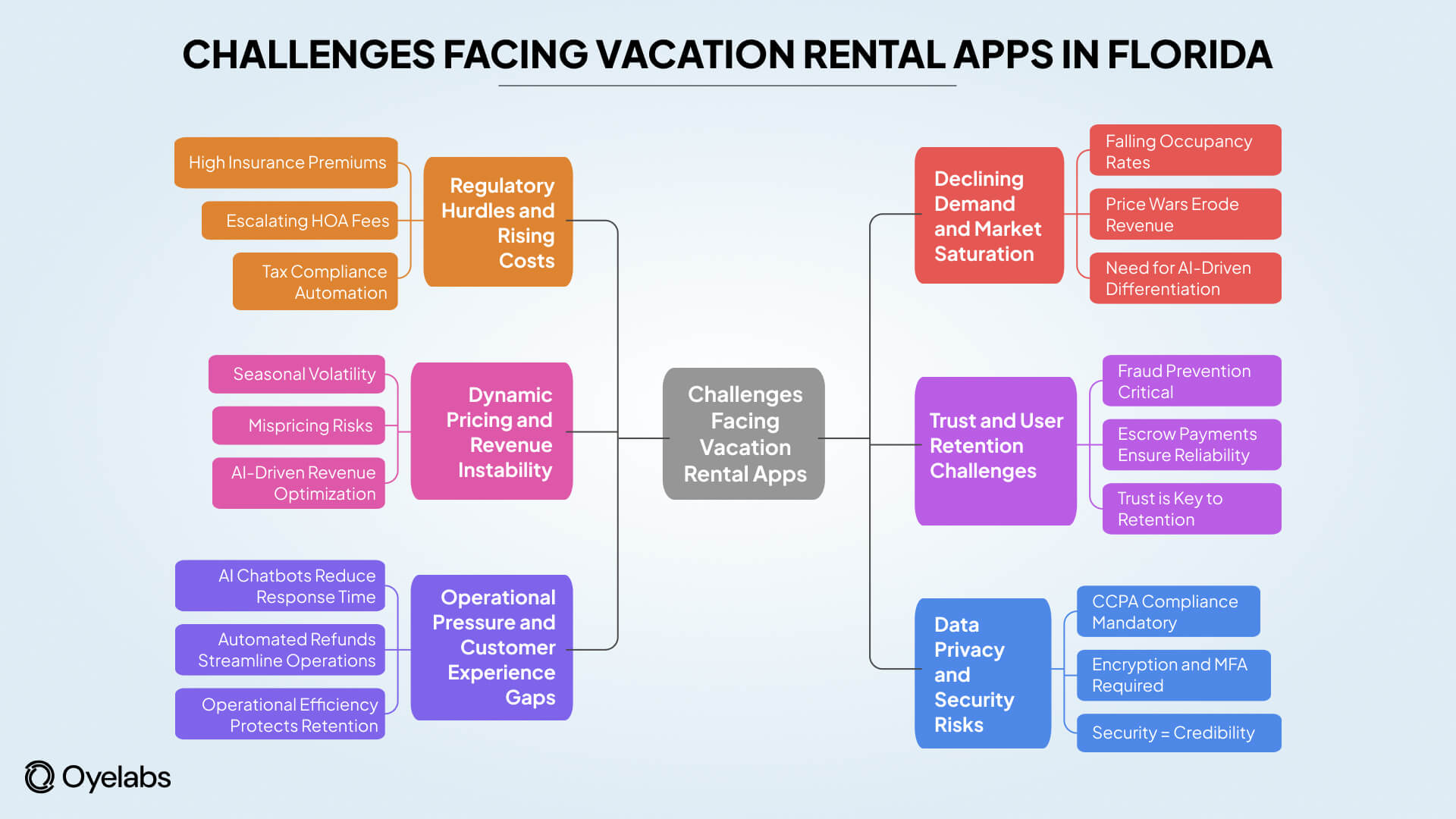
Florida’s regulatory environment is complex, but 2025 adds another layer: soaring homeowners’ insurance, higher property taxes, and rising HOA fees. Platforms must now integrate automated compliance features, real-time tax and fee calculations, and zoning verification tools. Non-compliance risks hefty fines and eroded host trust.
According to Redfin, insurance premiums for waterfront properties have jumped 20–25% year-on-year, while HOA fees rose by 15%. Vacation rental apps must balance legal compliance with financial transparency to maintain credibility, ensuring hosts and guests are protected in this increasingly high-cost environment.
- High insurance premiums
- Escalating HOA fees
- Tax compliance automation is required
Declining Demand and Market Saturation
The number of vacation home buyers in Florida has dropped sharply, with mortgages for second homes falling from 90,776 in 2023 to 86,604 estimated in 2024. Oversupply in key markets like Miami, Orlando, and Tampa compounds the issue. Apps now face low occupancy rates (down to 71% in 2025) and price wars that squeeze profitability.
Differentiation is critical: AI-driven search, curated experiences, and loyalty programs can help platforms stand out in a softening market. Without innovation, apps risk becoming irrelevant as both hosts and travelers rethink their investment and travel strategies.
- Falling occupancy rates
- Price wars erode revenue
- Need for AI-driven differentiation
Dynamic Pricing and Revenue Instability
Dynamic pricing models face new challenges in 2025 due to seasonal volatility, high interest rates, and declining short-term rental demand. Incorrect algorithmic adjustments can result in lost revenue or guest dissatisfaction. Platforms must leverage AI-powered demand forecasting, real-time occupancy data, and predictive analytics to adjust rates efficiently.
According to AirDNA, mispricing can reduce host revenue by up to 30%. For apps in Florida, mastering real-time revenue optimization while maintaining affordability for travelers is essential to sustaining profitability amid fluctuating market conditions.
- Seasonal volatility
- Mispricing risks
- AI-driven revenue optimization
Trust and User Retention Challenges
As occupancy rates drop and costs rise, hosts are more selective about platforms, and guests are more cautious about spending. Apps must combat issues like fraudulent listings, late cancellations, and low-quality properties.
Features like ID verification, escrow payments, and AI-powered fraud detection are no longer optional; they’re essential for credibility. This is the first step for starting a successful vacation rental app.
PwC research shows 87% of users consider trust a top factor in platform choice. In a market under pressure, apps that fail to build trust risk losing both hosts and guests permanently.
- Fraud prevention critical
- Escrow payments ensure reliability
- Trust is key to retention
Operational Pressure and Customer Experience Gaps
High cancellation rates, fluctuating occupancy, and seasonality create operational stress. Customer support must scale efficiently to handle refund disputes, rebookings, and emergency issues. AI chatbots, automated workflows, and predictive support analytics help apps maintain high service standards.
Zendesk reports that 70% of customers prioritize fast resolutions over brand loyalty, making speed and reliability crucial. Without operational resilience, platforms risk negative reviews and high churn, particularly in a market where user expectations remain high despite declining demand.
- AI chatbots reduce response time
- Automated refunds streamline operations
- Operational efficiency protects retention
Data Privacy and Security Risks
Rising digital transactions amid fewer bookings heighten scrutiny over data security. CCPA compliance, secure payment processing, and multi-factor authentication are critical. Breaches could damage credibility at a time when hosts and guests are already cautious due to economic uncertainty.
Florida apps must prioritize cybersecurity as both a legal and competitive requirement. Platforms that demonstrate robust data protection gain an edge in trust and user retention, a key differentiator in today’s turbulent market.
- CCPA compliance mandatory
- Encryption and MFA required
- Security = credibility
Also read: Top Monetization Strategies for Your Vacation Rental App
Future Outlook for Florida’s Vacation Rental Apps
The Florida vacation rental game isn’t slowing down anytime soon. But the future isn’t just about beachside bookings; it’s about smarter tech, tighter rules, and deeper trust. Let’s peek ahead.
Stricter Regulatory Landscape
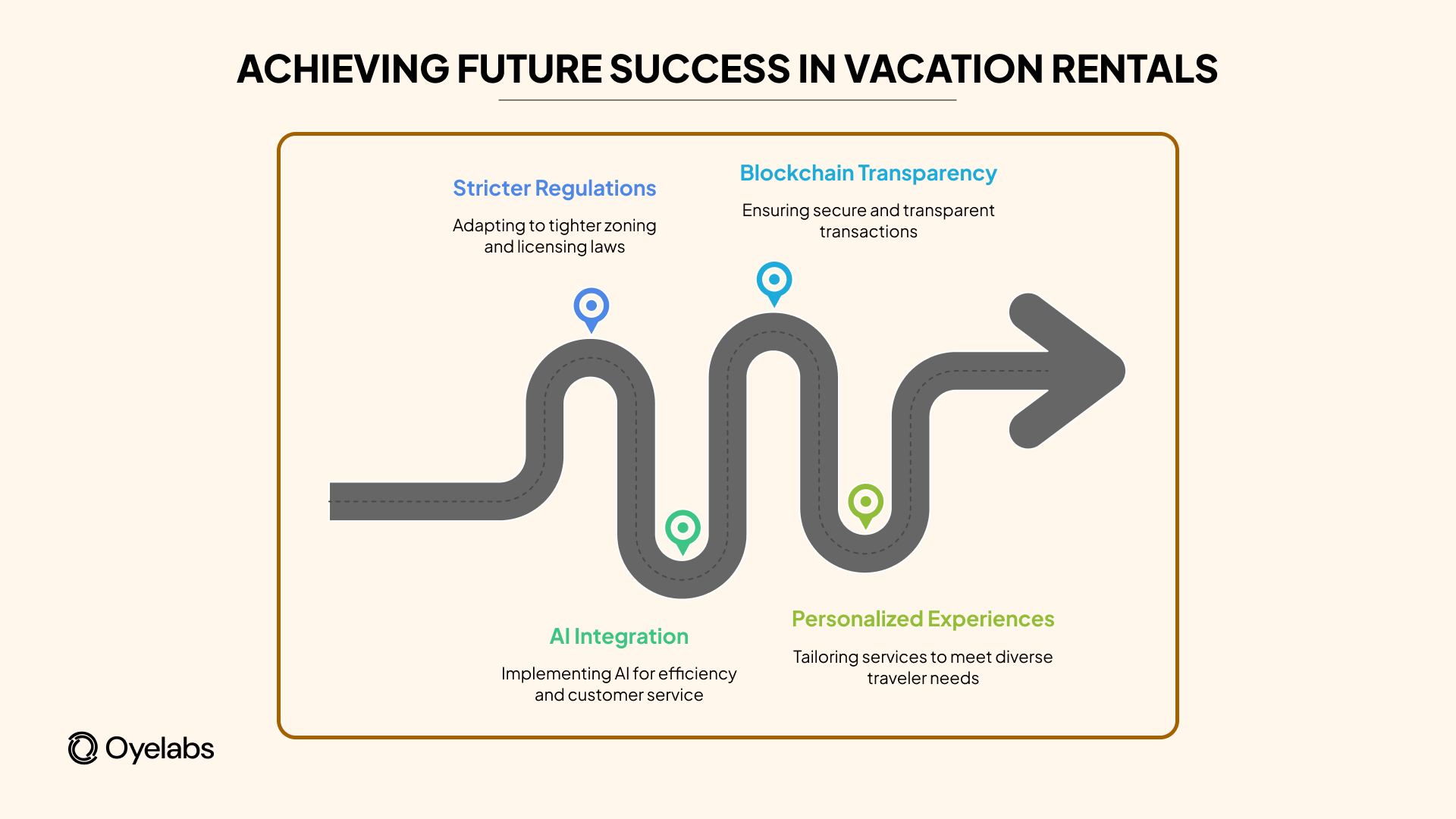
Florida’s lawmakers are unlikely to ease up. Expect tighter enforcement of zoning restrictions, licensing, and occupancy caps.
Stricter regulatory laws can be one of the common challenges in a vacation rental app. Apps will need embedded compliance frameworks to avoid penalties and maintain operational stability.
According to Florida DBPR updates, fines could scale into thousands per property, making proactive compliance a non-negotiable. Future winners will be those who transform regulation from a burden into a trust-building advantage.
Rise of AI and Automation
Artificial intelligence is set to redefine Florida’s vacation rental apps. From demand forecasting to fraud detection, automation will improve efficiency across the board.
AI-driven chatbots will cut customer support wait times, while machine learning algorithms refine dynamic pricing models for seasonal volatility. Deloitte reports that 62% of travel brands adopting AI have already seen revenue boosts.
For apps in Florida, leveraging automation isn’t just about cost savings; it’s a survival strategy. Those who integrate predictive analytics, natural language processing, and recommendation engines will pull ahead of competitors relying on outdated manual processes.
- AI chatbots for faster support
- Predictive analytics for pricing
Blockchain-Powered Transparency
Blockchain isn’t just hype; it’s a credibility engine. By decentralizing records of bookings, payments, and property ownership, apps can ensure tamper-proof transparency for both guests and hosts. This means fewer disputes, faster trust-building, and a stronger defense against fraud.
Platforms that adopt blockchain-based smart contracts will streamline escrow payments, reduce cancellations, and create accountability. PwC research shows blockchain adoption in travel could slash disputes by 40%.
In Florida’s crowded rental scene, apps leveraging distributed ledger technology will stand out as secure, transparent, and guest-first platforms. Trust will move from marketing claim to technical reality.
Hyper-Personalized Guest Experiences
The next frontier is personalization at scale. Florida’s diverse traveler base, from Gen Z spring breakers to snowbird retirees, demands tailored experiences. Future apps will use behavioral analytics, AI-driven recommendations, and hyperlocal integrations to deliver exactly what each traveler wants.
Think curated beachside activities, dynamic in-app concierge services, or loyalty perks tied to local partners. According to Accenture, 91% of consumers prefer brands offering personalized recommendations.
Apps that fail to personalize risk becoming generic booking engines, while those that lean into data-driven CX will set the gold standard for vacation rentals in Florida.
Read More: List of Lessons from a Vacation Rental Platform like Airbnb
Transform Short-Term Rentals with Custom App Development
Transform your vacation rental business with Oyelabs’ custom vacation app development solutions. Whether you’re launching a new platform or scaling an existing one, Oyelabs specializes in building revenue-ready, secure, and user-friendly apps tailored for the Florida market.
From AI-powered dynamic pricing and blockchain-enabled trust systems to real-time booking engines and automated compliance frameworks, every feature is designed for scalability and reliability.
With 51–200 expert engineers, a proven track record in white-label solutions, and a portfolio spanning Airbnb and Uber-like clones, Oyelabs combines technical expertise with market insight, helping you turn complex challenges into competitive advantages.
Conclusion
In 2025, Florida’s vacation rental market is no longer the guaranteed goldmine it once was. Rising insurance and HOA costs, declining second-home purchases, and fluctuating occupancy rates have created a high-stakes environment for vacation rental apps.
Platforms that fail to adapt with AI-driven pricing, automated compliance, and robust trust-building measures risk losing both hosts and travelers. Success now depends on blending technology with credibility, operational efficiency, and personalized experiences.
For startups and established operators aiming to navigate this challenging market, partnering with a trusted development partner like Oyelabs can turn obstacles into opportunities, ensuring scalable, revenue-ready solutions.